

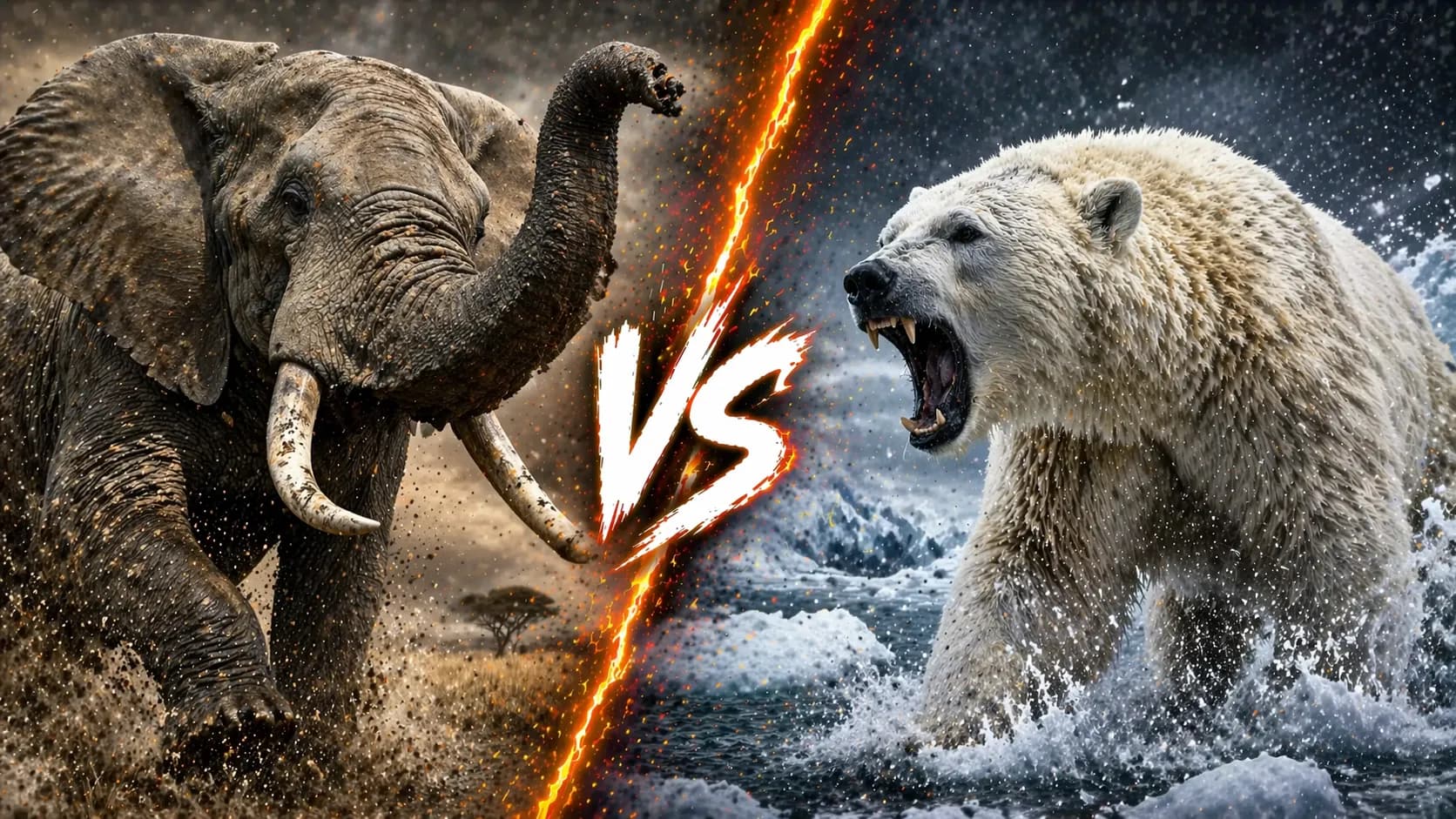
Elephant vs Polar Bear: Which Giant Has the Edge?
A grounded elephant vs polar bear comparison covering mass, reach, predatory intent, and why one of these giants still operates from a much larger physical frame.
Meet the animals in this matchup
Go straight to the species guides behind this comparison for identification, habitat, rarity, and deeper AnimalDex context.
Quick verdict
Start with the direct answer, then use the structured comparison below to see what changes the outcome.
Elephant gets the overwhelming overall edge through enormous size, reach, and space control. Polar bear remains dangerous because it is an apex predator with serious bite and commitment, but it is still far too outscaled in a clean direct clash.
This page looks closer in public imagination than it is in body-plan reality. Polar bear is formidable. Elephant is simply playing from a much larger platform.
Why this matchup is interesting
It separates apex-predator fear from actual heavyweight fight structure.
Head-to-head species stats
These are the same core AnimalDex stat dimensions used on the dedicated animal pages, pulled side by side so the matchup is faster to scan.
Elephant
Stats source: Generated canonical stats
Polar Bear
Stats source: Canonical species profile
Trait-by-trait comparison
Only the categories that matter to this matchup are included. The goal is not filler stats, but the real design differences that change the result.
Body size
Elephant
Massive land giant with huge reach and pushing force
Polar Bear
Enormous bear, but still much smaller overall
Why it matters
The size gap is the first and biggest fact of the matchup.
Primary weapons
Elephant
Trunk control, tusk threat, and overwhelming body authority
Polar Bear
Powerful bite, paws, and predatory aggression
Why it matters
The bear is dangerous, but the elephant carries more total ways to control contact.
Pressure style
Elephant
Dominates through scale and space denial
Polar Bear
Best when it can exploit weakness or angle
Why it matters
The cleaner the clash, the stronger the elephant answer gets.
Scenario breakdown
This is where shallow battle content usually fails. Terrain, spacing, timing, and engagement style can change the answer.
Clean open ground
Elephant clearly
This is the version of the matchup most dictated by scale and reach.
Chaotic close angle
Polar bear gets its best look
The bear only improves when it can attack from a compromised angle instead of absorbing full frontal control.
Broad who wins question
Elephant overall
The larger giant gets the far safer verdict.
Explore these animals
Use the full species pages to go deeper on biology, habitat fit, and the real traits behind this verdict.
Elephant
Elephants are large social herbivores with remarkable memory, trunk dexterity, and major influence on habitat structure wherever they still roam freely.
Read species guidePolar Bear
Polar bears are Arctic marine bears specialized for sea ice hunting, insulation, and long-range movement between seal access points.
Read species guideSystems Intelligence & Hidden Purpose
See the animals behind this comparison as engineered biological systems: what each one is built to do, where it gains leverage, and why the matchup changes by scenario.
System Role
The Landscape Memory Engine
Elephant
Specialized Hardware
A multipurpose trunk, low-frequency communication, seismic sensitivity through the feet, and long-term spatial memory make elephants large-scale environmental navigation hardware.
Systems Script
Elephants open paths, disperse seeds, modify vegetation, and uncover water access points that other species later use. They are not just large animals inside a habitat; they help write the habitat's infrastructure.
Strategic Insight
Scale is most useful when paired with memory. The bigger the system, the more it wins by remembering routes, resources, and failure points.
System Role
The Sea-Ice Ambush Auditor
Polar Bear
Specialized Hardware
Insulation, scent range, swimming power, and seal-focused hunting behavior make polar bears predatory hardware tuned to a moving frozen platform.
Systems Script
Polar bears link sea-ice structure to upper food-web pressure. When the platform changes, the hunter changes, and the whole Arctic operating system starts losing predictability.
Strategic Insight
If your system depends on one platform, monitor the platform harder than the performance metrics built on top of it.
Final take
Polar bear is one of the most dangerous mammals in its own world. Elephant still gets the clean overall answer because the total mass and control gap are too large.
Collect both animals in AnimalDex
Track the species behind this matchup, compare their real traits, and build the rivalry into your AnimalDex collection.
Comparison FAQ
Short, direct answers to the next questions readers usually ask after the headline verdict.
Who wins, elephant or polar bear?
Elephant overall by a very large margin.
Why is polar bear still worth taking seriously here?
Because it remains a fully dangerous apex predator even in matchups where the body-size disadvantage is too steep.
Related comparisons
Continue with nearby matchups to compare more real-world animal traits without dropping into junky who-wins filler.
Elephant vs Hippopotamus: Who Wins the Real Matchup?
Elephant is the stronger overall answer on land because it is larger, taller, and better at controlling space with bulk. Hippopotamus becomes far more dangerous in water-linked chaos where its bite and low heavy body matter more.
Read comparisonAlligator Snapping Turtle vs Polar Bear: Which Animal Has the Edge?
Polar bear gets the overwhelming overall edge through sheer mass, strength, and the ability to dominate most contact scenarios. Alligator snapping turtle stays dangerous only in a narrow front-facing water-side bite window where its jaws can punish a mistake.
Read comparisonBear vs Tiger: Who Has the Edge in a Real Clash?
Tiger is the safer general answer in a one-on-one land clash when stealth, timing, and clean engagement matter. A very large bear represented here by the polar bear changes the problem through sheer mass and durability, especially in open, cold terrain.
Read comparisonCrocodile vs Polar Bear: Which Predator Has the Edge?
Polar bear gets the overall edge on land or partial land because it is larger, more mobile out of water, and better at sustained violent contact once the crocodile loses ambush shape. Crocodile becomes far more dangerous in water-linked ambush where the bite starts first and the bear does not control footing.
Read comparison