

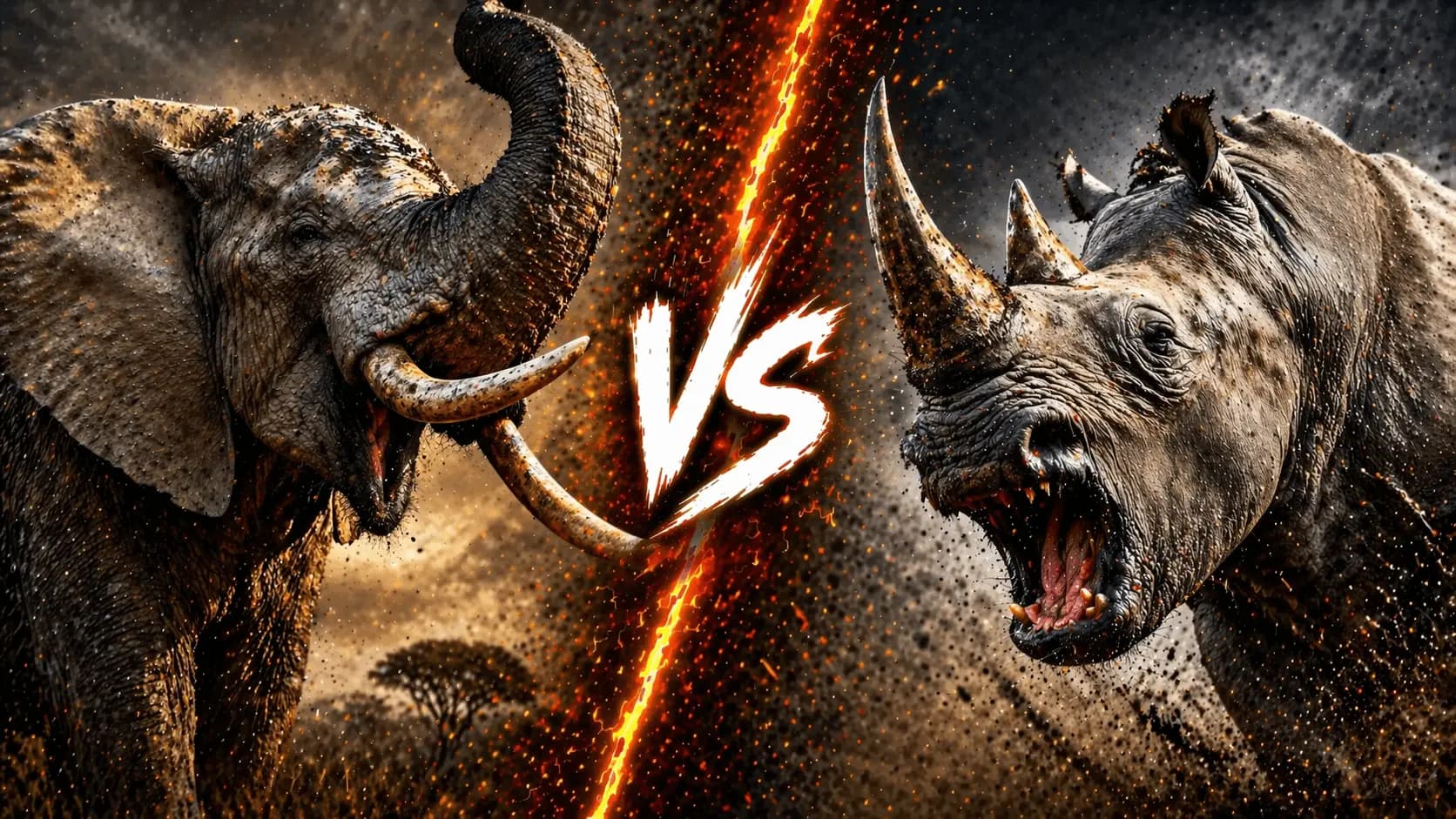
Elephant vs Rhino: Who Has the Real Edge?
A grounded elephant vs rhino comparison covering size, charge mechanics, temperament, footing, and what changes between a frontal clash and space-control standoff.
Meet the animals in this matchup
Go straight to the species guides behind this comparison for identification, habitat, rarity, and deeper AnimalDex context.
Quick verdict
Start with the direct answer, then use the structured comparison below to see what changes the outcome.
Elephant usually has the overall edge through greater size, reach, and control of space. A rhino still remains dangerous because its charge is compact, forceful, and built for brutal short-range disruption.
This is a classic megaherbivore matchup, but it is not just about which animal is larger. Elephants bring trunk reach, tusk leverage, and the ability to control more space with a taller, more versatile body. White rhinoceroses bring a lower, denser, horn-first charge that becomes dangerous when distance collapses quickly.
That makes the clean answer elephant, especially in a direct confrontation where reach and mass matter. Rhino remains credible because it is not trying to solve the same problem elegantly. It wants to hit hard, low, and suddenly.
Why this matchup is interesting
Elephant versus rhino is valuable because it compares two very different megaherbivore control systems. One wins through reach, memory, and infrastructural scale. The other wins through compact force and short explosive authority.
That gives the page more depth than a simple size ranking. It explains why body architecture changes what 'strength' actually means.
Head-to-head species stats
These are the same core AnimalDex stat dimensions used on the dedicated animal pages, pulled side by side so the matchup is faster to scan.
Elephant
Stats source: Generated canonical stats
White Rhinoceros
Stats source: Canonical species profile
Trait-by-trait comparison
Only the categories that matter to this matchup are included. The goal is not filler stats, but the real design differences that change the result.
Overall scale
Elephant
Greater height, reach, and body mass with more ways to manage distance
White Rhinoceros
Enormous bulk, but less vertical and lateral reach
Why it matters
The elephant's total operating space is larger, and that matters before the first collision even lands.
Charge mechanics
Elephant
Massive forward power with tusks and head control
White Rhinoceros
Lower horn-first rush built for blunt disruptive impact
Why it matters
Rhino charge is more compact and direct, but elephant charge carries more total mass and range.
Reach and control
Elephant
Tusks, trunk, and height all extend control of the engagement
White Rhinoceros
Horn-focused pressure with less range once alignment breaks
Why it matters
Elephant has more options when the initial approach is imperfect or the clash becomes positional.
Conflict style
Elephant
Can escalate with overwhelming body authority when committed
White Rhinoceros
More compact, head-down, and direct in how force is expressed
Why it matters
This is one of those matchups where style matters almost as much as raw size.
Scenario breakdown
This is where shallow battle content usually fails. Terrain, spacing, timing, and engagement style can change the answer.
Frontal clash on open ground
Elephant edge
The elephant's scale, reach, and ability to disrupt alignment usually make it the safer pick in a straight heavy collision.
Short-burst charge at close range
Rhino improves sharply
If the rhino gets a clean compact lane into contact, its horn-first impact becomes much more relevant.
Space-control standoff
Elephant stronger
Elephants are better at owning more of the space around the fight, not just the exact point of impact.
Messy broken ground
Depends on line of contact
Poor footing and disrupted lines can reduce the clean advantages of both animals and make the first bad angle decisive.
Explore these animals
Use the full species pages to go deeper on biology, habitat fit, and the real traits behind this verdict.
Elephant
Elephants are large social herbivores with remarkable memory, trunk dexterity, and major influence on habitat structure wherever they still roam freely.
Read species guideWhite Rhinoceros
White rhinoceroses are massive square-lipped grazers built for bulk feeding, territorial presence, and short explosive charges across open African grassland systems.
Read species guideSystems Intelligence & Hidden Purpose
See the animals behind this comparison as engineered biological systems: what each one is built to do, where it gains leverage, and why the matchup changes by scenario.
System Role
The Landscape Memory Engine
Elephant
Specialized Hardware
A multipurpose trunk, low-frequency communication, seismic sensitivity through the feet, and long-term spatial memory make elephants large-scale environmental navigation hardware.
Systems Script
Elephants open paths, disperse seeds, modify vegetation, and uncover water access points that other species later use. They are not just large animals inside a habitat; they help write the habitat's infrastructure.
Strategic Insight
Scale is most useful when paired with memory. The bigger the system, the more it wins by remembering routes, resources, and failure points.
System Role
The Grassland Mass-Throughput Grazer
White Rhinoceros
Specialized Hardware
Square grazing lip, heavy neck support, thick skin, and horn-forward charge mechanics make white rhinoceroses bulk-feeding hardware built for open ground.
Systems Script
White rhinoceroses convert large grass volumes into megaherbivore pressure across savannah systems. They reshape short-grass structure, path use, and wallow zones while forcing the landscape to make room for body scale.
Strategic Insight
Scale is powerful when it is paired with a simple repeatable operating loop. Do the basic high-value action well enough, and the whole environment starts bending around it.
Final take
Elephant is the safer overall answer because greater size, reach, and engagement control usually win out.
Rhino remains dangerous because it can still turn a short clean lane into a violent horn-first problem. The honest verdict is elephant overall, rhino in the tighter charge window.
Collect both animals in AnimalDex
Track the species behind this matchup, compare their real traits, and build the rivalry into your AnimalDex collection.
Comparison FAQ
Short, direct answers to the next questions readers usually ask after the headline verdict.
Who wins, elephant or rhino?
Elephant usually gets the edge overall because its size, reach, and control of space are greater, though a rhino remains dangerous in a short direct charge.
Is a rhino stronger than an elephant?
A rhino is tremendously powerful, but an elephant usually has the broader advantage because it combines mass with more reach and more ways to manage the clash.
Why is rhino still dangerous if elephant is larger?
Because rhino force is compact and immediate. One clean horn-first line can still make the fight costly.
Related comparisons
Continue with nearby matchups to compare more real-world animal traits without dropping into junky who-wins filler.
Bear vs Tiger: Who Has the Edge in a Real Clash?
Tiger is the safer general answer in a one-on-one land clash when stealth, timing, and clean engagement matter. A very large bear represented here by the polar bear changes the problem through sheer mass and durability, especially in open, cold terrain.
Read comparisonLion vs Hyena: Who Really Has the Edge?
Lion usually has the edge in a direct one-on-one clash. Spotted hyenas stay dangerous because they are durable, persistent, and far more formidable once the matchup involves clan pressure rather than a solo contest.
Read comparisonElephant vs Hippopotamus: Who Wins the Real Matchup?
Elephant is the stronger overall answer on land because it is larger, taller, and better at controlling space with bulk. Hippopotamus becomes far more dangerous in water-linked chaos where its bite and low heavy body matter more.
Read comparisonElephant vs Polar Bear: Which Giant Has the Edge?
Elephant gets the overwhelming overall edge through enormous size, reach, and space control. Polar bear remains dangerous because it is an apex predator with serious bite and commitment, but it is still far too outscaled in a clean direct clash.
Read comparison