

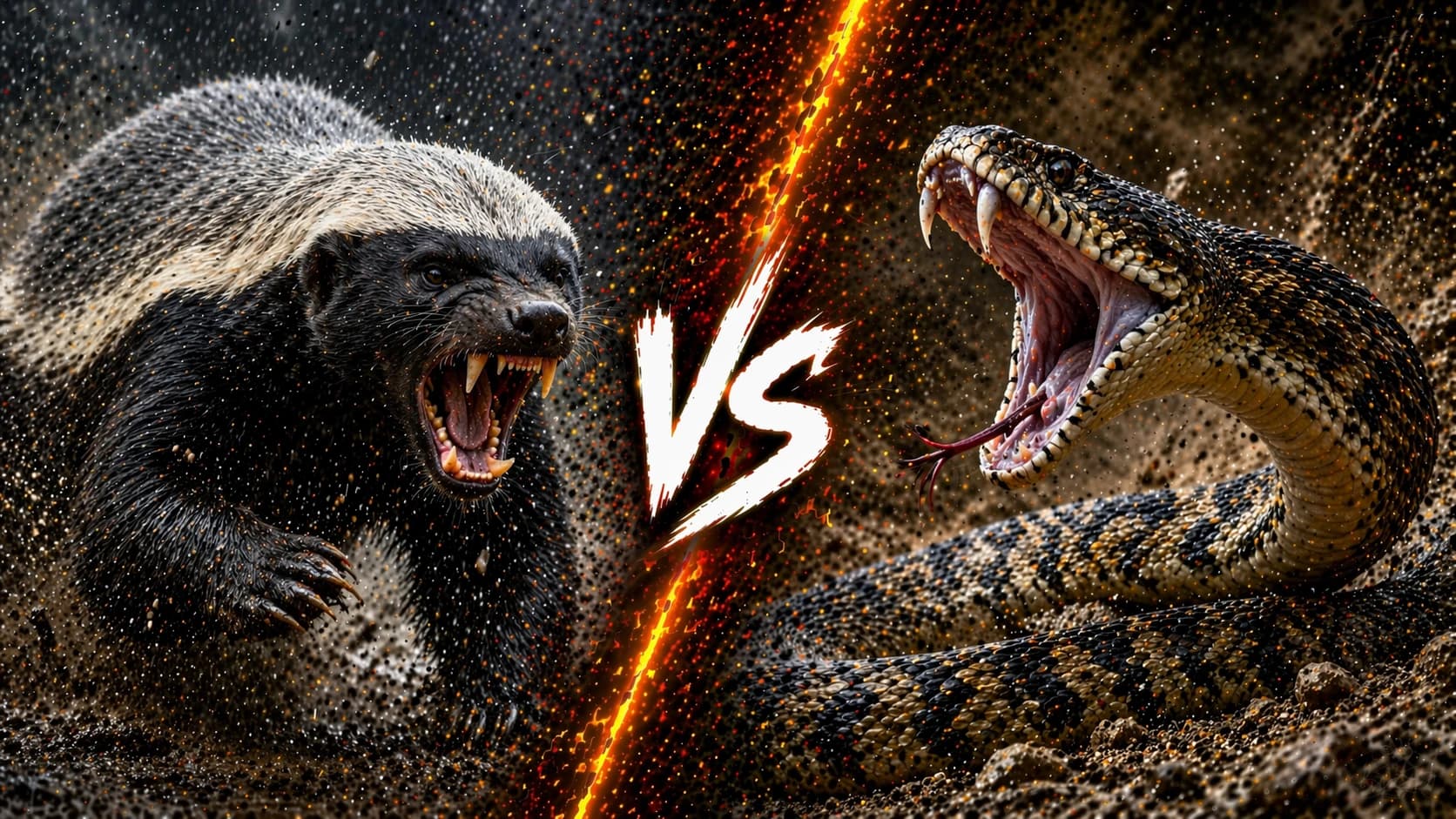
Honey Badger vs Snake: Which Side Usually Has the Edge?
A grounded honey badger vs snake comparison covering toughness, strike risk, prey handling, terrain, and why a generic snake page still needs scenario nuance.
Meet the animals in this matchup
Go straight to the species guides behind this comparison for identification, habitat, rarity, and deeper AnimalDex context.
Quick verdict
Start with the direct answer, then use the structured comparison below to see what changes the outcome.
Honey badger usually has the edge against many snakes because toughness, aggression, and prey-handling skill make it a specialized raid animal. Snake still remains dangerous because one clean venomous strike can flip the outcome fast.
This page uses a broad snake model because the intended query is generic and the fight logic changes a lot across venomous and non-venomous species. The honey badger still gets the safer headline because it is unusually willing and unusually built to handle defended prey.
That does not mean every snake loses cleanly. A venomous species with good strike distance, timing, and cover can still make the matchup dangerous or fatal.
Why this matchup is interesting
Honey badger versus snake works because it is really a comparison between raid persistence and strike precision. One side wants to keep forcing access. The other side wants one clean, costly interrupt.
That makes the page stronger than viral folklore. It explains why the badger gets the overall edge without pretending all snakes are interchangeable.
Head-to-head species stats
These are the same core AnimalDex stat dimensions used on the dedicated animal pages, pulled side by side so the matchup is faster to scan.
Honey Badger
Stats source: Canonical species profile
Snake
Stats source: Canonical base stats from public analysis
Trait-by-trait comparison
Only the categories that matter to this matchup are included. The goal is not filler stats, but the real design differences that change the result.
Toughness and persistence
Honey Badger
Loose skin, confidence under pressure, and willingness to keep forcing contact
Snake
Relies more on avoiding a sustained body contest
Why it matters
The badger is unusually good at staying in ugly fights that other mammals avoid.
First-strike danger
Honey Badger
Must close distance and survive the first weapon window
Snake
One clean venomous strike can be decisive in the right species
Why it matters
The snake's best chance is still the first clean strike before the badger gains control.
Control after contact
Honey Badger
Better at turning chaos into continued pressure
Snake
Much stronger if it preserves range and posture
Why it matters
Once the badger gets past the initial weapon window, the balance often shifts.
Species variance
Honey Badger
Honey badger remains broadly similar across the page
Snake
Different snakes change the risk profile drastically
Why it matters
This page must stay nuanced because 'snake' covers very different threat types.
Scenario breakdown
This is where shallow battle content usually fails. Terrain, spacing, timing, and engagement style can change the answer.
Venomous snake with clean open strike lane
Snake improves sharply
This is the best version of the snake's win condition: distance, timing, and a clean shot.
Messy close contact
Honey badger edge
If the badger survives the first danger and keeps forcing the issue, its persistence becomes the main story.
Non-venomous body fight
Honey badger clearly
Without a powerful venom interrupt, most snakes lose too much leverage once the fight stays close.
Cover-heavy ambush
Depends on strike quality and species
Ambush cover helps the snake, but the badger still remains one of the mammals most likely to keep coming after bad contact.
Explore these animals
Use the full species pages to go deeper on biology, habitat fit, and the real traits behind this verdict.
Honey Badger
The honey badger is a tough mustelid known for digging strength, bold behavior, and a broad diet.
Read species guideSnake
Snake is a reptile known for elongated limbless body, forked scenting tongue, and overlapping protective scales.
Read species guideSystems Intelligence & Hidden Purpose
See the animals behind this comparison as engineered biological systems: what each one is built to do, where it gains leverage, and why the matchup changes by scenario.
System Role
The Hard-Access Resource Raider
Honey Badger
Specialized Hardware
Black body with pale back stripe, low muscular body, and strong claws for digging give the Honey Badger a body plan tuned for its niche.
Systems Script
Honey Badgers operate in savannah, scrubland, dry forest edge, and semi-arid country. Their design helps them match food access, shelter, and timing inside that environment.
Strategic Insight
Confidence is strongest when your equipment can actually support it.
System Role
The Limbless Chemical Tracker
Snake
Specialized Hardware
Whole-body propulsion, forked-tongue chemosensing, flexible skull mechanics, and highly varied strike or constriction systems make snakes modular predatory hardware without limbs.
Systems Script
Snakes regulate rodents, birds, amphibians, reptiles, and eggs across almost every major terrestrial system. Their success comes from reducing structural overhead while keeping sensing and predation extremely efficient.
Strategic Insight
Do not confuse missing parts with weakness. Some of the most efficient systems win by removing what they do not need and perfecting what remains.
Final take
Honey badger is the stronger overall answer against the broad snake category because it is built to tolerate friction and keep attacking defended prey.
Snake still keeps real upset potential through venom, ambush angle, and species-specific strike power. The grounded verdict is honey badger overall, snake in the first clean strike window.
Collect both animals in AnimalDex
Track the species behind this matchup, compare their real traits, and build the rivalry into your AnimalDex collection.
Comparison FAQ
Short, direct answers to the next questions readers usually ask after the headline verdict.
Who wins, honey badger or snake?
Honey badger usually gets the edge overall, but a venomous snake can still reverse the outcome with one clean strike.
Why do honey badgers do well against snakes?
Because they combine toughness, persistence, loose skin, and a willingness to keep forcing close contact.
Does that mean snakes are not dangerous to honey badgers?
Not at all. Venomous snakes remain dangerous because timing and strike quality can still decide the fight quickly.
Related comparisons
Continue with nearby matchups to compare more real-world animal traits without dropping into junky who-wins filler.
Python vs Cobra: Which Snake Has the Better Real-World Edge?
King cobra has the edge if it lands the first clean venom strike at range. Python has the edge once it turns the fight into body contact and constriction.
Read comparisonKomodo Dragon vs King Cobra: What Happens in a Real Clash?
Komodo dragon usually has the edge in a direct physical clash because of its size, armor, and crushing close-range force. King cobra remains dangerous because one clean venom-delivering strike can change the outcome fast.
Read comparisonGorilla vs Honey Badger: Which Animal Has the Edge?
Gorilla gets the overwhelming overall edge through immense size, reach, and raw power. Honey badger keeps the page interesting because it is tough, aggressive, and comfortable in ugly contact, but it is still operating from a far smaller frame.
Read comparisonHoney Badger vs Crocodile: Which Dangerous Animal Has the Edge?
Crocodile gets the overall edge because one clean ambush bite or clamp is so punishing. Honey badger only improves if the reptile loses ideal position and the fight becomes a land-based scramble.
Read comparison