

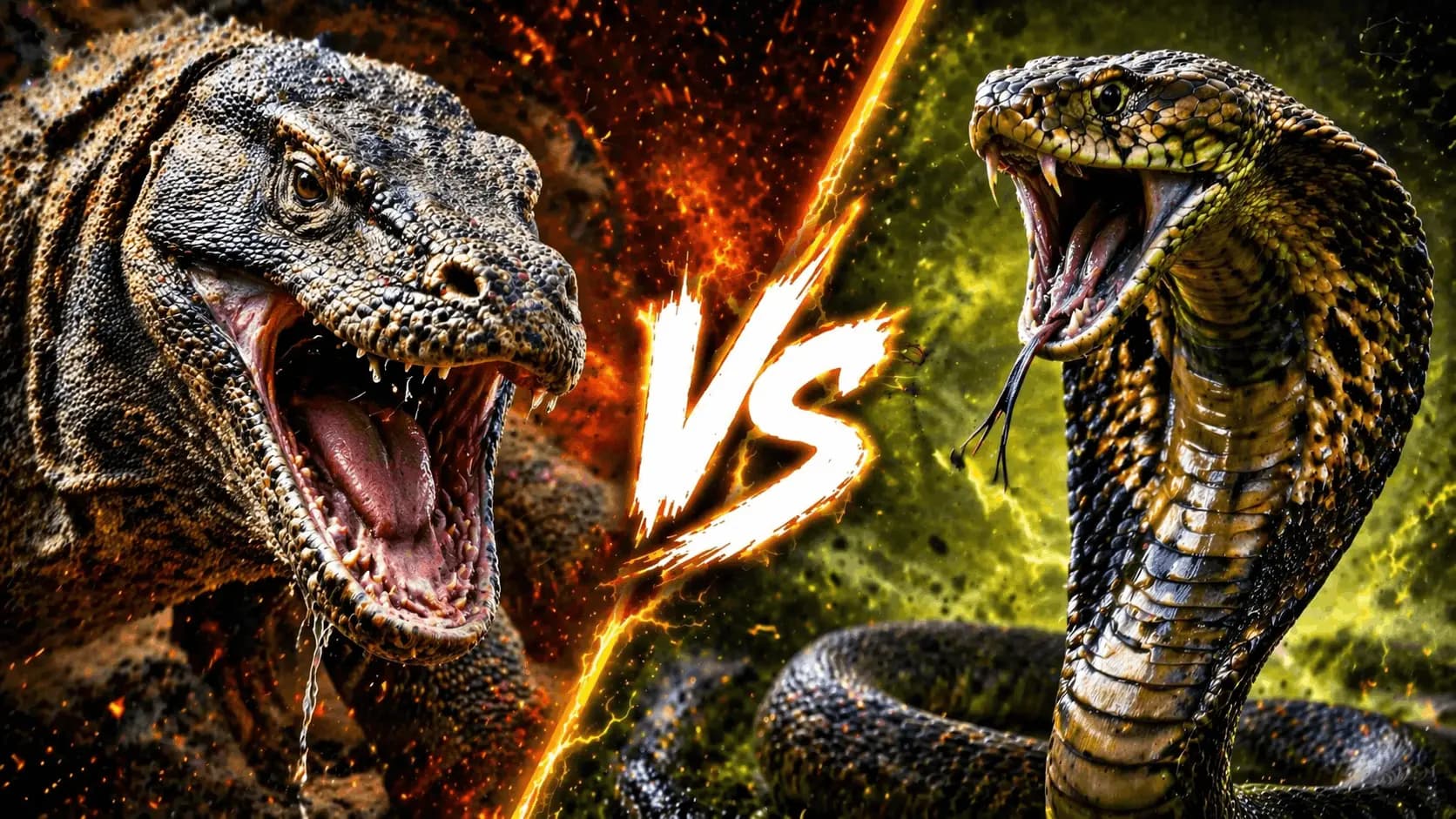
Komodo Dragon vs King Cobra: What Happens in a Real Clash?
A real-biology Komodo dragon vs king cobra comparison covering size, strike dynamics, armor, venom risk, terrain context, and why the answer depends on engagement conditions.
Meet the animals in this matchup
Go straight to the species guides behind this comparison for identification, habitat, rarity, and deeper AnimalDex context.
Quick verdict
Start with the direct answer, then use the structured comparison below to see what changes the outcome.
Komodo dragon usually has the edge in a direct physical clash because of its size, armor, and crushing close-range force. King cobra remains dangerous because one clean venom-delivering strike can change the outcome fast.
This matchup is compelling because it puts two very different reptile systems against each other: a heavy island apex lizard built for overpowering contact and a tall, intelligent snake built around reach, venom delivery, and threat display.
Komodo dragon gets the default verdict in a direct collision because mass, durability, and raw physical control matter a lot. King cobra stays live in the matchup because its strike is efficient, fast, and biologically expensive to ignore.
Why this matchup is interesting
Pages like this become shallow when they pretend a single cinematic answer covers every encounter. In reality, reptile matchups change dramatically with range, terrain, first contact, and whether the cobra lands an effective strike before the dragon closes distance.
That is exactly why the structured comparison format matters. It makes room for a direct answer without flattening the biology.
Head-to-head species stats
These are the same core AnimalDex stat dimensions used on the dedicated animal pages, pulled side by side so the matchup is faster to scan.
Komodo Dragon
Stats source: Canonical species profile
King Cobra
Stats source: Canonical species profile
Trait-by-trait comparison
Only the categories that matter to this matchup are included. The goal is not filler stats, but the real design differences that change the result.
Size and mass
Komodo Dragon
Much heavier body with strong leverage in contact
King Cobra
Long reach, but far less mass overall
Why it matters
Komodo dragon controls the size equation, which matters immediately once range collapses.
First-strike danger
Komodo Dragon
Powerful bite and rush pressure once close
King Cobra
Fast venom-delivering strike with elevated posture
Why it matters
King cobra is more dangerous at the first clean non-contact exchange.
Armor and durability
Komodo Dragon
Heavy scales, robust build, and better tolerance for rough contact
King Cobra
Flexible and evasive, but less protected if grabbed
Why it matters
Dragon durability is a major reason it keeps the overall edge.
Range management
Komodo Dragon
Best when forcing the fight into body contact
King Cobra
Best when keeping distance and timing the strike
Why it matters
The whole matchup turns on whether the cobra maintains range or the dragon collapses it.
Terrain leverage
Komodo Dragon
Benefits from stable footing and direct closing lanes
King Cobra
Benefits from space, warning distance, and clean strike timing
Why it matters
Terrain does not erase the dragon's edge, but it can improve or reduce the cobra's strike window.
Scenario breakdown
This is where shallow battle content usually fails. Terrain, spacing, timing, and engagement style can change the answer.
Direct close engagement
Komodo dragon edge
Once the dragon gets body contact, the size difference and crushing force become difficult for the cobra to survive.
Engagement with warning distance
Depends on the first clean strike
If the cobra sees the approach early and lands a well-timed venom strike, the matchup becomes much less stable for the dragon.
Tight ground with limited retreat lanes
Komodo dragon stronger
Limited spacing makes it easier for the dragon to turn reach into contact and harder for the cobra to keep a safe strike rhythm.
Open spacing with room to posture and reposition
King cobra improves
Open space favors range control, threat display, and a cleaner chance to land the kind of strike that makes the matchup dangerous for the dragon.
Explore these animals
Use the full species pages to go deeper on biology, habitat fit, and the real traits behind this verdict.
Komodo Dragon
The Komodo dragon is the largest living lizard, native to a small island range in Indonesia, and famous for its size, power, and apex-predator role.
Read species guideKing Cobra
The king cobra is the world’s longest venomous snake, known for its height when threatened, strong chemosensory tracking, and specialization on reptile prey.
Read species guideSystems Intelligence & Hidden Purpose
See the animals behind this comparison as engineered biological systems: what each one is built to do, where it gains leverage, and why the matchup changes by scenario.
System Role
The Island Apex Regulator
Komodo Dragon
Specialized Hardware
Heavy skeletal architecture, serrated bite mechanics, tongue-based chemical sensing, and heat-efficient reptile metabolism make the Komodo dragon premium hardware for ambush, tracking, and territorial control.
Systems Script
The Komodo dragon operates as apex environmental hardware inside a constrained island system. It removes weak links, regulates prey pressure, and keeps limited ecosystems from drifting into easy imbalance.
Strategic Insight
Premium energy should not be spent on noise. Position well, sense early, and commit hard only when the leverage justifies the burn.
System Role
The Reptile Specialist Regulator
King Cobra
Specialized Hardware
Long-range chemosensory tracking, elevated striking posture, large venom yield, and a body built to move efficiently through forest structure make the king cobra specialized anti-snake hardware.
Systems Script
King cobras sit high in reptile food chains and apply pressure to other snake populations. They occupy a narrow but strategic niche, proving that specialization can stabilize a system by targeting one hard problem well.
Strategic Insight
Broad competence is useful, but deep specialization can create uncontested territory. Pick the problem where precision matters more than popularity.
Final take
Komodo dragon has the better default claim because it brings more mass, more armor, and more physical control into the fight.
King cobra keeps the matchup honest because one efficient strike can change everything. The grounded answer is not 'dragon always wins' or 'cobra always wins' but that the dragon owns the physical baseline while the cobra owns the highest-value interrupt.
Collect both animals in AnimalDex
Track the species behind this matchup, compare their real traits, and build the rivalry into your AnimalDex collection.
Comparison FAQ
Short, direct answers to the next questions readers usually ask after the headline verdict.
Would a Komodo dragon beat a king cobra?
Usually the Komodo dragon gets the edge in a direct clash because of size and durability, but a clean king cobra strike can still make the outcome dangerous and unstable.
Is king cobra venom enough to stop a Komodo dragon?
Venom is the cobra's main equalizer in this matchup. If it lands effectively before the dragon gains control, it can change the fight quickly.
Why does the Komodo dragon still get the overall verdict?
Because the matchup eventually becomes a question of contact, and the Komodo dragon brings far more mass, armor, and overpowering force into close range.
Related comparisons
Continue with nearby matchups to compare more real-world animal traits without dropping into junky who-wins filler.
Tiger vs Lion: Who Actually Wins?
In a one-on-one land fight, the tiger usually has the edge. Lions become more dangerous when the matchup stops being a duel and starts rewarding coalition pressure, open-country control, or prolonged group conflict.
Read comparisonTiger vs Cheetah Speed: Which Big Cat Is Actually Faster?
Cheetah is the faster cat when the question is raw land speed. Tiger is more powerful and more dangerous in a fight, but speed is the cheetah's clear domain.
Read comparisonCrocodile Monitor vs Komodo Dragon: Which Giant Monitor Lizard Has the Edge?
Komodo dragon gets the overall edge because it is heavier and more brutally grounded in close combat. Crocodile monitor stays impressive through climbing, length, and speed in vertical forest structure.
Read comparisonKing Cobra vs Black Mamba: Which Snake Has the Edge?
King cobra gets the slight overall edge because it is built to handle other snakes and can fight from a high controlled posture. Black mamba remains terrifying through speed, strike delivery, and lethal venom.
Read comparison