

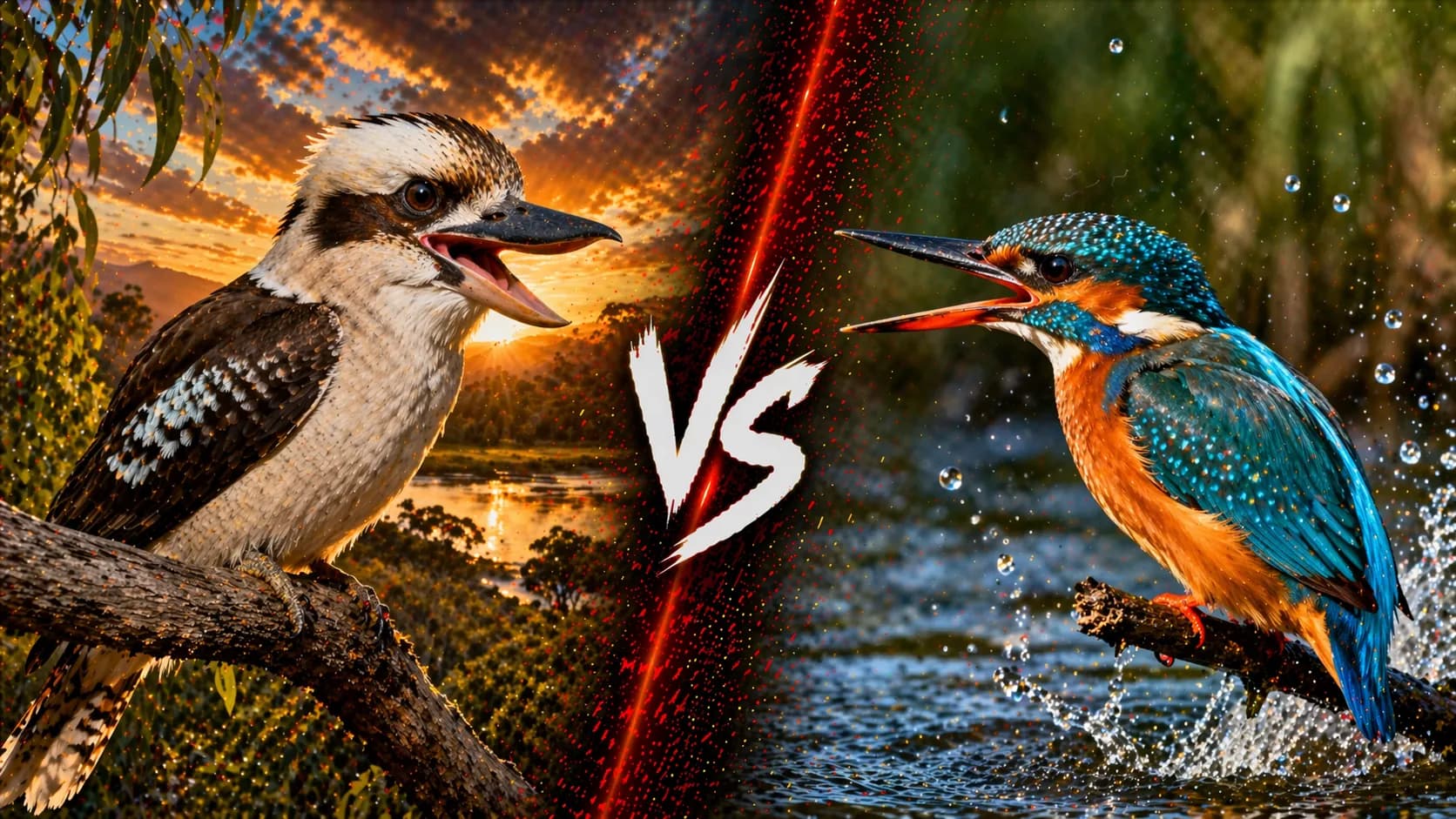
Laughing Kookaburra vs Common Kingfisher: Which Perch Hunter Has the Better Edge?
A laughing kookaburra vs common kingfisher comparison covering body size, prey style, perch hunting, and why a bigger kingfisher-relative changes the equation.
Meet the animals in this matchup
Go straight to the species guides behind this comparison for identification, habitat, rarity, and deeper AnimalDex context.
Quick verdict
Start with the direct answer, then use the structured comparison below to see what changes the outcome.
Laughing kookaburra usually has the edge because it is much larger, more forceful, and built to handle bigger prey. Common kingfisher is the finer precision specialist around small fish and tight-water strikes.
These birds share a perch-hunting logic, but not the same scale. The kookaburra is a heavier terrestrial and branch hunter. The common kingfisher is a tiny precision diver.
Why this matchup is interesting
The comparison works because it shows how the same broad hunting style can scale into very different physical outcomes.
Head-to-head species stats
These are the same core AnimalDex stat dimensions used on the dedicated animal pages, pulled side by side so the matchup is faster to scan.
Laughing Kookaburra
Stats source: Canonical species profile
Common Kingfisher
Stats source: Canonical species profile
Trait-by-trait comparison
Only the categories that matter to this matchup are included. The goal is not filler stats, but the real design differences that change the result.
Body size
Laughing Kookaburra
Much larger and heavier
Common Kingfisher
Tiny, compact river-edge specialist
Why it matters
The size gap is the central fact in any direct encounter.
Precision fish strike
Laughing Kookaburra
Strong from perch, but broader hunting focus
Common Kingfisher
Sharper small-target water strike
Why it matters
Kingfisher wins the fine-control fishing question.
Direct clash value
Laughing Kookaburra
Better equipped for rougher contact
Common Kingfisher
Best when it never has to take a rough exchange
Why it matters
Kookaburra owns the physical confrontation lane.
Scenario breakdown
This is where shallow battle content usually fails. Terrain, spacing, timing, and engagement style can change the answer.
Small stream hunt
Kingfisher precision edge
Tiny water targets and tight dive windows favor the smaller specialist.
Branch-side confrontation
Kookaburra edge
The larger bird carries much more authority in a direct dispute.
Mixed perch country
Kookaburra stronger
The more general and physical the encounter becomes, the better the kookaburra looks.
Explore these animals
Use the full species pages to go deeper on biology, habitat fit, and the real traits behind this verdict.
Laughing Kookaburra
The laughing kookaburra is a large kingfisher famous for loud cackling calls, sit-and-wait hunting, and comfort in both woodland and suburban habitats.
Read species guideCommon Kingfisher
The common kingfisher is a small bright river bird built for perch hunting, rapid dives, and precision fish capture in clear shallow water.
Read species guideSystems Intelligence & Hidden Purpose
See the animals behind this comparison as engineered biological systems: what each one is built to do, where it gains leverage, and why the matchup changes by scenario.
System Role
The Perch-and-Drop Controller
Laughing Kookaburra
Specialized Hardware
A heavy bill, broad perch vision, and short decisive strike pattern make kookaburras ambush hardware for mixed prey below branch height.
Systems Script
They convert elevated waiting points into predatory control over reptiles, insects, and small mammals. Their territory calls also make acoustic space part of the operating system.
Strategic Insight
You do not need constant motion when you already own the perch.
System Role
The Streamside Precision Dart
Common Kingfisher
Specialized Hardware
A spear-like bill, compact flight profile, and water-reading vision make the kingfisher efficient strike hardware for clear shallow channels.
Systems Script
Kingfishers translate small-fish movement into predator pressure across ponds and streams. They connect perch availability, bank stability, and water clarity into one visible hunting system.
Strategic Insight
Precision wins when the window is brief. Hold the perch, read the surface, then commit cleanly.
Final take
Common kingfisher is the finer precision fisher. Laughing kookaburra is the stronger overall answer when the page asks which bird carries the more dangerous direct edge.
Collect both animals in AnimalDex
Track the species behind this matchup, compare their real traits, and build the rivalry into your AnimalDex collection.
Comparison FAQ
Short, direct answers to the next questions readers usually ask after the headline verdict.
Is a kookaburra stronger than a kingfisher?
Yes. The kookaburra is much larger and better suited to a direct physical encounter.
What does the kingfisher do better?
It is the better tiny-target water striker and the cleaner precision specialist.
Related comparisons
Continue with nearby matchups to compare more real-world animal traits without dropping into junky who-wins filler.
African Wild Dog vs Hyena: Which Hunter Has the Edge?
Spotted hyena gets the edge in direct physical conflict because it is tougher and more built for brutal contact. African wild dog stays exceptional in pure pack-hunt coordination and endurance pursuit.
Read comparisonAlligator Snapping Turtle vs Polar Bear: Which Animal Has the Edge?
Polar bear gets the overwhelming overall edge through sheer mass, strength, and the ability to dominate most contact scenarios. Alligator snapping turtle stays dangerous only in a narrow front-facing water-side bite window where its jaws can punish a mistake.
Read comparisonBald Eagle vs Crowned Eagle: Which Eagle Has the Better Edge?
Bald eagle gets the broader size and open-space verdict, while crowned eagle becomes far more dangerous in forested ambush contexts where explosive attack on agile prey matters more.
Read comparisonBald Eagle vs Peregrine Falcon: Power or Speed?
Peregrine falcon wins the speed question clearly. Bald eagle usually gets the overall edge in a direct clash because size, talon grip, and durability matter more once contact happens.
Read comparison