

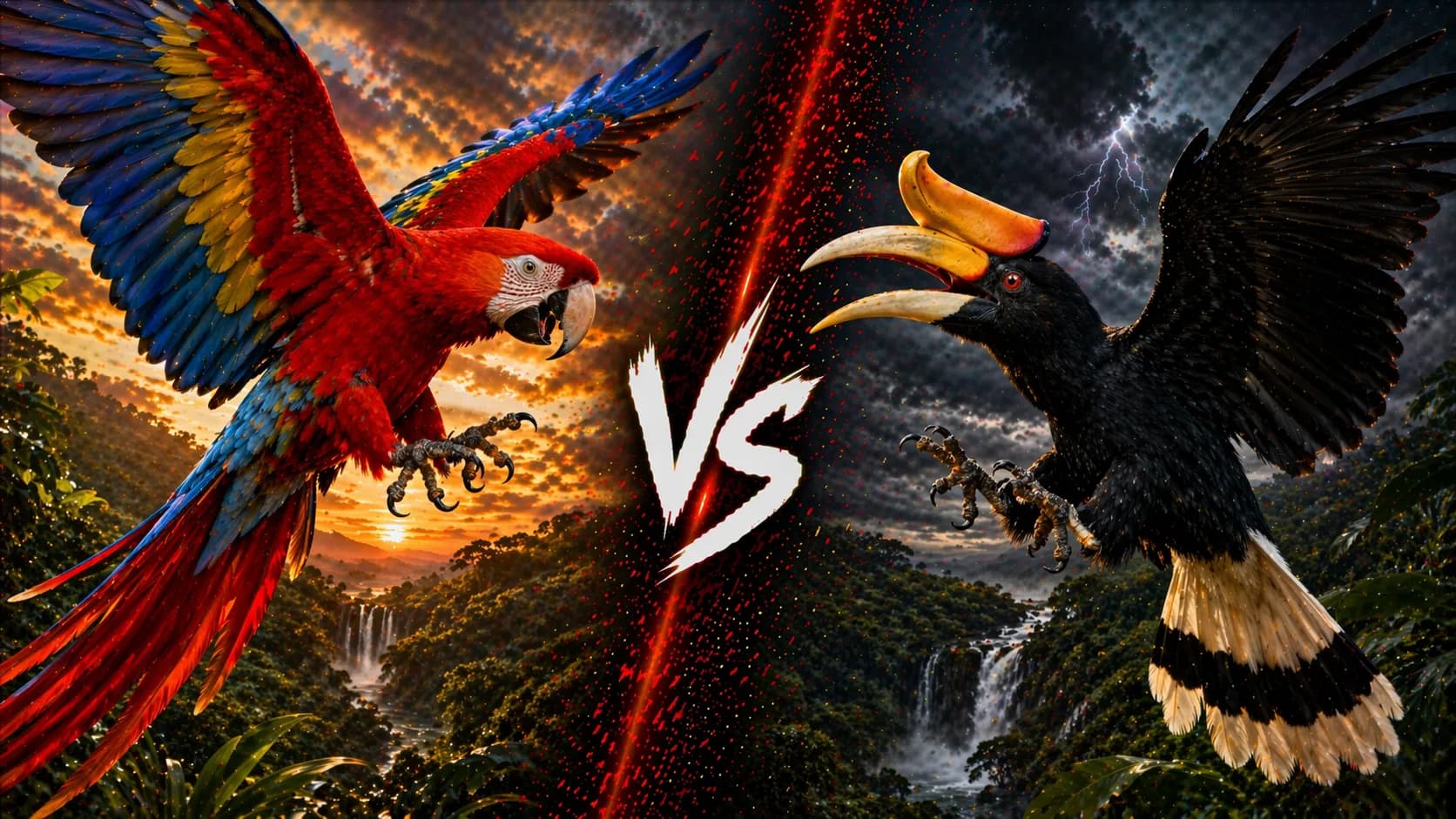
Scarlet Macaw vs Rhinoceros Hornbill: Which Tropical Bird Has the Stronger Edge?
A scarlet macaw vs rhinoceros hornbill comparison covering bill force, climbing control, canopy authority, and why these tropical icons are built for different kinds of leverage.
Meet the animals in this matchup
Go straight to the species guides behind this comparison for identification, habitat, rarity, and deeper AnimalDex context.
Quick verdict
Start with the direct answer, then use the structured comparison below to see what changes the outcome.
Rhinoceros hornbill usually has the stronger physical edge because of size and body authority. Scarlet macaw remains highly capable thanks to climbing control and a powerful hooked bill at close range.
The hornbill is the larger canopy heavyweight. The macaw is the more dexterous parrot, with better climbing control and a bill built for cracking and manipulation rather than only presence.
Why this matchup is interesting
It is a useful tropical-bird comparison because both species are striking and strong-billed, but one is a heavier forest mover while the other is a more manipulative climber.
Head-to-head species stats
These are the same core AnimalDex stat dimensions used on the dedicated animal pages, pulled side by side so the matchup is faster to scan.
Scarlet Macaw
Stats source: Canonical species profile
Rhinoceros Hornbill
Stats source: Canonical species profile
Trait-by-trait comparison
Only the categories that matter to this matchup are included. The goal is not filler stats, but the real design differences that change the result.
Body authority
Scarlet Macaw
Compact parrot frame with climbing control
Rhinoceros Hornbill
Larger canopy body with more total mass
Why it matters
Hornbill carries the stronger baseline in direct size terms.
Bill utility
Scarlet Macaw
Hooked bill with strong gripping and cracking power
Rhinoceros Hornbill
Large bill integrated with broader body presence
Why it matters
Macaw has a very effective close bill, but hornbill couples its bill to a bigger frame.
Climbing and perch control
Scarlet Macaw
Better manipulative climbing control
Rhinoceros Hornbill
Less parrot-like dexterity
Why it matters
Macaw improves when the contest becomes a perch-and-grip problem instead of raw size.
Scenario breakdown
This is where shallow battle content usually fails. Terrain, spacing, timing, and engagement style can change the answer.
Open canopy contact
Hornbill edge
The larger bird benefits when the exchange stays broad and physical.
Branch grip fight
Closer than it looks
Macaw's climbing control keeps it more competitive when the encounter becomes awkward and perch-dependent.
Short direct clash
Hornbill stronger
The hornbill's extra size still matters most in a clean physical contest.
Explore these animals
Use the full species pages to go deeper on biology, habitat fit, and the real traits behind this verdict.
Scarlet Macaw
The scarlet macaw is a large brilliantly colored parrot known for loud social flight, strong bill power, and canopy foraging in Neotropical forests.
Read species guideRhinoceros Hornbill
The rhinoceros hornbill is a large Southeast Asian forest bird known for its heavy casque, strong pair bonds, and dependence on old trees for nesting.
Read species guideSystems Intelligence & Hidden Purpose
See the animals behind this comparison as engineered biological systems: what each one is built to do, where it gains leverage, and why the matchup changes by scenario.
System Role
The Canopy Seed Cracker
Scarlet Macaw
Specialized Hardware
A crushing bill, mobile zygodactyl feet, and loud social flight make macaws forest processing hardware for hard fruits and seeds.
Systems Script
Macaws open tough plant resources and redistribute seeds through long flights between fruiting trees. Their presence helps keep canopy food systems dynamic instead of localized.
Strategic Insight
Some value stays locked until the right tool arrives. Build for access, not just speed.
System Role
The Old-Growth Courier
Rhinoceros Hornbill
Specialized Hardware
A heavy fruit-handling bill, strong flight, and dependence on giant cavity trees make rhinoceros hornbills distribution hardware for mature tropical forest.
Systems Script
Hornbills move seeds across large canopy distances and tie reproduction directly to old trees. They are part courier network, part forest continuity alarm.
Strategic Insight
Do not separate logistics from infrastructure. If the nesting platform disappears, the delivery system goes with it.
Final take
Scarlet macaw is more dexterous than many readers expect, but rhinoceros hornbill is still the safer overall verdict because size and canopy authority carry more weight in a direct clash.
Collect both animals in AnimalDex
Track the species behind this matchup, compare their real traits, and build the rivalry into your AnimalDex collection.
Comparison FAQ
Short, direct answers to the next questions readers usually ask after the headline verdict.
Is a scarlet macaw stronger than a hornbill?
The macaw has a strong bill and excellent grip control, but the hornbill usually keeps the bigger overall physical edge.
What helps the macaw stay competitive?
Its hooked bill, climbing dexterity, and perch control make it more dangerous in awkward close spaces than its size alone suggests.
Related comparisons
Continue with nearby matchups to compare more real-world animal traits without dropping into junky who-wins filler.
Rhinoceros Hornbill vs Toco Toucan: Which Bill Specialist Has the Edge?
Rhinoceros hornbill usually has the stronger overall edge because it is larger, heavier, and built for more forceful canopy movement. Toco toucan has an exceptional bill, but it is not the same kind of heavy forest bird.
Read comparisonAfrican Wild Dog vs Hyena: Which Hunter Has the Edge?
Spotted hyena gets the edge in direct physical conflict because it is tougher and more built for brutal contact. African wild dog stays exceptional in pure pack-hunt coordination and endurance pursuit.
Read comparisonAlligator Snapping Turtle vs Polar Bear: Which Animal Has the Edge?
Polar bear gets the overwhelming overall edge through sheer mass, strength, and the ability to dominate most contact scenarios. Alligator snapping turtle stays dangerous only in a narrow front-facing water-side bite window where its jaws can punish a mistake.
Read comparisonBald Eagle vs Crowned Eagle: Which Eagle Has the Better Edge?
Bald eagle gets the broader size and open-space verdict, while crowned eagle becomes far more dangerous in forested ambush contexts where explosive attack on agile prey matters more.
Read comparison