

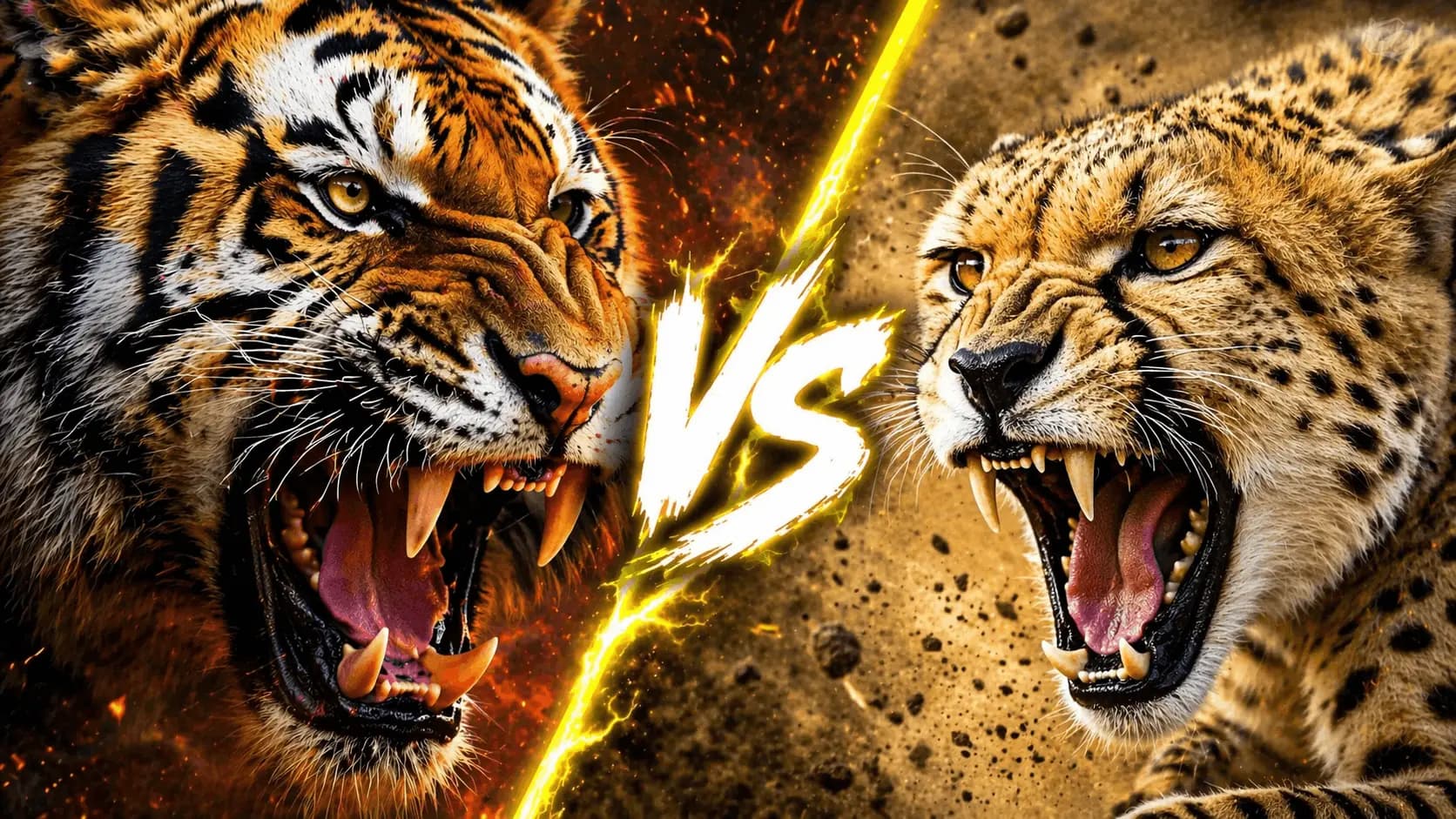
Meet the animals in this matchup
Go straight to the species guides behind this comparison for identification, habitat, rarity, and deeper AnimalDex context.
Quick verdict
Start with the direct answer, then use the structured comparison below to see what changes the outcome.
Cheetah is the faster cat when the question is raw land speed. Tiger is more powerful and more dangerous in a fight, but speed is the cheetah's clear domain.
This is a good example of why comparison type matters. 'Who wins' and 'who is faster' are not interchangeable questions, and speed pages should stay disciplined about that.
Cheetah is built for high-value short sprints on open ground, with lightweight structure, huge respiratory throughput, and steering hardware designed around fast pursuit. Tiger can move quickly in bursts, but it is not a top-speed specialist in the same way.
Why this matchup is interesting
Both animals are famous cats, but they solve hunting through different physics. Cheetah trades brute force for acceleration and open-ground pursuit. Tiger trades top-end running for strength, stealth, and close-range finishing.
That makes the page useful for long-tail search and for future short-form content: readers get a direct answer plus a clean explanation of what each body is optimized to do.
Head-to-head species stats
These are the same core AnimalDex stat dimensions used on the dedicated animal pages, pulled side by side so the matchup is faster to scan.
Tiger
Stats source: Generated canonical stats
Cheetah
Stats source: Canonical species profile
Trait-by-trait comparison
Only the categories that matter to this matchup are included. The goal is not filler stats, but the real design differences that change the result.
Top-end land speed
Tiger
Fast for a heavy ambush predator, but not a sprint specialist
Cheetah
Elite top-end runner built for brief open-ground pursuit
Why it matters
If the question is pure speed, cheetah gets the answer quickly.
Acceleration
Tiger
Explosive short-burst launch from cover
Cheetah
Exceptional acceleration across flat open terrain
Why it matters
Tiger launches hard, but cheetah turns acceleration into a central design feature.
High-speed maneuvering
Tiger
Strong close-range body control, less built for extended sprint turning
Cheetah
Long tail steering and light frame for fast directional corrections
Why it matters
Cheetah is engineered to stay stable while moving at far higher speed.
Burst power in contact range
Tiger
Massive strength and finishing force once distance closes
Cheetah
Lower emphasis on wrestling power
Why it matters
Tiger dominates the force question, but that is different from winning the speed question.
Best terrain fit
Tiger
Cover, forest edge, broken ground
Cheetah
Open plains and cleaner sprint lanes
Why it matters
Speed expression depends on whether the terrain allows a true sprint.
Scenario breakdown
This is where shallow battle content usually fails. Terrain, spacing, timing, and engagement style can change the answer.
Flat open run
Cheetah clearly
Open ground gives the cheetah the exact lane its body is designed to exploit.
Short ambush burst from cover
Tiger first-step edge
Tiger can explode out of concealment with heavy force, but that is not the same as sustaining a faster run.
Broken terrain or dense cover
Depends on footing
The cheetah loses some of its main advantage when the sprint lane disappears or footing becomes irregular.
Extended pursuit after the sprint window
Depends on what 'extended' means
Cheetah is unmatched at brief speed, but it also pays a high recovery cost. Once the burst window closes, the comparison stops being about pure top speed.
Explore these animals
Use the full species pages to go deeper on biology, habitat fit, and the real traits behind this verdict.
Tiger
The tiger is a large striped cat built for stealth, ambush, and territorial control across forests, wetlands, and grassland edges in Asia.
Read species guideCheetah
Cheetahs are lightly built sprinting cats designed for speed, visual tracking, and quick open-ground hunts rather than brute-force wrestling.
Read species guideSystems Intelligence & Hidden Purpose
See the animals behind this comparison as engineered biological systems: what each one is built to do, where it gains leverage, and why the matchup changes by scenario.
System Role
The Solitary Ambush Accountant
Tiger
Specialized Hardware
Striped camouflage, padded feet, strong night vision, and explosive forelimb power make the tiger highly effective close-range strike hardware in dense cover.
Systems Script
Tigers regulate herbivore pressure and prey behavior across forests, wetlands, and grasslands. Their presence changes how other animals move, feed, and allocate risk, which then reshapes vegetation and recovery patterns.
Strategic Insight
A high-value move beats a high-volume one. Save force for the window where surprise and position make the cost worth paying.
System Role
The Burst-Speed Precision Trader
Cheetah
Specialized Hardware
Lightweight frame, oversized lungs, long tail steering, and traction-focused claws make cheetahs acceleration hardware built for short high-value outcomes.
Systems Script
Cheetahs pressure mid-sized grazers in open country but pay dearly for failed commitments. Their niche rewards clean setup and punishes wasted effort.
Strategic Insight
Speed is expensive. Use it where the odds are already tilted, not where you are merely impatient.
Final take
Cheetah is the faster cat. That is the direct answer, and it should be stated plainly for searchers and AI readers.
Tiger remains the more powerful and dangerous animal overall in a combat sense, but those are separate categories. If the page stays disciplined about speed, cheetah wins the headline.
Compare real animals in the wild
Use AnimalDex to track the species behind this speed matchup and compare how real habitat, behavior, and body design shape the answer.
Comparison FAQ
Short, direct answers to the next questions readers usually ask after the headline verdict.
Is a tiger faster than a cheetah?
No. A tiger can burst quickly, but the cheetah is the clear specialist in top-end land speed and sprint acceleration.
Can a tiger run fast enough to catch prey?
Yes, but it usually relies on stealth and short-range explosive commitment rather than extended open-ground sprinting.
Why is the cheetah so much faster?
Its lightweight frame, long limbs, large respiratory capacity, traction-focused claws, and steering tail all push the design toward brief, extreme speed.
Related comparisons
Continue with nearby matchups to compare more real-world animal traits without dropping into junky who-wins filler.
Tiger vs Lion: Who Actually Wins?
In a one-on-one land fight, the tiger usually has the edge. Lions become more dangerous when the matchup stops being a duel and starts rewarding coalition pressure, open-country control, or prolonged group conflict.
Read comparisonKomodo Dragon vs King Cobra: What Happens in a Real Clash?
Komodo dragon usually has the edge in a direct physical clash because of its size, armor, and crushing close-range force. King cobra remains dangerous because one clean venom-delivering strike can change the outcome fast.
Read comparisonOstrich vs Cheetah Speed: Which Is Actually Faster?
Cheetah owns the cleaner top-speed headline, but ostrich is a real long-stride runner and can stay competitive when the question shifts from explosive pursuit to sustained open-ground movement.
Read comparisonBear vs Tiger: Who Has the Edge in a Real Clash?
Tiger is the safer general answer in a one-on-one land clash when stealth, timing, and clean engagement matter. A very large bear represented here by the polar bear changes the problem through sheer mass and durability, especially in open, cold terrain.
Read comparison