
Panduan lapangan hewan
Streaked Gurnard
Identifikasi, habitat, rarity, perilaku, simbolisme, fakta, dan pelajaran praktis dari alam.
Panduan lapangan hewan
Streaked Gurnard
Grounded Exploration
Explore with stability.
The streaked gurnard uses its modified pectoral fins to 'walk' along the ocean floor, showcasing the importance of a stable foundation in exploration.
You’re #1 of 1
Native range
Natural range, not this capture location
Native range keys: mediterranean, north_atlantic, europe. Sand, gravel and mixed bottoms in coastal water suit Streaked Gurnard because Grounded Exploration needs a floor it can both stand on and search by touch.
Wild reward hint
First-time wild species earn bonus rewards, including 1 free credit.
0/1 XP toward Level 2
AnimalDex stats
Dominance
25
Speed
30
Size
22
Intelligence
28
Rarity
20%
Total
125
Size scale
Zoo animal · comparisons disabled
Zoo animals stay in your collection, but they can't enter scenario comparisons or the Arena.
✦ Available actions
Compare this public animal when your deck meets the current rules.
Nama ilmiah
Chelidonichthys lastoviza
Kategori
Animal
Habitat
Native range keys: mediterranean, north_atlantic, europe. Sand, gravel and mixed bottoms in coastal water suit Streaked Gurnard because Grounded Exploration needs a floor it can both stand on and search by touch.
Rarity
Relatively common · 20/100
Native range
Native range keys: mediterranean, north_atlantic, europe. Sand, gravel and mixed bottoms in coastal water suit Streaked Gurnard because Grounded Exploration needs a floor it can both stand on and search by touch.
Mengapa Grounded Exploration?
Alasan di balik Prinsip Hewan ini dan biologi yang mendukungnya.
Streaked Gurnard teaches Grounded Exploration on the seabed, walking on three free fin rays per side that both carry it and taste the sand it is crossing.
Cara mengidentifikasi Streaked Gurnard
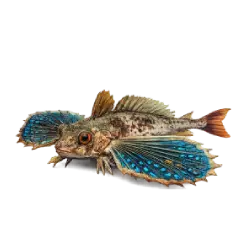
- Three free finger-like rays on each pectoral fin, used to walk and to taste
- Broad pectoral fins that fan open in blue and dark bands
- Bony, armoured head with a blunt profile
- Reddish body crossed by dark oblique streaks
Kenapa Streaked Gurnard menarik
- Its walking rays carry taste receptors, so it tastes the bottom as it steps.
- It produces audible grunts and growls using muscles against the swim bladder.
- The pectoral fins spread into a startling banded fan when it is disturbed.
- It lives on sand and gravel bottoms in the eastern Atlantic and Mediterranean.
- It walks more than it swims across open bottom.
Habitat: Native range keys: mediterranean, north_atlantic, europe. Sand, gravel and mixed bottoms in coastal water suit Streaked Gurnard because Grounded Exploration needs a floor it can both stand on and search by touch.
Native range: Native range keys: mediterranean, north_atlantic, europe. Sand, gravel and mixed bottoms in coastal water suit Streaked Gurnard because Grounded Exploration needs a floor it can both stand on and search by touch.
nativeRangeCardTitle
nativeRangeCardDescription
nativeRangeMissingAssets
Native range keys: mediterranean, north_atlantic, europe. Sand, gravel and mixed bottoms in coastal water suit Streaked Gurnard because Grounded Exploration needs a floor it can both stand on and search by touch.
To find Streaked Gurnard in the wild, focus on the exact habitat patches that match its body design and daily behavior, not just the broad country where it exists. You usually do better by working one good piece of habitat inside native range keys: mediterranean, north_atlantic, europe. Sand, gravel and mixed bottoms in coastal water suit Streaked Gurnard because Grounded Exploration needs a floor it can both stand on and search by touch. than by covering too much ground.
- Headlands, reef edges, island colonies, tidal channels, or productive coastal water
- Protected habitat blocks within native range keys: mediterranean, north_atlantic, europe. Sand, gravel and mixed bottoms in coastal water suit Streaked Gurnard because Grounded Exploration needs a floor it can both stand on and search by touch.
- First light and late afternoon are often best, when animals come out to feed along the edge of water.
- Time your search around tide, wind, and visibility, then focus on feeding lines, reef edges, and known haul-out or nesting spots.
- Move quietly, stop often, and give the habitat time to settle; many mammals and insects show themselves only after the first pause.
Crustaceans, small fish and worms located by the walking rays. This diet supports Grounded Exploration because prey is found by contact rather than by sight, which rewards slow, continuous ground coverage.
Larger fish and coastal predators. Its answer is a sudden fan of banded pectoral fins that makes it appear far larger, backed by a hard armoured head.
Streaked Gurnards stay on the bottom through the day and night, resting on their fin rays rather than settling into cover.
They live for years on the same coastal grounds, so Grounded Exploration turns into a worked map of which bottoms repay searching.
They spawn in coastal water in spring and summer, releasing pelagic eggs. Offspring fit the principle because juveniles begin walking and tasting the bottom while still very small.
Males and females look alike. Appearance carries no signal in a fish whose social communication is sound rather than colour.
- Three free finger-like rays on each pectoral fin, used to walk and to taste
- Broad pectoral fins that fan open in blue and dark bands
- Bony, armoured head with a blunt profile
- Reddish body crossed by dark oblique streaks
Streaked Gurnard most often symbolizes grounded exploration in AnimalDex because its real survival behavior repeatedly shows this pattern.
The streaked gurnard uses its modified pectoral fins to 'walk' along the ocean floor, showcasing the importance of a stable foundation in exploration.
Streaked gurnards have specialized pectoral fins that allow them to move along the seabed, providing stability and precision in their search for food.
- Observe from a respectful distance and avoid changing the animal's behavior.
- Do not block feeding, shelter, nesting, or travel routes.
- Use a live camera capture without handling or staging wildlife.
Hewan terkait
Lebih banyak hewan dengan kekuatan Grounded Strength
Jelajahi semua hewan Grounded Strength
African Forest Buffalo
African Forest Buffalo is the AnimalDex expression of Forest Herd Weight: Move heavy…
Baca panduan spesies
Argentine Black and White Tegu
Argentine Black and White Tegu is a reptile known for large patterned lizard body,…
Baca panduan spesies
Banteng
Banteng expresses Tropical Wild Strength through real survival details, not a generic…
Baca panduan spesiesBawa ensiklopedia ke dunia nyata
AnimalDex membantumu memindai hewan nyata, mengidentifikasi spesies, mengoleksi kartu, dan belajar dari alam di mana pun kamu berada.