
Panduan lapangan hewan
Tunnelweb Spider
Identifikasi, habitat, rarity, perilaku, simbolisme, fakta, dan pelajaran praktis dari alam.

Kartu AnimalDex
Buka kartu hewan ini
Pindai atau tangkap hewan ini dengan AnimalDex untuk membuka kartu koleksi dan menambahkannya ke koleksi satwa liarmu.
Dapatkan AnimalDexPanduan lapangan hewan
Tunnelweb Spider
The Tunnelweb Spider lines a tube of silk beneath logs and stones and grabs beetles that cross the entrance. It shows us that patience in the right doorway needs no trap at all.
No captures yet
Native range
Natural range, not this capture location
Native range keys: australia_oceania. Under logs, stones, loose bark and garden debris across New Zealand, because Patient Ambush needs a covered doorway with traffic passing it and no need for an exposed web.
Search near meAnimalDex stats
Dominance
30
Speed
12
Size
5
Intelligence
20
Rarity
70%
Total
137
Size scale
Nama ilmiah
Porrhothele antipodum
Kategori
Arachnid
Habitat
Native range keys: australia_oceania. Under logs, stones, loose bark and garden debris across New Zealand, because Patient Ambush needs a covered doorway with traffic passing it and no need for an exposed web.
Rarity
Rare · 70/100
Native range
Native range keys: australia_oceania. Under logs, stones, loose bark and garden debris across New Zealand, because Patient Ambush needs a covered doorway with traffic passing it and no need for an exposed web.
Mengapa Tunnelweb Spider?
Alasan di balik Prinsip Hewan ini dan biologi yang mendukungnya.
Tunnelweb Spider teaches Patient Ambush from a sheet of silk under a log. It builds no snare in the air, only a tube it retreats into, and takes what walks across the doorway.
Cara mengidentifikasi Tunnelweb Spider
- Silk tube built under logs, stones and loose bark
- Glossy dark brown body with long, prominent spinnerets
- Large, forward-facing fangs
- Retreats backwards into the tunnel rather than fleeing across open ground
Kenapa Tunnelweb Spider menarik
- It is one of New Zealand's largest and most commonly encountered native spiders.
- It is a relative of the Australian funnel-webs, but its bite is painful rather than dangerous.
- It is a determined predator of other spiders, including ones larger than itself.
- The tunnel has no sticky web — prey is caught by hand at the entrance.
Habitat: Native range keys: australia_oceania. Under logs, stones, loose bark and garden debris across New Zealand, because Patient Ambush needs a covered doorway with traffic passing it and no need for an exposed web.
Native range: Native range keys: australia_oceania. Under logs, stones, loose bark and garden debris across New Zealand, because Patient Ambush needs a covered doorway with traffic passing it and no need for an exposed web.
nativeRangeCardTitle
nativeRangeCardDescription
Native range keys: australia_oceania. Under logs, stones, loose bark and garden debris across New Zealand, because Patient Ambush needs a covered doorway with traffic passing it and no need for an exposed web.
To find Tunnelweb Spider in the wild, focus on the exact habitat patches that match its body design and daily behavior, not just the broad country where it exists. You usually do better by working one good piece of habitat inside native range keys: australia_oceania. Under logs, stones, loose bark and garden debris across New Zealand, because Patient Ambush needs a covered doorway with traffic passing it and no need for an exposed web. than by covering too much ground.
- Headlands, reef edges, island colonies, tidal channels, or productive coastal water
- Burrow systems, sandy banks, fallen logs, or ground with clear den entrances
- Sunlit logs, exposed branches, warm rocks, or regular perch sites used for scanning
- Start early, pick one strong patch of habitat, and stay long enough for movement to return after you arrive.
- Time your search around tide, wind, and visibility, then focus on feeding lines, reef edges, and known haul-out or nesting spots.
- Move quietly, stop often, and give the habitat time to settle; many mammals and insects show themselves only after the first pause.
Beetles, wētā, slaters, other spiders and whatever crosses the tunnel mouth. This diet supports Patient Ambush because none of it is chased — it is taken at arm's length from inside cover.
Birds, centipedes, parasitic wasps and introduced mammals take tunnelwebs, especially when logs are turned over. The tunnel answers this by giving one defended entrance instead of an open web.
Tunnelwebs are nocturnal and stay in the tube by day, coming to the entrance after dark. Their rhythm keeps them under cover in the damp, which is also where their prey moves.
Females can live for several years in the same tunnel, extending and repairing it. The principle deepens because a well-sited doorway becomes more productive the longer it is held.
Females guard a pale egg sac inside the tunnel, and spiderlings stay in the tube before dispersing to build their own. Offspring fit the principle because the first lesson is the doorway itself.
Males are slimmer and longer-legged and leave the tunnel to search for females. Both sexes share the same build and the same way of feeding.
- Silk tube built under logs, stones and loose bark
- Glossy dark brown body with long, prominent spinnerets
- Large, forward-facing fangs
- Retreats backwards into the tunnel rather than fleeing across open ground
- Observe from a respectful distance and avoid changing the animal's behavior.
- Do not block feeding, shelter, nesting, or travel routes.
- Use a live camera capture without handling or staging wildlife.
Hewan terkait
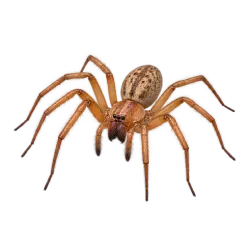
Agrarian Sac Spider
The Night-Hunting Crop Guardian. The Night-Hunting Crop Guardian. Quiet, unseen work…
Baca panduan spesies
Ant-mimicking Spider
The Ant-mimicking Spider shows that identity can be protective. By resembling ants, it…
Baca panduan spesies
Assassin Spider
The Assassin Spider is a lesson in specialized strategy. It does not win by being…
Baca panduan spesiesBawa ensiklopedia ke dunia nyata
AnimalDex membantumu memindai hewan nyata, mengidentifikasi spesies, mengoleksi kartu, dan belajar dari alam di mana pun kamu berada.