

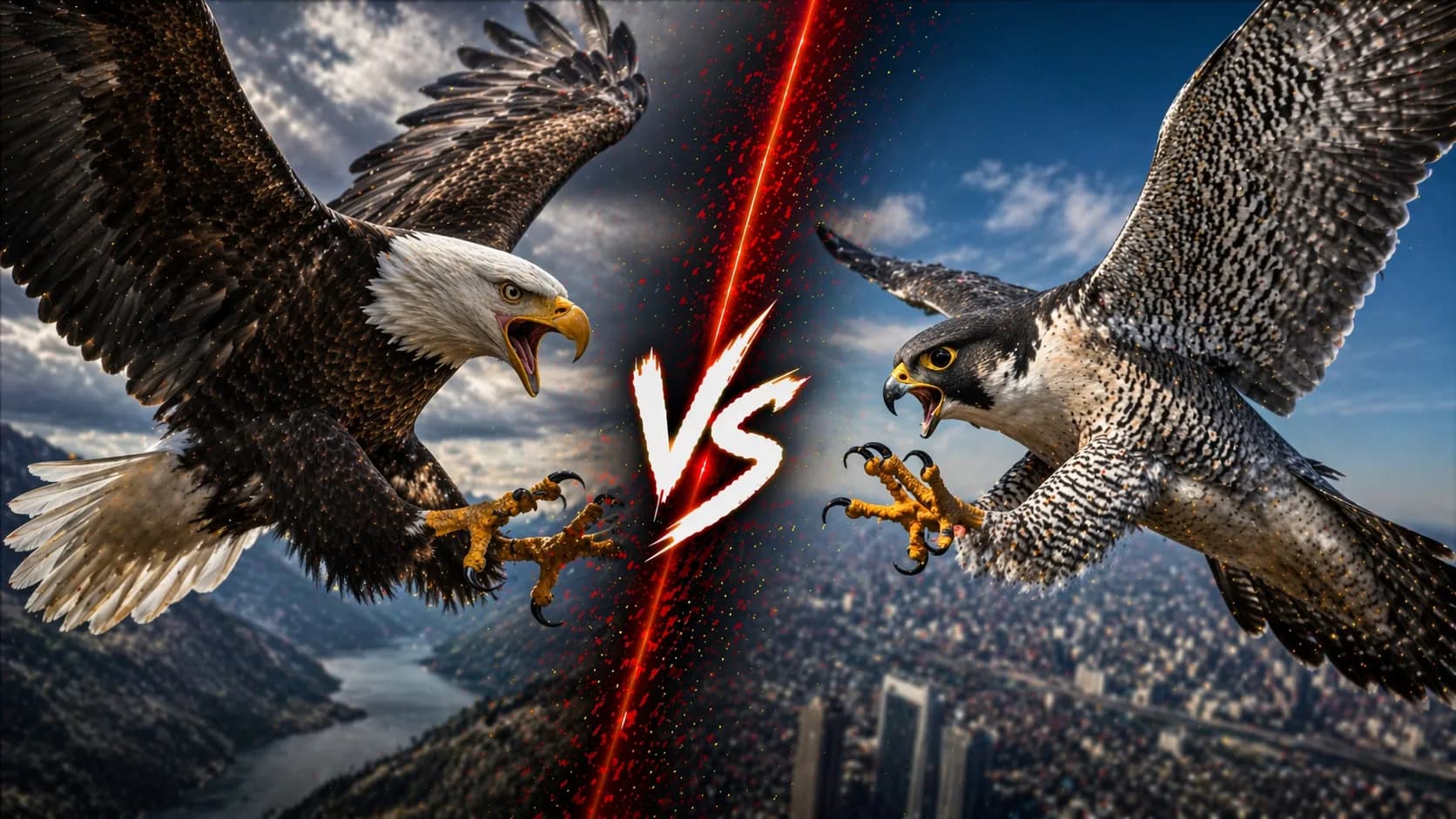
Bald Eagle vs Peregrine Falcon: Power or Speed?
A bald eagle vs peregrine falcon comparison covering grip strength, stoop speed, collision range, and how contact changes an aerial matchup.
Meet the animals in this matchup
Go straight to the species guides behind this comparison for identification, habitat, rarity, and deeper AnimalDex context.
Quick verdict
Start with the direct answer, then use the structured comparison below to see what changes the outcome.
Peregrine falcon wins the speed question clearly. Bald eagle usually gets the overall edge in a direct clash because size, talon grip, and durability matter more once contact happens.
This is a classic speed-versus-power raptor page. The falcon owns the cleaner intercept geometry, but the eagle owns the messier contact phase.
Why this matchup is interesting
Readers often blur all big raptors together. This page works because it shows how radically flight design changes when one bird is built for stoops and the other for authority.
Head-to-head species stats
These are the same core AnimalDex stat dimensions used on the dedicated animal pages, pulled side by side so the matchup is faster to scan.
Bald Eagle
Stats source: Canonical species profile
Peregrine Falcon
Stats source: Canonical species profile
Trait-by-trait comparison
Only the categories that matter to this matchup are included. The goal is not filler stats, but the real design differences that change the result.
Attack speed
Bald Eagle
Fast, but not a true stoop specialist
Peregrine Falcon
Elite dive speed and sharper approach angles
Why it matters
Falcon owns the pure speed lane.
Contact power
Bald Eagle
Heavier body and stronger gripping force
Peregrine Falcon
More reliant on hit-and-pass attack style
Why it matters
The closer the birds get to a wrestling problem, the more the eagle improves.
Durability in bad contact
Bald Eagle
More mass and better tolerance for collision
Peregrine Falcon
Better at avoiding bad contact than absorbing it
Why it matters
Falcon wants a clean exchange. Eagle can survive a messier one.
Scenario breakdown
This is where shallow battle content usually fails. Terrain, spacing, timing, and engagement style can change the answer.
Open high sky
Falcon edge
Plenty of room lets the peregrine exploit its best attack geometry.
Forced close contact
Bald eagle edge
Once the birds actually have to contest position at close range, the eagle's size becomes the central fact.
Perch-to-perch conflict
Bald eagle stronger
Reduced room takes speed away from the falcon and shifts the problem toward body control.
Explore these animals
Use the full species pages to go deeper on biology, habitat fit, and the real traits behind this verdict.
Bald Eagle
The bald eagle is a large North American raptor recognized by adult white head and tail plumage and strong association with large water bodies.
Read species guidePeregrine Falcon
The peregrine falcon is a high-speed hunting raptor famous for steep aerial stoops, pointed wings, and success in both wild cliffs and modern cities.
Read species guideSystems Intelligence & Hidden Purpose
See the animals behind this comparison as engineered biological systems: what each one is built to do, where it gains leverage, and why the matchup changes by scenario.
System Role
The Watershed Signal Pilot
Bald Eagle
Specialized Hardware
Long-range vision, broad soaring wings, and a hooked bill optimized for fish capture make the bald eagle a precision hunter built for scanning large water systems with minimal wasted energy.
Systems Script
Bald eagles sit near the top of aquatic food chains, linking fish-rich waterways to wider nutrient and predator dynamics. Where they persist, they often reflect habitat quality, prey stability, and protected nesting space.
Strategic Insight
Altitude is a strategy. Step back, widen the field, and let pattern recognition do work before you commit energy to the dive.
System Role
The Vertical Strike Specialist
Peregrine Falcon
Specialized Hardware
Pointed wings, deep chest, visual lock, and impact-tuned talons make peregrines aerial interception hardware built for velocity with control.
Systems Script
Peregrines regulate bird movement in open airspace, coastlines, and cliffs. They turn altitude into a killing advantage and keep flock behavior from becoming complacent.
Strategic Insight
If gravity can do part of the work, let it. Great systems borrow force from setup.
Final take
Peregrine falcon is the faster bird, but bald eagle is the safer overall verdict in a real clash because it owns the power and durability side of the matchup.
Collect both animals in AnimalDex
Track the species behind this matchup, compare their real traits, and build the rivalry into your AnimalDex collection.
Comparison FAQ
Short, direct answers to the next questions readers usually ask after the headline verdict.
Who wins, a bald eagle or a peregrine falcon?
In a direct physical contest, the bald eagle usually gets the edge because it is heavier and better built for gripping force.
Is the peregrine falcon still faster?
Yes. The peregrine clearly wins the speed and intercept question.
Related comparisons
Continue with nearby matchups to compare more real-world animal traits without dropping into junky who-wins filler.
Bald Eagle vs Crowned Eagle: Which Eagle Has the Better Edge?
Bald eagle gets the broader size and open-space verdict, while crowned eagle becomes far more dangerous in forested ambush contexts where explosive attack on agile prey matters more.
Read comparisonEagle vs Falcon: Which Raptor Has the Real Edge?
Eagle usually has the power edge in a direct clash. Falcon owns the speed edge and often the cleaner aerial intercept, but size and grip strength still favor the eagle when contact happens.
Read comparisonPeregrine Falcon vs Owl: Which Bird Has the Better Edge?
Peregrine falcon gets the speed and open-air answer by a mile. Owl gets the quieter low-light answer and can become much more relevant when the page shifts from raw speed to surprise in darkness.
Read comparisonPeregrine Falcon vs Red-tailed Hawk: Which Bird Has the Better Speed Edge?
Peregrine falcon is the clear speed winner. Red-tailed hawk remains the better soaring, watching, and broad-habitat control bird rather than the faster one.
Read comparison