

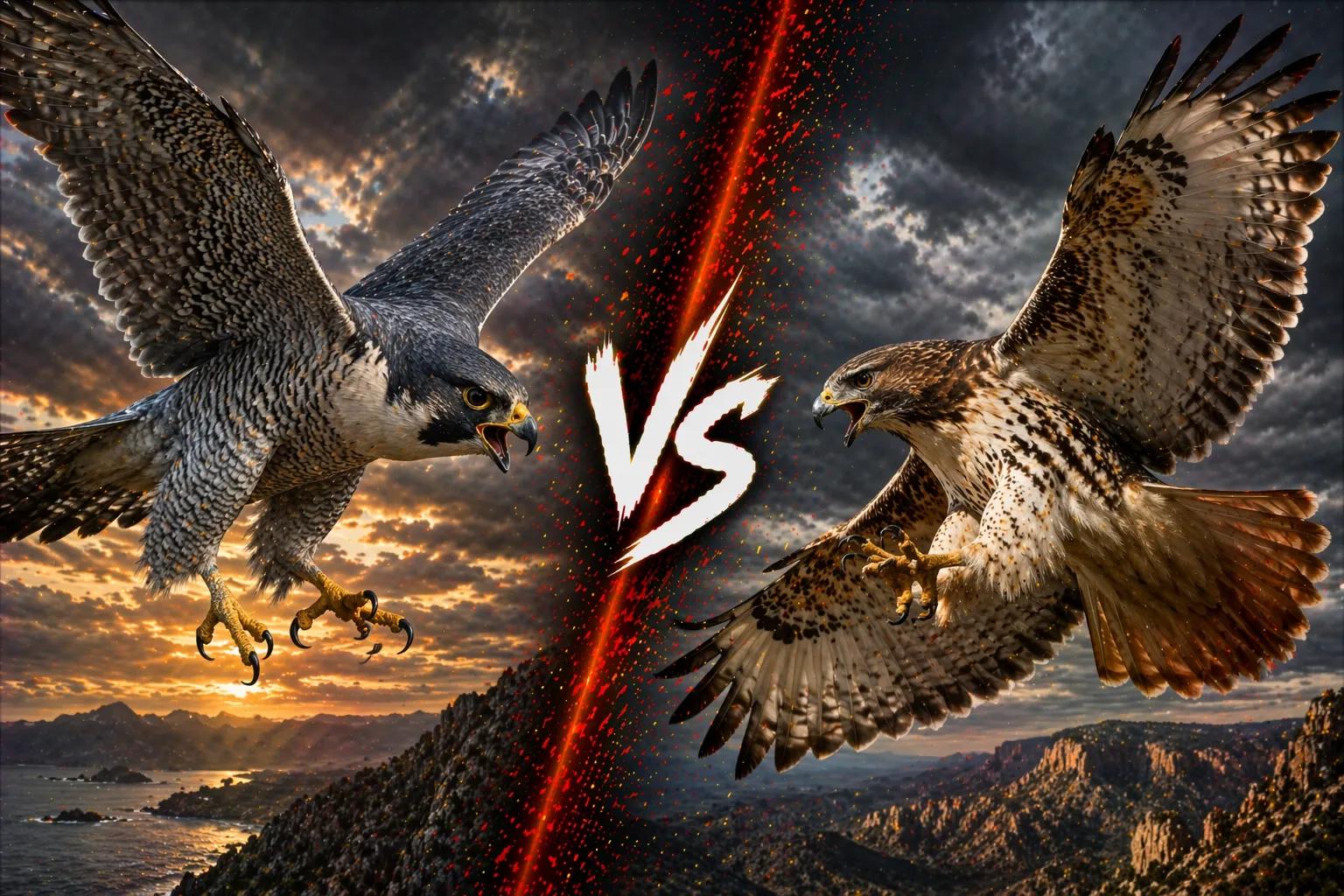
Peregrine Falcon vs Red-tailed Hawk: Which Bird Has the Better Speed Edge?
A grounded peregrine falcon vs red-tailed hawk comparison covering speed, soaring, diving, and why these raptors solve flight differently.
Peregrine Falcon vs Red-tailed Hawk
Matchup winner
Peregrine Falcon
Quick verdict
Start with the direct answer, then use the structured comparison below to see what changes the outcome.
Peregrine falcon is the clear speed winner. Red-tailed hawk remains the better soaring, watching, and broad-habitat control bird rather than the faster one.
Read the full explanation
This is a clean speed page. Peregrine is built for blistering aerial attack. Red-tailed hawk is built for efficient scanning and strike timing from height.
Reader vote
Who do you think wins?
Pick a side — no account needed. Results update live.
No votes yet — be the first to call it.
Editorial note
Why people disagree
It separates true speed specialization from general-purpose raptor success.
Speed
Falcon owns the speed headline.
Soaring and watching
Hawk wins the open-country observer role.
Attack style
Each bird is optimized for a different aerial problem.
Comparison FAQ
Short, direct answers to the next questions readers usually ask after the headline verdict.
Who is faster, peregrine falcon or red-tailed hawk?+
Peregrine falcon by a clear margin.
Why is red-tailed hawk still so successful?+
Because speed is not the only path to hunting success; broad scanning, timing, and energy-efficient control matter too.
Head-to-head species stats
These are the same core AnimalDex stat dimensions used on the dedicated animal pages, pulled side by side so the matchup is faster to scan.
Peregrine Falcon
Tier BRed-tailed Hawk
Tier CTrait-by-trait comparison
Only the categories that matter to this matchup are included. The goal is not filler stats, but the real design differences that change the result.
Elite dive and pursuit speed
Speed
Peregrine Falcon
Good speed, not a specialist at that extreme
Speed
Peregrine Falcon
Less defined by patient broad scanning
Soaring and watching
Red-tailed Hawk
Excellent at reading open country from above
Soaring and watching
Red-tailed Hawk
High-speed aerial commit
Attack style
Depends on context
More patient perch and glide attack model
Attack style
Depends on context
How the verdict forms
Verdict timeline
01 · Speed
Peregrine Falcon
02 · Soaring and watching
Red-tailed Hawk
03 · Attack style
Depends on context
Change the conditions
Scenario breakdown
This is where shallow battle content usually fails. Terrain, spacing, timing, and engagement style can change the answer.
Scenario lean
Peregrine Falcon
Verdict confidence
82%
Peregrine clearly
This is the easiest page segment to answer.
AnimalDex field profiles
Explore these animals
Peregrine Falcon
Falco peregrinus
Cliffs, coasts, mountains, wetlands, and increasingly tall urban structures near bird-rich feeding areas.
Red-tailed Hawk
Buteo jamaicensis
open country, woodland edge, desert, and farmland
Systems Intelligence & Hidden Purpose
See the animals behind this comparison as engineered biological systems: what each one is built to do, where it gains leverage, and why the matchup changes by scenario.
Specialized Hardware
Pointed wings, deep chest, visual lock, and impact-tuned talons make peregrines aerial interception hardware built for velocity with control.
Systems Script
Peregrines regulate bird movement in open airspace, coastlines, and cliffs. They turn altitude into a killing advantage and keep flock behavior from becoming complacent.
Strategic Insight
If gravity can do part of the work, let it. Great systems borrow force from setup.
Specialized Hardware
broad soaring wings, brick-red tail, and high-perch hunting give the Red-tailed Hawk a body plan tuned for its niche.
Systems Script
Red-tailed Hawks operate through open country, woodland edge, desert, and farmland Their design links movement, shelter, and feeding into one workable survival system.
Strategic Insight
Altitude is a way of turning information into advantage.
Final take
Peregrine falcon wins speed. Red-tailed hawk wins the patient open-country observer role.
Compare real animals in the wild
Use AnimalDex to track the species behind this speed matchup and compare how real habitat, behavior, and body design shape the answer.
Related comparisons
Continue with nearby matchups to compare more real-world animal traits without dropping into junky who-wins filler.

Eagle vs Falcon: Which Raptor Has the Real Edge?
Eagle usually has the power edge in a direct clash. Falcon owns the speed edge and often the cleaner aerial intercept, but size and grip strength still favor the eagle when contact happens.
Read comparison
Hawk vs Eagle: Which Raptor Has the Better Edge?
Eagle usually has the edge because it brings more size, grip strength, and direct-contact authority. The hawk remains impressive as a flexible aerial hunter, but not usually the heavier fighter in a clash like this.
Read comparison
Discussion
What do you think?
Share your reasoning with other readers. Be civil and stick to the animals.
Sign in to join the discussion.
Sign inNo comments yet. Start the conversation.