

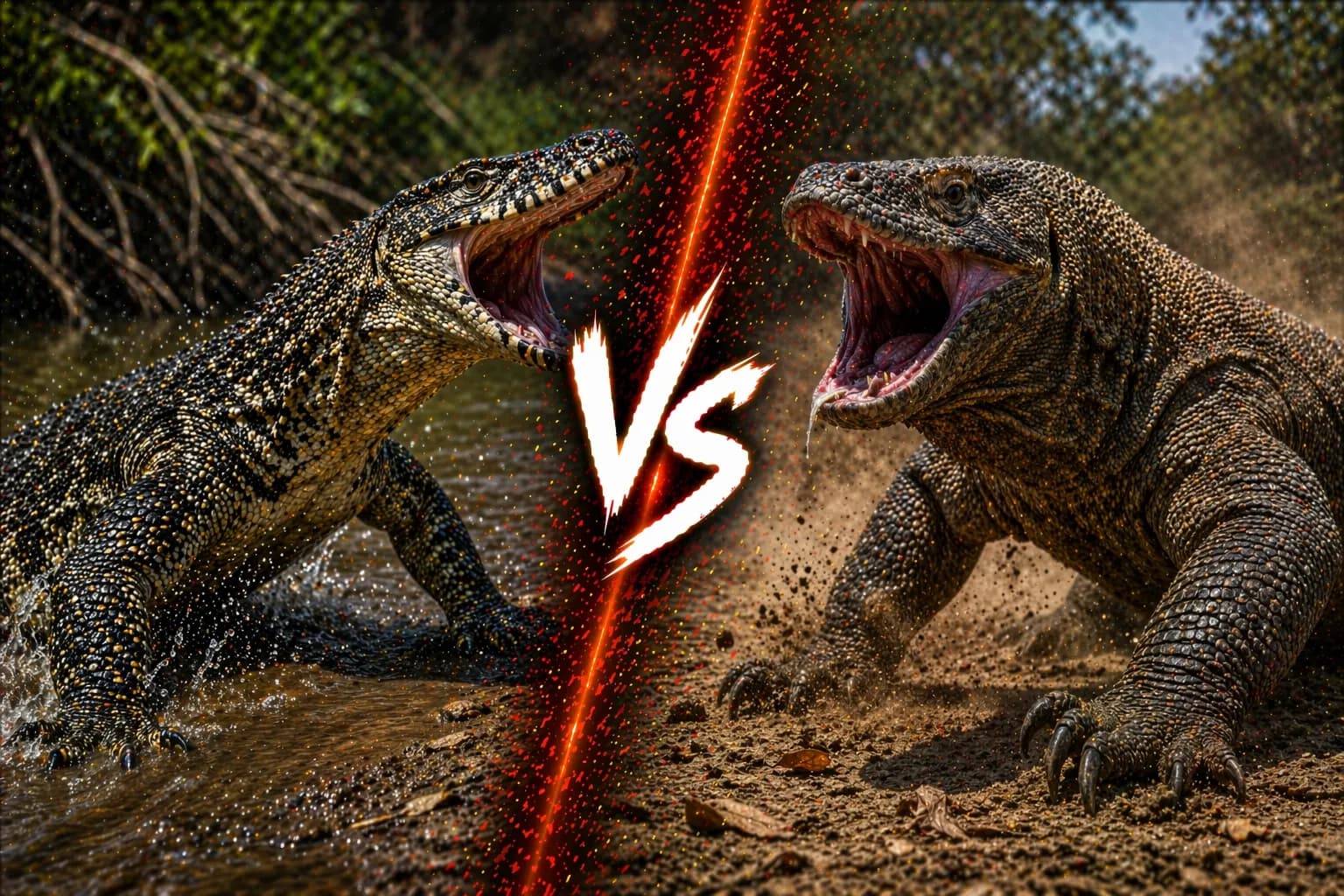
Crocodile Monitor vs Komodo Dragon: Which Giant Monitor Lizard Has the Edge?
A grounded crocodile monitor vs Komodo dragon comparison covering size, arboreal ability, bite power, and the difference between a forest climber and a heavy island giant.
Meet the animals in this matchup
Go straight to the species guides behind this comparison for identification, habitat, rarity, and deeper AnimalDex context.
Quick verdict
Start with the direct answer, then use the structured comparison below to see what changes the outcome.
Komodo dragon gets the overall edge because it is heavier and more brutally grounded in close combat. Crocodile monitor stays impressive through climbing, length, and speed in vertical forest structure.
These are both giant monitors, but they are built for different worlds. Komodo dragon is the heavier heavyweight. Crocodile monitor is the longer more arboreal blade.
Why this matchup is interesting
It is one of the best reptile pages for comparing two closely related designs expressed in very different habitats.
Head-to-head species stats
These are the same core AnimalDex stat dimensions used on the dedicated animal pages, pulled side by side so the matchup is faster to scan.
Crocodile Monitor
Stats source: Canonical species profile
Komodo Dragon
Stats source: Canonical species profile
Trait-by-trait comparison
Only the categories that matter to this matchup are included. The goal is not filler stats, but the real design differences that change the result.
Bulk and force
Crocodile Monitor
Long and athletic, but lighter
Komodo Dragon
Heavier and more punishing in direct ground contact
Why it matters
Komodo dragon owns the heavier-fight answer.
Climbing and vertical use
Crocodile Monitor
Much stronger arboreal ability
Komodo Dragon
Less defined by vertical movement
Why it matters
Crocodile monitor gets better when the page goes vertical.
Ground confrontation
Crocodile Monitor
Less ideal if forced into heavy close contact
Komodo Dragon
Built for it
Why it matters
On the ground the heavier monitor usually wins.
Scenario breakdown
This is where shallow battle content usually fails. Terrain, spacing, timing, and engagement style can change the answer.
Ground fight
Komodo dragon edge
This is the strongest form of the Komodo case.
Forest vertical space
Crocodile monitor improves
This rewards the arboreal specialist.
Mixed broken terrain
Depends on who forces the shape
Each lizard wants the arena to look different.
Explore these animals
Use the full species pages to go deeper on biology, habitat fit, and the real traits behind this verdict.
Crocodile Monitor
Crocodile Monitor is a reptile known for very long muscular tail, powerful climbing claws, and big riverbank monitor frame.
Read species guideKomodo Dragon
The Komodo dragon is the largest living lizard, native to a small island range in Indonesia, and famous for its size, power, and apex-predator role.
Read species guideSystems Intelligence & Hidden Purpose
See the animals behind this comparison as engineered biological systems: what each one is built to do, where it gains leverage, and why the matchup changes by scenario.
System Role
The River-claw Giant Monitor
Crocodile Monitor
Specialized Hardware
very long muscular tail, powerful climbing claws, and big riverbank monitor frame give the Crocodile Monitor a body plan tuned for its niche.
Systems Script
Crocodile Monitors operate through mangrove, river forest, and lowland rainforest. Their design links movement, feeding, shelter, and timing into one workable survival system.
Strategic Insight
Dense environments reward precision, patience, and the ability to read layered cover.
System Role
The Island Apex Regulator
Komodo Dragon
Specialized Hardware
Heavy skeletal architecture, serrated bite mechanics, tongue-based chemical sensing, and heat-efficient reptile metabolism make the Komodo dragon premium hardware for ambush, tracking, and territorial control.
Systems Script
The Komodo dragon operates as apex environmental hardware inside a constrained island system. It removes weak links, regulates prey pressure, and keeps limited ecosystems from drifting into easy imbalance.
Strategic Insight
Premium energy should not be spent on noise. Position well, sense early, and commit hard only when the leverage justifies the burn.
Final take
Komodo dragon wins the heavier ground-fight question. Crocodile monitor wins the vertical forest question.
Collect both animals in AnimalDex
Track the species behind this matchup, compare their real traits, and build the rivalry into your AnimalDex collection.
Comparison FAQ
Short, direct answers to the next questions readers usually ask after the headline verdict.
Who wins, crocodile monitor or Komodo dragon?
Komodo dragon overall, especially on the ground.
Why is crocodile monitor still interesting here?
Because it is a huge agile arboreal monitor with a very different terrain advantage.
Related comparisons
Continue with nearby matchups to compare more real-world animal traits without dropping into junky who-wins filler.
Komodo Dragon vs King Cobra: What Happens in a Real Clash?
Komodo dragon usually has the edge in a direct physical clash because of its size, armor, and crushing close-range force. King cobra remains dangerous because one clean venom-delivering strike can change the outcome fast.
Read comparisonJaguar vs Crocodile: Who Has the Edge at the Waterline?
Jaguar usually has the edge on land or at the immediate waterline where stealth and skull-crushing bite placement matter. Crocodile becomes more dangerous as the fight shifts deeper into its own water-heavy ambush zone.
Read comparisonKomodo Dragon vs Alligator Snapping Turtle: Which Reptile Has the Edge?
Komodo dragon gets the overall edge through size, mobility, and the ability to pressure from more angles. Alligator snapping turtle remains dangerous because the bite zone is severe and the shell makes quick finishing harder than it first looks.
Read comparisonKomodo Dragon vs Black Mamba: Which Dangerous Reptile Has the Edge?
Komodo dragon gets the slight overall edge because the size and direct-contact threat are so overwhelming once the mamba is caught. Black mamba stays extremely dangerous because its first-strike speed is the clearest single interrupt on the page.
Read comparison