

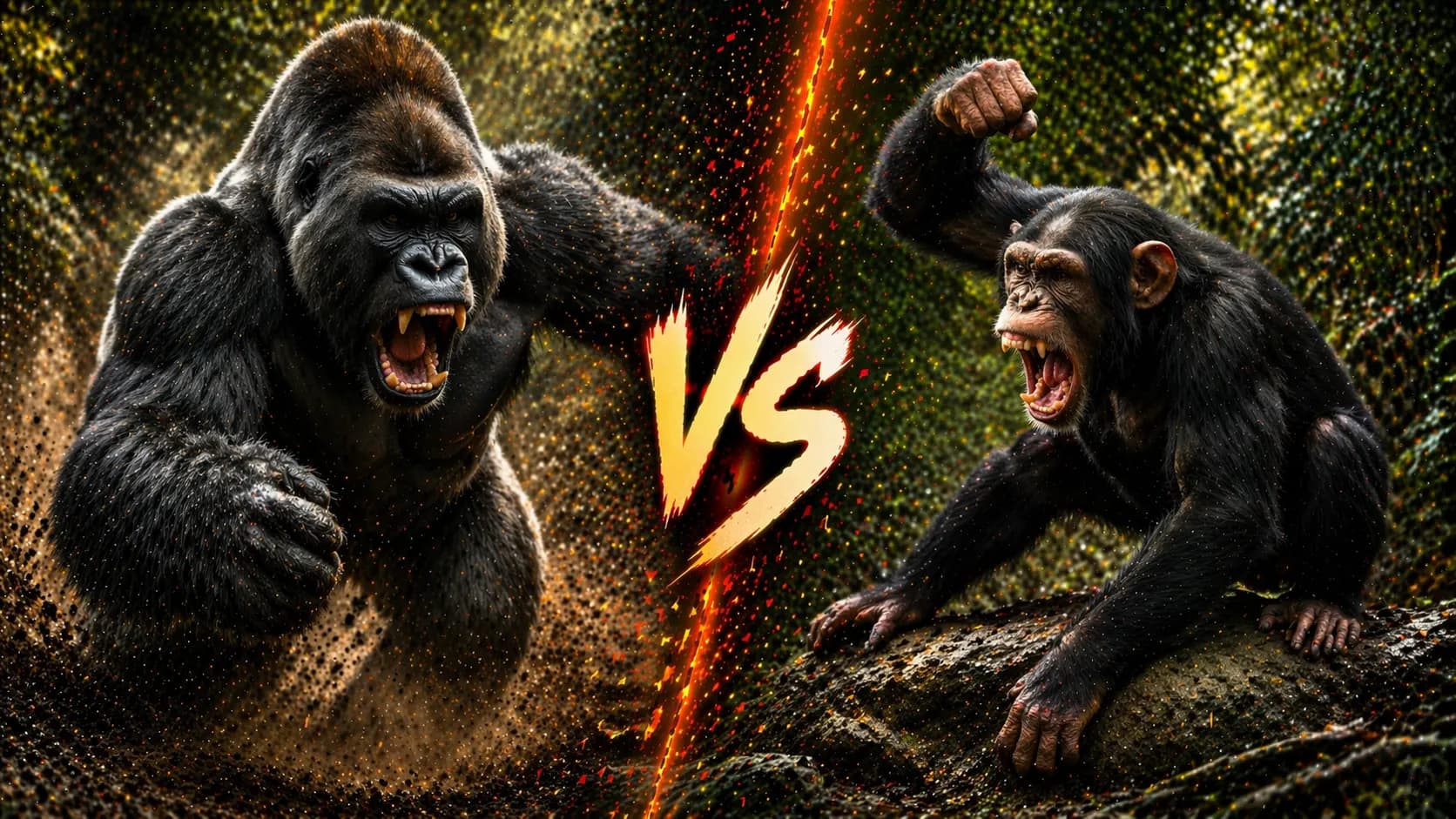
Gorilla vs Chimpanzee: Which Primate Is Stronger?
A grounded gorilla vs chimpanzee comparison focused on strength, body design, aggression, and why a smaller ape can still stay dangerous.
Meet the animals in this matchup
Go straight to the species guides behind this comparison for identification, habitat, rarity, and deeper AnimalDex context.
Quick verdict
Start with the direct answer, then use the structured comparison below to see what changes the outcome.
Gorilla is the stronger overall answer by a wide margin. Chimpanzee stays dangerous through speed, social aggression, and unpredictability, but it does not match gorilla scale.
This is best handled as a strength page, not fantasy combat hype. Gorilla is simply the larger and more powerful ape.
Why this matchup is interesting
The query is common because both are famous great apes, but the body-size gap is much larger than many readers assume.
Head-to-head species stats
These are the same core AnimalDex stat dimensions used on the dedicated animal pages, pulled side by side so the matchup is faster to scan.
Gorilla
Stats source: Canonical species profile
Chimpanzee
Stats source: Canonical species profile
Trait-by-trait comparison
Only the categories that matter to this matchup are included. The goal is not filler stats, but the real design differences that change the result.
Size and power
Gorilla
Largest living ape with immense upper-body force
Chimpanzee
Smaller but still very strong and explosive
Why it matters
Gorilla owns the scale question.
Speed and volatility
Gorilla
Power-first primate
Chimpanzee
Quicker, more abrupt, and more socially aggressive
Why it matters
Chimpanzee stays dangerous because it is fast and intense, not because it is bigger.
Direct contact
Gorilla
More body behind every collision
Chimpanzee
Less mass to carry through contact
Why it matters
In heavy contact, gorilla's size dominates.
Scenario breakdown
This is where shallow battle content usually fails. Terrain, spacing, timing, and engagement style can change the answer.
Pure strength question
Gorilla clearly
This is the least ambiguous scenario on the page.
Fast chaotic contact
Still gorilla
Chimpanzee can make things volatile, but not enough to erase the power gap.
Group social pressure
Chimpanzee side improves
Chimpanzees become more complicated when the page stops being one ape versus one ape.
Explore these animals
Use the full species pages to go deeper on biology, habitat fit, and the real traits behind this verdict.
Gorilla
Gorillas are the largest living primates, built around immense upper-body strength, social family groups, and forest-based foraging rather than predatory violence.
Read species guideChimpanzee
The chimpanzee is an intelligent African ape famous for tool use, social politics, and expressive communication.
Read species guideSystems Intelligence & Hidden Purpose
See the animals behind this comparison as engineered biological systems: what each one is built to do, where it gains leverage, and why the matchup changes by scenario.
System Role
The Forest Power Diplomat
Gorilla
Specialized Hardware
Massive upper-body strength, dexterous hands, social signaling, and plant-processing gut design make gorillas authority hardware for dense forest life without a predator's operating model.
Systems Script
Gorillas move seeds, prune vegetation, open travel routes, and stabilize social groups in forest systems where communication and memory matter. Their influence comes less from killing power and more from how a large intelligent herbivore uses space.
Strategic Insight
Strength is most stable when it does not need to prove itself constantly. The best-positioned systems often lead by clarity, not by endless escalation.
System Role
The Tool-Learning Social Engine
Chimpanzee
Specialized Hardware
Long arms and flexible hands, dark hair with bare face and ears, and moves by climbing, knuckle-walking, and short bipedal steps give the Chimpanzee a body plan tuned for its niche.
Systems Script
Chimpanzees operate in rainforest, woodland, forest edge, and mixed savannah mosaics. Their design helps them match food access, shelter, and timing inside that environment.
Strategic Insight
A flexible mind becomes even more powerful when knowledge can spread through a whole group.
Final take
Gorilla is the stronger ape. Chimpanzee is better understood as the quicker, more volatile, and more socially aggressive side of the comparison.
Track the species behind this matchup
Use AnimalDex to move from one comparison page into deeper species tracking, field-guide context, and real-animal collecting.
Comparison FAQ
Short, direct answers to the next questions readers usually ask after the headline verdict.
Who is stronger, gorilla or chimpanzee?
Gorilla by a wide margin overall.
Why are chimpanzees still dangerous?
Because they are fast, intense, and socially coordinated even if they are not as large as gorillas.
Related comparisons
Continue with nearby matchups to compare more real-world animal traits without dropping into junky who-wins filler.
Gorilla vs Orangutan: Which Ape Is Stronger?
Gorilla is the stronger overall answer because it brings much more total mass and collision power. Orangutan remains extraordinary in arm strength and climbing control, but it is built for the trees, not for overpowering a gorilla on the ground.
Read comparisonBonobo vs Chimpanzee Intelligence: Which Ape Thinks Better?
Chimpanzee often gets the edge in tool-use intensity and aggressive problem solving, while bonobo is stronger in social regulation, tolerance, and cooperation. The real answer depends on what kind of intelligence the task rewards.
Read comparisonChimpanzee vs Orangutan: Which Ape Has the Better Edge?
Orangutan gets the stronger pure-strength verdict, while chimpanzee gets the faster, more aggressive, and more socially volatile profile.
Read comparisonGorilla vs Crocodile: Which Dangerous Animal Has the Edge?
Gorilla gets the slight overall edge on dry land because the crocodile loses ambush shape and the primate gains mobility and arm-driven force. Crocodile becomes much more dangerous if the fight starts at the waterline with the first clamp already happening.
Read comparison