

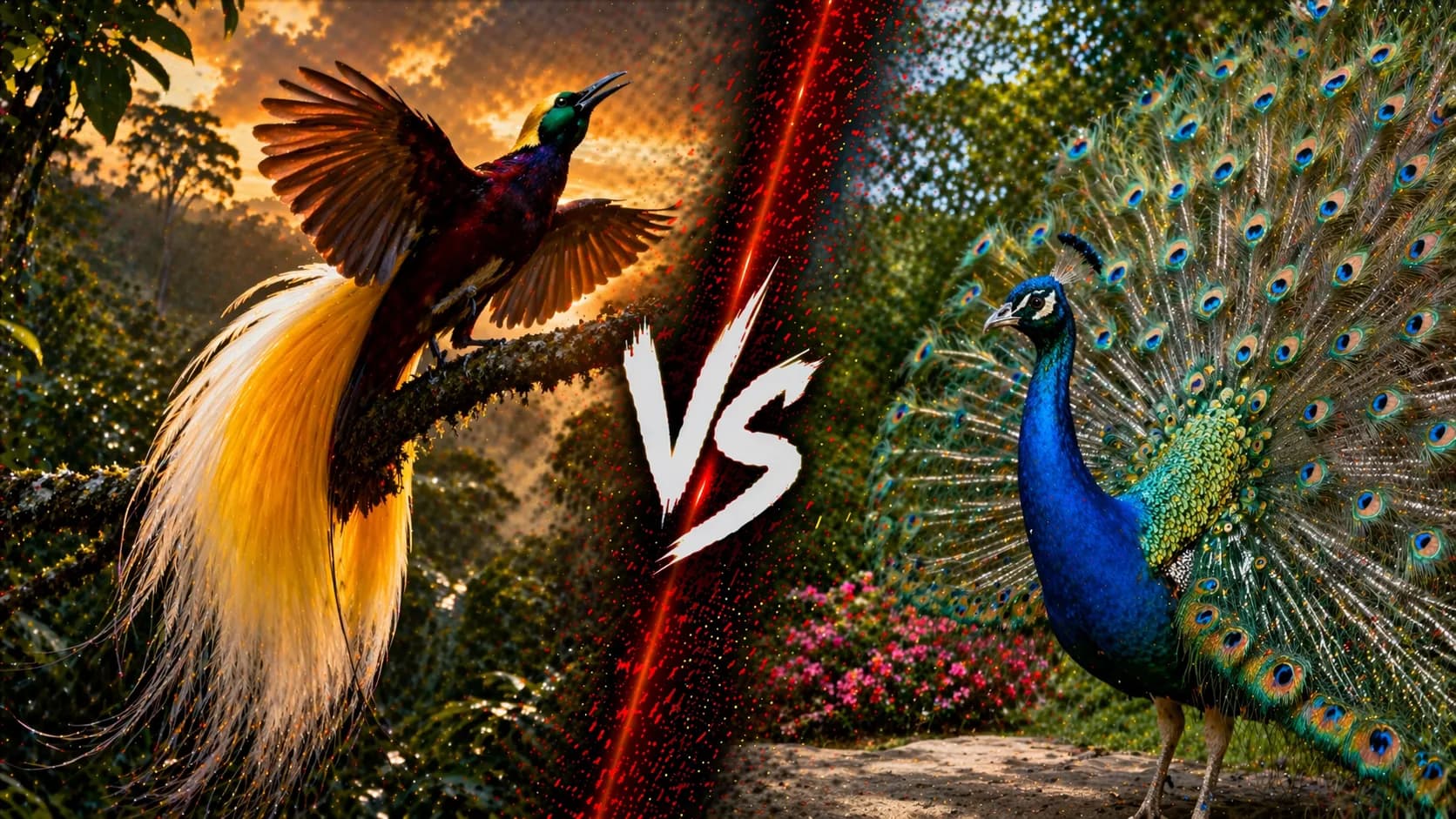
Greater Bird-of-Paradise vs Indian Peafowl: Which Display Bird Is More Agile?
A greater bird-of-paradise vs Indian peafowl agility comparison covering display movement, perch control, body weight, and how ornament changes maneuverability.
Meet the animals in this matchup
Go straight to the species guides behind this comparison for identification, habitat, rarity, and deeper AnimalDex context.
Quick verdict
Start with the direct answer, then use the structured comparison below to see what changes the outcome.
Greater bird-of-paradise usually has the agility edge because it stays lighter, more arboreal, and more maneuverable through display space. Indian peafowl carries more size and ground-based presence than fine aerial or branch agility.
Both birds are famous for display, but they display through different movement environments. Bird-of-paradise is more arboreal and maneuver-focused. Peafowl is heavier and more ground-oriented.
Why this matchup is interesting
It is a good example of how ornament does not erase physics. Display birds still have to move through real space, and lighter arboreal bodies usually handle that better.
Head-to-head species stats
These are the same core AnimalDex stat dimensions used on the dedicated animal pages, pulled side by side so the matchup is faster to scan.
Greater Bird-of-paradise
Stats source: Canonical species profile
Indian Peafowl
Stats source: Canonical species profile
Trait-by-trait comparison
Only the categories that matter to this matchup are included. The goal is not filler stats, but the real design differences that change the result.
Arboreal control
Greater Bird-of-paradise
Lighter branch-based display movement
Indian Peafowl
Less arboreal and more weight-bound
Why it matters
Bird-of-paradise owns the branch and perch agility question.
Ground presence
Greater Bird-of-paradise
Less built for heavy ground display
Indian Peafowl
Strong visual presence on the ground
Why it matters
Peafowl wins presence, but not necessarily agility.
Movement cost of ornament
Greater Bird-of-paradise
Better overall control despite display burden
Indian Peafowl
Greater bulk and drag in movement
Why it matters
The lighter bird handles ornamental movement more efficiently.
Scenario breakdown
This is where shallow battle content usually fails. Terrain, spacing, timing, and engagement style can change the answer.
Branch display
Bird-of-paradise edge
This is the exact movement problem the species is better built to solve.
Open ground display
Peafowl presence edge
Ground display favors the bird with the larger visual footprint.
Pure agility question
Bird-of-paradise stronger
When the category is actual maneuverability, the lighter arboreal bird gets the cleaner answer.
Explore these animals
Use the full species pages to go deeper on biology, habitat fit, and the real traits behind this verdict.
Greater Bird-of-paradise
The greater bird-of-paradise is a New Guinea display bird known for ornamental flank plumes, lek behavior, and strong ties to mature forest canopy.
Read species guideIndian Peafowl
The Indian peafowl is a large pheasant known for shimmering plumage, loud calls, and elaborate train displays in open woodland and human-modified landscapes.
Read species guideSystems Intelligence & Hidden Purpose
See the animals behind this comparison as engineered biological systems: what each one is built to do, where it gains leverage, and why the matchup changes by scenario.
System Role
The Display-Driven Recruiter
Greater Bird-of-paradise
Specialized Hardware
Elaborate flank plumes, strong canopy mobility, and behavior tuned for repeated performance make this bird a signaling system built for mate selection pressure.
Systems Script
Birds-of-paradise shift reproductive competition into visible display arenas that concentrate attention and choice. They show how sexual selection can become a structural force in its own right.
Strategic Insight
A strong signal only matters if the audience can evaluate it clearly. Design for legibility, not just spectacle.
System Role
The Display-Weighted Forager
Indian Peafowl
Specialized Hardware
Ground-running legs, omnivorous feeding hardware, and visually extravagant male trains make peafowl a blend of practical forager and display machine.
Systems Script
Peafowl connect insect control, seed use, and visual signaling in human-adjacent landscapes. They prove that showmanship can coexist with very practical resource use.
Strategic Insight
A system can carry a costly display only if the operational core still works.
Final take
Indian peafowl wins spectacle and ground presence. Greater bird-of-paradise wins the more honest agility question.
Track the species behind this matchup
Use AnimalDex to move from one comparison page into deeper species tracking, field-guide context, and real-animal collecting.
Comparison FAQ
Short, direct answers to the next questions readers usually ask after the headline verdict.
Which is more agile, bird-of-paradise or peacock?
The greater bird-of-paradise usually gets the agility edge because it is lighter and more arboreal.
Why does the peafowl still matter in the comparison?
Because it carries more display mass and presence, even if that does not make it the more agile bird.
Related comparisons
Continue with nearby matchups to compare more real-world animal traits without dropping into junky who-wins filler.
Ruby-Throated Hummingbird vs Rainbow Bee-Eater: Which Bird Is More Agile?
Hummingbird wins the pure agility question because hovering, reverse flight, and tiny-space control are its entire design brief. Bee-eater is still the better fast intercept bird over slightly broader feeding airspace.
Read comparisonAfrican Wild Dog vs Hyena: Which Hunter Has the Edge?
Spotted hyena gets the edge in direct physical conflict because it is tougher and more built for brutal contact. African wild dog stays exceptional in pure pack-hunt coordination and endurance pursuit.
Read comparisonAlligator Snapping Turtle vs Polar Bear: Which Animal Has the Edge?
Polar bear gets the overwhelming overall edge through sheer mass, strength, and the ability to dominate most contact scenarios. Alligator snapping turtle stays dangerous only in a narrow front-facing water-side bite window where its jaws can punish a mistake.
Read comparisonBald Eagle vs Crowned Eagle: Which Eagle Has the Better Edge?
Bald eagle gets the broader size and open-space verdict, while crowned eagle becomes far more dangerous in forested ambush contexts where explosive attack on agile prey matters more.
Read comparison