

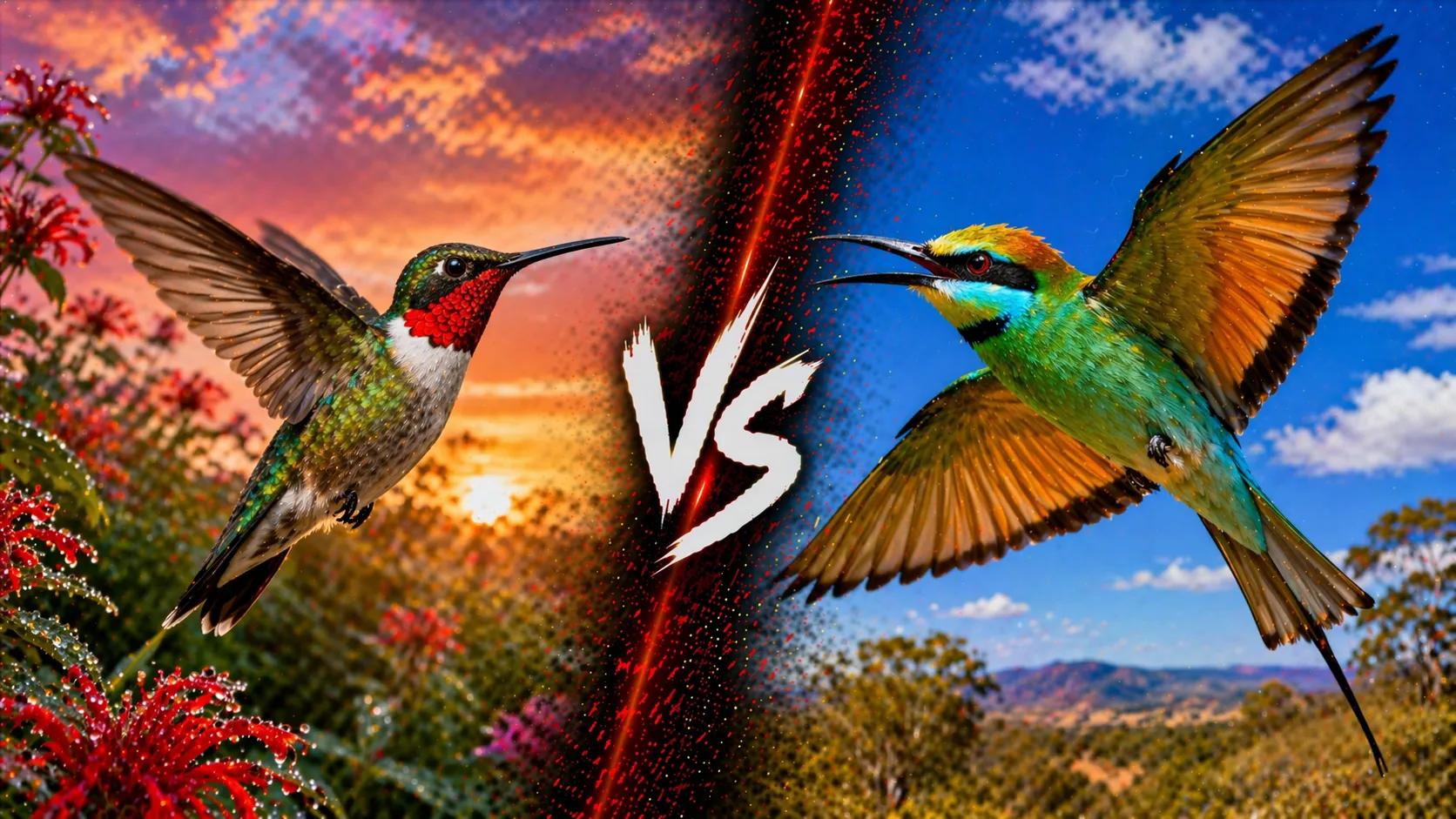
Ruby-Throated Hummingbird vs Rainbow Bee-Eater: Which Bird Is More Agile?
A ruby-throated hummingbird vs rainbow bee-eater agility comparison covering hovering, tight turning, flight reversals, and prey-focused maneuvering.
Ruby-throated Hummingbird vs Rainbow Bee-eater
Matchup winner
Ruby-throated Hummingbird
Quick verdict
Start with the direct answer, then use the structured comparison below to see what changes the outcome.
Hummingbird wins the pure agility question because hovering, reverse flight, and tiny-space control are its entire design brief. Bee-eater is still the better fast intercept bird over slightly broader feeding airspace.
Read the full explanation
Agility is not the same as speed. The hummingbird owns smaller-space control. The bee-eater owns a more pursuit-oriented aerial lane.
Reader vote
Who do you think wins?
Pick a side — no account needed. Results update live.
No votes yet — be the first to call it.
Editorial note
Why people disagree
It is a good category discipline page: one bird is built for hovering precision, the other for insect interception on the wing.
Hover control
This single category almost decides the pure agility question.
Fast aerial intercept
Bee-eater stays dangerous when the agility task includes active pursuit.
Tight-space maneuvering
Hummingbird owns the smaller movement grid.
Comparison FAQ
Short, direct answers to the next questions readers usually ask after the headline verdict.
Is a hummingbird more agile than a bee-eater?+
Yes in pure maneuverability, because hummingbirds can hover and reverse in ways bee-eaters cannot.
What is the bee-eater better at?+
Fast open-air insect interception over a broader flight lane.
Head-to-head species stats
These are the same core AnimalDex stat dimensions used on the dedicated animal pages, pulled side by side so the matchup is faster to scan.
Ruby-throated Hummingbird
Tier DRainbow Bee-eater
Tier DTrait-by-trait comparison
Only the categories that matter to this matchup are included. The goal is not filler stats, but the real design differences that change the result.
Elite hover and reverse-flight ability
Hover control
Ruby-throated Hummingbird
Not built for true hovering precision
Hover control
Ruby-throated Hummingbird
Excellent in tiny space
Fast aerial intercept
Rainbow Bee-eater
Better at larger-airspace prey capture
Fast aerial intercept
Rainbow Bee-eater
Much sharper control in tiny windows
Tight-space maneuvering
Ruby-throated Hummingbird
Needs more room for its best rhythm
Tight-space maneuvering
Ruby-throated Hummingbird
How the verdict forms
Verdict timeline
01 · Hover control
Ruby-throated Hummingbird
02 · Fast aerial intercept
Rainbow Bee-eater
03 · Tight-space maneuvering
Ruby-throated Hummingbird
Change the conditions
Scenario breakdown
This is where shallow battle content usually fails. Terrain, spacing, timing, and engagement style can change the answer.
Scenario lean
Ruby-throated Hummingbird
Verdict confidence
82%
Hummingbird edge
The tiny hover zone is exactly where hummingbird agility becomes obvious.
AnimalDex field profiles
Explore these animals
Ruby-throated Hummingbird
Archilochus colubris
Woodland edge, gardens, meadows, and forest openings with reliable flowering plants.
Rainbow Bee-eater
Merops ornatus
Open woodland, farmland, riverbanks, grassland, and sandy cuttings suitable for burrows.
Systems Intelligence & Hidden Purpose
See the animals behind this comparison as engineered biological systems: what each one is built to do, where it gains leverage, and why the matchup changes by scenario.
Specialized Hardware
Rapid wingbeats, a needle bill, and a metabolism built for constant refueling make hummingbirds micro-scale energy extraction hardware.
Systems Script
They tie flower spacing to pollination flow and turn scattered nectar points into a navigable network. Their survival depends on route efficiency more than brute endurance.
Strategic Insight
When margins are thin, optimize the route. Tiny inefficiencies become existential at high burn rates.
Specialized Hardware
Fine flight control, long bill, and prey-handling precision make bee-eaters specialized hardware for catching and disarming flying insects.
Systems Script
Bee-eaters reduce aerial insect abundance while converting open sky and sandy nest banks into a tightly linked feeding-breeding system. They make niche precision look easy.
Strategic Insight
Specialization pays when the handling protocol is as important as the catch.
Final take
If the page asks which bird is more agile in the strict sense, the hummingbird wins. If the page asks which bird is better at agile prey pursuit over open air, the bee-eater closes the gap.
Track the species behind this matchup
Use AnimalDex to move from one comparison page into deeper species tracking, field-guide context, and real-animal collecting.
Discussion
What do you think?
Share your reasoning with other readers. Be civil and stick to the animals.
Sign in to join the discussion.
Sign inNo comments yet. Start the conversation.