

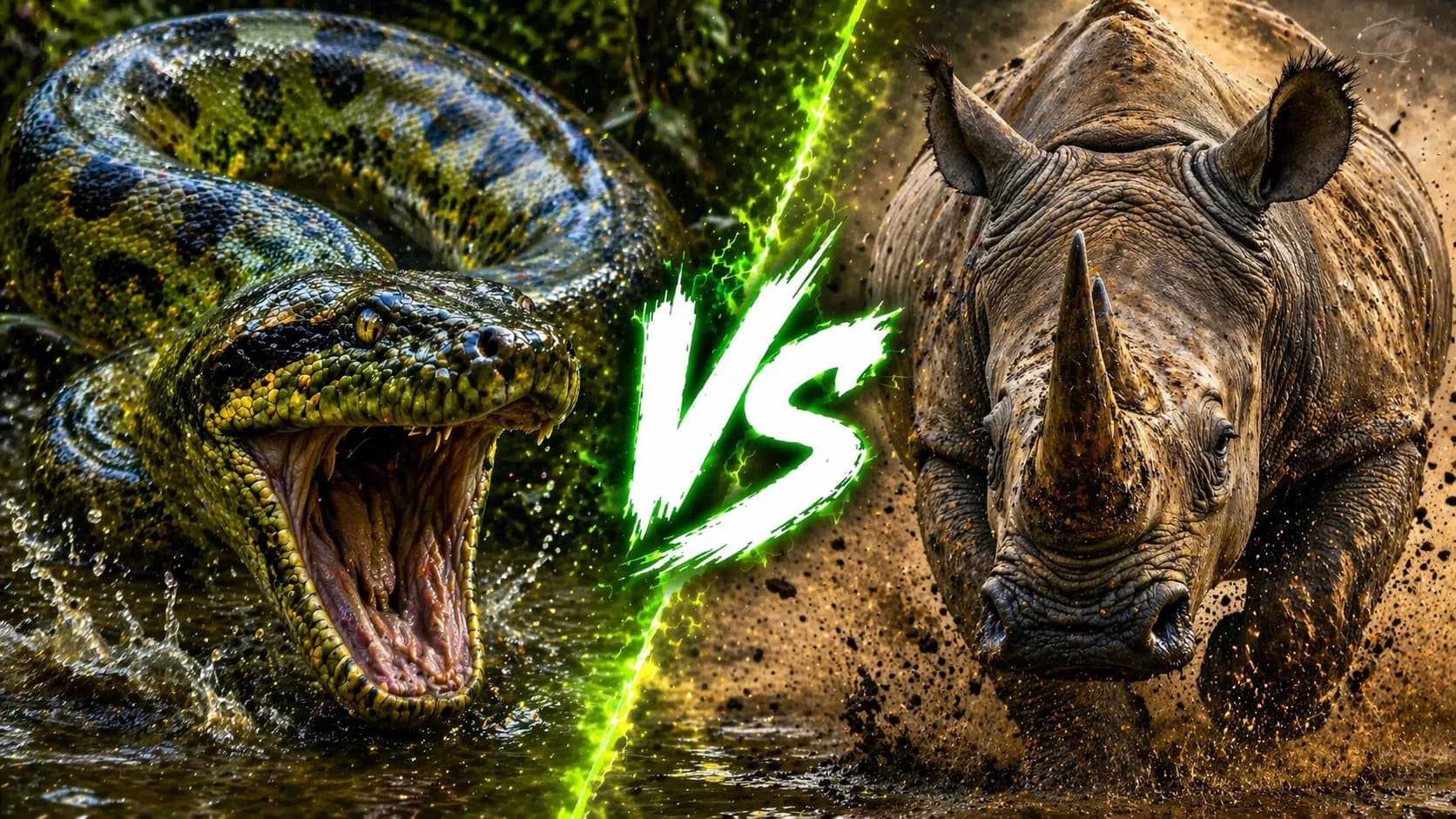
Green Anaconda vs Rhino: Which Dangerous Animal Has the Edge?
A grounded green anaconda vs rhino comparison covering constriction geometry, mass, and whether the snake can realistically solve an enormous horned body.
Meet the animals in this matchup
Go straight to the species guides behind this comparison for identification, habitat, rarity, and deeper AnimalDex context.
Quick verdict
Start with the direct answer, then use the structured comparison below to see what changes the outcome.
White rhinoceros gets the overwhelming overall edge because the size, thickness, and forward-driving mass are too much for the anaconda to manage in any broad realistic matchup. The snake only becomes relevant through a highly specific positional miracle.
Anaconda needs a fantasy-perfect wrap. Rhino only needs to stay a rhino.
Why this matchup is interesting
It is a useful page because it tests the outer limit of constriction hype against megafauna reality.
Head-to-head species stats
These are the same core AnimalDex stat dimensions used on the dedicated animal pages, pulled side by side so the matchup is faster to scan.
Green Anaconda
Stats source: Canonical species profile
White Rhinoceros
Stats source: Canonical species profile
Trait-by-trait comparison
Only the categories that matter to this matchup are included. The goal is not filler stats, but the real design differences that change the result.
Mass and leverage
Green Anaconda
Huge snake, but not megafauna scale
White Rhinoceros
Massive armored grazer with brutal forward pressure
Why it matters
The body mismatch is extreme.
Positional dependence
Green Anaconda
Needs exact body placement first
White Rhinoceros
Can ruin that geometry through sheer motion and size
Why it matters
The snake's win condition is almost too narrow.
Contact danger
Green Anaconda
Can still be dangerous in tight wrap-friendly space
White Rhinoceros
Terrible to be under once the fight becomes a shove and lane problem
Why it matters
The rhino side remains much more stable.
Scenario breakdown
This is where shallow battle content usually fails. Terrain, spacing, timing, and engagement style can change the answer.
Ideal wrap
Anaconda gets its only lane
The snake needs the exact geometry before the rhino can express size.
Open ground
Rhino clearly
This is completely wrong for the constrictor.
Broad matchup
Rhino overall
The megafauna body wins by a huge margin.
Explore these animals
Use the full species pages to go deeper on biology, habitat fit, and the real traits behind this verdict.
Green Anaconda
The green anaconda is a giant semi-aquatic constrictor built for ambush from dark water, with heavy body mass and cryptic olive coloration.
Read species guideWhite Rhinoceros
White rhinoceroses are massive square-lipped grazers built for bulk feeding, territorial presence, and short explosive charges across open African grassland systems.
Read species guideSystems Intelligence & Hidden Purpose
See the animals behind this comparison as engineered biological systems: what each one is built to do, where it gains leverage, and why the matchup changes by scenario.
System Role
The Swamp Coil Anchor
Green Anaconda
Specialized Hardware
Heavy aquatic body mass, low-profile head placement, and constriction strength make anacondas ambush hardware for slow dark wetlands.
Systems Script
Anacondas own the murky zone where visibility collapses and surface confidence gets punished. They keep wetland prey from treating shallow cover as safety by default.
Strategic Insight
If the environment hides you for free, let the environment subsidize your advantage.
System Role
The Grassland Mass-Throughput Grazer
White Rhinoceros
Specialized Hardware
Square grazing lip, heavy neck support, thick skin, and horn-forward charge mechanics make white rhinoceroses bulk-feeding hardware built for open ground.
Systems Script
White rhinoceroses convert large grass volumes into megaherbivore pressure across savannah systems. They reshape short-grass structure, path use, and wallow zones while forcing the landscape to make room for body scale.
Strategic Insight
Scale is powerful when it is paired with a simple repeatable operating loop. Do the basic high-value action well enough, and the whole environment starts bending around it.
Final take
Green anaconda stays interesting only as a position-first specialist. White rhinoceros still gets the overwhelming answer because the total size and lane problem are simply too large.
Collect both animals in AnimalDex
Track the species behind this matchup, compare their real traits, and build the rivalry into your AnimalDex collection.
Comparison FAQ
Short, direct answers to the next questions readers usually ask after the headline verdict.
Who wins, green anaconda or white rhinoceros?
White rhinoceros gets the overwhelming overall edge because the size, thickness, and forward-driving mass are too much for the anaconda to manage in any broad realistic matchup. The snake only becomes relevant through a highly specific positional miracle.
Why does this matchup stay interesting?
Green anaconda stays interesting only as a position-first specialist. White rhinoceros still gets the overwhelming answer because the total size and lane problem are simply too large.
Related comparisons
Continue with nearby matchups to compare more real-world animal traits without dropping into junky who-wins filler.
Tiger vs Rhino: Which Heavy Animal Has the Edge?
White rhinoceros gets the overwhelming overall edge because the mass and horn-forward pressure are too much for a tiger in any clean clash. Tiger only improves if the question is reduced to a perfect opportunistic attack on a vulnerable angle.
Read comparisonElephant vs Rhino: Who Has the Real Edge?
Elephant usually has the overall edge through greater size, reach, and control of space. A rhino still remains dangerous because its charge is compact, forceful, and built for brutal short-range disruption.
Read comparisonGreen Anaconda vs Crocodile: Which Reptile Has the Edge?
Crocodile gets the safer overall edge because armor, bite, and water ambush control make it the more complete direct predator. Green anaconda remains dangerous in tight aquatic contact where its body can wrap before the crocodile gets full leverage.
Read comparisonGreen Anaconda vs Jaguar: Which Amazon Predator Has the Edge?
Jaguar gets the overall edge because it is more complete on land and carries a crushing close-range finish. Green anaconda becomes much more dangerous in water-heavy surprise contact where constriction and body control can start first.
Read comparison