

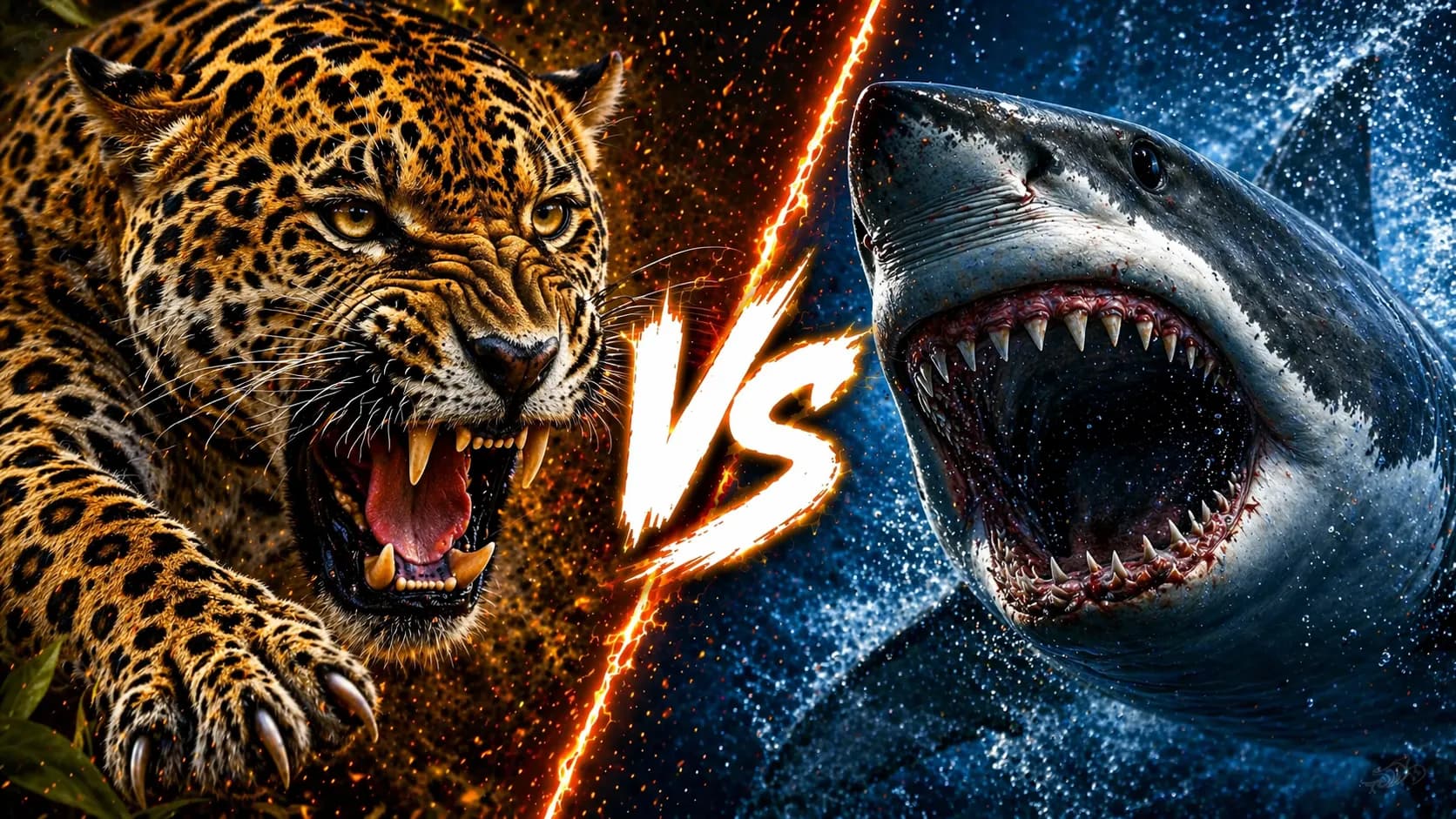
Jaguar vs Bull Shark: Which Predator Has the Edge?
A grounded jaguar vs bull shark comparison covering shoreline geometry, bite danger, and why both animals become much better at the exact boundary between land and water.
Meet the animals in this matchup
Go straight to the species guides behind this comparison for identification, habitat, rarity, and deeper AnimalDex context.
Quick verdict
Start with the direct answer, then use the structured comparison below to see what changes the outcome.
Bull shark gets the slight overall edge in true water through stronger aquatic authority. Jaguar improves sharply at the shoreline where explosive land-linked attack mechanics can break the shark's cleaner movement profile.
Bull shark wants water. Jaguar wants the edge where water stops being enough.
Why this matchup is interesting
It compares two predators that both gain leverage near murky boundaries but through very different mechanics.
Head-to-head species stats
These are the same core AnimalDex stat dimensions used on the dedicated animal pages, pulled side by side so the matchup is faster to scan.
Jaguar
Stats source: Canonical species profile
Bull Shark
Stats source: Canonical species profile
Trait-by-trait comparison
Only the categories that matter to this matchup are included. The goal is not filler stats, but the real design differences that change the result.
Water authority
Jaguar
Can enter water but is not a true aquatic specialist
Bull Shark
Built for aggressive movement and bite delivery in water
Why it matters
The shark side strengthens as soon as the arena stays aquatic.
Edge attack quality
Jaguar
Excellent explosive power from mixed terrain
Bull Shark
Less comfortable once movement channels narrow
Why it matters
The shoreline is where jaguar becomes most credible.
Environmental dependence
Jaguar
Needs the fight to stay mixed
Bull Shark
Needs the fight to stay fluid and wet
Why it matters
This page only works when the arena is specified.
Scenario breakdown
This is where shallow battle content usually fails. Terrain, spacing, timing, and engagement style can change the answer.
Open water
Bull shark edge
The shark gets the cleaner attack map.
Shoreline lunge
Jaguar improves
The cat matters much more when land still contributes to the attack.
Broad matchup
Bull shark slight overall edge
The total water authority keeps the shark ahead.
Explore these animals
Use the full species pages to go deeper on biology, habitat fit, and the real traits behind this verdict.
Jaguar
Jaguar is a mammal known for heavy rosette-marked body, crushing bite strength, and river-and-forest ambush movement.
Read species guideBull Shark
Bull Shark is a fish known for thick heavy body, salt-and-freshwater tolerance, and close-range power.
Read species guideSystems Intelligence & Hidden Purpose
See the animals behind this comparison as engineered biological systems: what each one is built to do, where it gains leverage, and why the matchup changes by scenario.
System Role
The Heavy Rosette River Cat
Jaguar
Specialized Hardware
heavy rosette-marked body, crushing bite strength, and river-and-forest ambush movement give the Jaguar a body plan tuned for its niche.
Systems Script
Jaguars operate through rainforest, wetland, and dense river corridor habitat. Their design links movement, feeding, shelter, and timing into one workable survival system.
Strategic Insight
Dense environments reward precision, patience, and the ability to read layered cover.
System Role
The Water-Boundary Predator
Bull Shark
Specialized Hardware
thick heavy body, salt-and-freshwater tolerance, and close-range power give the Bull Shark a body plan tuned for its niche.
Systems Script
Bull Sharks operate through coast, estuary, river mouth, and lower river systems Their design links movement, shelter, feeding, and survival into one workable system.
Strategic Insight
A system that crosses boundaries can unlock territory others cannot use.
Final take
Jaguar is more dangerous than most people expect at mixed terrain. Bull shark still gets the slight total nod because the broader water question belongs to the shark.
Collect both animals in AnimalDex
Track the species behind this matchup, compare their real traits, and build the rivalry into your AnimalDex collection.
Comparison FAQ
Short, direct answers to the next questions readers usually ask after the headline verdict.
Who wins, jaguar or bull shark?
Bull shark gets the slight overall edge in true water through stronger aquatic authority. Jaguar improves sharply at the shoreline where explosive land-linked attack mechanics can break the shark's cleaner movement profile.
Why does this matchup stay interesting?
Jaguar is more dangerous than most people expect at mixed terrain. Bull shark still gets the slight total nod because the broader water question belongs to the shark.
Related comparisons
Continue with nearby matchups to compare more real-world animal traits without dropping into junky who-wins filler.
Crocodile vs Shark: Who Wins Where Water Meets Shore?
Great white shark has the edge in open ocean. Crocodile becomes more dangerous the closer the matchup gets to shallow water, shoreline bottlenecks, and ambush-heavy edge habitat.
Read comparisonJaguar vs Green Anaconda: Which Predator Has the Edge?
Jaguar gets the slight overall edge because it carries the cleaner direct-kill mechanics on land or partial land. Green anaconda becomes much more dangerous in water or tight body-control positions where constriction can start before the cat gets a clean bite.
Read comparisonBull Shark vs Alligator Snapping Turtle: Which Water Hunter Has the Edge?
Bull shark gets the overall edge through movement, size, and broader aquatic control. Alligator snapping turtle remains dangerous only in a narrow front-end bite trap where the shark enters the wrong angle in confined water.
Read comparisonGorilla vs Jaguar: Which Powerful Animal Has the Edge?
Gorilla gets the slight overall edge in a face-up clash through size and blunt-force power. Jaguar remains fully dangerous because it may be the better ambush starter and carries one of the nastiest bite profiles in the dataset.
Read comparison