

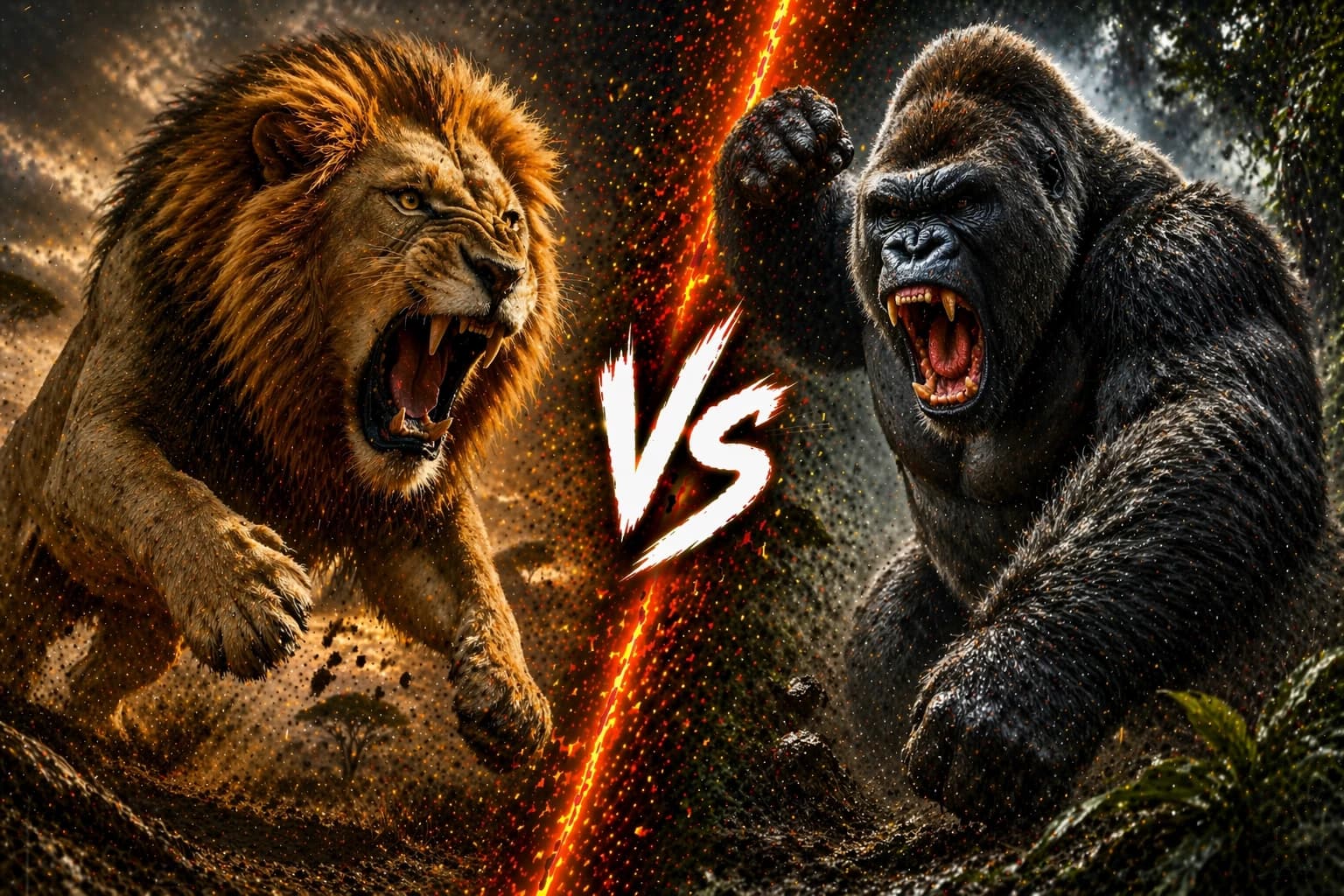
Meet the animals in this matchup
Go straight to the species guides behind this comparison for identification, habitat, rarity, and deeper AnimalDex context.
Quick verdict
Start with the direct answer, then use the structured comparison below to see what changes the outcome.
Lion is the stronger overall fight answer because it is a dedicated large-prey predator. Gorilla has huge strength, but it is not built around finishing predator-level combat under pressure.
This matchup attracts attention because gorilla looks overwhelmingly strong. The missing piece is operating model: lion is built for violent killing mechanics, while gorilla is built for social authority and forest life.
Why this matchup is interesting
It is one of the best examples of why raw strength and true combat advantage are not identical.
Head-to-head species stats
These are the same core AnimalDex stat dimensions used on the dedicated animal pages, pulled side by side so the matchup is faster to scan.
Lion
Stats source: Canonical species profile
Gorilla
Stats source: Canonical species profile
Trait-by-trait comparison
Only the categories that matter to this matchup are included. The goal is not filler stats, but the real design differences that change the result.
Predatory hardware
Lion
Claws, bite, and finishing mechanics built for killing prey
Gorilla
Massive strength, but not a predator design
Why it matters
Lion brings the more relevant equipment for a committed fight.
Body strength
Lion
High grappling and forequarter power
Gorilla
Exceptional upper-body force
Why it matters
Gorilla strength is real, but it is only one layer of the outcome.
Decision model
Lion
Built to close and finish
Gorilla
Built to warn, display, and avoid useless damage
Why it matters
Lion is more structurally committed to the kind of violence this page asks about.
Scenario breakdown
This is where shallow battle content usually fails. Terrain, spacing, timing, and engagement style can change the answer.
Clean predator approach
Lion edge
A clean entry rewards the predator's finishing system.
Front-on awareness
More chaotic
Awareness and posture give the gorilla more chance to make the exchange ugly.
Dense forest chaos
Still not simple
Clutter reduces clean access, but it does not turn the gorilla into a predator.
Explore these animals
Use the full species pages to go deeper on biology, habitat fit, and the real traits behind this verdict.
Lion
Lions are social big cats recognized for pride living, coordinated hunts, and heavy-bodied strength on open African landscapes and a small remnant Asian range.
Read species guideGorilla
Gorillas are the largest living primates, built around immense upper-body strength, social family groups, and forest-based foraging rather than predatory violence.
Read species guideSystems Intelligence & Hidden Purpose
See the animals behind this comparison as engineered biological systems: what each one is built to do, where it gains leverage, and why the matchup changes by scenario.
System Role
The Pride-Based Pressure Broker
Lion
Specialized Hardware
Heavy forequarters, social coordination, strong jaws, and low-light hunting ability turn lions into open-country control hardware built for decisive close-range force.
Systems Script
Lions regulate herd behavior and prey distribution across grassland systems. Their influence is partly in the kill and partly in the fear patterns that reshape where herbivores linger.
Strategic Insight
Shared force works best when roles are clear. Good teams do not all do the same thing at once.
System Role
The Forest Power Diplomat
Gorilla
Specialized Hardware
Massive upper-body strength, dexterous hands, social signaling, and plant-processing gut design make gorillas authority hardware for dense forest life without a predator's operating model.
Systems Script
Gorillas move seeds, prune vegetation, open travel routes, and stabilize social groups in forest systems where communication and memory matter. Their influence comes less from killing power and more from how a large intelligent herbivore uses space.
Strategic Insight
Strength is most stable when it does not need to prove itself constantly. The best-positioned systems often lead by clarity, not by endless escalation.
Final take
Lion is the better real-fight answer. Gorilla remains massively strong, but this is another page where predator hardware beats abstract power.
Collect both animals in AnimalDex
Track the species behind this matchup, compare their real traits, and build the rivalry into your AnimalDex collection.
Comparison FAQ
Short, direct answers to the next questions readers usually ask after the headline verdict.
Who wins, lion or gorilla?
Lion usually gets the edge because it is built for predatory finishing rather than just raw body strength.
Is a gorilla stronger than a lion?
In some pure strength dimensions, yes. In an actual fight, lion still has the more relevant combat design.
Related comparisons
Continue with nearby matchups to compare more real-world animal traits without dropping into junky who-wins filler.
Gorilla vs Tiger: Who Actually Has the Edge?
Tiger usually has the edge because it is a true apex ambush predator built for finishing violent encounters. Gorilla is enormously strong, but its body and behavior are not specialized for predator-style combat in the same way.
Read comparisonTiger vs Lion: Who Actually Wins?
In a one-on-one land fight, the tiger usually has the edge. Lions become more dangerous when the matchup stops being a duel and starts rewarding coalition pressure, open-country control, or prolonged group conflict.
Read comparisonGiraffe vs Lion: Can a Giraffe Actually Win?
Adult giraffe is far more dangerous than people assume and can absolutely repel or injure lions. Lion still gets the better overall predation answer once pride pressure, target vulnerability, or repeated attacks enter the story.
Read comparisonGorilla vs Crocodile: Which Dangerous Animal Has the Edge?
Gorilla gets the slight overall edge on dry land because the crocodile loses ambush shape and the primate gains mobility and arm-driven force. Crocodile becomes much more dangerous if the fight starts at the waterline with the first clamp already happening.
Read comparison