

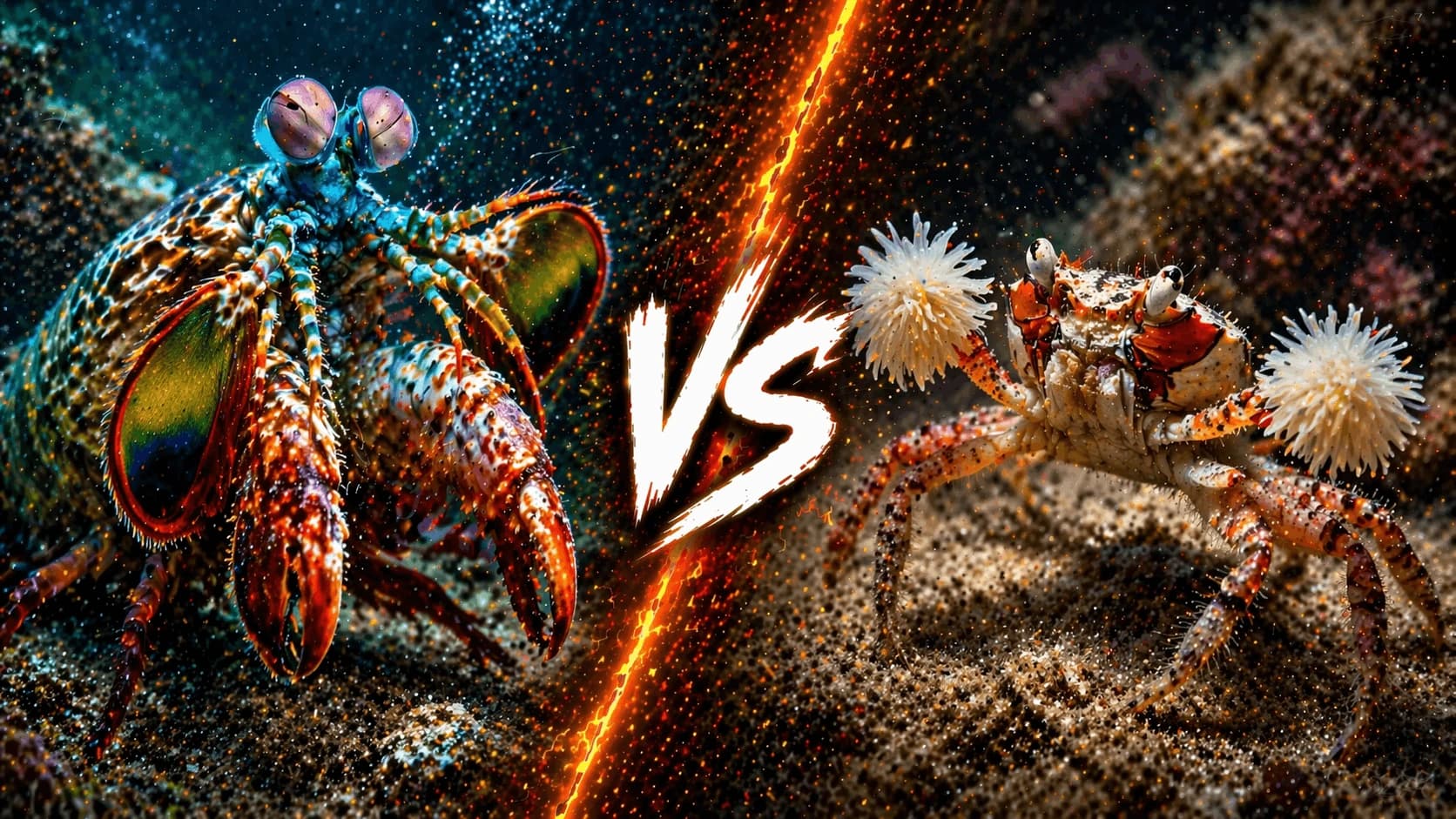
Mantis Shrimp vs Boxer Crab: Which Reef Fighter Has the Better Design?
A reef-scale mantis shrimp vs boxer crab comparison covering strike speed, defensive symbiosis, close-range control, and what happens when tiny specialists meet.
Meet the animals in this matchup
Go straight to the species guides behind this comparison for identification, habitat, rarity, and deeper AnimalDex context.
Quick verdict
Start with the direct answer, then use the structured comparison below to see what changes the outcome.
Mantis shrimp usually has the edge because its strike power and sensory advantage are extreme. Boxer crab stays interesting because its anemone-based defense can still punish careless close contact.
This is a small-animal matchup, but not a trivial one. The mantis shrimp is one of the most overbuilt close-range strike systems on the reef. The boxer crab is smaller and less forceful, but it cheats the usual scale equation by carrying live stinging defenders in its claws.
That means the overall answer is mantis shrimp, but the boxer crab still creates risk in the first contact window if the shrimp misreads the interaction.
Why this matchup is interesting
Mantis shrimp versus boxer crab is exactly the kind of page that makes the comparison system feel premium rather than generic. It compares two genuinely unusual reef designs with very different ideas about winning.
It also works well for AI summaries because the answer is strong, but the mechanism behind it is the interesting part.
Head-to-head species stats
These are the same core AnimalDex stat dimensions used on the dedicated animal pages, pulled side by side so the matchup is faster to scan.
Mantis Shrimp
Stats source: Canonical species profile
Boxer Crab
Stats source: Canonical species profile
Trait-by-trait comparison
Only the categories that matter to this matchup are included. The goal is not filler stats, but the real design differences that change the result.
Strike force
Mantis Shrimp
Extreme spring-loaded strike speed and impact power
Boxer Crab
No comparable raw impact system
Why it matters
The mantis shrimp owns the violence category at this scale.
Active defense
Mantis Shrimp
Armor and speed-based confidence in direct exchange
Boxer Crab
Live anemones provide stinging deterrence in the claws
Why it matters
The boxer crab's defense is unusual because it is outsourced, not built from shell alone.
Sensing and targeting
Mantis Shrimp
Exceptional visual hardware for reading the contact problem
Boxer Crab
More limited sensing compared with the shrimp's extreme visual system
Why it matters
The mantis shrimp is usually better informed before the strike even begins.
Close-contact risk
Mantis Shrimp
Can likely end the fight fast if the first hit lands cleanly
Boxer Crab
Can still make reckless contact painful through the anemone gloves
Why it matters
The boxer crab cannot outpunch the mantis shrimp, but it can still punish bad approach quality.
Scenario breakdown
This is where shallow battle content usually fails. Terrain, spacing, timing, and engagement style can change the answer.
Clean strike lane
Mantis shrimp clearly
If the mantis shrimp gets the contact geometry it wants, the boxer crab has little answer.
Hesitant close contact
Boxer crab improves
This is where the anemone defense matters most: making first contact less comfortable than expected.
Reef-rubble encounter
Depends on strike visibility
Clutter can either hide the shrimp's line or let it launch from perfect cover.
Fully committed attack
Mantis shrimp side
Once the mantis shrimp stops testing and starts hitting, the power gap becomes the main story.
Explore these animals
Use the full species pages to go deeper on biology, habitat fit, and the real traits behind this verdict.
Mantis Shrimp
Mantis shrimp are reef-dwelling crustaceans with extraordinary visual systems and spring-loaded raptorial limbs used for smashing or spearing prey.
Read species guideBoxer Crab
Boxer crabs are small reef crabs famous for carrying tiny sea anemones in their claws, turning borrowed stinging partners into defensive and feeding tools.
Read species guideSystems Intelligence & Hidden Purpose
See the animals behind this comparison as engineered biological systems: what each one is built to do, where it gains leverage, and why the matchup changes by scenario.
System Role
The Ballistic Spectrum Analyst
Mantis Shrimp
Specialized Hardware
Hyper-specialized eyes that detect polarized and complex light, plus spring-loaded raptorial appendages that release extreme acceleration, make mantis shrimp elite sensing-and-strike hardware.
Systems Script
Mantis shrimp pressure reef prey with a combination of signal processing and mechanical violence. They help drive local armor races in shells and exoskeletons while occupying tight, defensible burrow systems.
Strategic Insight
Speed is often designed before it is expressed. Preload the mechanism, then let structure deliver the force.
System Role
The Symbiotic Defense Carrier
Boxer Crab
Specialized Hardware
Tiny crab frame, delicate claws, and live sea-anemone partners turn the boxer crab into mutualist hardware with outsourced stinging defense.
Systems Script
Boxer crabs move through reef rubble as tiny examples of cooperative engineering. Their niche proves that a small system can scale its defense by partnering with another species rather than building everything itself.
Strategic Insight
When internal resources are limited, carry the right ally. A strong partnership can function like extra hardware.
Final take
Mantis shrimp is the stronger overall answer because its strike system is one of the reef's most extreme close-range weapons.
Boxer crab still deserves respect for turning tiny symbiotic defenders into a meaningful deterrent. The honest verdict is mantis shrimp overall, boxer crab only in the cautious first-contact window.
Collect both animals in AnimalDex
Track the species behind this matchup, compare their real traits, and build the rivalry into your AnimalDex collection.
Comparison FAQ
Short, direct answers to the next questions readers usually ask after the headline verdict.
Who wins, mantis shrimp or boxer crab?
Mantis shrimp usually gets the edge because its strike power and visual targeting are much stronger overall.
Why is boxer crab still dangerous?
Because it carries live sea anemones in its claws, which can make careless close contact painful and disruptive.
Is this matchup mostly about size?
Not really. It is more about extreme strike hardware versus clever outsourced defense.
Related comparisons
Continue with nearby matchups to compare more real-world animal traits without dropping into junky who-wins filler.
Octopus vs Crab: Which Sea Fighter Has the Better Edge?
Octopus usually has the edge because intelligence, flexibility, and grip-based control are excellent answers to a crab's shell and claws. Crab still becomes dangerous in tight defensive terrain where armor and pinch range matter more.
Read comparisonDolphin vs Shark Intelligence: Which Marine Hunter Is Smarter?
Dolphin is clearly smarter in flexible cognition, communication, and social coordination. Shark remains an elite sensory hunter, but intelligence and predatory efficiency are not the same thing.
Read comparisonAfrican Wild Dog vs Hyena: Which Hunter Has the Edge?
Spotted hyena gets the edge in direct physical conflict because it is tougher and more built for brutal contact. African wild dog stays exceptional in pure pack-hunt coordination and endurance pursuit.
Read comparisonAlligator Snapping Turtle vs Polar Bear: Which Animal Has the Edge?
Polar bear gets the overwhelming overall edge through sheer mass, strength, and the ability to dominate most contact scenarios. Alligator snapping turtle stays dangerous only in a narrow front-facing water-side bite window where its jaws can punish a mistake.
Read comparison