

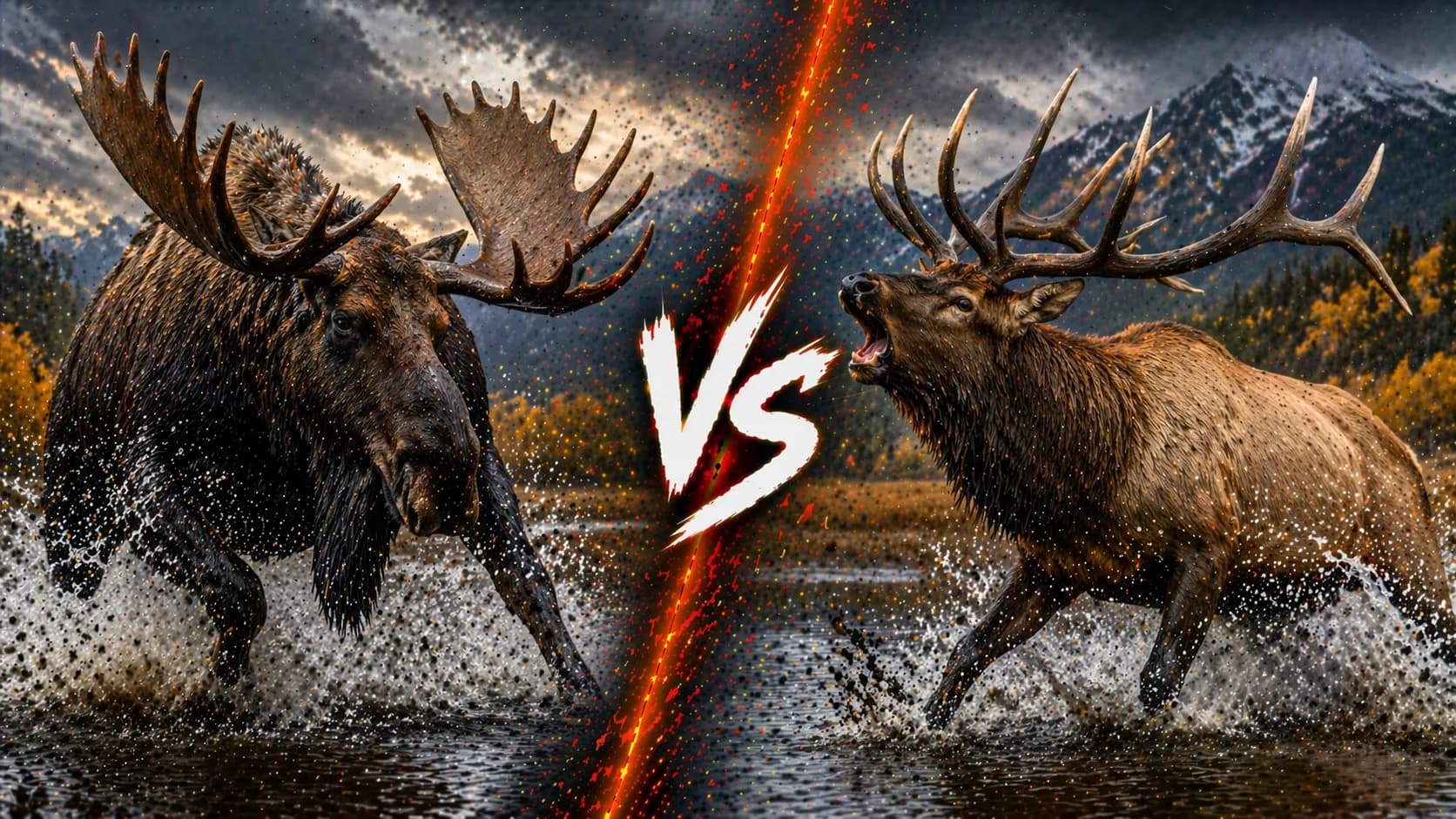
Meet the animals in this matchup
Go straight to the species guides behind this comparison for identification, habitat, rarity, and deeper AnimalDex context.
Quick verdict
Start with the direct answer, then use the structured comparison below to see what changes the outcome.
Moose is the stronger overall answer because it is usually much larger and heavier. Elk stays more agile and more group-oriented, but it does not usually match full moose scale.
This page is best as a strength and size comparison. Moose is the bigger and more imposing cervid. Elk is the more social and mobile herd animal.
Why this matchup is interesting
It is a strong high-intent ungulate page because readers often compare these animals directly when they see antlers and body size.
Head-to-head species stats
These are the same core AnimalDex stat dimensions used on the dedicated animal pages, pulled side by side so the matchup is faster to scan.
Moose
Stats source: Canonical species profile
Elk
Stats source: Canonical species profile
Trait-by-trait comparison
Only the categories that matter to this matchup are included. The goal is not filler stats, but the real design differences that change the result.
Body size
Moose
Heavier and taller at the shoulder
Elk
Large but usually smaller than moose
Why it matters
Moose owns the scale question.
Mobility
Moose
Strong mover but less herd-run oriented
Elk
Better flowing movement in open herd contexts
Why it matters
Elk is the cleaner mover in more open repeated travel.
Heavy contact
Moose
More body behind collisions
Elk
Less total mass in direct heavy contact
Why it matters
If the question becomes brute strength, moose gets the answer.
Scenario breakdown
This is where shallow battle content usually fails. Terrain, spacing, timing, and engagement style can change the answer.
Pure size question
Moose clearly
This is the least ambiguous form of the matchup.
Open herd movement
Elk improves
This rewards the more flowing herd-style animal.
Direct strength comparison
Moose
Mass decides the answer.
Explore these animals
Use the full species pages to go deeper on biology, habitat fit, and the real traits behind this verdict.
Moose
The moose is the largest deer species, known for its long legs, hanging snout, and the giant antlers of adult males.
Read species guideElk
Elk is a mammal known for huge sweeping antlers on males, deep bugling breeding calls, and long-distance herd travel.
Read species guideSystems Intelligence & Hidden Purpose
See the animals behind this comparison as engineered biological systems: what each one is built to do, where it gains leverage, and why the matchup changes by scenario.
System Role
The Wetland Canopy Browser
Moose
Specialized Hardware
Long legs and tall shoulder height, large drooping nose and heavy head, and broad paddle-shaped antlers on adult males give the Moose a body plan tuned for its niche.
Systems Script
Mooses operate in boreal forest, wetlands, willow thickets, and lake edges. Their design helps them match food access, shelter, and timing inside that environment.
Strategic Insight
Height becomes useful when it opens paths and food that smaller bodies cannot reach.
System Role
The Range-Spanning Caller
Elk
Specialized Hardware
huge sweeping antlers on males, deep bugling breeding calls, and long-distance herd travel give the Elk a body plan tuned for its niche.
Systems Script
Elks operate through mountain meadow, open forest, valley grassland, and river-edge habitat Their design links movement, shelter, and feeding into one workable survival system.
Strategic Insight
A far-carrying signal matters most when a system is spread over a large space.
Final take
Moose is the stronger overall answer. Elk is the more socially mobile and open-country side of the comparison.
Track the species behind this matchup
Use AnimalDex to move from one comparison page into deeper species tracking, field-guide context, and real-animal collecting.
Comparison FAQ
Short, direct answers to the next questions readers usually ask after the headline verdict.
Who is bigger, moose or elk?
Moose is usually bigger and heavier.
Who is stronger, moose or elk?
Moose overall.
Related comparisons
Continue with nearby matchups to compare more real-world animal traits without dropping into junky who-wins filler.
Deer vs Wolf: Which Side Usually Wins?
Wolf is the stronger overall predation answer, but deer survives plenty of encounters through awareness, escape timing, and terrain. As a one-on-one body contest, the deer is more dangerous than people often assume.
Read comparisonElk vs Wolf: Which Side Has the Real Advantage?
A healthy adult elk is the stronger one-body answer, but wolves get the stronger overall predation verdict because pack coordination and winter pressure change the problem.
Read comparisonMoose vs Wolf: Which Side Usually Wins?
Adult moose is the stronger one-on-one answer. Wolves become the stronger overall predation answer when the scenario includes a pack, winter pressure, or a target that cannot move cleanly.
Read comparisonChimpanzee vs Orangutan: Which Ape Has the Better Edge?
Orangutan gets the stronger pure-strength verdict, while chimpanzee gets the faster, more aggressive, and more socially volatile profile.
Read comparison