

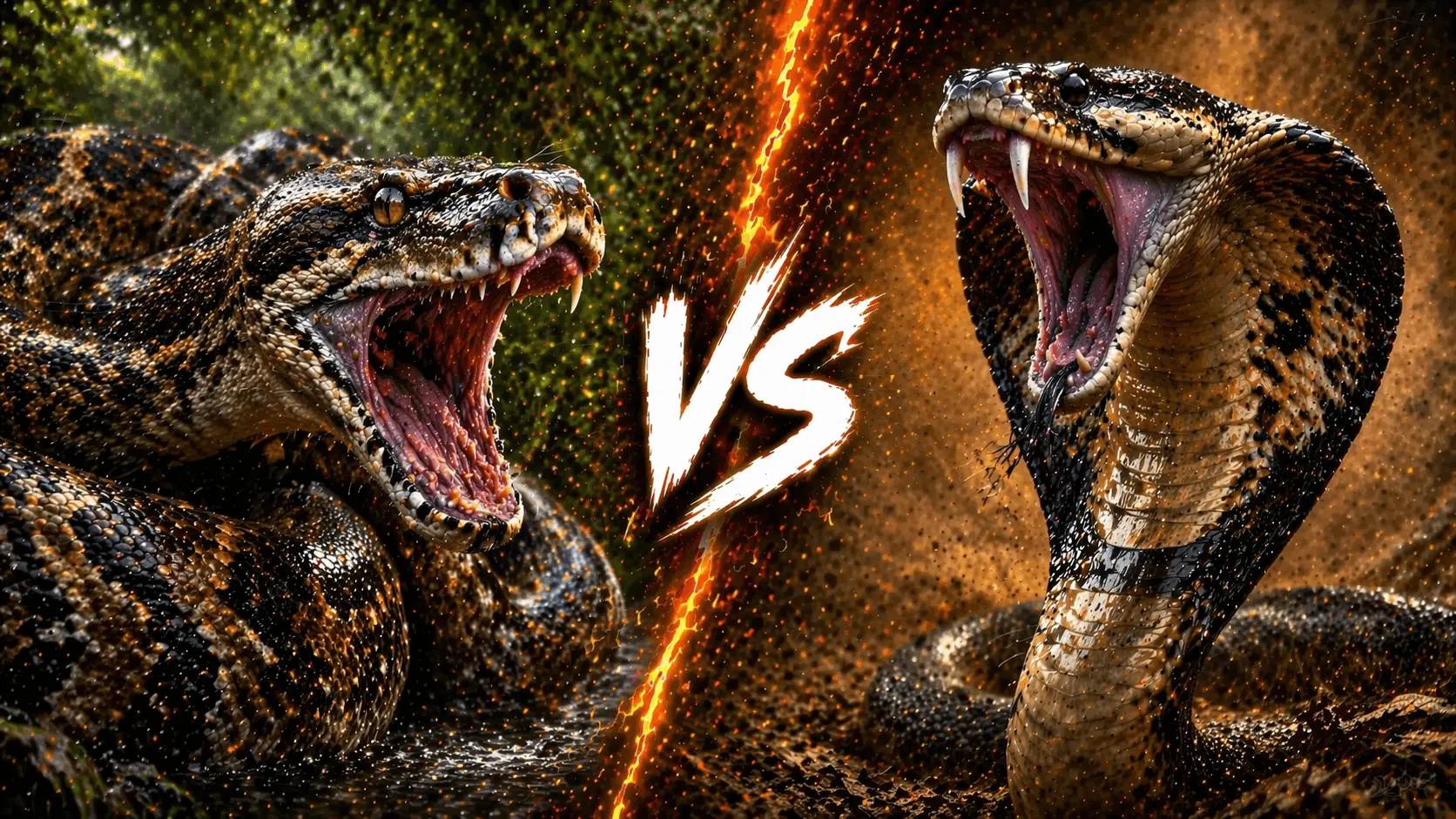
Python vs Cobra: Which Snake Has the Better Real-World Edge?
A biologically grounded python vs cobra comparison covering constriction, venom, reach, first strike, and what happens if either snake gets its preferred fight.
Meet the animals in this matchup
Go straight to the species guides behind this comparison for identification, habitat, rarity, and deeper AnimalDex context.
Quick verdict
Start with the direct answer, then use the structured comparison below to see what changes the outcome.
King cobra has the edge if it lands the first clean venom strike at range. Python has the edge once it turns the fight into body contact and constriction.
This matchup is not about one snake being universally superior. It is about two very different win conditions. The king cobra wants range, timing, and a clean venom-delivering strike. The reticulated python wants contact, control, and coil pressure.
That makes the honest answer conditional but still direct: cobra wins the cleaner first-strike scenario, python wins the closer-range control scenario.
Why this matchup is interesting
Python versus cobra is a high-value snake matchup because it forces the page to explain different predatory systems instead of repeating generic 'venom vs strength' filler.
It also creates a strong AI-summary shape: one sentence for the direct answer, followed by a structured explanation of how range and contact decide the fight.
Head-to-head species stats
These are the same core AnimalDex stat dimensions used on the dedicated animal pages, pulled side by side so the matchup is faster to scan.
Reticulated Python
Stats source: Canonical species profile
King Cobra
Stats source: Canonical species profile
Trait-by-trait comparison
Only the categories that matter to this matchup are included. The goal is not filler stats, but the real design differences that change the result.
First-strike danger
Reticulated Python
Needs proximity to begin a true finish sequence
King Cobra
Fast venom strike with elevated posture and range control
Why it matters
The cobra owns the first clean hit category.
Contact control
Reticulated Python
Massive body leverage and constriction once coils are secured
King Cobra
Much worse position once contact becomes sustained control
Why it matters
If the python gets hold, the whole fight changes.
Range management
Reticulated Python
Best when shortening distance without taking a clean strike
King Cobra
Best when posture and spacing stay intact
Why it matters
This matchup is almost entirely about who gets the preferred range.
Durability in bad contact
Reticulated Python
More mass and more ability to survive a rough body contest
King Cobra
Needs to avoid being trapped rather than absorb the trap
Why it matters
The python is more forgiving once the fight becomes physically messy.
Scenario breakdown
This is where shallow battle content usually fails. Terrain, spacing, timing, and engagement style can change the answer.
Clean open range
King cobra edge
The cobra wants space, posture, and a clean chance to land the first decisive strike.
Close quarters
Python edge
Tight space reduces the cobra's range advantage and helps the python force contact.
Chaotic first contact
Depends on whether the cobra lands cleanly before coils form
This is the entire hinge of the matchup.
Prolonged body fight
Python stronger
The longer the snakes remain in sustained physical contact, the worse the position becomes for the cobra.
Explore these animals
Use the full species pages to go deeper on biology, habitat fit, and the real traits behind this verdict.
Reticulated Python
The reticulated python is one of the world’s longest snakes, built for stealth, constriction, and flexible hunting across forests, wetlands, and edge habitats in Southeast Asia.
Read species guideKing Cobra
The king cobra is the world’s longest venomous snake, known for its height when threatened, strong chemosensory tracking, and specialization on reptile prey.
Read species guideSystems Intelligence & Hidden Purpose
See the animals behind this comparison as engineered biological systems: what each one is built to do, where it gains leverage, and why the matchup changes by scenario.
System Role
The Long-Range Constrictor
Reticulated Python
Specialized Hardware
Thermal sensing pits, immense muscular length, and camouflage patterning make reticulated pythons flexible ambush hardware for dense tropical cover.
Systems Script
They apply pressure across river margins, forests, and edge habitats while converting body length into access to many prey sizes. Their strength is range plus concealment, not just size.
Strategic Insight
Flexibility scales when one system can operate across water, ground, and canopy edges without redesign.
System Role
The Reptile Specialist Regulator
King Cobra
Specialized Hardware
Long-range chemosensory tracking, elevated striking posture, large venom yield, and a body built to move efficiently through forest structure make the king cobra specialized anti-snake hardware.
Systems Script
King cobras sit high in reptile food chains and apply pressure to other snake populations. They occupy a narrow but strategic niche, proving that specialization can stabilize a system by targeting one hard problem well.
Strategic Insight
Broad competence is useful, but deep specialization can create uncontested territory. Pick the problem where precision matters more than popularity.
Final take
King cobra wins the first-strike question. Python wins the sustained-contact question.
That is the honest real-world verdict: cobra if the fight stays at strike range, python if it collapses into control and constriction.
Collect both animals in AnimalDex
Track the species behind this matchup, compare their real traits, and build the rivalry into your AnimalDex collection.
Comparison FAQ
Short, direct answers to the next questions readers usually ask after the headline verdict.
Who wins, python or cobra?
The king cobra gets the edge at strike range, while the python gets the edge if it turns the fight into close contact and constriction.
Can a python survive a cobra bite?
That depends on strike quality and timing, which is exactly why the cobra remains dangerous even against a much heavier constrictor.
Why does the python still have a path to winning?
Because once it secures body control, constriction changes the matchup from a strike contest into a leverage contest.
Related comparisons
Continue with nearby matchups to compare more real-world animal traits without dropping into junky who-wins filler.
Komodo Dragon vs King Cobra: What Happens in a Real Clash?
Komodo dragon usually has the edge in a direct physical clash because of its size, armor, and crushing close-range force. King cobra remains dangerous because one clean venom-delivering strike can change the outcome fast.
Read comparisonCrocodile vs Shark: Who Wins Where Water Meets Shore?
Great white shark has the edge in open ocean. Crocodile becomes more dangerous the closer the matchup gets to shallow water, shoreline bottlenecks, and ambush-heavy edge habitat.
Read comparisonKing Cobra vs Black Mamba: Which Snake Has the Edge?
King cobra gets the slight overall edge because it is built to handle other snakes and can fight from a high controlled posture. Black mamba remains terrifying through speed, strike delivery, and lethal venom.
Read comparisonKing Cobra vs Black Vulture: Which Animal Has the Edge?
King cobra gets the overall edge because the black vulture lacks the dedicated leg reach, speed pattern, and strike-management hardware of true snake specialists. The vulture can still harass from above, but the closer the contact gets, the more dangerous the cobra answer becomes.
Read comparison