

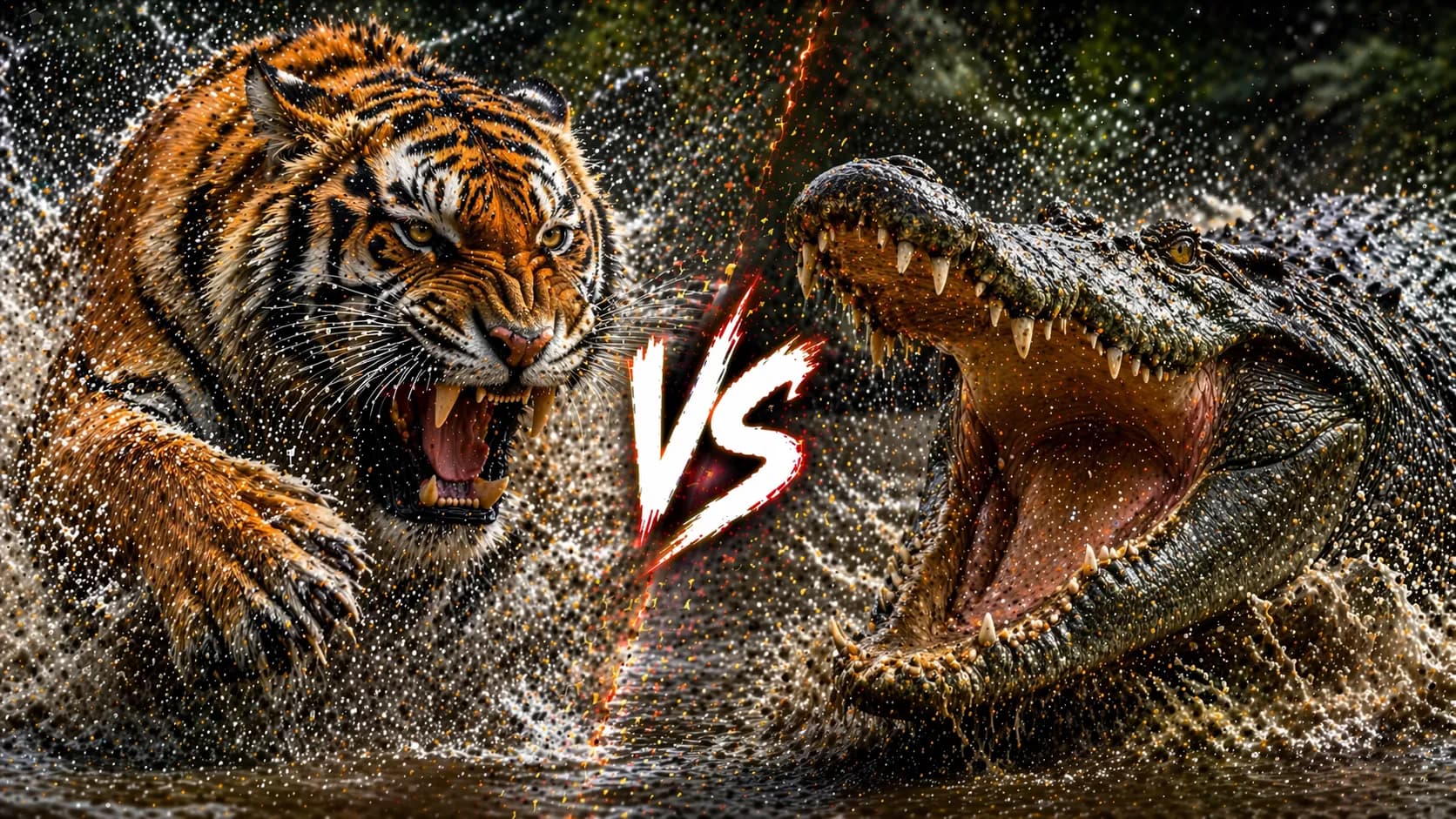
Meet the animals in this matchup
Go straight to the species guides behind this comparison for identification, habitat, rarity, and deeper AnimalDex context.
Quick verdict
Start with the direct answer, then use the structured comparison below to see what changes the outcome.
Tiger gets the slight overall edge on land through mobility and attack quality. Crocodile becomes more dangerous the closer the fight gets to shallow water, stillness, and first-bite ambush control.
Tiger wants land and motion. Crocodile wants the waterline and one brutal start.
Why this matchup is interesting
It is a clean example of two apex predators that dominate different parts of the same boundary.
Head-to-head species stats
These are the same core AnimalDex stat dimensions used on the dedicated animal pages, pulled side by side so the matchup is faster to scan.
Tiger
Stats source: Generated canonical stats
Crocodile
Stats source: Canonical species profile
Trait-by-trait comparison
Only the categories that matter to this matchup are included. The goal is not filler stats, but the real design differences that change the result.
Land control
Tiger
More agile and better at mobile engagement
Crocodile
Far less comfortable away from strong water support
Why it matters
The farther onto land the fight moves, the stronger tiger looks.
Ambush bite
Tiger
Excellent stalking and explosive opening
Crocodile
Devastating if it starts from the exact right water-edge position
Why it matters
Each predator owns a different kind of first contact.
Terrain dependence
Tiger
Broader effectiveness on land
Crocodile
Much better at the waterline
Why it matters
The arena still decides too much to ignore.
Scenario breakdown
This is where shallow battle content usually fails. Terrain, spacing, timing, and engagement style can change the answer.
Dry ground
Tiger edge
This gives the cat the cleaner movement and attack shape.
Shallow ambush
Crocodile edge
A hidden clamp near water is the reptile's best answer.
Broad matchup
Tiger slight overall edge
The wider direct-contact range on land gives the cat the total nod.
Explore these animals
Use the full species pages to go deeper on biology, habitat fit, and the real traits behind this verdict.
Tiger
The tiger is a large striped cat built for stealth, ambush, and territorial control across forests, wetlands, and grassland edges in Asia.
Read species guideCrocodile
Crocodiles are powerful semi-aquatic predators built for ambush, with pressure-sensitive jaws, armored bodies, and explosive short-range acceleration.
Read species guideSystems Intelligence & Hidden Purpose
See the animals behind this comparison as engineered biological systems: what each one is built to do, where it gains leverage, and why the matchup changes by scenario.
System Role
The Solitary Ambush Accountant
Tiger
Specialized Hardware
Striped camouflage, padded feet, strong night vision, and explosive forelimb power make the tiger highly effective close-range strike hardware in dense cover.
Systems Script
Tigers regulate herbivore pressure and prey behavior across forests, wetlands, and grasslands. Their presence changes how other animals move, feed, and allocate risk, which then reshapes vegetation and recovery patterns.
Strategic Insight
A high-value move beats a high-volume one. Save force for the window where surprise and position make the cost worth paying.
System Role
The Estuary Pressure Valve
Crocodile
Specialized Hardware
Pressure-sensitive receptors around the jaws, eyes and nostrils mounted high on the skull, and a tail built for explosive propulsion make crocodiles effective ambush hardware at the land-water edge.
Systems Script
Crocodiles control chokepoints where rivers, wetlands, and shorelines concentrate traffic. They regulate prey behavior, move nutrients through kills and carcasses, and add caution to landscapes that would otherwise become too predictable.
Strategic Insight
You do not need to dominate every square meter. Control the bottlenecks and the rest of the map starts behaving differently.
Final take
Crocodile remains terrifying in the exact right ambush setup. Tiger still gets the slight overall verdict because the broader fight space favors the more mobile land predator.
Collect both animals in AnimalDex
Track the species behind this matchup, compare their real traits, and build the rivalry into your AnimalDex collection.
Comparison FAQ
Short, direct answers to the next questions readers usually ask after the headline verdict.
Who wins, tiger or crocodile?
Tiger gets the slight overall edge on land through mobility and attack quality. Crocodile becomes more dangerous the closer the fight gets to shallow water, stillness, and first-bite ambush control.
Why does this matchup stay interesting?
Crocodile remains terrifying in the exact right ambush setup. Tiger still gets the slight overall verdict because the broader fight space favors the more mobile land predator.
Related comparisons
Continue with nearby matchups to compare more real-world animal traits without dropping into junky who-wins filler.
Crocodile vs Shark: Who Wins Where Water Meets Shore?
Great white shark has the edge in open ocean. Crocodile becomes more dangerous the closer the matchup gets to shallow water, shoreline bottlenecks, and ambush-heavy edge habitat.
Read comparisonTiger vs Lion: Who Actually Wins?
In a one-on-one land fight, the tiger usually has the edge. Lions become more dangerous when the matchup stops being a duel and starts rewarding coalition pressure, open-country control, or prolonged group conflict.
Read comparisonBear vs Tiger: Who Has the Edge in a Real Clash?
Tiger is the safer general answer in a one-on-one land clash when stealth, timing, and clean engagement matter. A very large bear represented here by the polar bear changes the problem through sheer mass and durability, especially in open, cold terrain.
Read comparisonCrocodile vs Alligator: Which Crocodilian Has the Edge?
Crocodile usually gets the slight overall edge because it is often more aggressive and more built for a wider range of salty and open-water environments. Alligator remains massively dangerous and can look better in some freshwater ambush contexts.
Read comparison