dolphinsanimal communicationanimal intelligence
Can Dolphins Talk? They Made Up a Whistle on a Keyboard
Scientists gave dolphins an underwater keyboard, and they invented a new whistle. What dolphin names, mirrors and AI reveal about whether dolphins can talk.
Dalam panduan ini
- Can dolphins talk?
- Scientists gave dolphins an underwater keyboard
- They copied the whistles, then made a new one
- Do dolphins have names?
- Dolphins, elephants and belugas in the mirror
- The elephant who would not use a stick
- Can AI translate dolphin?
- Talk to a dolphin in AnimalDex
- Better tests, not just better tools
Can dolphins talk?
Quick answer
Not in words, but they do more with sound than almost any other animal. Bottlenose dolphins learn new whistles by copying, give themselves a signature whistle that works much like a name, and answer when another dolphin copies it. In a 1980s experiment, two young dolphins given an underwater keyboard went further: they copied the computer's whistles and then produced a new whistle of their own while playing a game nobody had taught them.
Nobody can translate dolphin yet. Researchers are now recording which dolphin makes which sound and using AI to look for structure in the whistles, but there is no dolphin dictionary and no dolphin translator.
The experiment
Scientists gave dolphins an underwater keyboard
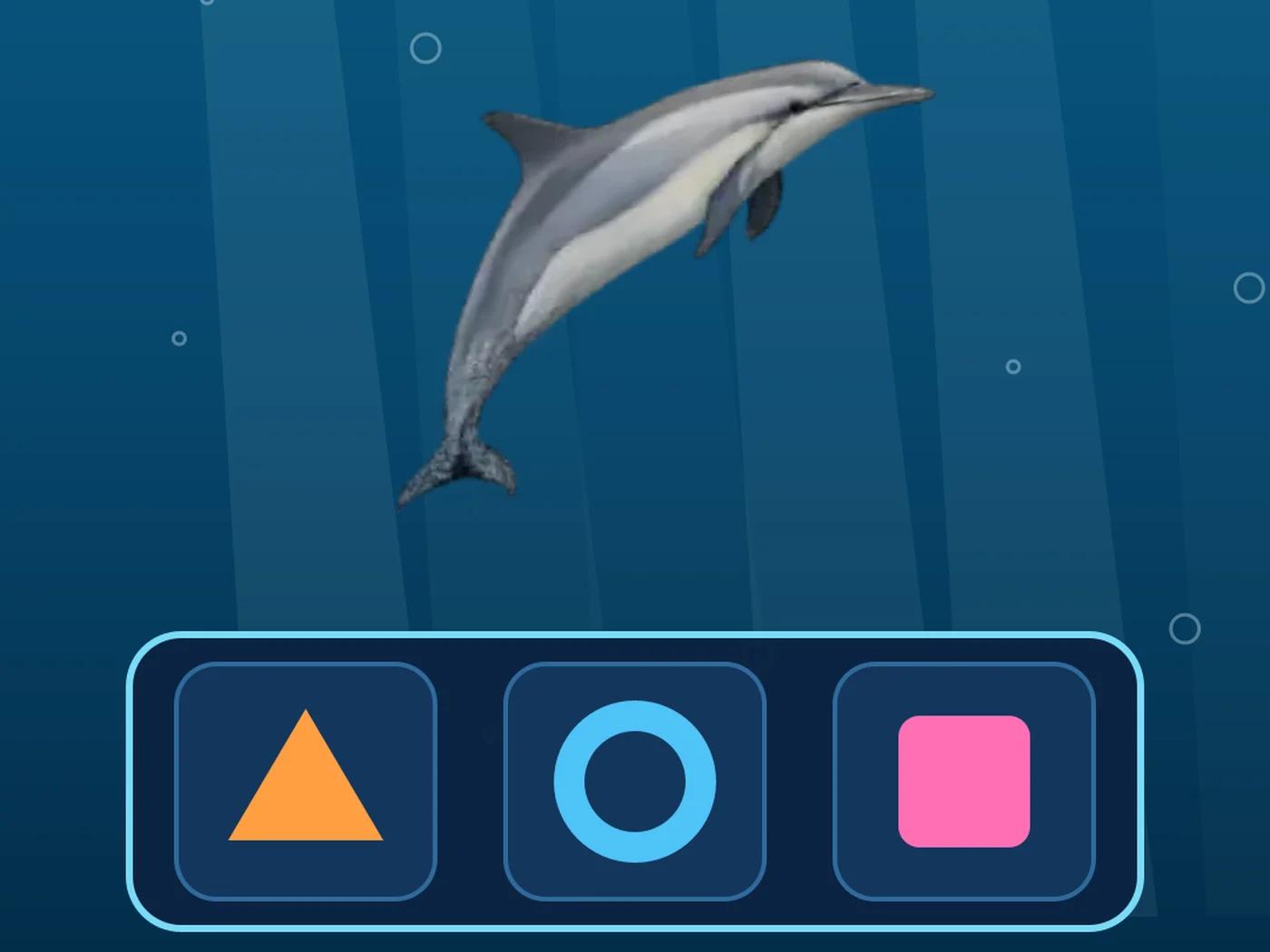
In the mid 1980s, psychologist Diana Reiss built an underwater keyboard for a small group of bottlenose dolphins: two young males, Delphi and Pan, and their mothers. Each key carried a simple shape. Touching a key played a whistle made by a computer and brought the thing it stood for, such as a ball, a ring or a rub from the humans at the side of the pool.
The whistles were invented for the study. They sat inside the range of pitches and lengths dolphins use, so the animals could copy them if they chose, but they were unlike the whistles these dolphins already made. Touch the triangle, hear the ball whistle, get a ball.
The point was choice and control. Instead of a trainer asking and the dolphins answering, the dolphins could ask, and the people had to respond. Reiss tells the story in her recent talk for The Well, which is where this article's short video got its idea.
What happened
They copied the whistles, then made a new one
After only a few exposures, both young dolphins began imitating the computer whistles, matching their timing and pitch closely. Reiss and Brenda McCowan published the copying in 1993 as evidence that dolphins learn sounds by imitation.
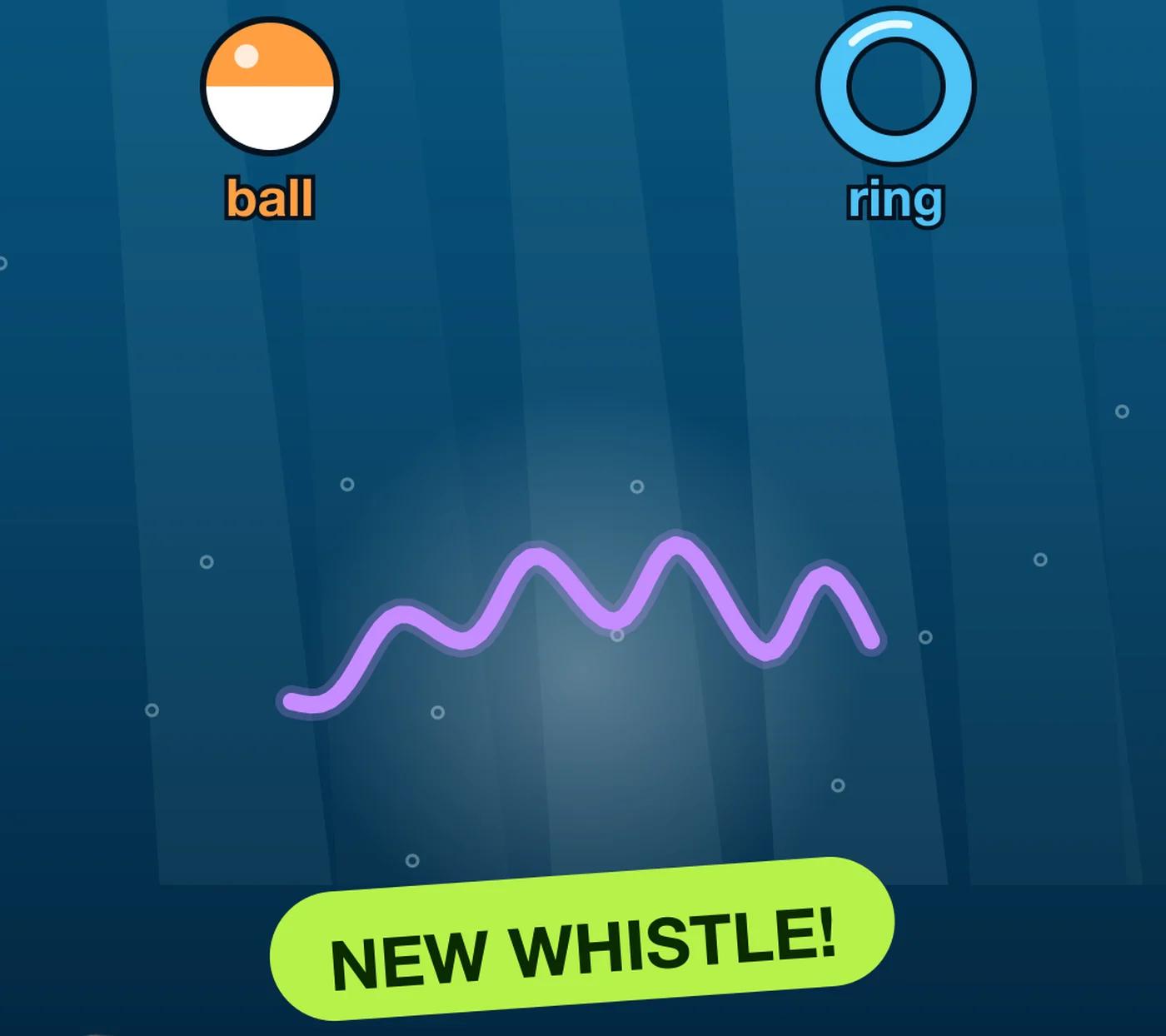
Then the dolphins invented a game. They would ask for a ball, ask for a ring, and toss both into the air together. During that game the researchers recorded a whistle 31 times that looked like the ball whistle and the ring whistle joined into one. Reiss is careful about what it means: it is a hint that dolphin sounds may be built from parts, not proof that the dolphins coined a word.
Even as a hint, it changed how she looked for meaning. If dolphins can combine sounds, then a dictionary of single whistles, which is what she first tried to build, would miss how the system works.
The dolphins were not taught the game, or the joined-up whistle that went with it.
Dolphin names
Do dolphins have names?
Something close to it. Each bottlenose dolphin develops a signature whistle in its first months, a contour of rising and falling pitch that belongs to it. A 2006 study showed dolphins recognise one another from the shape of that whistle alone, even when it is played in a synthetic voice with the caller's own voice features removed.
In 2013, Stephanie King and Vincent Janik played wild dolphins copies of their own signature whistles. The dolphins whose whistle was copied called back far more than to other whistles. Dolphins also copy each other's signature whistles in the wild, which suggests they can call a particular individual, the way you might call a friend by name.
That is the strongest evidence for dolphin 'words' so far: not sentences, but learned labels for individuals.
| Claim | What the evidence shows | How sure |
|---|---|---|
| Dolphins learn new sounds by copying | Keyboard dolphins copied computer whistles closely (Reiss & McCowan, 1993) | Strong |
| Dolphins have name-like whistles | Signature whistles identify individuals by shape alone (Janik et al., 2006) | Strong |
| Dolphins answer to their 'name' | Wild dolphins called back to copies of their own whistle (King & Janik, 2013) | Strong |
| Dolphins combine whistles into new ones | One joined ball-and-ring whistle, heard 31 times in a game | A hint, not proven |
| Dolphin speech can be translated | No translator exists; AI work is still finding structure | Not yet |
learned labels for individuals
Self-awareness
Dolphins, elephants and belugas in the mirror
Reiss also tested whether dolphins recognise themselves. In 2001, she and Lori Marino reported that bottlenose dolphins use a mirror to look at marks on their own bodies, the first animals outside the primates shown to do it. Reiss has described a young dolphin named Bailey showing the behaviour at about seven months old; children usually start between 18 and 24 months.
The same team found it in an Asian elephant named Happy at the Bronx Zoo in 2006, and a 2026 study reported evidence for it in beluga whales. Other labs have reported versions of it in magpies and in a small fish, the cleaner wrasse. Reiss's group is now testing octopuses, starting with how they behave with each other, so mirror behaviour can be told apart from ordinary social behaviour.
Fair tests
The elephant who would not use a stick
Older studies said Asian elephants failed at insight problems, because they never used a stick to reach food. When Reiss's student Preston Foerder hung fruit out of reach and gave the elephants a big movable cube as well as sticks, a seven-year-old elephant called Kandula pushed the cube under the fruit, stood on it and took the food. He never used the sticks.
An elephant smells, feels and grabs with the tip of its trunk, so holding a stick blocks the very tool it needs. The test had been designed for a primate. That is the thread through all of Reiss's work: an animal can only show what it can do if the test gives it the right tools and enough choice.
AI and dolphins
Can AI translate dolphin?
Not yet, and the first problem is not the AI. In a group of dolphins it is hard to know who made which sound. Reiss's team works with 22 dolphins in natural seawater lagoons at the Roatan Institute for Marine Sciences in Honduras, where some dolphins have been trained to wear small suction-cup recorders called HydroMoths. With one recorder per dolphin, the team can separate each animal's calls before asking AI to look for patterns.
Other teams are working on the same question. Google, Georgia Tech and the Wild Dolphin Project announced DolphinGemma in April 2025, an AI model trained on decades of recordings of wild Atlantic spotted dolphins to learn the structure of their sounds. Project CETI is doing similar work with sperm whale clicks. All of them are looking for structure and context, not a ready-made translation.
Try it
Talk to a dolphin in AnimalDex
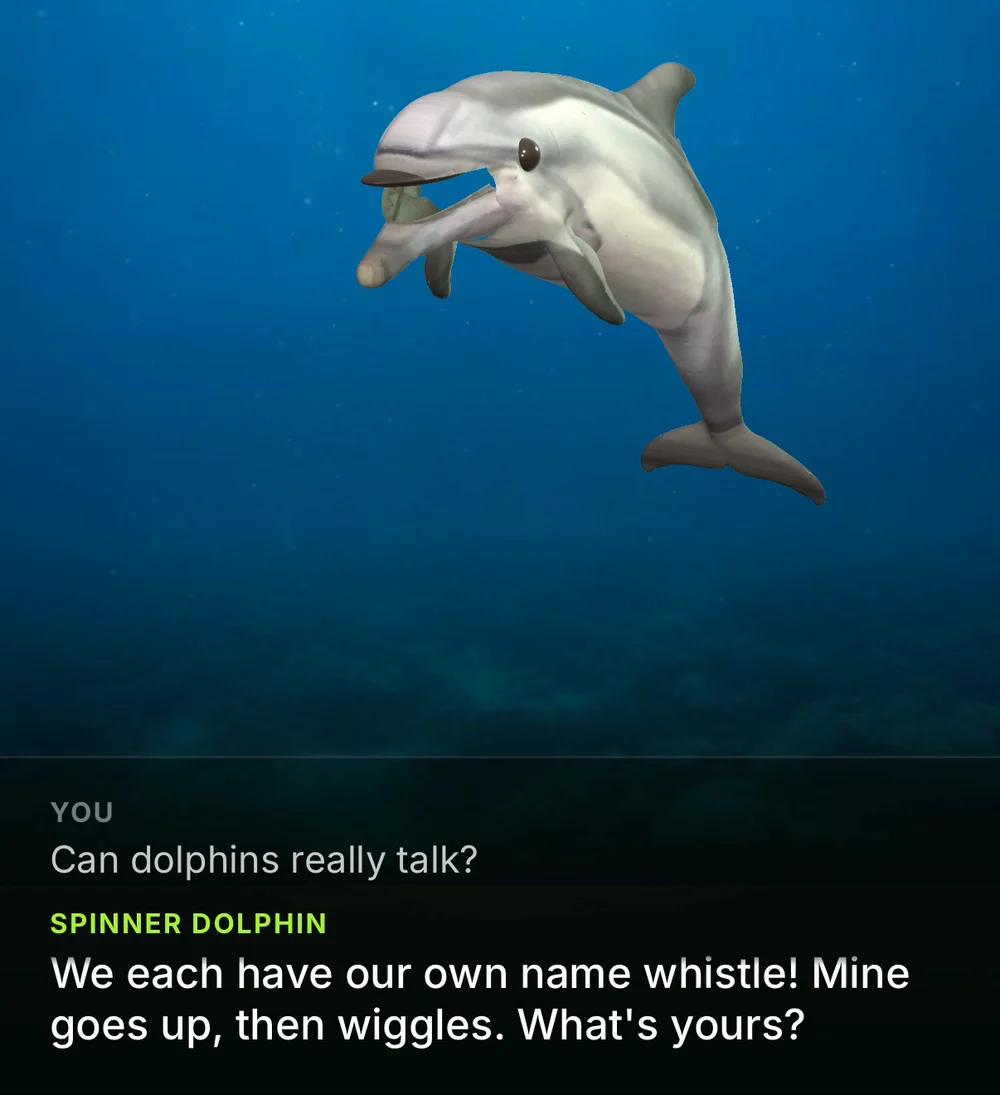
We can't speak dolphin yet, but you can ask one a question. In AnimalDex, you snap a photo of a real animal, and it joins your collection. Then you can chat with it or call it, and a talking 3D model answers in an animal voice.
To be clear about what that is: the dolphin in the app is an AI character, not a translation. It answers from what science knows about its species, such as signature whistles, echolocation and life in a pod, and it speaks in a voice made for the animal. It is a way to learn about dolphins, not to hear from a particular one.
Read more about dolphins on the AnimalDex dolphin page.
The takeaway
Better tests, not just better tools
Dolphins don't talk like us, but they learn sounds, use something like names and, given a keyboard and a little control, did things nobody planned for. Reiss's conclusion is that understanding minds unlike ours needs better imaginations as much as better tools: tests that let the animal show what it can do.
Pertanyaan singkat
Jawaban ringkas untuk pertanyaan yang paling sering muncul pada topik ini.
- Can dolphins talk?
- Not in words. Dolphins communicate with whistles, clicks and body language, learn new sounds by copying, and use signature whistles that work much like names. Nobody has translated dolphin communication yet.
- What was the dolphin keyboard experiment?
- In the 1980s, Diana Reiss gave bottlenose dolphins an underwater keyboard. Each key played a computer whistle and brought a toy or a rub. The young dolphins copied the whistles and, during a game they invented, produced a new whistle that seemed to join the ball and ring whistles.
- Do dolphins have names?
- Each bottlenose dolphin has a signature whistle that identifies it. Dolphins recognise each other from these whistles, and wild dolphins answer when their own signature whistle is copied, so they work much like names.
- Can AI translate dolphin language?
- Not yet. Projects such as Diana Reiss's recorder study in Honduras and Google's DolphinGemma use AI to find structure in dolphin sounds, but there is no working dolphin translator.
- Can dolphins recognise themselves in a mirror?
- Yes. In 2001, Diana Reiss and Lori Marino showed bottlenose dolphins use mirrors to inspect marks on their bodies. Asian elephants and beluga whales have since shown the same ability.
- Who is Diana Reiss?
- Diana Reiss is a psychology professor at Hunter College who has studied dolphin communication and animal minds for decades, including the dolphin keyboard, mirror self-recognition in dolphins and elephants, and AI-assisted study of dolphin whistles.
Hewan yang disebut
Lompat dari artikel ini ke halaman spesies di balik contoh, catatan systems, dan referensi field guide.
Sources and further reading
- The Well: We tried speaking to dolphins – and they spoke back | Diana Reiss (YouTube)
- Reiss & McCowan (1993), Spontaneous vocal mimicry and production by bottlenose dolphins: evidence for vocal learning. Journal of Comparative Psychology
- Janik, Sayigh & Wells (2006), Signature whistle shape conveys identity information to bottlenose dolphins. PNAS
- King & Janik (2013), Bottlenose dolphins can use learned vocal labels to address each other. PNAS
- Reiss & Marino (2001), Mirror self-recognition in the bottlenose dolphin: a case of cognitive convergence. PNAS
- Plotnik, de Waal & Reiss (2006), Self-recognition in an Asian elephant. PNAS
- Evidence for mirror self-recognition in beluga whales (Delphinapterus leucas) (2026). PLOS One
- Foerder et al. (2011), Insightful problem solving in an Asian elephant. PLOS ONE
- Google: DolphinGemma, how AI can decipher dolphin communication
Panduan jawaban terkait topik ini
Kalau kamu ingin perbandingan langsung dan rekomendasi yang jelas, lanjutkan ke halaman jawaban berikut.
Best Animal Identification Apps
Compare the best animal identification apps by features like photo/video identification, species coverage, collection capabilities, offline use, and more.
What Is Animal Collecting
Learn what animal collecting means in modern apps and how AnimalDex turns real-world sightings into cards, sets, rarity, and species learning.
Pokemon-Like Animal App
Looking for a Pokemon-like app with real animals? AnimalDex is something else: take any idea to a real animal for a genuinely different take, and every animal you meet in the wild joins your collection.