

How Chameleons See and Strike: Vision, Behavior, and Survival Strategy
Learn how chameleon vision, camouflage, tongue mechanics, animal behavior, and ecosystem role make this reptile an elite patient hunter.
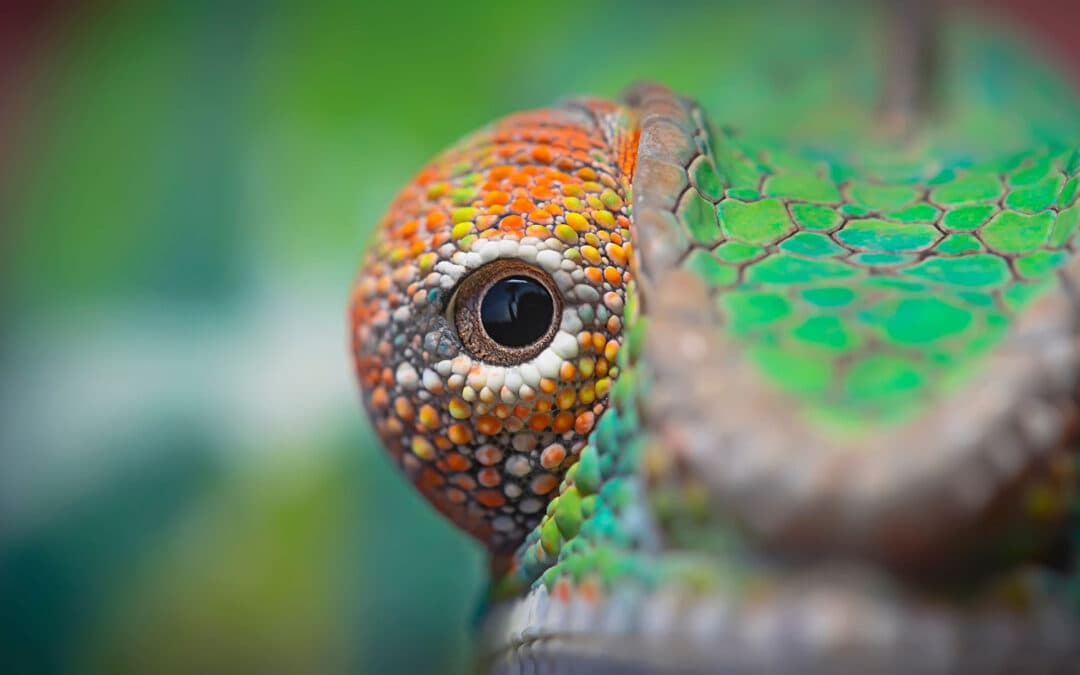
Why chameleons are more than just color-change curiosities
Chameleons are famous for camouflage, but the more useful systems view is that they combine surveillance, grip, and ballistic feeding into one integrated hunting platform.
That makes them interesting not because they look strange, but because their design solves a very specific arboreal problem set efficiently.
What makes a chameleon unique?
Independently moving eyes give chameleons unusually broad visual coverage, while zygodactyl feet and gripping tails stabilize the body on narrow branches.
Then the tongue does the final work, converting a long visual setup phase into a rapid capture event. It is a clean example of sensor-first hunting.
How chameleons survive
Chameleon survival strategy depends on patience, concealment, and precise commitment. They do not benefit from wasteful movement because movement makes them easier to notice and costs energy.
Their animal behavior therefore looks almost conservative. They hold position, keep scanning, and act when the probability turns in their favor.
The ecosystem role of chameleons
Chameleons regulate insect populations in shrubs, trees, and forest edges while also serving as prey for larger animals. Their ecosystem role sits in a mid-level control band that helps keep local insect pressure from drifting upward unchecked.
They matter because fine-scale predation is still system structure, even when it happens branch by branch.
What humans can learn from chameleons
Chameleons are a strong case for patient sensing. You do not need constant activity if your observation quality is high enough to make the one important move count.
That is the practical insight: better surveillance often creates more value than busier execution.
Systems Intelligence & Hidden Purpose
See these animals as engineered biological systems: what they are built to do, how they fit the wider environment, and what their design can teach us.
System Role
The Directional Surveillance Turret
Chameleon
Specialized Hardware
Independently mobile eyes, a ballistic tongue, and branch-gripping feet let a chameleon scan multiple angles before converting visual lock into a precise strike.
Systems Script
Chameleons operate as small-scale insect regulators in arboreal environments. They show how patient sensory coverage can stabilize a niche without high-speed roaming or constant conflict.
Strategic Insight
Do not confuse stillness with inactivity. Good surveillance buys better timing than constant motion.
Animals mentioned
Jump from this article into the species pages behind the examples, systems notes, and field-guide references.
Answer guides related to this topic
If you want direct comparisons and clear recommendations, continue with these answer-focused pages.
Best Animal Identification App
Looking for the best animal identification app? Learn how AnimalDex combines AI scanning, collecting, rarity tracking, and field-guide learning in one app.
Read answer guideWhat Is Animal Collecting
Learn what animal collecting means in modern apps and how AnimalDex turns real-world sightings into cards, sets, rarity, and species learning.
Read answer guidePokemon-Like Animal App
Looking for a Pokemon-like animal app with real species? AnimalDex combines creature-collection energy with AI scanning and wildlife learning.
Read answer guideTurn what you learn into a real animal collection
Keep going in AnimalDex with the species behind this guide, real-world sighting context, and a collection that grows beyond the article.
Related guides
Mantis Shrimp Vision and Strike Power: How This Animal Sees and Hits So Fast
See how mantis shrimp combine extreme animal vision, explosive strike mechanics, reef survival strategy, and a powerful ecosystem role.
Read articleHow Eagles Use Height, Vision, and Timing to Survive
Learn how eagle behavior, animal vision, hunting strategy, and ecosystem role turn altitude and timing into survival advantages.
Read articleChameleon Symbolism: Directional Vision, Patient Surveillance & Color Truth
Explore chameleon symbolism through independently mobile eyes, color change, ballistic precision, and the archetype of targeting what matters most.
Read article