

Mantis shrimpAnimal visionReef behavior
Mantis Shrimp Vision and Strike Power Explained
Mantis shrimp vision and strike explained: 12 to 16 photoreceptor types, polarised light, and a club that hits at 23 m/s and 10,000 g, then hits again.
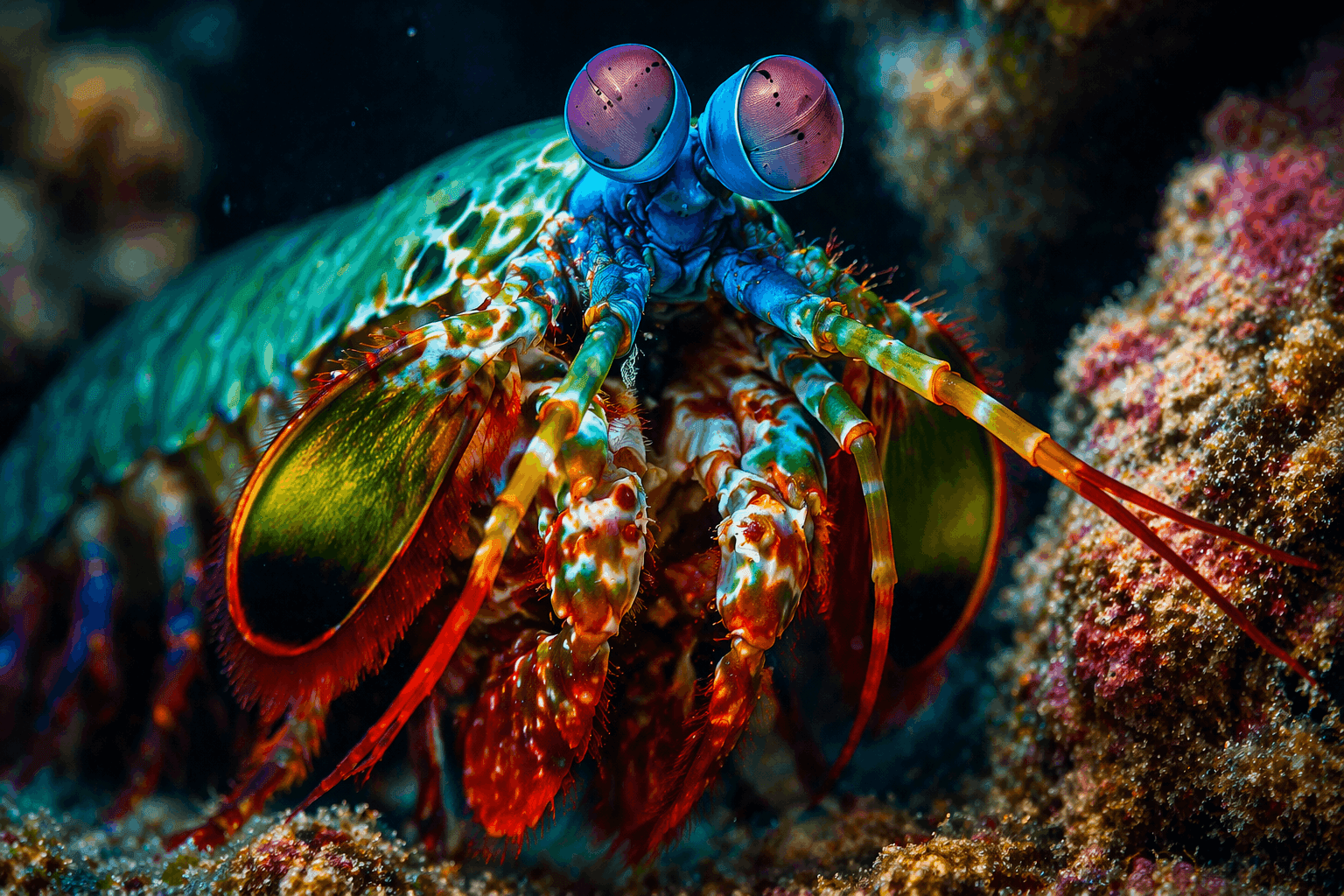
Why mantis shrimp keep breaking people's mental models
Mantis shrimp are neither mantises nor shrimp. They are stomatopods, an order of around 450 marine crustaceans that split from the rest of the crustacean line about 400 million years ago. Most are 5 to 20 centimetres long and live in burrows on tropical and subtropical seafloors; the peacock mantis shrimp (Odontodactylus scyllarus) of the Indo-Pacific is the one in most photographs because it is bright green, red, and blue and reaches 18 centimetres.
They are famous for carrying two extreme systems in one small body: the most complex eyes known in any animal and the fastest strike measured in any animal that lives in water. Both are documented in careful laboratory work, which is why the claims survive scrutiny better than most internet superlatives.
The reason the pairing matters is that each system was built for the other. The eyes locate a hard-shelled target precisely in three dimensions; the strike has to be aimed to the millimetre because it cannot be corrected once released.
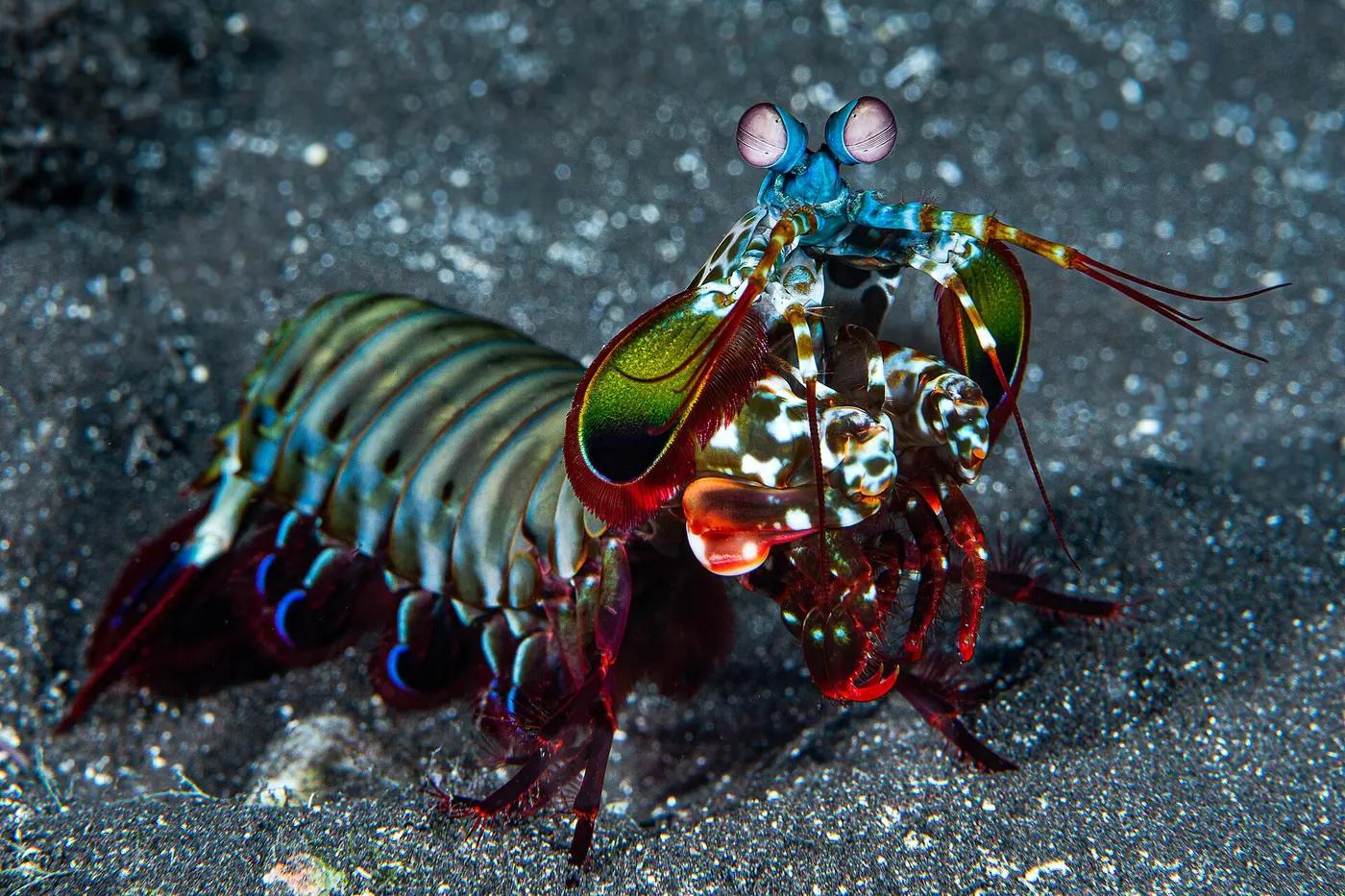
What makes a mantis shrimp unique?
The eyes sit on stalks and move independently. Each compound eye is divided into an upper and lower hemisphere with a band of six rows of specialised facets across the middle, and because the three regions can all look at the same point, a single eye can judge distance on its own. Across those rows sit 12 to 16 types of photoreceptor, depending on species, compared with three in a human eye. They cover ultraviolet to far red, and they detect both linearly and circularly polarised light, the latter a sense found in no other animal.
The surprise is what the eye does with all that. A 2014 study in Science by Hanne Thoen and colleagues found mantis shrimp are poor at telling similar colours apart, worse than humans. Instead of comparing signals across receptors as we do, they appear to scan a scene with the midband and read each receptor type as a separate channel, a fast lookup rather than a computation. It is a different design for colour vision, not simply a better one.
The strike comes from a pair of raptorial appendages folded under the head. Smashers such as the peacock mantis shrimp carry a calcified club; spearers carry barbed spines. In both, muscle loads energy into a saddle-shaped spring in the limb while a latch holds it, then the latch releases. Sheila Patek's 2004 measurements in Nature clocked the club at 23 metres per second with an acceleration of around 10,000 times gravity, reaching the target in under three milliseconds. The limb moves so fast that water vaporises behind it, and the collapse of that cavitation bubble delivers a second blow after the club itself. Peak forces of around 1,500 newtons have been recorded from an animal that weighs a few tens of grams.
| Measure | Peacock mantis shrimp | Human, for scale |
|---|---|---|
| Photoreceptor types | 12 to 16 | 3 (plus rods) |
| Polarised light | Linear and circular, both detected | Not detected |
| Depth perception | Each eye judges distance alone (three viewing regions per eye) | Needs both eyes together |
| Strike speed | About 23 m/s, roughly 80 km/h, through water | A boxer's jab, about 10 m/s, through air |
| Strike acceleration | Around 10,000 g | Under 100 g for a punch |
| Time to impact | Under 3 milliseconds | A blink takes 100 to 150 milliseconds |
| Impact force | Up to about 1,500 N from an 18 cm animal | A heavyweight punch is a few thousand N from an 80 kg body |
How mantis shrimp survive on a crowded reef
Everything happens around the burrow. Smashers excavate holes in rubble and coral and defend them; spearers dig vertical tunnels in sand and ambush from the opening. A burrow is shelter from octopuses, groupers, and triggerfish, a place to moult safely, and a nursery, and competition for good ones is intense.
That competition is where the strike meets behaviour. Mantis shrimp settle disputes over burrows with ritualised sparring: the defender presents its telson, the armoured tail plate, and the rival strikes it. The telson absorbs blows that would kill if they landed on the body, and the animal that can keep striking longest usually wins. Only when threat displays and telson sparring fail does the fight escalate.
Vision runs the social side too. Some species signal with ultraviolet and polarised patches on the body that are invisible to most predators, which lets rivals and mates communicate without broadcasting their position. Many spearers pair for life in a shared burrow, in some species for 20 years or more. A freshly moulted mantis shrimp is soft and defenceless for days, so a known partner and a defended hole are worth a great deal.
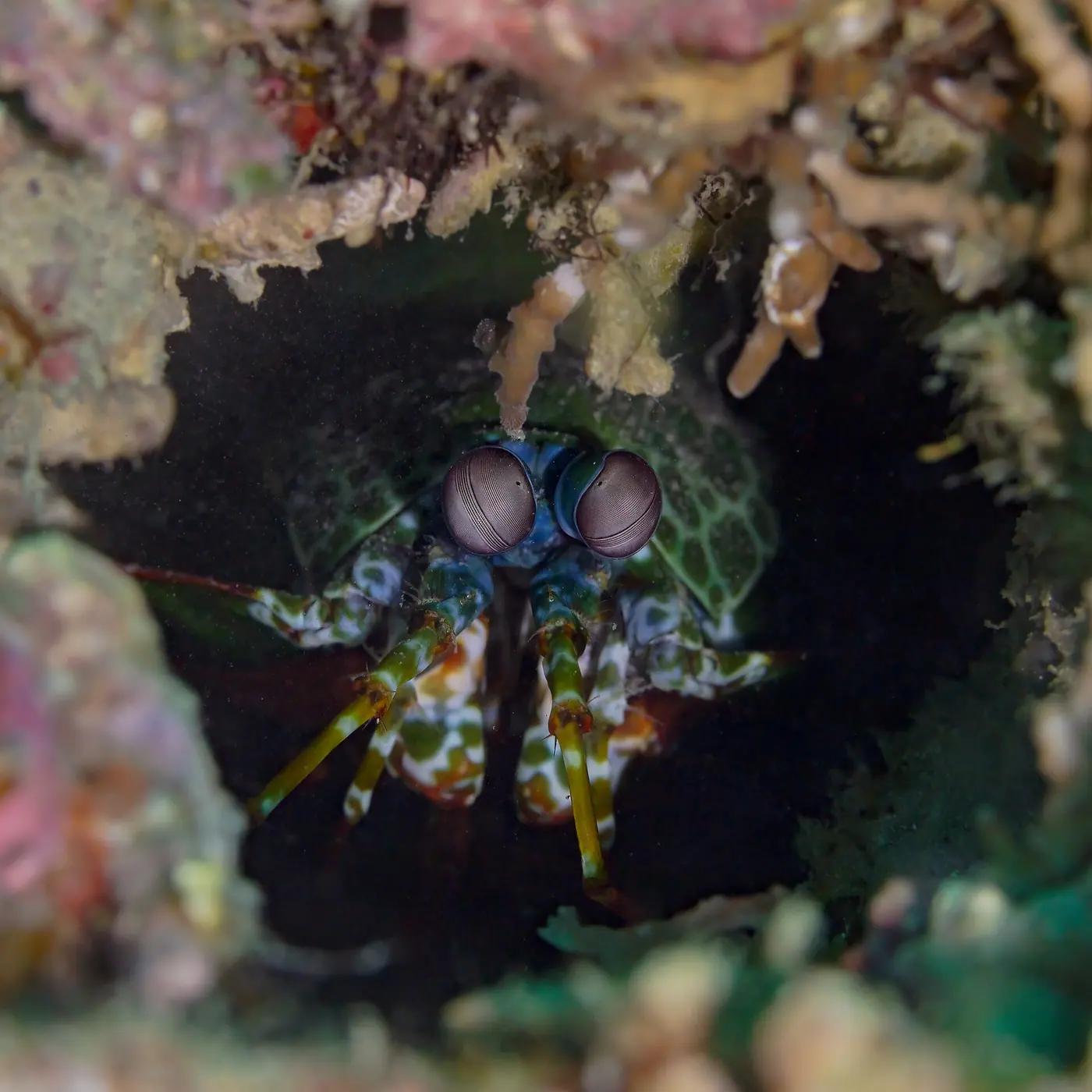
The ecosystem role of a mantis shrimp
Smashers are specialists in armoured prey. They crack snails, hermit crabs, clams, and crabs that few other reef animals can open, which keeps those populations in check and recycles shell material into the sediment. Spearers take fish, shrimp, and worms from the water column above their burrows. Together they are a significant part of the reef's mid-level predator community.
They are also prey. Reef fish, octopuses, and sharks take mantis shrimp, and their larvae, which spend weeks to months in the plankton, feed everything from jellyfish to juvenile fish. Their burrowing turns over sediment, moving oxygen into seabeds that would otherwise go stagnant.
Because they are long-lived, sedentary, and sensitive to water quality, mantis shrimp are monitored in some regions as indicators of reef and estuary health. A healthy population of burrows is a sign the rubble zone is working.
The strike is not strength. It is energy stored slowly, held by a latch, and released all at once.
What humans can learn from mantis shrimp design
The club has become a materials-science reference. Its outer layer is hard hydroxyapatite; beneath it, chitin fibres are stacked in a twisted helicoidal pattern that stops cracks spreading. David Kisailus's lab at the University of California has copied that architecture into carbon-fibre composites for aircraft panels and body armour that resist impact better than conventional layups.
The eye is a reference too. Cameras that mimic the midband's polarisation sensors have been built to detect cancerous tissue, which reflects polarised light differently from healthy tissue, and to see through underwater haze. The design lesson from the whole animal is to do the computation in the sensor rather than after it.
You can see all of this on a shallow reef with a mask and patience. Mantis shrimp are common; they are just good at not being noticed.
Where to look
Rubble and coral-edge zones in 1 to 20 metres of water across the Indo-Pacific, and sandy flats for spearers. Look for a round, tidy hole with a shrimp-shaped shadow at the entrance.
What gives it away
Two stalked eyes that swivel independently while the body stays still. A peacock mantis shrimp also flashes red and green when it moves. Spearers show only the eyes and antennal scales above the sand.
Keep your distance
Never put a finger, a GoPro, or a glove near the burrow. Smashers have split fingers and cracked aquarium glass. They cannot hurt you if you do not reach in.
Logging the sighting
Note smasher or spearer, approximate length, depth, and whether it was in a burrow or moving across open ground. Peacock mantis shrimp are the one species most people can identify from a photo.
How octopus intelligence worksWhy jumping spiders are so precise
Systems Intelligence & Hidden Purpose
See these animals as engineered biological systems: what they are built to do, how they fit the wider environment, and what their design can teach us.
Specialized Hardware
Hyper-specialized eyes that detect polarized and complex light, plus spring-loaded raptorial appendages that release extreme acceleration, make mantis shrimp elite sensing-and-strike hardware.
Systems Script
Mantis shrimp pressure reef prey with a combination of signal processing and mechanical violence. They help drive local armor races in shells and exoskeletons while occupying tight, defensible burrow systems.
Strategic Insight
Speed is often designed before it is expressed. Preload the mechanism, then let structure deliver the force.
Quick questions
Short answers to common questions readers ask on this topic.
- How fast is a mantis shrimp punch?
- About 23 metres per second, roughly 80 km/h, measured in the peacock mantis shrimp with high-speed video by Sheila Patek's team in 2004. The club accelerates at around 10,000 times gravity and reaches its target in under three milliseconds. The speed vaporises water behind the club, and the collapsing cavitation bubble delivers a second impact.
- Can a mantis shrimp break aquarium glass?
- Yes, large smashers have cracked standard aquarium panes, which is why public aquaria keep them behind acrylic. A strike delivering up to around 1,500 newtons at a point is enough to chip glass, and a shrimp that treats the wall as a rival will keep hitting it. They can also split a careless finger, so never reach into a burrow.
- What do mantis shrimp see that humans cannot?
- Ultraviolet light, far red, and both linear and circularly polarised light, using 12 to 16 photoreceptor types against our three. They are not better at telling similar colours apart; a 2014 study showed they are worse. Instead each receptor acts as a separate channel the animal scans across a scene, a fast lookup rather than the comparison our brains perform.
- Is a mantis shrimp a shrimp?
- No. Mantis shrimp are stomatopods, a separate order of crustaceans that diverged from shrimps, crabs, and lobsters around 400 million years ago. They are called mantis for the folded raptorial limbs that resemble a praying mantis and shrimp for the general body shape. There are about 450 species, split into smashers and spearers.
Animals mentioned
Jump from this article into the species pages behind the examples, systems notes, and field-guide references.
Answer guides related to this topic
If you want direct comparisons and clear recommendations, continue with these answer-focused pages.
Best Animal Identification Apps
Compare the best animal identification apps by features like photo/video identification, species coverage, collection capabilities, offline use, and more.
What Is Animal Collecting
Learn what animal collecting means in modern apps and how AnimalDex turns real-world sightings into cards, sets, rarity, and species learning.
Pokemon-Like Animal App
Looking for a Pokemon-like animal app with real species? AnimalDex combines creature-collection energy with AI scanning and wildlife learning.
Related comparisons
Continue with structured animal-vs-animal comparison pages connected to the species in this guide.
Related guides
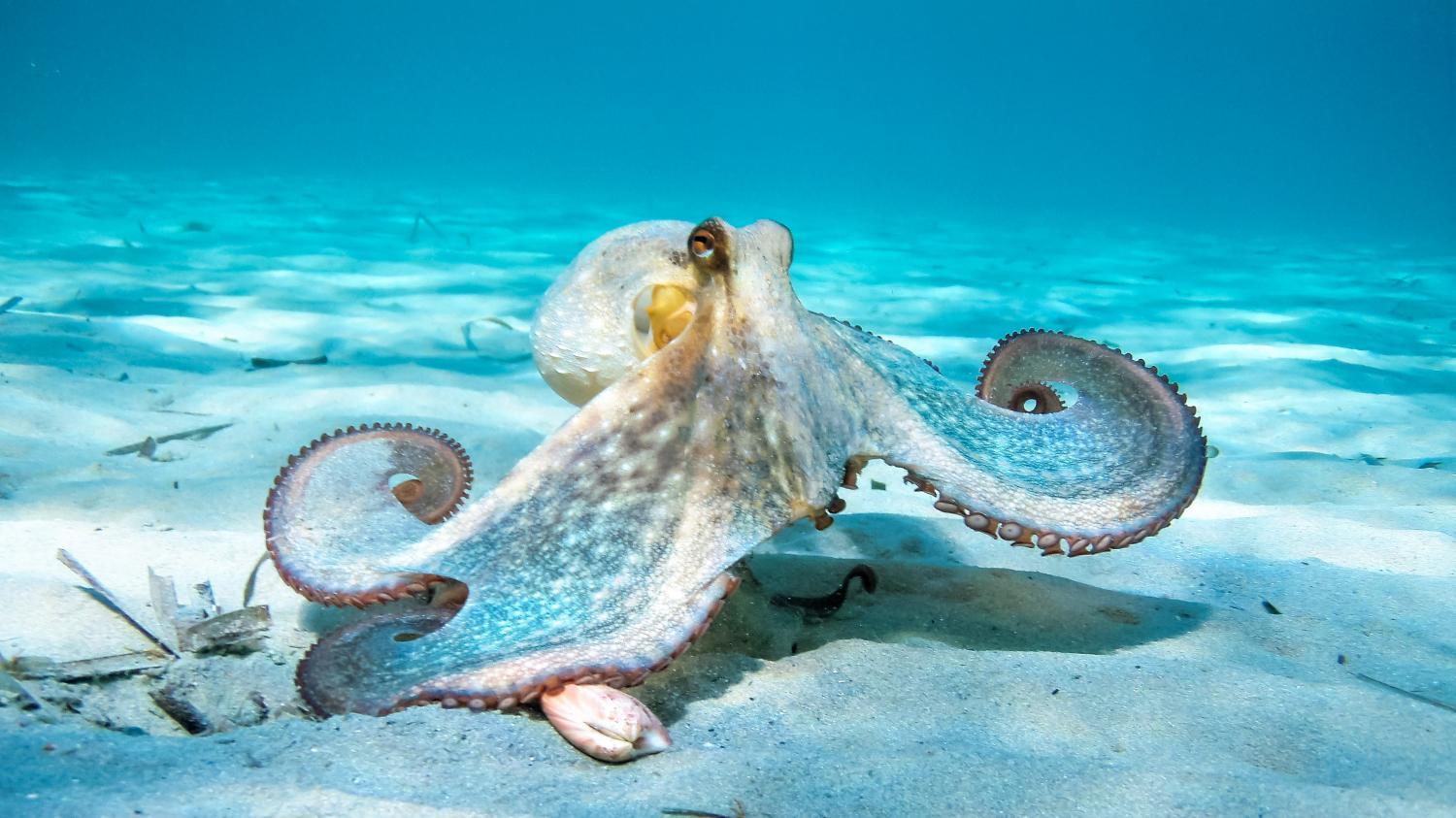
Octopus intelligence
How Octopus Intelligence Works: Arms That Think
How octopus intelligence works: 500 million neurons, two thirds in the arms, suckers that taste, skin that changes in under a second, and fast learning.
8 min read
How Chameleons See and Strike: Vision and Tongue Mechanics
How chameleon vision and tongue strikes work: independent eyes, tongues that reach two body lengths in hundredths of a second, and why colour changes.
7 min read
Why Jumping Spiders Are So Precise: Vision and Jump Planning
Why jumping spiders are so precise: four pairs of eyes with set roles, principal eyes near a pigeon in acuity, depth from defocus, and hydraulic legs.
9 min read