

How King Cobras Survive and Hunt Other Snakes
Explore king cobra behavior, specialized hunting strategy, ecosystem role, and how this predator survives by focusing on one of the hardest niches in the forest.
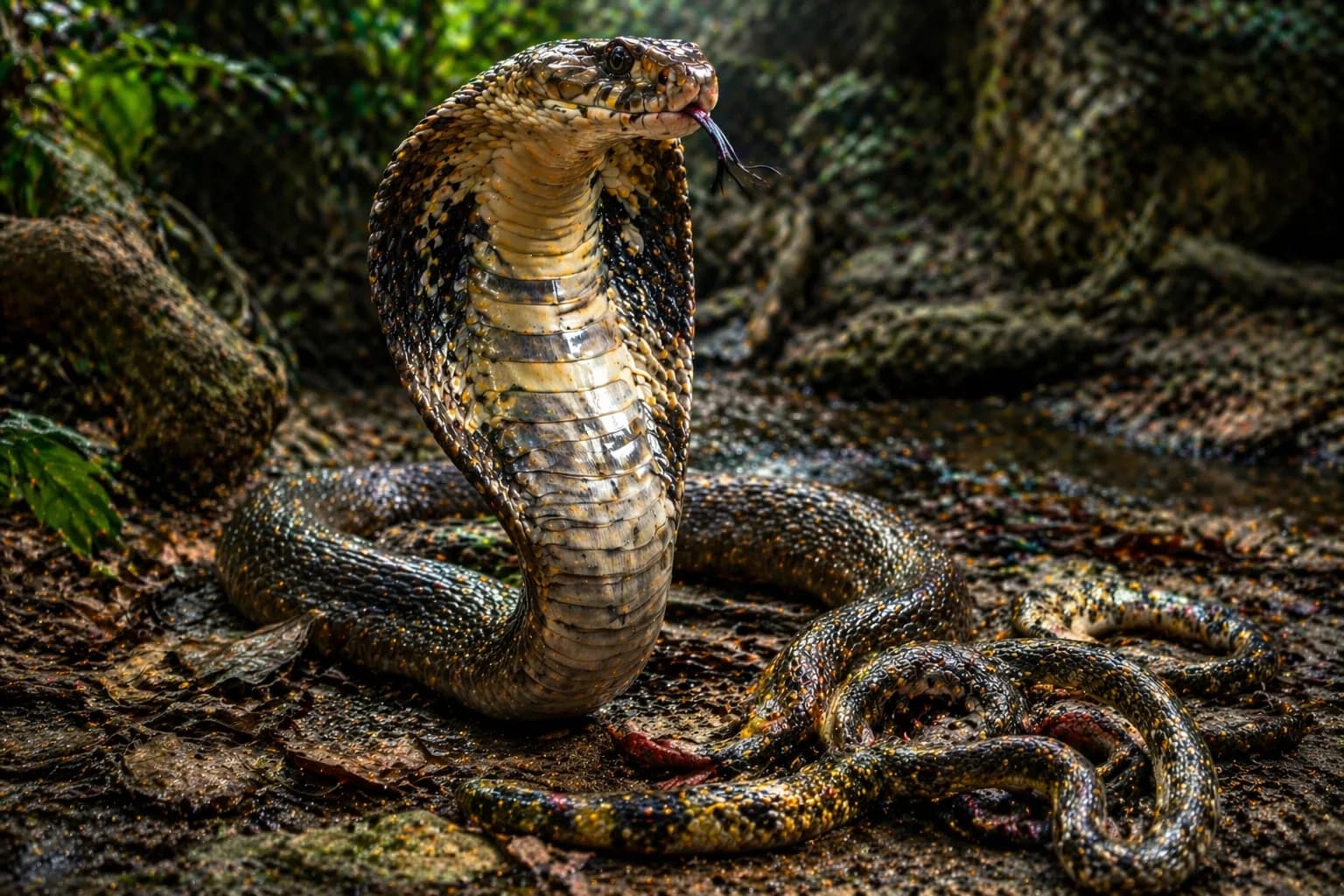
Why the king cobra stands apart
The king cobra matters because it is a specialist with scale. It is not just another venomous snake; it is a predator tuned to track, confront, and consume other reptiles, including other snakes.
That narrow focus gives it a distinct place in discussions about animal behavior and evolutionary strategy.
What makes a king cobra unique?
The king cobra combines strong chemosensory tracking, an elevated defensive and striking posture, significant venom yield, and a long body built for efficient movement through forest structure.
Those traits create a predator that can locate difficult prey and still defend itself with intimidating presence when needed.
How king cobras survive
King cobra survival is built on specialization. By focusing on reptiles that many other predators avoid or cannot manage cleanly, it reduces direct competition for one of its main food channels.
Its animal behavior reflects that economy. This is not a generalist gambler. It is a system tuned for a narrow, high-skill niche.
The ecosystem role of a king cobra
King cobras regulate other snake populations and occupy a high position in reptile food chains. Their ecosystem role helps keep one difficult predator layer from going unchecked.
That matters because controlling predator density inside predator-rich systems can stabilize the broader structure in less obvious ways.
What humans can learn from king cobras
The king cobra demonstrates the value of hard specialization. General competence has value, but some systems create their edge by getting extremely good at one difficult job.
The lesson is not to narrow blindly. It is to choose the niche where precision has the highest payoff.
Systems Intelligence & Hidden Purpose
See these animals as engineered biological systems: what they are built to do, how they fit the wider environment, and what their design can teach us.
System Role
The Reptile Specialist Regulator
King Cobra
Specialized Hardware
Long-range chemosensory tracking, elevated striking posture, large venom yield, and a body built to move efficiently through forest structure make the king cobra specialized anti-snake hardware.
Systems Script
King cobras sit high in reptile food chains and apply pressure to other snake populations. They occupy a narrow but strategic niche, proving that specialization can stabilize a system by targeting one hard problem well.
Strategic Insight
Broad competence is useful, but deep specialization can create uncontested territory. Pick the problem where precision matters more than popularity.
Animals mentioned
Jump from this article into the species pages behind the examples, systems notes, and field-guide references.
Related comparisons
Continue with structured animal-vs-animal comparison pages connected to the species in this guide.
King Cobra vs Black Mamba: Which Snake Has the Edge?
King cobra gets the slight overall edge because it is built to handle other snakes and can fight from a high controlled posture. Black mamba remains terrifying through speed, strike delivery, and lethal venom.
Read comparisonKing Cobra vs Black Vulture: Which Animal Has the Edge?
King cobra gets the overall edge because the black vulture lacks the dedicated leg reach, speed pattern, and strike-management hardware of true snake specialists. The vulture can still harass from above, but the closer the contact gets, the more dangerous the cobra answer becomes.
Read comparisonKing Cobra vs Wolverine: Which Dangerous Animal Has the Edge?
King cobra gets the slight overall edge because one clean venom strike can decide the encounter quickly. Wolverine remains dangerous because it is relentless, fast to close, and built to turn the fight ugly if it survives the first danger window.
Read comparisonKomodo Dragon vs King Cobra: What Happens in a Real Clash?
Komodo dragon usually has the edge in a direct physical clash because of its size, armor, and crushing close-range force. King cobra remains dangerous because one clean venom-delivering strike can change the outcome fast.
Read comparisonAnswer guides related to this topic
If you want direct comparisons and clear recommendations, continue with these answer-focused pages.
Best Animal Identification App
Looking for the best animal identification app? Learn how AnimalDex combines AI scanning, collecting, rarity tracking, and field-guide learning in one app.
Read answer guideWhat Is Animal Collecting
Learn what animal collecting means in modern apps and how AnimalDex turns real-world sightings into cards, sets, rarity, and species learning.
Read answer guidePokemon-Like Animal App
Looking for a Pokemon-like animal app with real species? AnimalDex combines creature-collection energy with AI scanning and wildlife learning.
Read answer guideTurn what you learn into a real animal collection
Keep going in AnimalDex with the species behind this guide, real-world sighting context, and a collection that grows beyond the article.
Related guides
How Wolves Hunt, Survive, and Shape Ecosystems
A clear guide to wolf behavior, pack intelligence, survival strategy, and ecosystem role, with a systems view of how wolves reshape landscapes.
Read articleHow Eagles Use Height, Vision, and Timing to Survive
Learn how eagle behavior, animal vision, hunting strategy, and ecosystem role turn altitude and timing into survival advantages.
Read articleIndus River Dolphin Symbolism: Blind Observation, River Wisdom & Hidden Navigation
Explore Indus river dolphin symbolism through blind echolocation, river navigation, endangered status, and the archetype of seeing without eyes.
Read article