

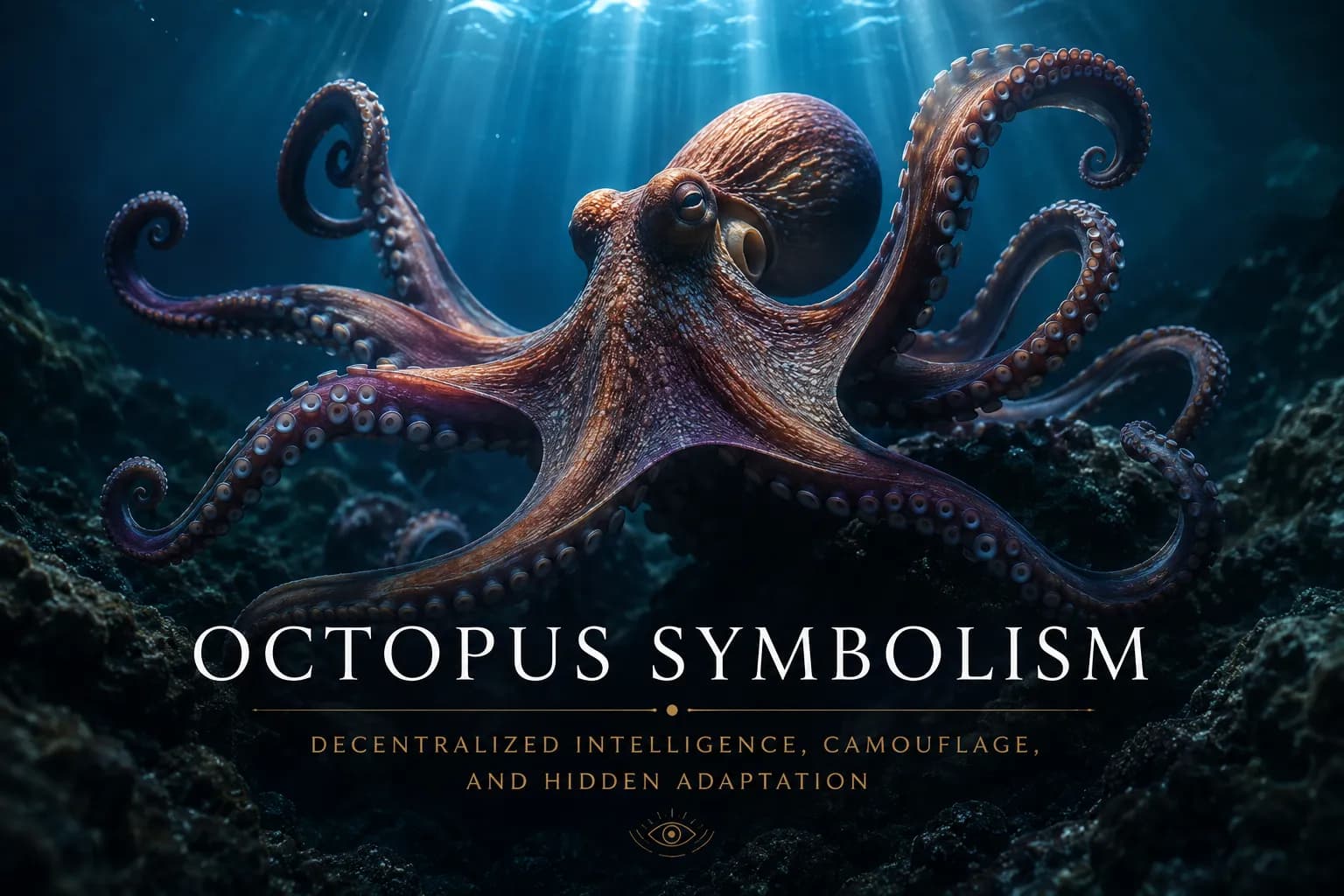
Octopus Symbolism: Decentralized Intelligence, Camouflage, and Hidden Adaptation
Explore octopus symbolism through distributed intelligence, camouflage, regeneration, nervous system symbolism, ancient sea monster mythology, and the archetype of hidden adaptation.
Quick answer
Quick Answer
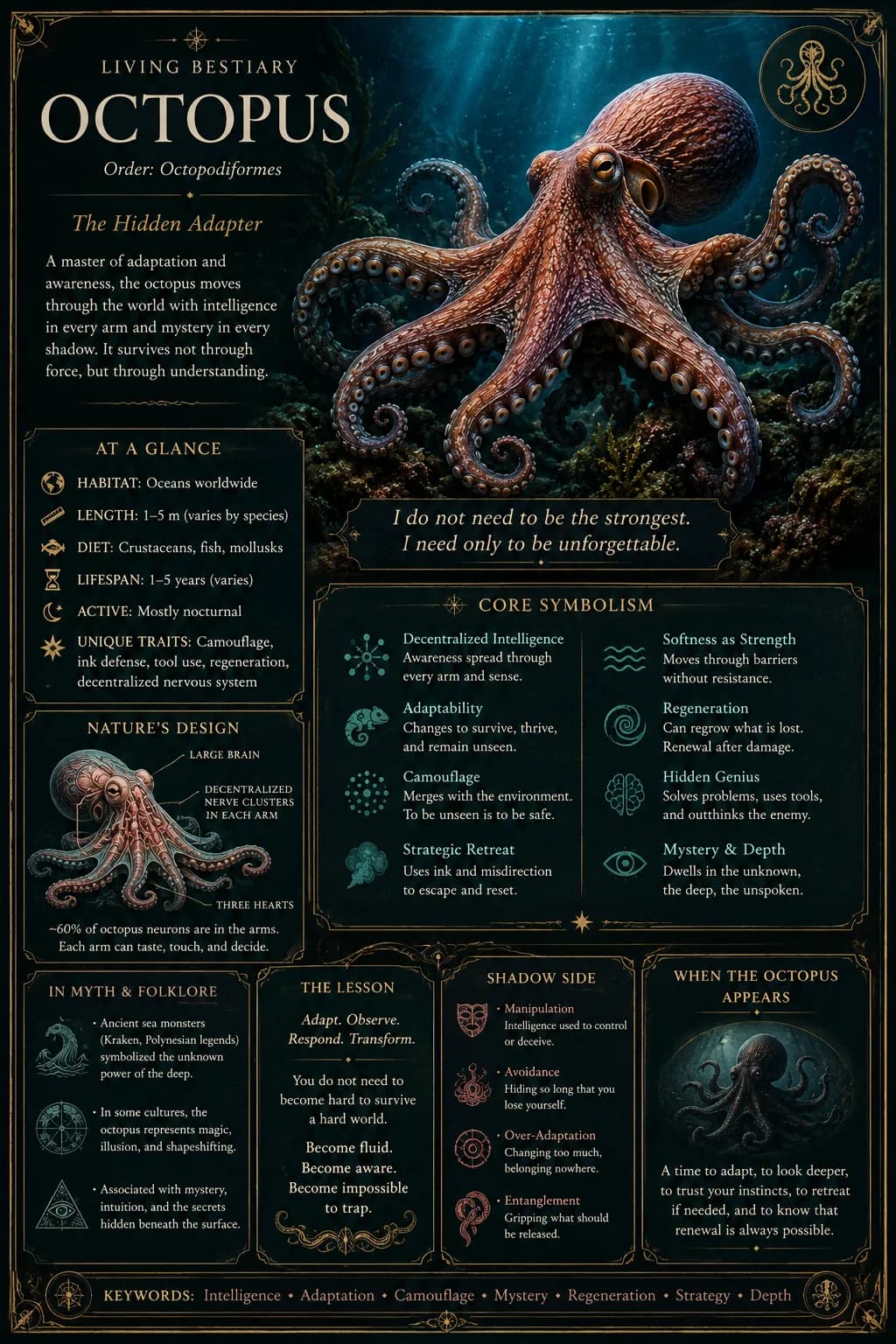
The octopus symbolizes decentralized intelligence, adaptability, hidden mastery, camouflage, mystery, emotional fluidity, tactical retreat, regeneration, survival through softness, and the ability to think in many directions at once.
The octopus does not represent loud power. It does not dominate through armor, teeth, or brute force. It survives through softness, observation, flexibility, camouflage, misdirection, and a kind of intelligence that seems to move through the whole body.
In AnimalDex symbolism, the octopus is not just a sea creature. It is an archetype of intelligence that refuses to become rigid.
The octopus is the animal of intelligence that adapts instead of controls.
Watch: The Octopus as a Living Symbol
Before reading deeper, watch this short AnimalDex video. This article expands on the idea in that video: the octopus as a symbol of distributed intelligence, hidden adaptation, and survival without hardness.
Octopus Symbolism Short
Why the Octopus Feels So Symbolic
Some animals become symbols because they are obvious. The lion looks like royalty. The eagle looks like vision and height. The snake looks like danger and transformation. The wolf looks like instinct and pack loyalty.
But the octopus is different. The octopus does not reveal its meaning immediately. It feels alien, hidden, deep, and fluid. It belongs to the ocean, but not just the surface of the ocean. It belongs to caves, reefs, shadows, currents, and strange intelligence beneath visibility.
The octopus is symbolic because it breaks normal categories. It is soft but powerful. It is solitary but highly aware. It is vulnerable but hard to catch. It is intelligent but not human-like. It has no skeleton but can manipulate the world with incredible precision. It can disappear without leaving the room.
The octopus teaches that power does not always look like force. Sometimes power looks like flexibility.
The Core Meaning of Octopus Symbolism
At its deepest level, the octopus symbolizes intelligence that adapts instead of controls.
The octopus does not survive by forcing the world to become simple. It survives by becoming complex enough to match the world.
It reads the environment. It changes its body. It uses its arms independently. It hides when needed. It escapes through small openings. It confuses predators with ink. It regrows what is lost.
Symbolically, this makes the octopus an animal of hidden adaptation. It represents the kind of person, system, or spirit that does not need to be the strongest thing in the room. It only needs to be the most responsive.
The Octopus as a Living Nervous System
One of the most powerful ways to understand octopus symbolism is to see the octopus as a living nervous system.
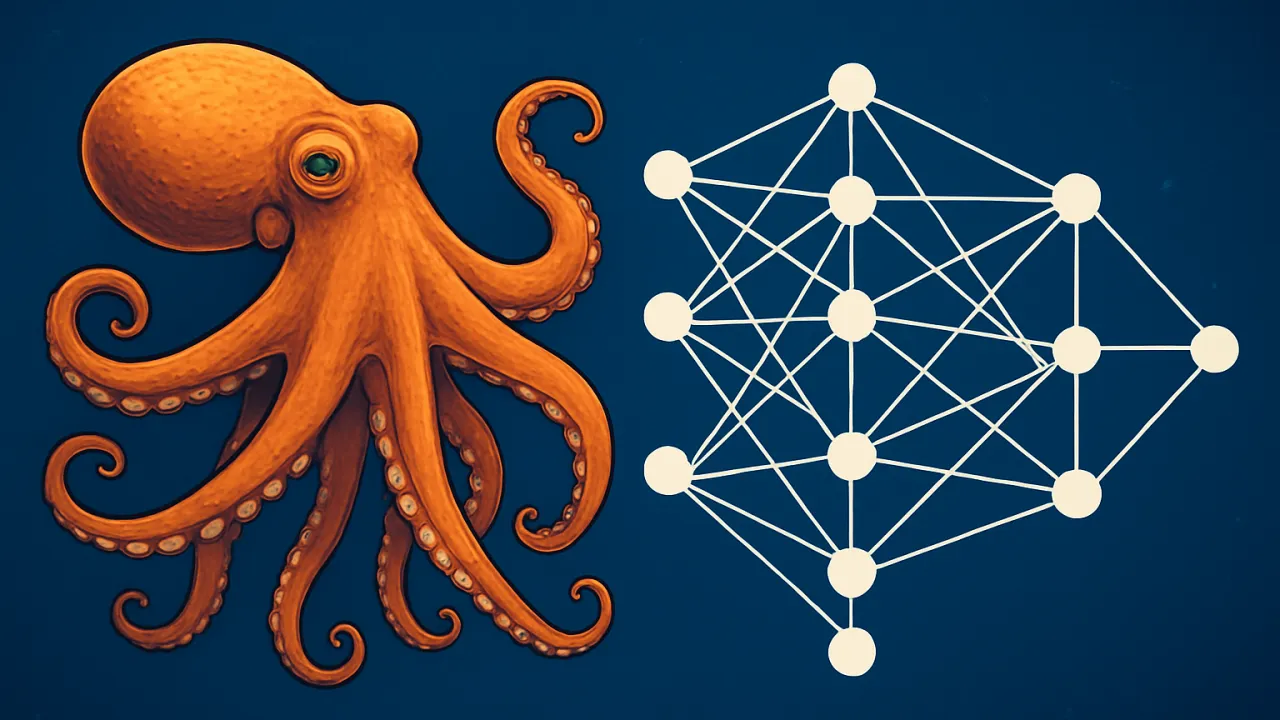
Its arms branch outward like neural pathways, constantly sensing, touching, tasting, gripping, and responding to the environment. Unlike animals whose intelligence appears to be controlled from one central point, the octopus feels distributed. Its awareness seems to move through the whole body.
Symbolically, this makes the octopus a perfect image of decentralized intelligence.
It does not just think from one place. It processes the world through contact, motion, pressure, texture, and response. Each arm becomes like a channel of perception. Each movement becomes a kind of thought.
This is why the octopus can symbolize the nervous system itself: a network of signals, reactions, instincts, memories, and adaptations reaching into the unknown.
In AnimalDex symbolism, the octopus represents the ability to process many signals at once. It is the animal of embodied awareness, emotional intelligence, deep sensitivity, and adaptive response.
The octopus teaches that intelligence is not always a single voice in the head. Sometimes intelligence is a whole-body network.
For SEO language, this is the heart of octopus nervous system symbolism: octopus distributed intelligence, octopus as a symbol of the nervous system, and decentralized intelligence animal symbolism all point to the same core image.
Octopus nervous system symbolism
Decentralized Intelligence
One of the most fascinating things about the octopus is its nervous system. Unlike humans, whose intelligence feels strongly centered in the brain, the octopus has a large amount of neural processing distributed through its arms. Its arms can explore, taste, touch, grip, and respond with a surprising degree of local control.
This gives the octopus a strange symbolic meaning: the octopus is not just smart. It is smart everywhere.
Its intelligence is not only in one command center. It is spread across its body, senses, and contact with the world.
Symbolically, this can represent thinking through experience, trusting more than one source of information, using intuition and environment, letting different parts of yourself solve different problems, moving without needing perfect central control, and building systems where intelligence is distributed instead of trapped at the top.
The octopus is a symbol for people who do not think in straight lines. It is the animal of multidirectional awareness.
The octopus is not just smart. It is smart everywhere.
The Arms: Eight Directions of Awareness
The eight arms of the octopus are not just limbs. Symbolically, they can be read as eight channels of attention.
Each arm reaches into a different part of the world. One arm explores. One arm grips. One arm tastes. One arm searches. One arm protects. One arm manipulates. One arm anchors. One arm escapes.
This makes the octopus a powerful symbol of many-directional intelligence. Where a predator like a shark moves forward, the octopus can move outward.
Its intelligence is radial. Its body is a living network. Its awareness is spread like a web.
In human terms, the octopus can symbolize emotional intelligence, social adaptation, strategic thinking, creative problem-solving, multitasking, environmental awareness, intuitive sensing, and survival through flexibility.
This is why the octopus feels so connected to artists, strategists, introverts, inventors, mystics, and people who survive by reading the room.
Camouflage: The Power of Becoming Unreadable
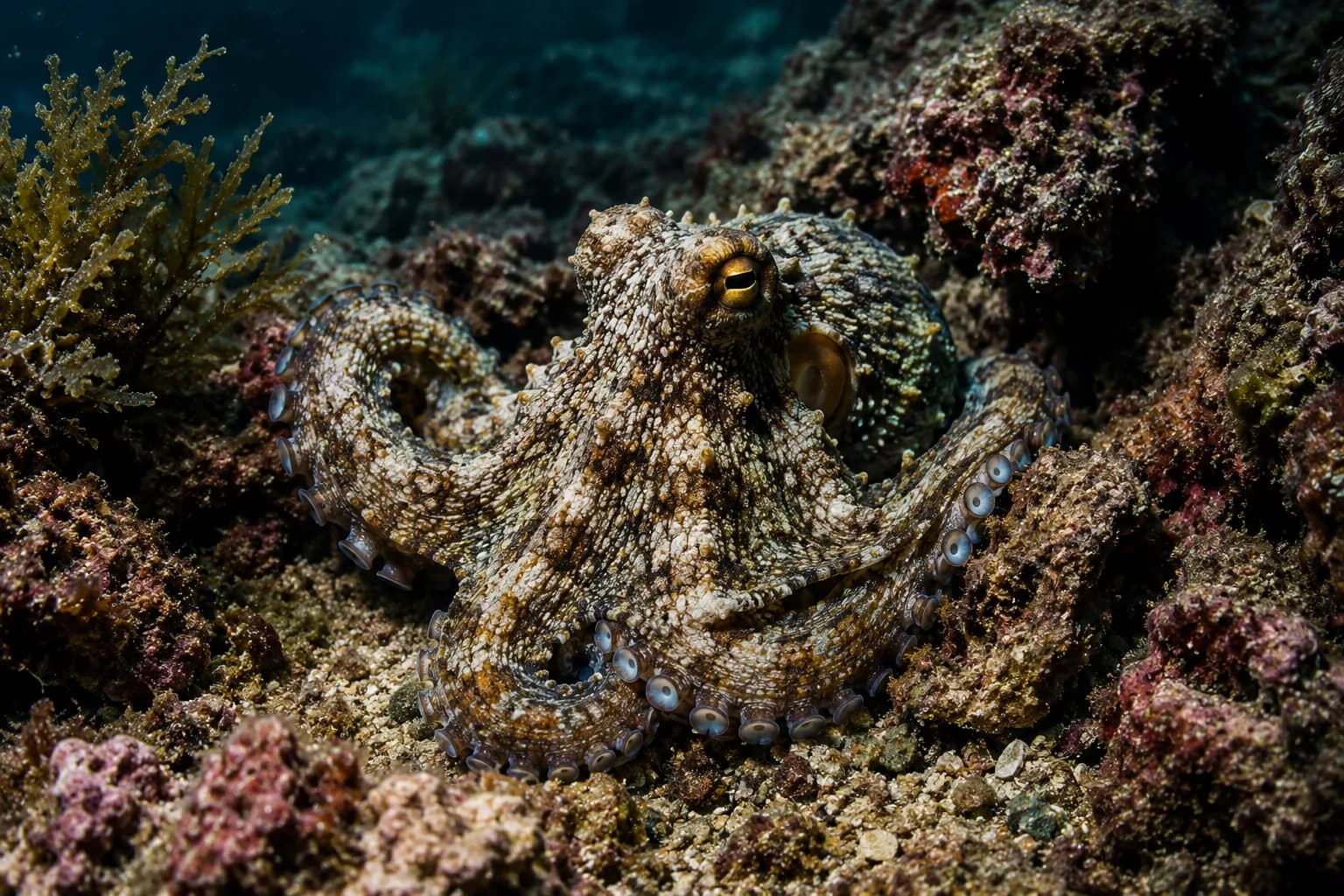
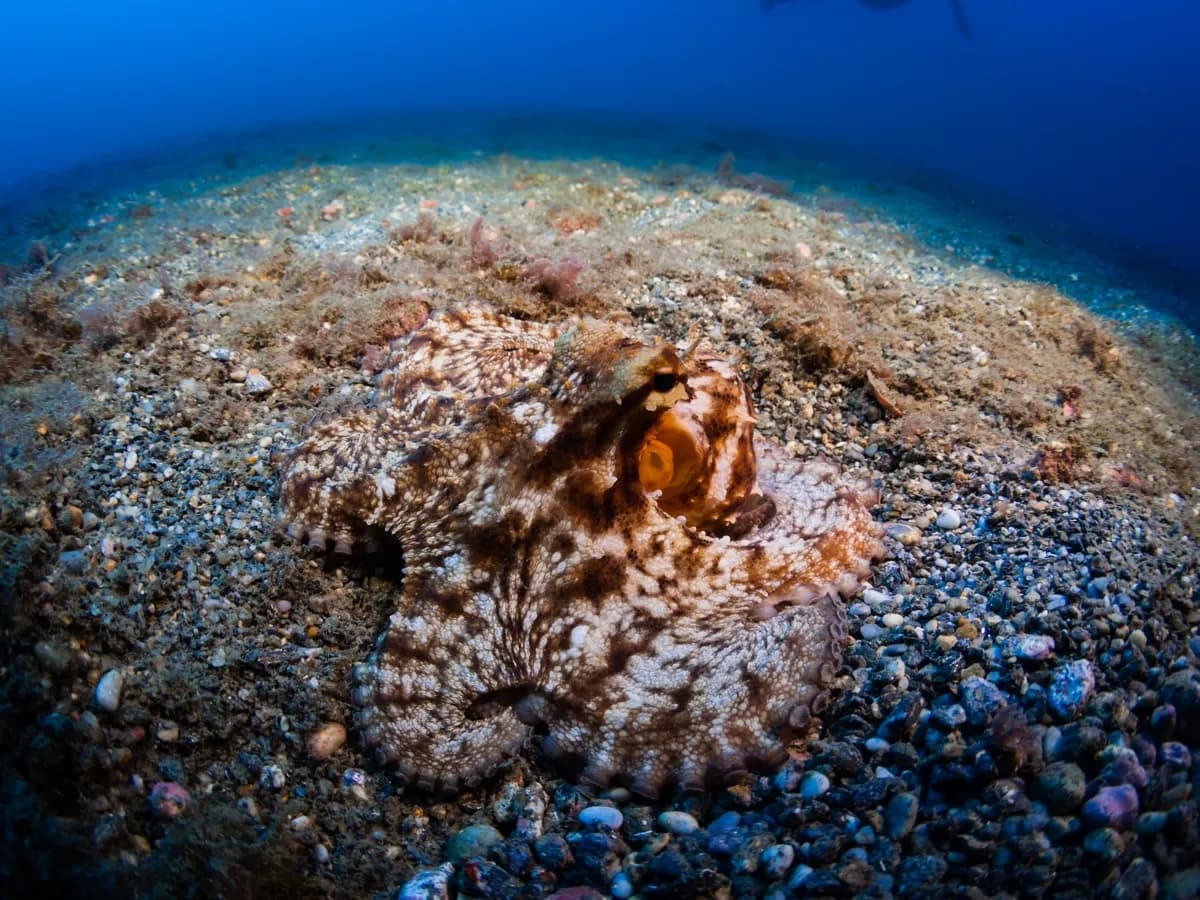
The octopus is famous for camouflage. It can change color, pattern, and sometimes even skin texture to blend into its surroundings. This is not just hiding. It is environmental translation.
The octopus looks at the world and becomes part of it.
Symbolically, camouflage can mean adaptation, invisibility, protection, social masking, mystery, emotional intelligence, knowing when not to reveal yourself, and becoming unreadable to danger.
In a positive sense, octopus camouflage represents wisdom. It means knowing that not every moment requires full exposure.
Not every truth needs to be spoken immediately. Not every strength needs to be displayed. Not every plan needs to be announced. Not every battle needs to be fought directly.
The octopus teaches the sacred intelligence of concealment.
The Shadow Side of Camouflage
Every animal symbol has a shadow side. If camouflage is used wisely, it becomes protection.
But if camouflage becomes unconscious, it can become avoidance, deception, fear of being seen, loss of identity, emotional hiding, manipulation, and never showing your true form.
This is the darker side of octopus symbolism.
The octopus may ask: are you adapting, or are you disappearing? Are you protecting yourself, or are you hiding from life? Are you changing shape because you are wise, or because you are afraid to be known?
The octopus does not only symbolize camouflage. It also challenges us to ask when camouflage has gone too far.
Ink: Confusion as a Survival Strategy
When threatened, many octopuses can release ink into the water. This creates confusion. It blocks vision. It buys time. It allows escape.
Symbolically, ink represents tactical obscurity. The octopus does not always fight the predator. It changes the conditions of the encounter.
Some battles are not won by strength. Some are won by creating distance. Some are won by refusing to be fully captured. Some are won by leaving before the enemy understands what happened.
In human life, octopus ink may symbolize misdirection, emergency boundaries, strategic retreat, confusing hostile attention, protecting your inner world, escaping control, and refusing to be pinned down.
This does not mean lying or manipulating. At its highest level, ink represents the right to create space when danger gets too close.
Softness: Power Without Armor
The octopus has a soft body. This makes it vulnerable, but also gives it one of its greatest powers.
Because it has no bones, the octopus can squeeze into small spaces and move through environments that would trap more rigid animals.
This is one of the most important symbolic lessons of the octopus: softness is not weakness. Softness is mobility.
The armored animal survives by resisting pressure. The octopus survives by changing shape under pressure.
This makes the octopus a symbol of emotional flexibility, adaptability under stress, survival without hardness, nonlinear strength, moving through impossible situations, and escaping traps by refusing rigidity.
In a world that often teaches people to become harder, the octopus suggests another path: become more responsive, become more fluid, become less easy to trap.
Regeneration: The Ability to Return From Loss
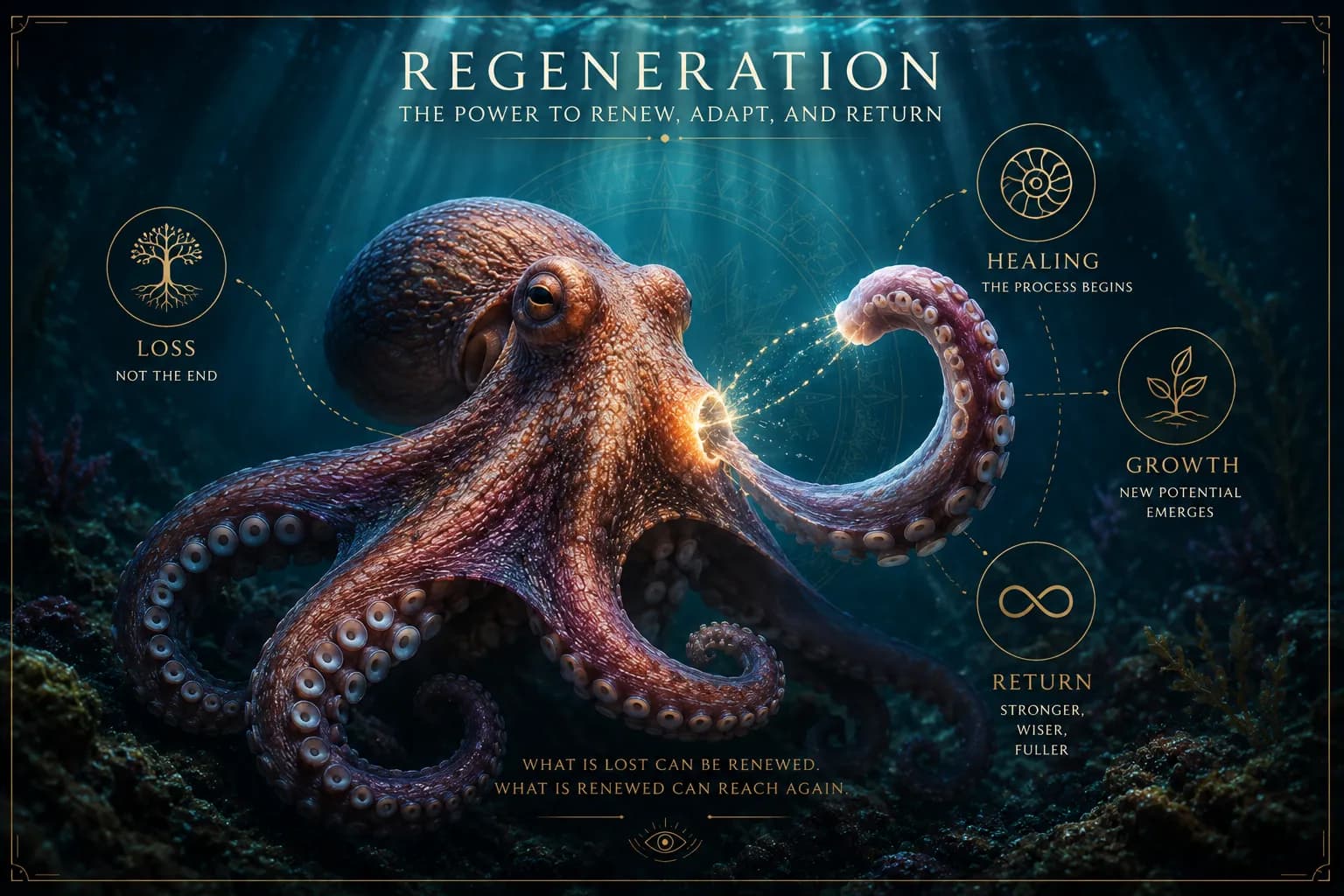
Octopuses can regenerate lost arms. Symbolically, this makes the octopus a creature of recovery.
It does not avoid all injury. It does not live untouched by danger. But when something is lost, it has a biological pathway back toward wholeness.
This gives octopus symbolism a deep healing layer. The octopus may represent recovery after loss, rebuilding after trauma, returning after damage, the intelligence of repair, not being permanently defined by what was taken, and growing new ways to reach the world.
Regeneration is different from invincibility. The octopus is not saying, nothing can hurt me. It is saying, even if I am hurt, I can regrow my reach.
The Octopus and the Ocean Depths
The ocean is already symbolic. It represents the unconscious, emotion, mystery, memory, dreams, birth, death, and the unknown.
The octopus lives inside that symbolism. It is not a sky animal. It is not a desert animal. It is not a mountain animal. It belongs to depth.
This makes the octopus especially connected to the unconscious mind, emotional complexity, hidden fears, intuition, dreams, mystery, deep memory, and the unknown self.
When the octopus appears as a symbol, it may be asking you to look beneath the obvious surface. Not what do I think, but what is moving underneath what I think? Not what is visible, but what is shaping the visible from below?
Ancient Sea Monsters and the Fear of the Deep
The octopus also connects to a long symbolic tradition of sea monsters. Across cultures, tentacled sea creatures and giant ocean beings often represent the unknown forces of the deep.
They appear as monsters because the deep ocean itself was terrifying: dark, vast, hard to map, and full of hidden life.
This gives the octopus a second symbolic layer. It can represent wisdom and adaptation, but it can also represent the fear of being pulled into something unknown.
Tentacles are symbolically powerful because they reach, wrap, grip, and emerge from places we cannot fully see.
That is why octopus-like creatures can feel mysterious or frightening in mythology, art, and horror. They represent forces that are intelligent but not human, alive but not familiar, powerful but not easily understood.
The octopus is the animal of alien intelligence. Not alien because it comes from space, but because it shows us that intelligence on Earth can evolve in a completely different form.
The Octopus as an Archetype
As an archetype, the octopus can be described as the Hidden Adapter.
This archetype survives by observing, sensing, adjusting, and transforming.
It does not need to be the center of attention. It does not need to overpower every enemy. It does not need a fixed identity in every situation. It knows when to be visible and when to vanish. It knows when to grip and when to release. It knows when to fight and when to flow.
The Hidden Adapter is powerful because it cannot be easily predicted.
It lives by intelligence, timing, and transformation.
The Hidden Adapter is powerful because it cannot be easily predicted.
Positive Octopus Symbolism
The positive meanings of the octopus include intelligence, adaptability, creativity, strategy, flexibility, mystery, regeneration, emotional depth, problem-solving, intuition, survival, sensory awareness, protection, transformation, and multidirectional thinking.
When the octopus appears positively, it may mean you are learning to adapt, becoming harder to trap, developing deeper intelligence, learning when to be seen and when to stay hidden, healing your reach after loss, and finding power in softness.
Shadow Octopus Symbolism
The shadow meanings of the octopus include manipulation, emotional hiding, over-adaptation, deception, control, avoidance, fear of exposure, entanglement, escapism, unclear identity, silent resentment, and becoming unreadable even to yourself.
When the octopus appears in its shadow form, it may be asking: where am I hiding too much? Where am I adapting so often that I lose myself? Where am I using intelligence to avoid vulnerability? Where am I creating confusion instead of honesty? Where am I gripping something I need to release?
Octopus Symbolism in Personal Growth
In personal growth, the octopus can symbolize the stage where you stop trying to survive through force. Instead, you learn to survive through awareness.
You become more observant. You become more emotionally intelligent. You stop announcing every move. You learn to read environments. You become flexible without losing yourself. You learn to retreat without shame. You learn to repair after damage.
The octopus teaches that survival is not always about becoming tougher. Sometimes survival is about becoming more fluid.
Octopus Symbolism in Creativity
The octopus is also a strong symbol for creative people.
Creativity is not linear. It reaches in many directions. It touches many ideas at once. It changes color depending on context. It pulls hidden things from the unconscious and gives them form.
This makes the octopus a perfect animal symbol for artists, writers, designers, musicians, inventors, strategists, worldbuilders, symbolists, researchers, and people with many creative identities.
The octopus does not create by marching in a straight line. It creates by exploring through multiple arms of awareness.
Octopus Symbolism in Business and Strategy
The octopus can also symbolize a powerful business strategy. A rigid company breaks when the environment changes. An octopus-like company adapts.
It senses the market. It changes shape. It explores many directions. It hides its weaknesses. It uses tools. It retreats from bad fights. It regenerates after loss. It survives because its intelligence is distributed.
This is why the octopus is a strong symbol for startups, creators, and builders. It represents adaptive intelligence in uncertain environments.
Octopus Symbolism in Relationships
In relationships, octopus symbolism can be both beautiful and dangerous.
The beautiful side is emotional depth, sensitivity, intuition, and the ability to understand many signals at once.
The difficult side is over-gripping, hiding, testing, disappearing, or changing shape to avoid being truly known.
The octopus asks for balance: can you be flexible without becoming unclear? Can you protect yourself without disappearing? Can you hold someone without trapping them? Can you reveal yourself without losing your mystery?
What the Octopus Teaches
The octopus teaches that intelligence does not need to be loud.
It teaches that softness can be strategic. It teaches that mystery can be protective. It teaches that escape is sometimes wiser than confrontation. It teaches that the body can know things before the mind explains them. It teaches that adaptation is a form of power.
Most importantly, the octopus teaches: you do not need to become hard to survive a hard world.
You can become fluid. You can become observant. You can become creative. You can become difficult to trap. You can regrow what was lost. You can learn to move through the world with many forms of intelligence.
Octopus Symbolism Summary
Distributed nervous system
Symbolic meaning: decentralized intelligence, intuition, and body wisdom.
Eight arms
Symbolic meaning: multidirectional awareness, reach, and complexity.
Camouflage
Symbolic meaning: adaptation, protection, invisibility, and social masking.
Ink
Symbolic meaning: misdirection, tactical retreat, and emergency boundaries.
Soft body
Symbolic meaning: flexibility, softness as strength, and escape from rigidity.
Regeneration
Symbolic meaning: healing, recovery, and rebuilding after loss.
Tool use
Symbolic meaning: hidden genius, practical intelligence, and creative survival.
Ocean habitat
Symbolic meaning: depth, mystery, unconscious emotion, and hidden knowledge.
Solitary nature
Symbolic meaning: independence, self-containment, and private mastery.
Final Interpretation
The octopus symbolizes decentralized intelligence, hidden adaptation, and the power of softness.
It is the animal of people who think in many directions. It is the animal of those who survive by reading the room, changing shape, staying fluid, and knowing when to disappear.
The octopus does not say, become stronger than everything.
It says, become harder to capture.
That is the deeper lesson of the octopus: not domination, not aggression, not armor, but awareness, flexibility, regeneration, mystery, and intelligence spread through every part of the self.
Become harder to capture.
Systems Intelligence & Hidden Purpose
See these animals as engineered biological systems: what they are built to do, how they fit the wider environment, and what their design can teach us.
System Role
The Soft-Bodied Escape Engineer
Octopus
Specialized Hardware
A distributed nervous system, dexterous arms loaded with sensory receptors, chromatophore camouflage, and a body that can compress through tiny gaps make the octopus extraordinary adaptive hardware.
Systems Script
Octopuses regulate crustaceans, mollusks, and reef-floor prey while occupying crevices other predators cannot exploit. They show how flexible architecture can compete with armored design by turning shape itself into strategy.
Strategic Insight
Do not centralize every decision. Put sensing and action closer together and the whole system becomes faster under pressure.
Quick questions
Short answers to common questions readers ask on this topic.
What does an octopus symbolize?
The octopus commonly symbolizes intelligence, adaptability, mystery, camouflage, emotional depth, regeneration, and survival through flexibility. Because of its unusual nervous system and behavior, it can also symbolize decentralized intelligence and multidirectional awareness.
What is the spiritual meaning of an octopus?
Spiritually, the octopus can represent hidden wisdom, intuition, transformation, and the ability to adapt to difficult emotional environments. It may also symbolize the unconscious mind because it lives in the ocean, a common symbol of depth and mystery.
Is the octopus a symbol of intelligence?
Yes. The octopus is often associated with intelligence because of its problem-solving ability, complex nervous system, curiosity, and flexible behavior. Symbolically, it represents intelligence that is adaptive, embodied, and non-linear.
What does octopus camouflage symbolize?
Octopus camouflage can symbolize protection, adaptation, invisibility, emotional masking, or knowing when not to reveal yourself. In its shadow form, it can also represent deception, avoidance, or losing your identity by constantly changing for your environment.
What does an octopus tattoo mean?
An octopus tattoo can represent intelligence, mystery, adaptability, resilience, creativity, independence, or survival through flexibility. It may also symbolize someone who thinks in many directions or has learned to survive by becoming fluid instead of rigid.
What is the shadow meaning of the octopus?
The shadow side of octopus symbolism includes manipulation, hiding, emotional avoidance, over-adaptation, control, and confusion. The octopus can warn against disappearing so often that you lose touch with your true self.
Sources and Further Reading
- Hochner - An Embodied View of Octopus Neurobiology
- Gutnick et al. - Use of Peripheral Sensory Information for Central Nervous Control of Arm Movement by Octopus
- Wang et al. - Modeling the Neuromuscular Control System of an Octopus Arm
- Finn, Tregenza, and Norman - Defensive tool use in a coconut-carrying octopus
- Ramirez and Oakley - Eye-independent, light-activated chromatophore expansion in Octopus bimaculoides
Animals mentioned
Jump from this article into the species pages behind the examples, systems notes, and field-guide references.
Related comparisons
Continue with structured animal-vs-animal comparison pages connected to the species in this guide.
Dolphin vs Octopus Intelligence: Which Animal Thinks Better?
Dolphin gets the edge in social intelligence, communication, and group learning. Octopus gets the edge in solitary problem solving, manipulation, and flexible immediate adaptation. The smartest answer still depends on the task.
Read comparisonCuttlefish vs Octopus Intelligence: Which Cephalopod Thinks Better?
Octopus gets the edge in direct manipulation and puzzle-style problem solving. Cuttlefish gets the edge in visual signaling, camouflage control, and rapid display-based adaptation. The smartest answer depends on the task format.
Read comparisonOctopus vs Crab: Which Sea Fighter Has the Better Edge?
Octopus usually has the edge because intelligence, flexibility, and grip-based control are excellent answers to a crab's shell and claws. Crab still becomes dangerous in tight defensive terrain where armor and pinch range matter more.
Read comparisonAnswer guides related to this topic
If you want direct comparisons and clear recommendations, continue with these answer-focused pages.
Best Animal Identification App
Looking for the best animal identification app? Learn how AnimalDex combines AI scanning, collecting, rarity tracking, and field-guide learning in one app.
Read answer guideWhat Is Animal Collecting
Learn what animal collecting means in modern apps and how AnimalDex turns real-world sightings into cards, sets, rarity, and species learning.
Read answer guidePokemon-Like Animal App
Looking for a Pokemon-like animal app with real species? AnimalDex combines creature-collection energy with AI scanning and wildlife learning.
Read answer guideTurn what you learn into a real animal collection
Keep going in AnimalDex with the species behind this guide, real-world sighting context, and a collection that grows beyond the article.
Related guides
What If Every Animal Is a Lesson? Animal Frequencies, Symbolism & AnimalDex
Explore animal frequencies, animal symbolism, reincarnation theories, octopus intelligence, jellyfish meaning, eagle vision, dolphin communication, and the AnimalDex method for decoding animals as living lessons.
Read articleHow Octopus Intelligence Works: Nature’s Most Advanced Problem Solver
Explore octopus intelligence through animal behavior, flexible nervous systems, camouflage, survival strategy, and the octopus ecosystem role.
Read articleAnimal Experiments They Won’t Repeat — Ethics or Cover-Up?
Explore the forbidden animal files: CIA spy cats, bat bombs, planarian memory, Rupert Sheldrake, animal death instincts, Kirlian photography, medieval bestiaries, and ancient animal symbolism.
Read article