

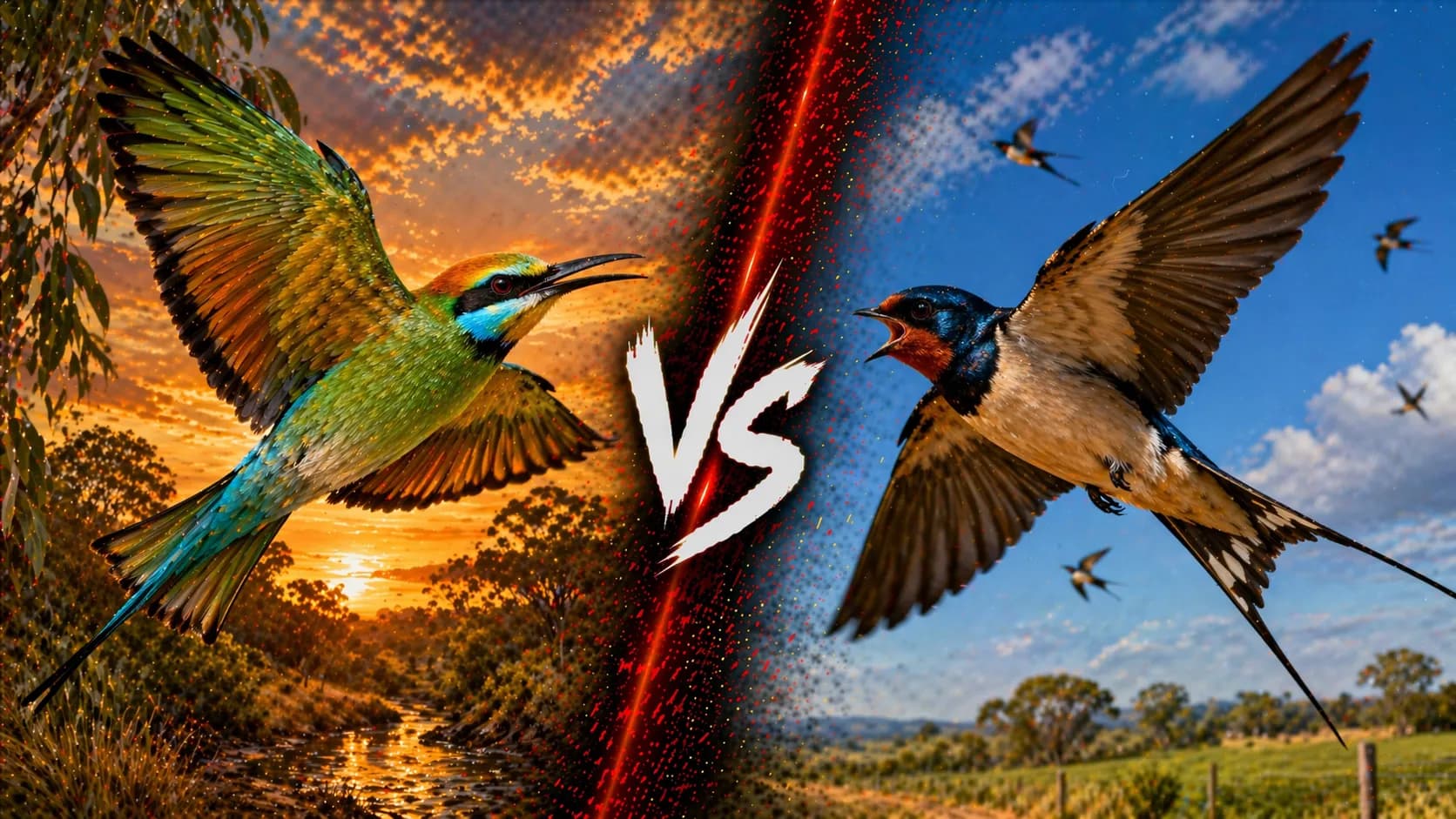
Rainbow Bee-Eater vs Barn Swallow Speed: Which Aerial Insect Hunter Is Faster?
A rainbow bee-eater vs barn swallow speed comparison covering pursuit style, turning, wing shape, and what 'faster' means in small-bird flight.
Meet the animals in this matchup
Go straight to the species guides behind this comparison for identification, habitat, rarity, and deeper AnimalDex context.
Quick verdict
Start with the direct answer, then use the structured comparison below to see what changes the outcome.
Barn swallow usually gets the cleaner speed verdict in sustained fast flight. Rainbow bee-eater stays more specialized for agile insect intercepts and short aerial adjustments around feeding space.
This is not a heavyweight speed page. It is a flight-style page. The swallow is the better sustained fast flier, while the bee-eater is excellent at quick aerial corrections around prey.
Why this matchup is interesting
It shows that small-bird speed is not only about a top number. Sustained flight and prey-snatching agility are related but different strengths.
Head-to-head species stats
These are the same core AnimalDex stat dimensions used on the dedicated animal pages, pulled side by side so the matchup is faster to scan.
Rainbow Bee-eater
Stats source: Canonical species profile
Barn Swallow
Stats source: Canonical species profile
Trait-by-trait comparison
Only the categories that matter to this matchup are included. The goal is not filler stats, but the real design differences that change the result.
Sustained flight speed
Rainbow Bee-eater
Fast and agile over feeding territory
Barn Swallow
More efficient sustained fast flight
Why it matters
Swallow is the stronger pure speed answer.
Insect intercept control
Rainbow Bee-eater
Excellent quick-turn prey capture
Barn Swallow
Very strong aerial feeding, but less specialized for larger stinging prey
Why it matters
Bee-eater wins the more prey-specific intercept question.
Flight style
Rainbow Bee-eater
Snap adjustments around visible prey
Barn Swallow
Smoother sustained aerial efficiency
Why it matters
The answer changes depending on whether the question is speed or prey-handling agility.
Scenario breakdown
This is where shallow battle content usually fails. Terrain, spacing, timing, and engagement style can change the answer.
Long open flight
Barn swallow edge
This is the cleaner sustained-speed environment.
Short insect chase
Bee-eater edge
Short targeted interception is where the bee-eater shines.
Mixed airspace feeding
Depends on the prey task
If the question is who can stay fast longer, swallow wins. If it is who handles the specific catch better, bee-eater improves.
Explore these animals
Use the full species pages to go deeper on biology, habitat fit, and the real traits behind this verdict.
Rainbow Bee-eater
The rainbow bee-eater is a slim brightly colored aerial insect hunter that catches stinging insects on the wing and nests in burrows.
Read species guideBarn Swallow
Barn swallows are agile aerial insectivores known for forked tails, high-speed turning, and close ties to open landscapes and human structures.
Read species guideSystems Intelligence & Hidden Purpose
See the animals behind this comparison as engineered biological systems: what each one is built to do, where it gains leverage, and why the matchup changes by scenario.
System Role
The Aerial Stinger Filter
Rainbow Bee-eater
Specialized Hardware
Fine flight control, long bill, and prey-handling precision make bee-eaters specialized hardware for catching and disarming flying insects.
Systems Script
Bee-eaters reduce aerial insect abundance while converting open sky and sandy nest banks into a tightly linked feeding-breeding system. They make niche precision look easy.
Strategic Insight
Specialization pays when the handling protocol is as important as the catch.
System Role
The Aerial Insect Net
Barn Swallow
Specialized Hardware
Forked tail steering, narrow wings, and high-frequency turning control make swallows efficient flying insect capture hardware.
Systems Script
Barn swallows skim insect populations over fields, wetlands, and human settlements while linking migration routes to everyday architecture. They turn open air into a working harvest zone.
Strategic Insight
If the resource is moving, your system has to move with equal fluency.
Final take
Barn swallow is the better pure speed answer. Rainbow bee-eater is the better prey-specific aerial intercept answer.
Compare real animals in the wild
Use AnimalDex to track the species behind this speed matchup and compare how real habitat, behavior, and body design shape the answer.
Comparison FAQ
Short, direct answers to the next questions readers usually ask after the headline verdict.
Which is faster, a rainbow bee-eater or a barn swallow?
Barn swallow usually gets the stronger sustained speed verdict.
Why does the bee-eater still matter in a speed page?
Because it is exceptionally good at fast insect interception, which is related to speed but not identical to sustained straight-line flight.
Related comparisons
Continue with nearby matchups to compare more real-world animal traits without dropping into junky who-wins filler.
Ruby-Throated Hummingbird vs Rainbow Bee-Eater: Which Bird Is More Agile?
Hummingbird wins the pure agility question because hovering, reverse flight, and tiny-space control are its entire design brief. Bee-eater is still the better fast intercept bird over slightly broader feeding airspace.
Read comparisonOstrich vs Cheetah Speed: Which Is Actually Faster?
Cheetah owns the cleaner top-speed headline, but ostrich is a real long-stride runner and can stay competitive when the question shifts from explosive pursuit to sustained open-ground movement.
Read comparisonPeregrine Falcon vs Owl: Which Bird Has the Better Edge?
Peregrine falcon gets the speed and open-air answer by a mile. Owl gets the quieter low-light answer and can become much more relevant when the page shifts from raw speed to surprise in darkness.
Read comparisonPeregrine Falcon vs Red-tailed Hawk: Which Bird Has the Better Speed Edge?
Peregrine falcon is the clear speed winner. Red-tailed hawk remains the better soaring, watching, and broad-habitat control bird rather than the faster one.
Read comparison