

crocodilesfossilsancient Egypt
Crocodile Fossil Is Missing Its Nose, Like the Great Sphinx
A 45-million-year-old crocodile skull from the same rock as the Great Sphinx sat misfiled for nearly a century. Now it has a god's name, and no nose.
Dalam panduan ini
- Which crocodile fossil came from the same rock as the Great Sphinx?
- Why is it called Herugavialis, and who is Heru?
- Is Herugavialis really a new species?
- Why do gharials have such long, thin snouts?
- Gharial vs false gharial: the last two of 40-plus species
- Were there crocodiles in the Mediterranean, and why did they disappear?
- Where can you see a gharial today?
The short answer
Quick answer
The crocodile is Herugavialis cairensis, an extinct, roughly 45-million-year-old gavial-type crocodile whose skull came from the Mokattam Formation, the rock the Great Sphinx was carved from. First named Tomistoma cairense in 1927, it was moved into a new genus after nearly a century under the wrong name. Like the Sphinx, its skull is missing the tip of its nose.
Same rock
Which crocodile fossil came from the same rock as the Great Sphinx?
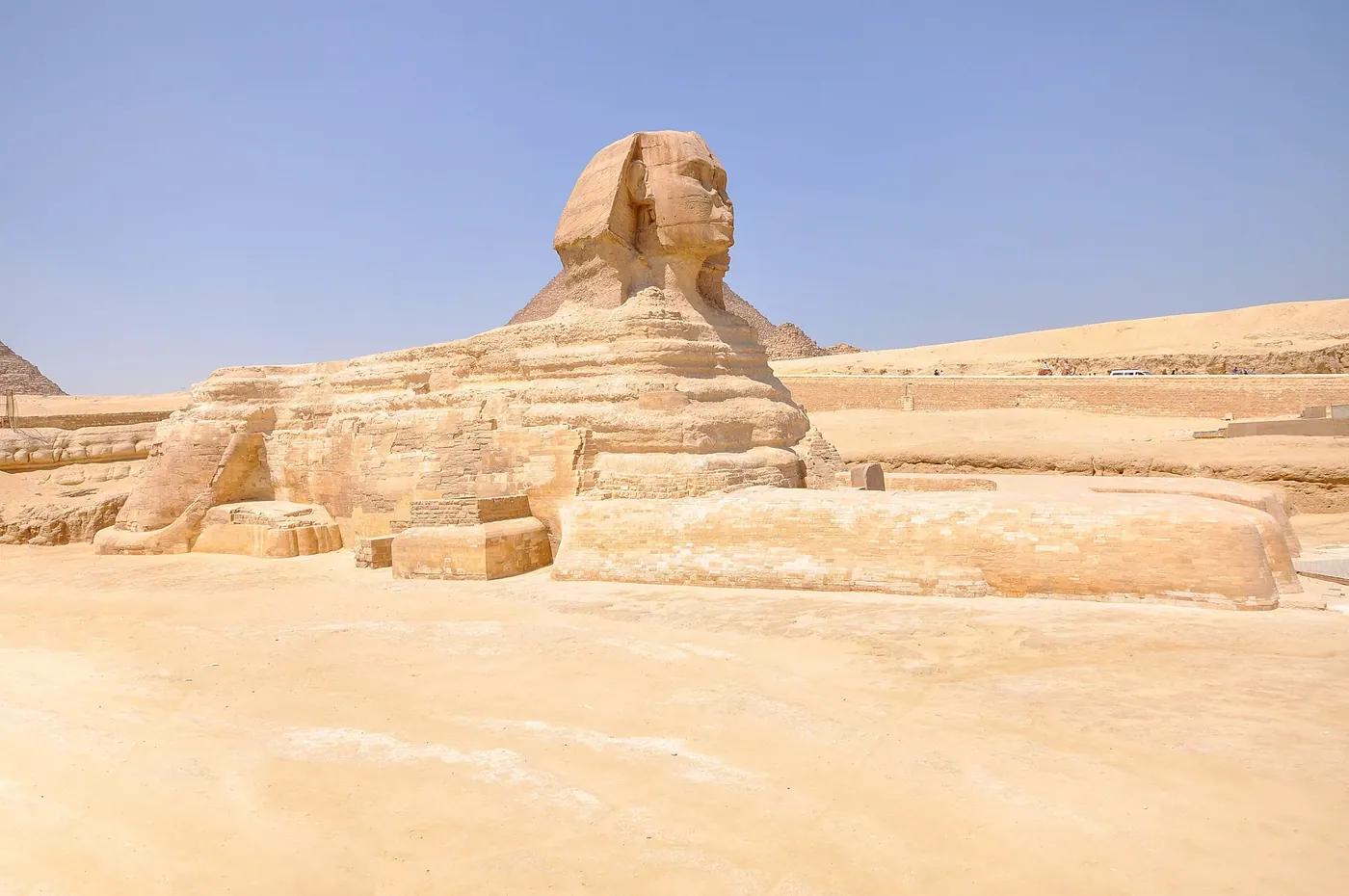
The Great Sphinx and a 45-million-year-old crocodile came out of the same rock, and both are missing their noses. The crocodile is Herugavialis cairensis. Its skull is nearly complete except for one detail: the tip of the snout is gone.
The shared rock is the Mokattam Formation, the layer the Sphinx was carved from. The skull was not prised out of the monument itself. It was collected east of Cairo in the 1920s and now sits in the Stuttgart State Museum of Natural History in Germany. Two icons of Giza came from the same rock, and neither of them kept its nose.
A new study in Royal Society Open Science, led by Paul Burke of the Swedish Museum of Natural History and Philip Mannion of UCL, found that this crocodile had been on the wrong branch of the family tree for nearly a century. Moving it is not just tidying up a label. Where a fossil sits on the tree decides which animals it gets compared with, and getting this one right changes the picture of which long-snouted crocodiles once lived around the Mediterranean.
That picture has a strange ending. Today the Mediterranean has no crocodiles at all, and the reason involves something far bigger than a missing nose: what happened to the sea itself.
The name
Why is it called Herugavialis, and who is Heru?
Heru is the Egyptian god better known as Horus. He is often linked to the Sphinx, and Mannion describes him as possibly the monument's inspiration. That 'possibly' is doing honest work. When the team noticed their skull shared the monument's most famous flaw, the name more or less chose itself.
Mannion explained the choice directly: "Given this coincidence with the famously missing nose of the Great Sphinx, we decided to name the new crocodile after the Egyptian god Heru, who was possibly the inspiration for this iconic monument."
Every part of the name has a job. The ending, -gavialis, points to its relationship with the gharial, Gavialis gangeticus. The species name, cairensis, refers to Cairo.
Put together, the name reads roughly as "Heru's gharial from Cairo". That is a regal title for an animal that died about 45 million years before anyone carved a Sphinx.
Heru
The Egyptian god also called Horus, often linked to the Great Sphinx and possibly its inspiration.
-gavialis
Points to the animal's relationship with the gharial, Gavialis gangeticus.
cairensis
Refers to Cairo, east of which the skull was collected in the 1920s.
It earned a god's name by missing the same bit as the Sphinx.
Myth check
Is Herugavialis really a new species?
No, although plenty of headlines said it was. The species was named in 1927 by Müller, who called it Tomistoma cairense and placed it with the living false gharial, Tomistoma schlegelii.
What is new is the genus. The paper creates Herugavialis, moves Müller's species into it, and changes the ending from cairense to cairensis to match. In the formal shorthand of taxonomy, that is Herugavialis gen. nov. and Herugavialis cairensis n. comb. (Müller, 1927).
According to Mannion, the fossil was already recognised as distinct but needed more detailed study to pin down what it actually was. That study combined CT scans of the skull's interior, bone-by-bone comparisons and a family-tree analysis based on a method called maximum parsimony.
The result was clear. Herugavialis does not group with the false gharial, and it does not group with the other Mediterranean species either. Its eye sockets are another giveaway. They are "telescoped", meaning raised and sticking out, one of the features that separates it from the false gharial.
So for nearly a century, a crocodile from the Sphinx's rock sat in a German museum filed under the wrong relative. Nobody had missed that it was unusual. What it was waiting for, as Mannion puts it, was a detailed modern restudy.
Built for fish
Why do gharials have such long, thin snouts?
Picture a crocodile's head, then stretch the front until it looks like a pair of chopsticks. In Herugavialis, the snout makes up about 64% of the skull's length.
That long, thin profile is the signature of the gavials, a group of crocodiles that specialise in one item on the menu: fish. The study places Herugavialis as an early branch of the gavialoids, specialist fish-hunters that lived in warm, shallow seas over northern Egypt in the Middle Eocene.
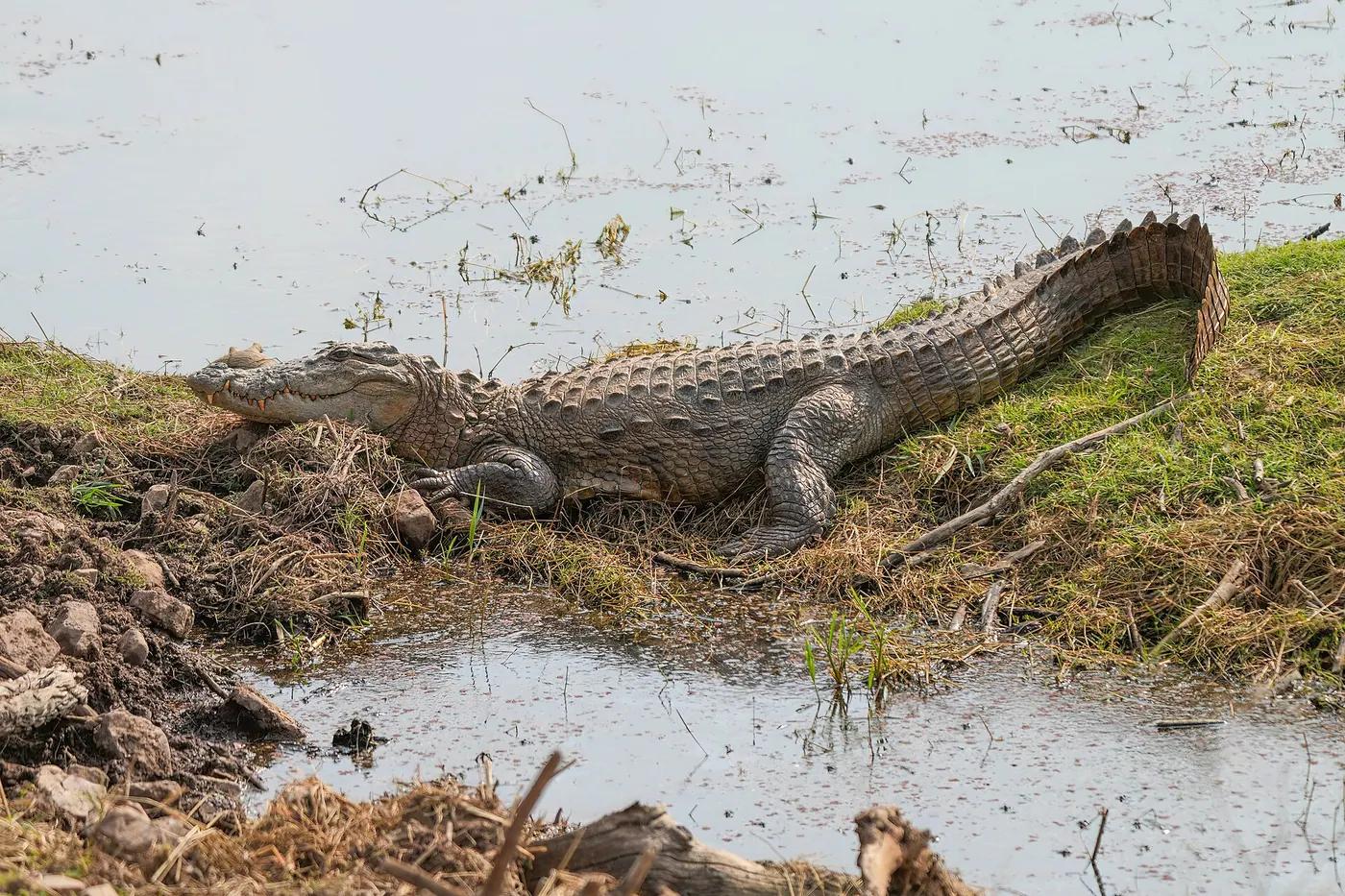
It sits at the far end of the crocodile design range from a broad, heavy-headed species like the mugger crocodile. One head is a pair of tweezers. The other is closer to a club.
The teeth tell the same story. Burke says their shape suggests the animal ate mostly fish, and the Mokattam Formation preserves many kinds of bony and cartilaginous fish that it probably fed on. The rock that gave Egypt its most famous monument is also a fossilised seafood counter.
The rock that gave Egypt its most famous monument is also a fossilised seafood counter.
Last two left
Gharial vs false gharial: the last two of 40-plus species
The gavial lineage goes back more than 100 million years. The fossil record holds more than 40 gavialoid species, spread across nearly the whole planet. Today, exactly two are left.
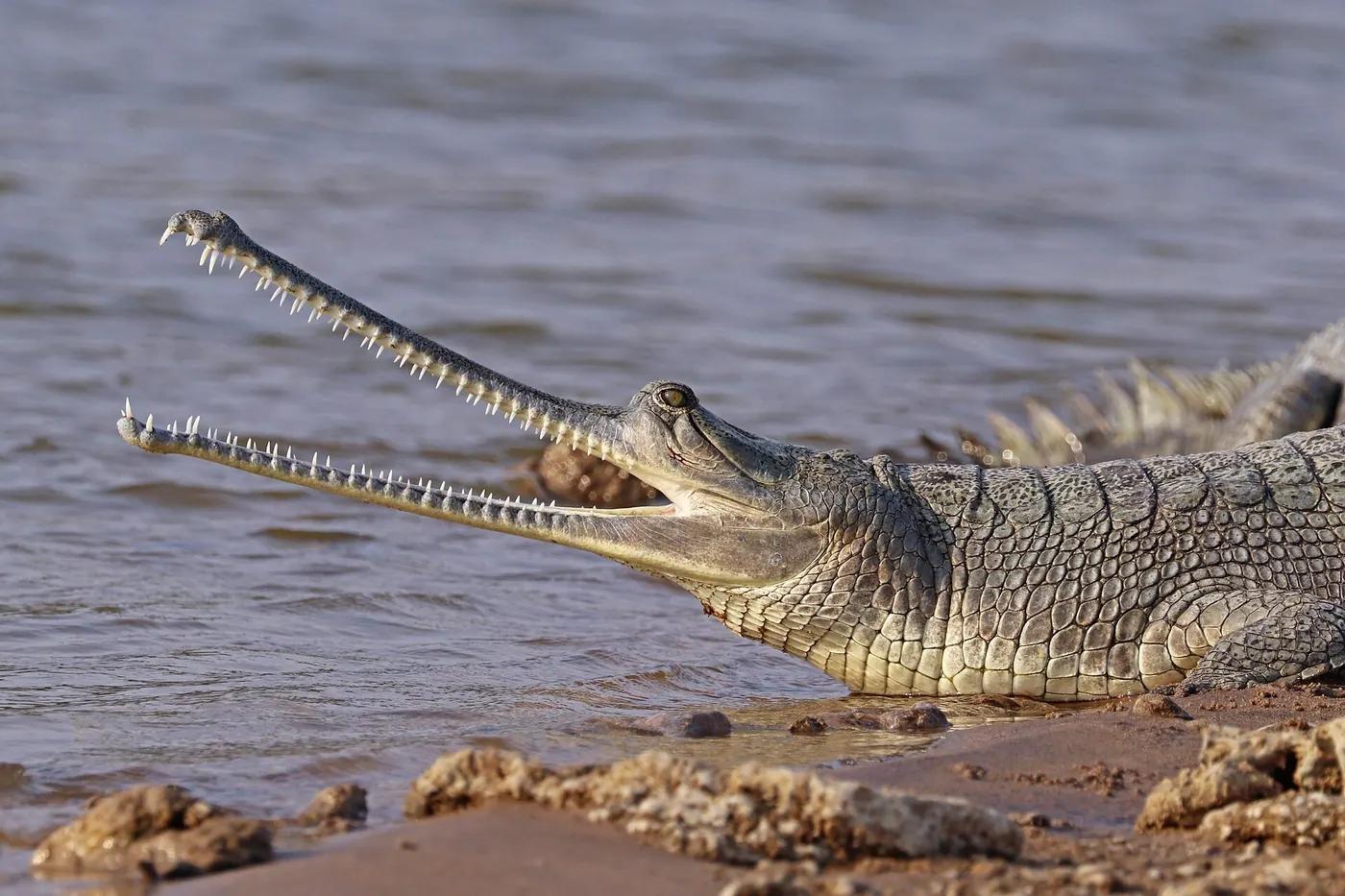
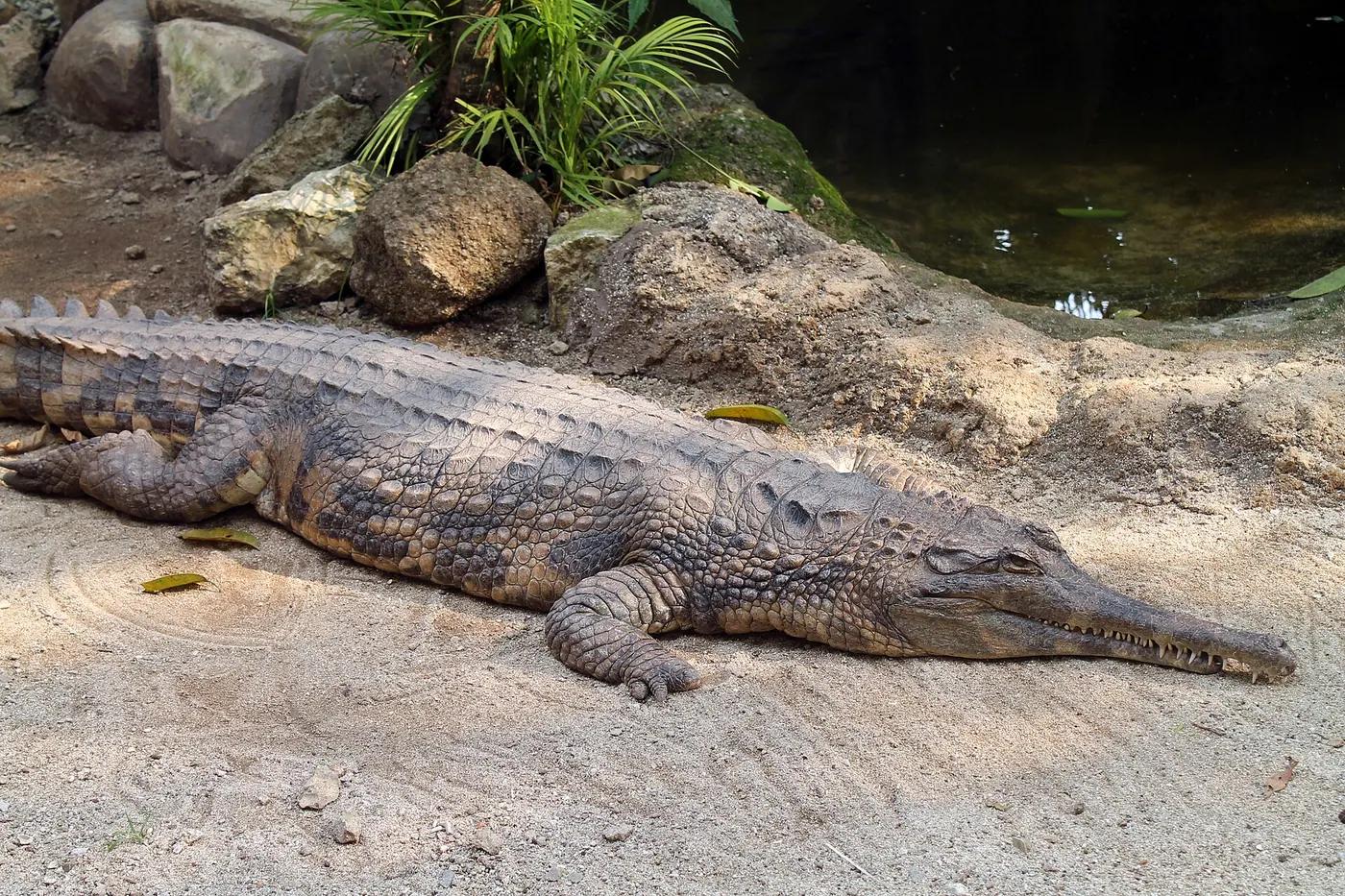
The gharial, Gavialis gangeticus, lives on the Indian subcontinent. The false gharial, Tomistoma schlegelii, lives in Southeast Asia and is endangered. Both carry the long, slender snout that defines the group.
Then there is the twist. Both survivors are freshwater animals, yet many of their extinct relatives lived in shallow seas. Herugavialis was one of them: a sea-going crocodile hunting fish where the Giza plateau now stands.
This is where the Egyptian skull's new address matters. For nearly a century it was treated as a cousin of the false gharial. Now its name nods to the gharial, and the study places it on an early branch of the whole group rather than beside either living species.
| Crocodile | Scientific name | When | Where | Water |
|---|---|---|---|---|
| Gharial | Gavialis gangeticus | Living today | Indian subcontinent | Fresh water |
| False gharial | Tomistoma schlegelii | Living today (endangered) | Southeast Asia | Fresh water |
| Herugavialis | Herugavialis cairensis | About 45 million years ago | Northern Egypt | Warm, shallow sea |
More than 40 species across 100 million years, and just two left, both in rivers.
Lost sea
Were there crocodiles in the Mediterranean, and why did they disappear?
About 45 million years ago, the ground under Giza was a warm, shallow sea, and at least three kinds of long-snouted, fish-hunting crocodile lived in it at the same time. Herugavialis was one of them.
Zoom out and the count grows. Burke says Herugavialis is one of six gavial species known from the Mediterranean region between 66 and 23 million years ago. Those six are spread across a 43-million-year span, not swimming side by side, so be wary of anyone who says the Eocene sea held six at once.
For tens of millions of years, then, the region was crocodile country. Today the Mediterranean has none.
According to Burke, crocodiles vanished from the Mediterranean about 6 million years ago, when the sea largely dried up. The fish-hunters had outlasted whole epochs. In the end, the water went out from under them.
The Mediterranean once had crocodiles. Then the sea itself nearly dried up.
Your turn
Where can you see a gharial today?
You can't meet Herugavialis, but you can still meet its living relatives. The gharial lives in fresh water on the Indian subcontinent, and our guide to Animals in India is a good place to start if you want to see one.
Once you know the gavial silhouette, you will spot it instantly: a head that is mostly snout, lined with teeth built for fish. Put it next to a saltwater crocodile or a classic crocodile and the specialist design jumps out.
If you see a gharial, false gharial or mugger at a zoo or in the wild, AnimalDex lets you capture the real animal with your phone camera and add it to your collection. Keep your distance, let the animal be, and take a good look at that snout. It is the closest you will get to the crocodile that shares the Sphinx's rock.
Animals in Indiasaltwater crocodile
Pertanyaan singkat
Jawaban ringkas untuk pertanyaan yang paling sering muncul pada topik ini.
- What crocodile was found in the rocks of the Great Sphinx?
- It is Herugavialis cairensis, an extinct long-snouted gavial-type crocodile. Its skull came from the Mokattam Formation, the same rock the Sphinx was carved from, but it was collected east of Cairo in the 1920s, not from the monument itself.
- Why is it called Herugavialis, and who is Heru?
- Heru is the Egyptian god also known as Horus, whom the researchers describe as possibly the inspiration for the Sphinx. Because the skull is missing its snout tip, just as the Sphinx is missing its nose, the team named it after him, and -gavialis points to its relationship with the gharial.
- How old is the crocodile fossil from Egypt?
- Most reports put it at about 45 million years old, from the Middle Eocene. At that time, northern Egypt was covered by warm, shallow seas.
- Is it really a new species?
- No. The species was first named Tomistoma cairense by Müller in 1927. The new study created the genus Herugavialis and showed that the animal does not group with the false gharial.
- What's the difference between a gharial and a false gharial?
- They are the only two living gavials. The gharial, Gavialis gangeticus, lives on the Indian subcontinent, while the endangered false gharial, Tomistoma schlegelii, lives in Southeast Asia. Both are freshwater crocodiles with long, slender snouts.
- Were there crocodiles in the Mediterranean, and why did they disappear?
- Yes. Six gavial species are known from the Mediterranean region between 66 and 23 million years ago, with at least three living at once around 45 million years ago. According to Paul Burke, crocodiles vanished from the Mediterranean about 6 million years ago, when the sea largely dried up.
Hewan yang disebut
Lompat dari artikel ini ke halaman spesies di balik contoh, catatan systems, dan referensi field guide.
Sources and further reading
- Phys.org: New crocodile species discovered in rocks used to build the Great Sphinx
- Species New to Science: Herugavialis cairensis
- BBC Discover Wildlife: Herugavialis cairensis, the extinct crocodile from Egypt
- The National: Ancient crocodile from the Sphinx's rock
- Mongabay: New crocodile species found fossilized in stone used to build Egypt's Great Sphinx
- StudyFinds: Ancient Crocodile From Sphinx's Rock Formation Misidentified For A Century
- Time News: Researchers identify new genus of extinct crocodile from Egypt fossils
- Ziare.com: Unknown species found in the rock of the Great Sphinx (reporting CNN)
Panduan jawaban terkait topik ini
Kalau kamu ingin perbandingan langsung dan rekomendasi yang jelas, lanjutkan ke halaman jawaban berikut.
Best Animal Identification Apps
Compare the best animal identification apps by features like photo/video identification, species coverage, collection capabilities, offline use, and more.
What Is Animal Collecting
Learn what animal collecting means in modern apps and how AnimalDex turns real-world sightings into cards, sets, rarity, and species learning.
Pokemon-Like Animal App
Looking for a Pokemon-like animal app with real species? AnimalDex combines creature-collection energy with AI scanning and wildlife learning.