Jumping spiderAnimal behaviorPredator strategy
Why Jumping Spiders Are So Precise: Vision and Jump Planning
Why jumping spiders are so precise: four pairs of eyes with set roles, principal eyes near a pigeon in acuity, depth from defocus, and hydraulic legs.
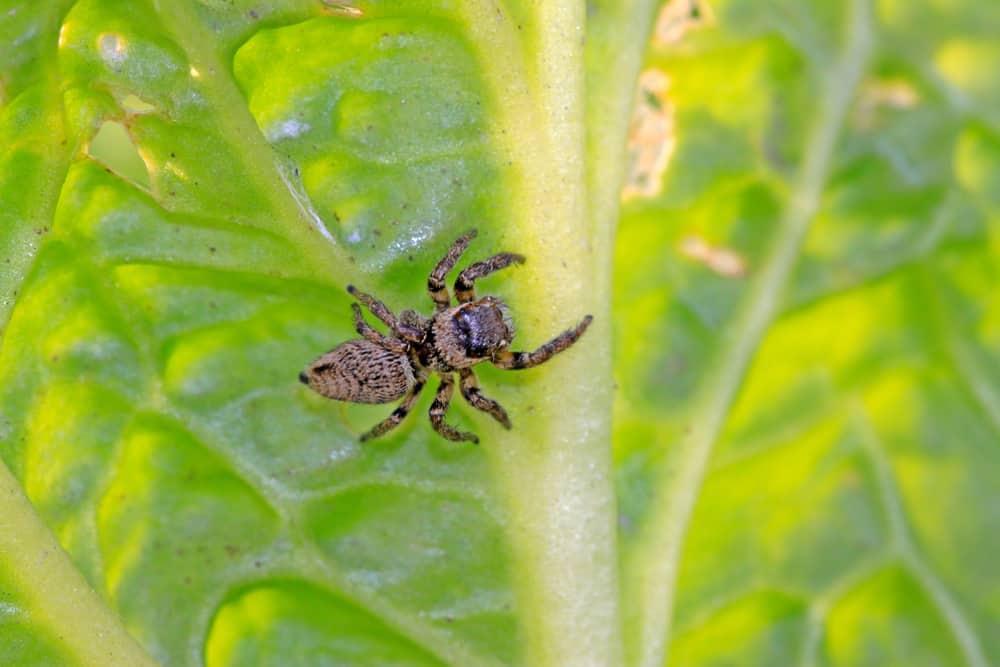
Why jumping spiders feel smarter than their size suggests
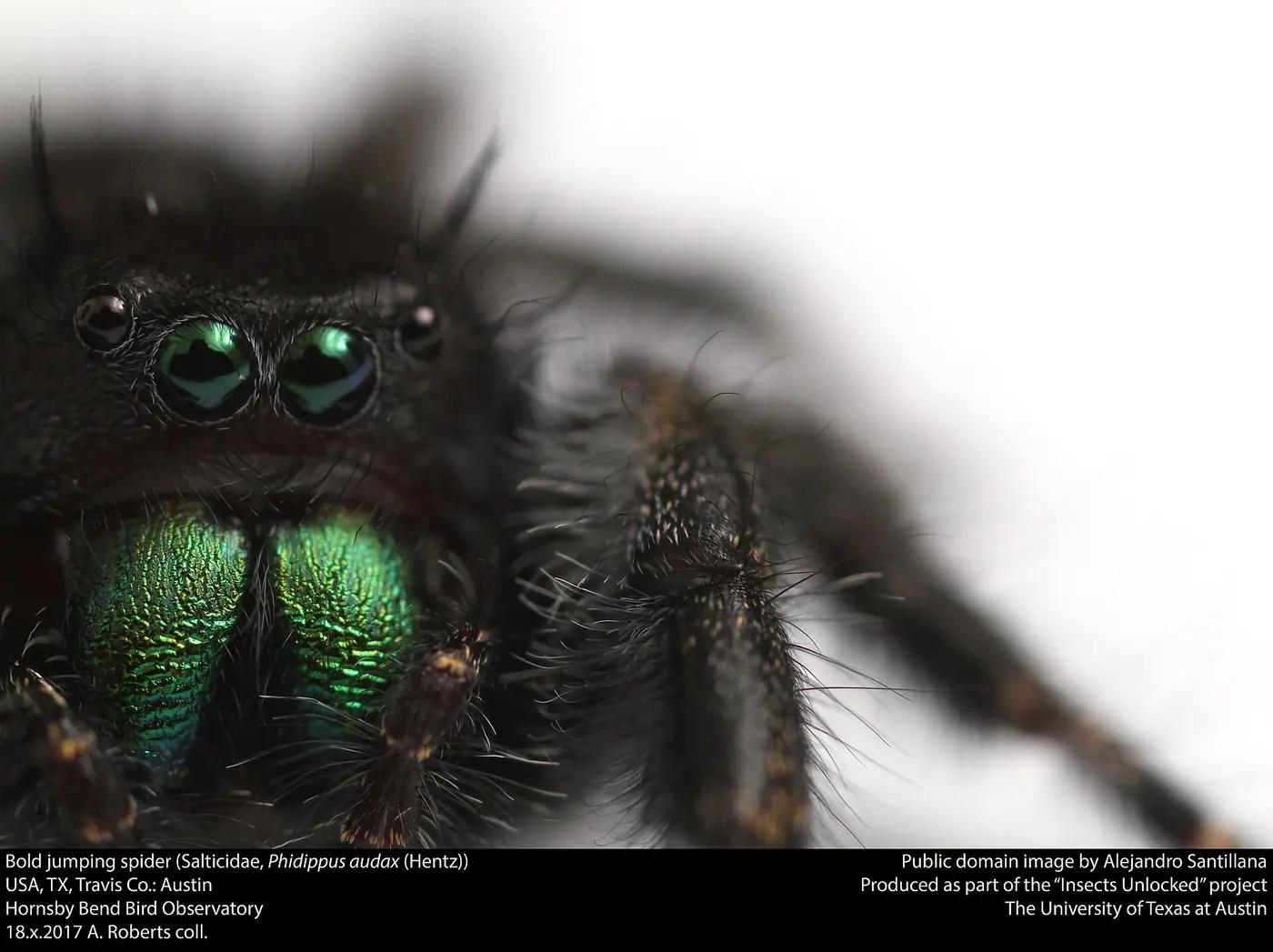
Jumping spiders are the family Salticidae, the largest spider family with more than 6,000 described species, and most of them are tiny: 3 to 15 millimetres. The bold jumping spider (Phidippus audax) of North America is one of the biggest you will meet at up to 15 millimetres, black with white spots and iridescent green fangs. None of them build a web to catch food.
What people notice is that a jumping spider looks back. Turn toward one on a fence post and it rotates its body to keep its two big front eyes on you, then may lift its front legs or hop closer to inspect. That behaviour comes from a visual system better than anything else its size, and from a brain the size of a poppy seed that plans a route before it moves.
The Australian genus Portia is the extreme. Portia hunts other spiders, takes detours of a metre or more that break line of sight with its target, and plucks a web in patterns that imitate a trapped insect to draw the owner out. That is a predator with a plan, running on a few hundred thousand neurons.
Mantis shrimp vision and strike
What makes a jumping spider unique?
A jumping spider has eight eyes in four pairs, and each pair has a job. The two large anterior median eyes, the principal eyes, see in detail and colour. The anterior lateral pair beside them detects motion and gives depth across the front. The two posterior pairs, small and set back on the head, watch the sides and rear, giving close to 360 degree motion detection. When a rear eye sees movement, the spider swivels to put the principal eyes on it.
The principal eyes are the remarkable part. Each is a long tube with a fixed lens at the front and a tiny, boomerang-shaped retina at the back that is stacked in four layers of photoreceptors. The field of view is only a few degrees, so the spider scans by moving the retinas with muscles inside the head, which you can sometimes see as a shifting dark shape behind the lens. Acuity in Portia has been measured at about 0.04 degrees, around ten times sharper than a dragonfly's compound eye and close to a pigeon's. No other animal that size sees anything like as well.
Depth comes from a trick with the layers. Green light focuses on one retinal layer while the layer in front of it receives a blurred image, and the amount of blur depends on distance. A 2012 study in Science by Takashi Nagata and colleagues showed that under red light, which defocuses differently, jumping spiders consistently jump short. The spider is measuring distance from how out of focus the world is, a method no camera used at the time.
| Trait | Jumping spider (Salticidae) | Orb-weaver (Araneidae) | Wolf spider (Lycosidae) |
|---|---|---|---|
| How it hunts | Stalks by sight and jumps on prey | Waits in a web; feels vibration | Runs down or ambushes prey on the ground |
| Vision | Excellent; principal eyes resolve fine detail and colour | Poor; eyes detect light and dark | Good motion detection, moderate detail |
| Web for prey | None; silk only for safety lines and shelters | Yes, rebuilt most days | None, or a funnel in some species |
| Active | Daytime, in sun | Mostly night | Night and day |
| Depth perception | Image defocus in layered retina | Not needed | Rough, from eye spacing |
| Typical size | 3 to 15 mm | 5 to 30 mm body | 10 to 35 mm body |
| Risk to people | Negligible; rare, mild bites | Negligible | Painful but not dangerous bite if handled |
How jumping spiders survive
The jump is hydraulic. Spiders have no extensor muscles in two of the main leg joints; instead they raise blood pressure in the body and force fluid into the legs, which snap straight. A jumping spider does this with its rear two pairs of legs and can clear many times its body length, ten body lengths being routine and some species going well beyond. Before it leaves, it attaches a dragline of silk to the surface, so a missed jump ends as a swing on a thread, not a fall.
The sequence is cat-like and deliberate. The spider sights prey with the principal eyes, creeps forward, stops, re-measures, adjusts its angle, and launches only when the geometry favours it. Prey includes flies, mosquitoes, aphids, leafhoppers, caterpillars, and other spiders, often larger than the hunter. The bite delivers venom and the spider feeds in place.
Survival off the hunt is mostly about not being eaten. Jumping spiders are taken by birds, lizards, mantises, and mud-dauber wasps that stock their nests with them, so they spend nights and bad weather in a silk tent spun under bark or in a leaf fold. Many species have been shown to drink nectar, and one Central American species, Bagheera kiplingi, is mostly vegetarian, eating the protein bodies acacia trees grow for ants. Males court with waving legs and vibrations drummed through the surface, and the peacock spiders of Australia (Maratus) add a fan of coloured abdomen flaps. A 2022 study in PNAS even found jumping spiders twitching their retinas and legs in regular bouts overnight, a pattern that looks like REM sleep.
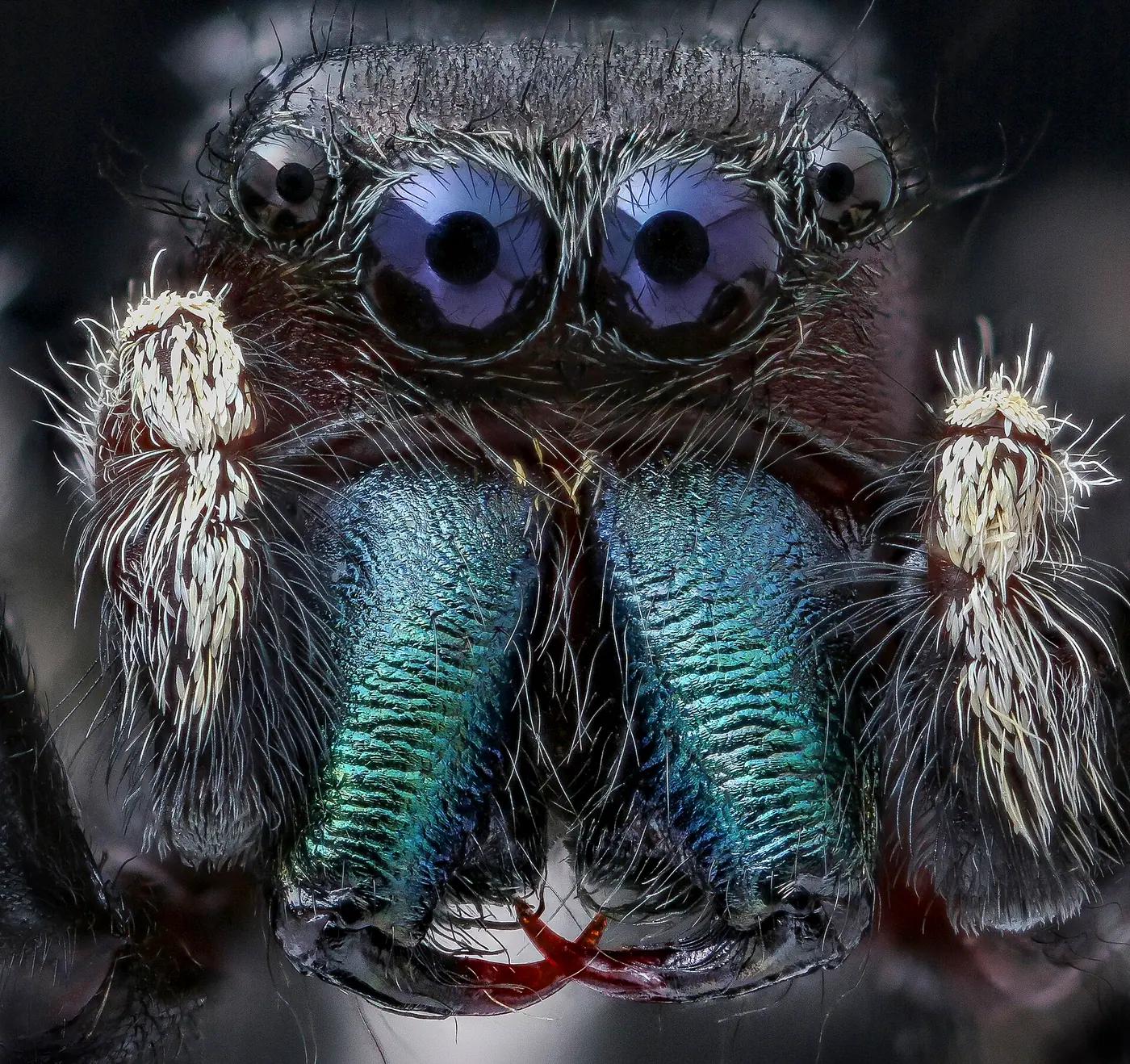
The ecosystem role of a jumping spider
Jumping spiders are the daytime shift of the insect-control workforce. On bark, foliage, walls, fences, and crop plants they take flies, aphids, planthoppers, caterpillars, and mosquitoes one at a time, and because there are so many of them, the sum is large. Spiders as a group are estimated to eat several hundred million tonnes of insects a year worldwide, and in rice, cotton, and orchard systems jumping spiders are among the most abundant predators on the plant itself.
They are also food. Their size and daytime habits make them a staple for small birds, lizards, and the mud-dauber wasps that paralyse and store dozens of spiders per nest cell. Being in the middle of the food web at that scale means jumping spider abundance tracks both insect supply and pesticide use, and the family is used in some studies as an indicator of how much life a managed landscape still supports.
They need no web and little water, so they do well in gardens, on buildings, and in fragments of habitat where larger predators cannot persist. The bold jumping spider is as happy on a city windowsill as on a prairie fence.
A jumping spider does not need force. It needs to know the exact distance, and it measures that before it moves.
What humans can learn from jumping spiders
Engineers took the defocus trick directly. Depth-from-defocus is now a technique in smartphone cameras and robot vision, and the layered-retina principle has been built into a metalens depth sensor at Harvard that estimates distance in a single shot the way the spider does, with far less computation than stereo cameras.
The design lesson is about division of labour between sensors. Wide, cheap motion detectors watch everywhere; one narrow, expensive high-resolution sensor is pointed only where it is needed. The spider does not try to see everything in detail. It sees a little in detail and knows where to look.
And the behavioural lesson is the pause before the jump. Re-measure, adjust, then commit once. It is slower per attempt and far cheaper per success.
Where to look
Sun-warmed vertical surfaces: fence posts, walls, window frames, tree trunks, and the tops of leaves on a bright day. Jumping spiders hunt by sight, so they are out when the light is good and tucked into silk retreats when it is not.
How to tell it is a jumping spider
Compact, often furry body; short, stout legs; and two huge forward-facing eyes that turn to follow you. It moves in short hops and pauses rather than scuttling. No web nearby.
Photographing one
They track the lens, so a macro shot from slightly above and in front gets both principal eyes in focus. Move slowly; a quick approach triggers a jump. Do not use a flash at point-blank range on the same spider repeatedly.
Handling and bites
You do not need to. Bites are very rare, happen only when a spider is pressed against skin, and amount to a small itchy bump. Let it walk onto a leaf if it is somewhere inconvenient.
How chameleons see and strikeWildlife photography companion app
Systems Intelligence & Hidden Purpose
Lihat hewan-hewan ini sebagai sistem biologis yang dirancang dengan presisi: apa fungsinya, bagaimana ia bekerja di lingkungan, dan apa yang bisa kita pelajari dari desainnya.
Specialized Hardware
Large forward-facing eyes, sharp depth judgment, and hydraulically powered jumps make jumping spiders unusually accurate visual hunters without the need for capture webs.
Systems Script
Jumping spiders regulate insect traffic at a tiny scale across leaves, bark, walls, and understory surfaces. They show how precision predation can emerge from compact hardware and strong sensory computation.
Strategic Insight
Accuracy compounds. At small scales, the cleanest win usually comes from better targeting, not more force.
Pertanyaan singkat
Jawaban ringkas untuk pertanyaan yang paling sering muncul pada topik ini.
- How do jumping spiders see so well?
- Through two large principal eyes built like telescopes: a fixed lens at the front and a tiny layered retina at the back that the spider moves with internal muscles to scan a scene. Acuity in the genus Portia is about 0.04 degrees, roughly ten times sharper than a dragonfly's eye. The other six eyes detect motion around the body and tell the spider where to point the principal pair.
- How far can a jumping spider jump?
- Routinely ten or more times its body length, and some species go well beyond that; for a 10 millimetre spider that is 10 centimetres or more in one hop. The jump is powered hydraulically, by forcing blood into the rear legs so they snap straight. A silk dragline is attached before every jump, so a miss ends as a swing rather than a fall.
- Are jumping spiders dangerous to humans?
- No. Bites are rare, happen only when a spider is trapped against skin, and produce at most a small itchy bump. Jumping spiders are curious rather than aggressive and will usually hop away or turn to watch you. They are beneficial in homes and gardens, where they eat flies, mosquitoes, and aphids.
- What is the bold jumping spider?
- Phidippus audax, the most familiar jumping spider in North America: a black, furry species up to 15 millimetres long with white or orange spots on the abdomen and iridescent green or blue fangs. It hunts on fences, walls, and plants in daylight from Canada to Mexico and lives about a year. It is harmless and happy to pose for a camera.
- Do jumping spiders make webs?
- Not for catching prey. They hunt by sight and jump on what they find. They do use silk for a safety line before every jump, for small tent-shaped retreats under bark or leaves where they spend the night and moult, and for egg sacs. If you see a spider in a large wheel-shaped web, it is a different family.
Hewan yang disebut
Lompat dari artikel ini ke halaman spesies di balik contoh, catatan systems, dan referensi field guide.
Panduan jawaban terkait topik ini
Kalau kamu ingin perbandingan langsung dan rekomendasi yang jelas, lanjutkan ke halaman jawaban berikut.
Best Animal Identification Apps
Compare the best animal identification apps by features like photo/video identification, species coverage, collection capabilities, offline use, and more.
What Is Animal Collecting
Learn what animal collecting means in modern apps and how AnimalDex turns real-world sightings into cards, sets, rarity, and species learning.
Pokemon-Like Animal App
Looking for a Pokemon-like app with real animals? AnimalDex is something else: take any idea to a real animal for a genuinely different take, and every animal you meet in the wild joins your collection.
Panduan terkait
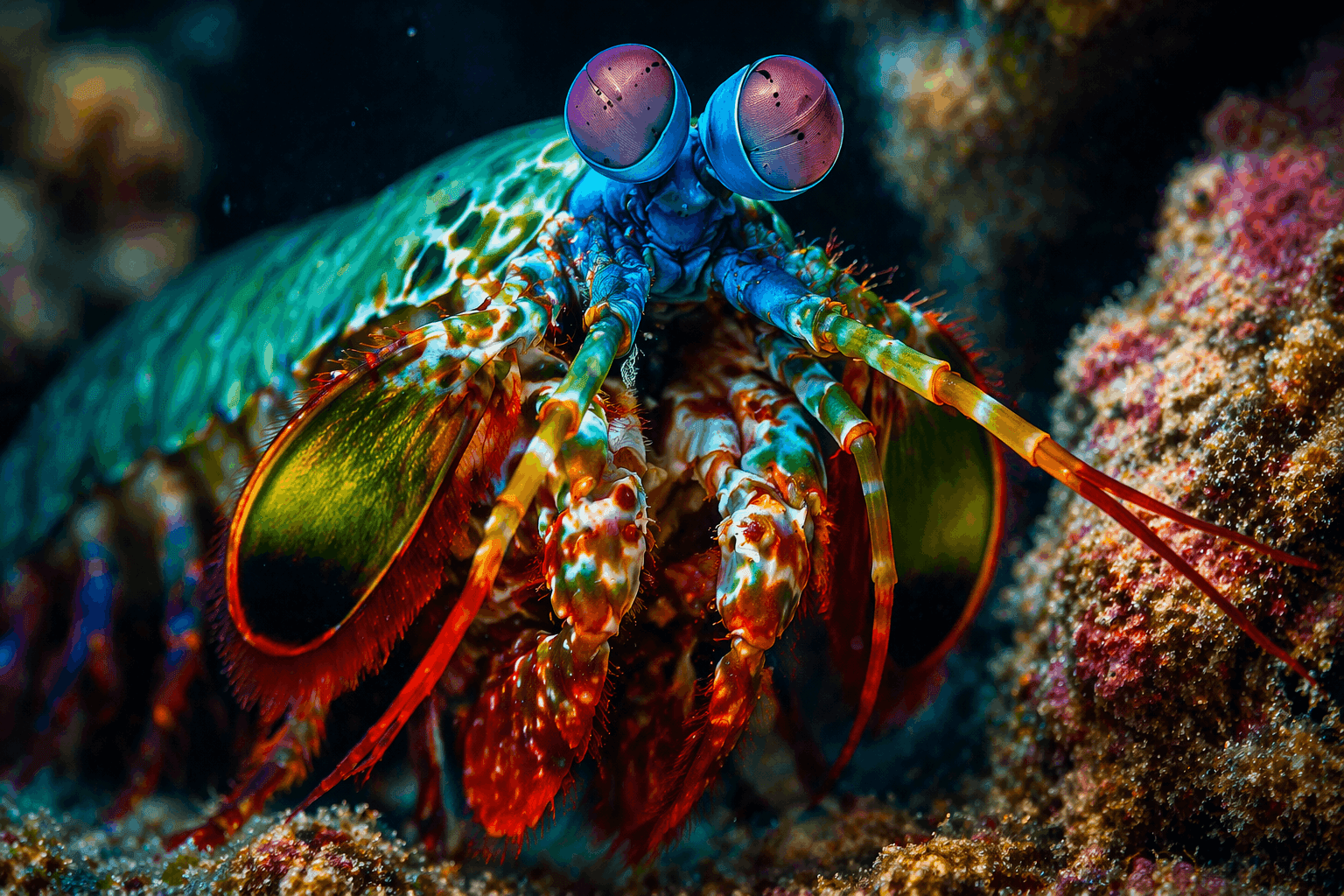
Mantis shrimp
Mantis Shrimp Vision and Strike Power Explained
Mantis shrimp vision and strike explained: 12 to 16 photoreceptor types, polarised light, and a club that hits at 23 m/s and 10,000 g, then hits again.
8 menit baca
How Chameleons See and Strike: Vision and Tongue Mechanics
How chameleon vision and tongue strikes work: independent eyes, tongues that reach two body lengths in hundredths of a second, and why colour changes.
7 menit baca
Why Fireflies Use Light So Well: Flash Codes Explained
How fireflies make light with luciferin and luciferase, why each species flashes its own code, and how Photuris females fake replies to eat rivals.
7 menit baca