

How Crocodiles Dominate the Water Edge: Ambush, Behavior, and Ecosystem Role
Understand crocodile behavior, ambush survival strategy, ecosystem role, and why riverbanks and estuaries become so dangerous when crocodiles control the chokepoints.
Listen to this story
Hear the full article read aloud.
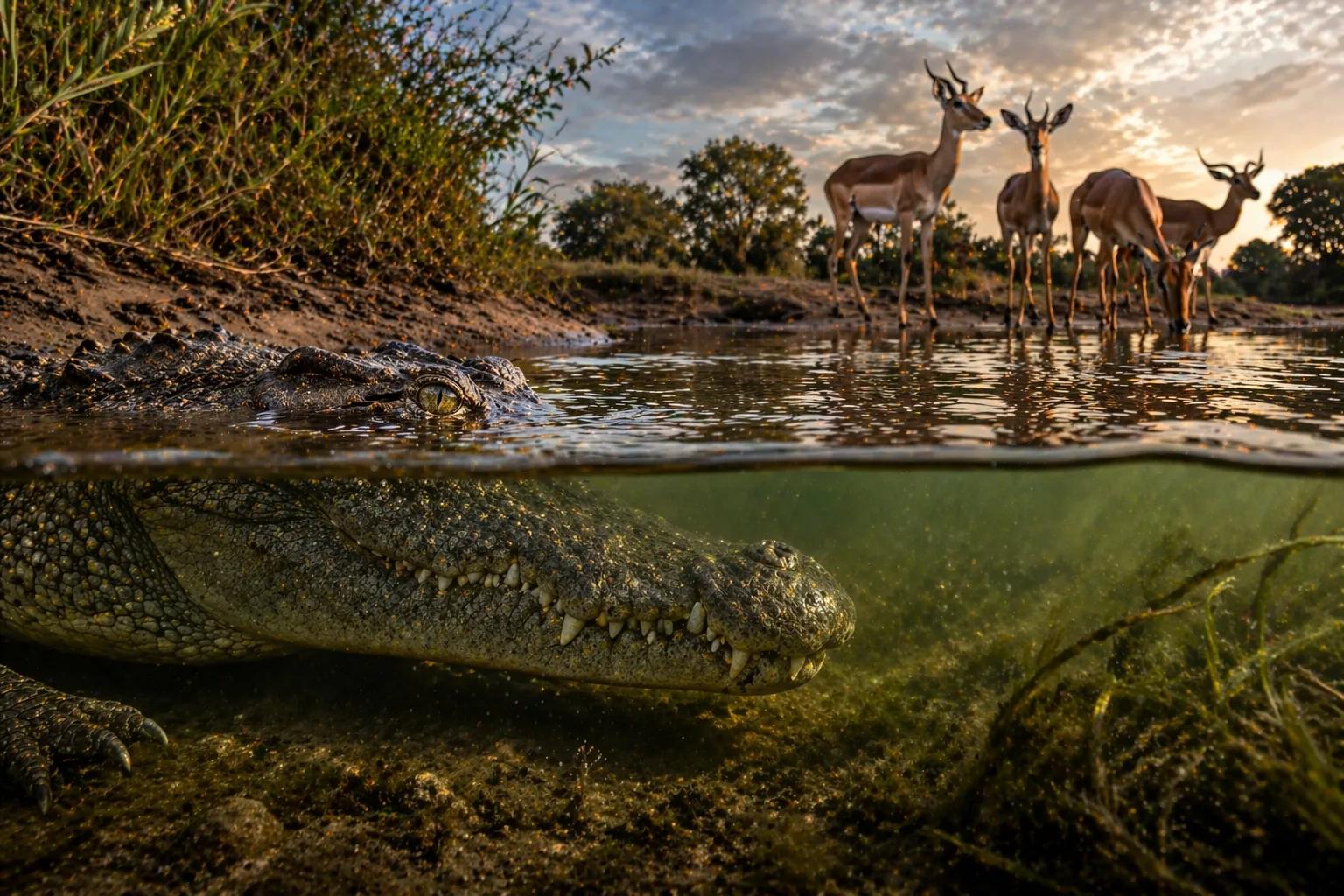
Why crocodiles remain such effective predators
Crocodiles matter because they solve one problem extremely well: control the edge between land and water where movement narrows and attention gets split.
That makes them less about constant domination and more about strategic geography. A crocodile is dangerous because the terrain is helping.
What makes a crocodile unique?
Jaw pressure sensors, high-mounted eyes and nostrils, explosive tail propulsion, and a body plan that vanishes into the waterline make crocodiles specialized ambush hardware.
They are not built to waste energy in open pursuit. They are built to hold still until the environment starts doing most of the setup.
How crocodiles survive
Crocodile survival strategy depends on patience, low visible profile, and decisive short-range force. The success window is narrow, so timing matters more than continuous action.
That is why crocodile animal behavior often looks lazy to casual observers. In reality, it is an energy-saving system waiting for a chokepoint to become a trap.
The ecosystem role of crocodiles
Crocodiles regulate prey access around rivers, wetlands, estuaries, and shorelines. Their ecosystem role includes shifting drinking behavior, movement timing, and carcass-driven nutrient movement.
They turn exposed edges into risk zones, and that alone changes how the rest of the system allocates space.
What humans can learn from crocodiles
Crocodiles are a sharp lesson in bottleneck control. You do not need to own the entire map if you understand where the map collapses into a few forced pathways.
In strategic terms, chokepoints often matter more than surface area.
Systems Intelligence & Hidden Purpose
Lihat hewan-hewan ini sebagai sistem biologis yang dirancang dengan presisi: apa fungsinya, bagaimana ia bekerja di lingkungan, dan apa yang bisa kita pelajari dari desainnya.
Specialized Hardware
Pressure-sensitive receptors around the jaws, eyes and nostrils mounted high on the skull, and a tail built for explosive propulsion make crocodiles effective ambush hardware at the land-water edge.
Systems Script
Crocodiles control chokepoints where rivers, wetlands, and shorelines concentrate traffic. They regulate prey behavior, move nutrients through kills and carcasses, and add caution to landscapes that would otherwise become too predictable.
Strategic Insight
You do not need to dominate every square meter. Control the bottlenecks and the rest of the map starts behaving differently.
Hewan yang disebut
Lompat dari artikel ini ke halaman spesies di balik contoh, catatan systems, dan referensi field guide.
Comparisons terkait
Lanjutkan ke halaman comparison animal-vs-animal terstruktur yang terhubung dengan spesies di panduan ini.
Crocodile vs Alligator: Which Crocodilian Has the Edge?
Crocodile usually gets the slight overall edge because it is often more aggressive and more built for a wider range of salty and open-water environments. Alligator remains massively dangerous and can look better in some freshwater ambush contexts.
Baca comparisonCrocodile vs Black Caiman: Which Aquatic Predator Has the Edge?
Crocodile gets the slight broader edge through more generalized dominance and a stronger all-round reputation. Black caiman remains extremely dangerous and fully credible in quiet river-ambush contexts.
Baca comparisonCrocodile vs Polar Bear: Which Predator Has the Edge?
Polar bear gets the overall edge on land or partial land because it is larger, more mobile out of water, and better at sustained violent contact once the crocodile loses ambush shape. Crocodile becomes far more dangerous in water-linked ambush where the bite starts first and the bear does not control footing.
Baca comparisonCrocodile vs Shark: Who Wins Where Water Meets Shore?
Great white shark has the edge in open ocean. Crocodile becomes more dangerous the closer the matchup gets to shallow water, shoreline bottlenecks, and ambush-heavy edge habitat.
Baca comparisonPanduan jawaban terkait topik ini
Kalau kamu ingin perbandingan langsung dan rekomendasi yang jelas, lanjutkan ke halaman jawaban berikut.
Best Animal Identification Apps
Compare the best animal identification apps by features like photo/video identification, species coverage, collection capabilities, offline use, and more.
Baca answer guideWhat Is Animal Collecting
Learn what animal collecting means in modern apps and how AnimalDex turns real-world sightings into cards, sets, rarity, and species learning.
Baca answer guidePokemon-Like Animal App
Looking for a Pokemon-like animal app with real species? AnimalDex combines creature-collection energy with AI scanning and wildlife learning.
Baca answer guideUbah apa yang kamu pelajari jadi koleksi hewan nyata
Lanjutkan di AnimalDex dengan spesies di balik panduan ini, konteks spotting dunia nyata, dan koleksi yang terus tumbuh setelah artikel selesai dibaca.
Panduan terkait
What Makes Crows So Intelligent? Systems, Behavior, and Survival Strategy
Learn what makes crows so intelligent, from memory and tool use to adaptive behavior, survival strategy, and their ecosystem role in changing environments.
Baca artikelWhy Elephants Never Stop Reshaping Landscapes
Explore elephant behavior, memory, survival strategy, ecosystem role, and the systems biology behind how elephants reshape habitats over time.
Baca artikelHow Orangutans Think and Survive in the Canopy
Discover orangutan intelligence, canopy behavior, survival strategy, and ecosystem role through a systems view of one of the forest’s best problem solvers.
Baca artikel