

Orangutan intelligenceCanopy behaviorEcosystem role
How Orangutans Think and Survive in the Canopy
How orangutans survive 30 metres up: nightly nest building, tool use, fruit tracking, flanged males, and Bornean vs Sumatran vs Tapanuli orangutans.
The short version · 0:46
10,000 BEDS. ONE APE.
This article in under a minute. Watch it here, then read on for the detail and sources.
AI-narrated, with motion added to some photos. Photo credits are with each image in the article.
In this guide
- Why orangutans matter in conversations about animal intelligence
- What makes an orangutan unique?
- Types of orangutans
- Bornean, Sumatran, and Tapanuli orangutans compared
- How orangutans survive in a complex forest
- The ecosystem role of orangutans
- How to see orangutans in the wild
- What humans can learn from orangutans
Why orangutans matter in conversations about animal intelligence
Orangutans are the largest animals that live almost entirely in trees. An adult flanged male weighs 50 to 90 kilograms, a female 30 to 50, and both spend most of their lives 10 to 30 metres above the ground, where one bad handhold is fatal. Their intelligence is not theatrical. It is patient, spatial, and tied to the job of moving a heavy body through a three-dimensional forest and finding fruit that ripens unpredictably.
They are also the slowest-living primates apart from humans. A female gives birth about once every seven to nine years, the longest interbirth interval of any mammal, and a youngster stays with its mother for seven to eight years learning which of several hundred food plants are edible, when they fruit, and how to process them. That makes orangutans a stronger systems-biology story than the usual narrative about being smart in a human-like way.
What makes an orangutan unique?
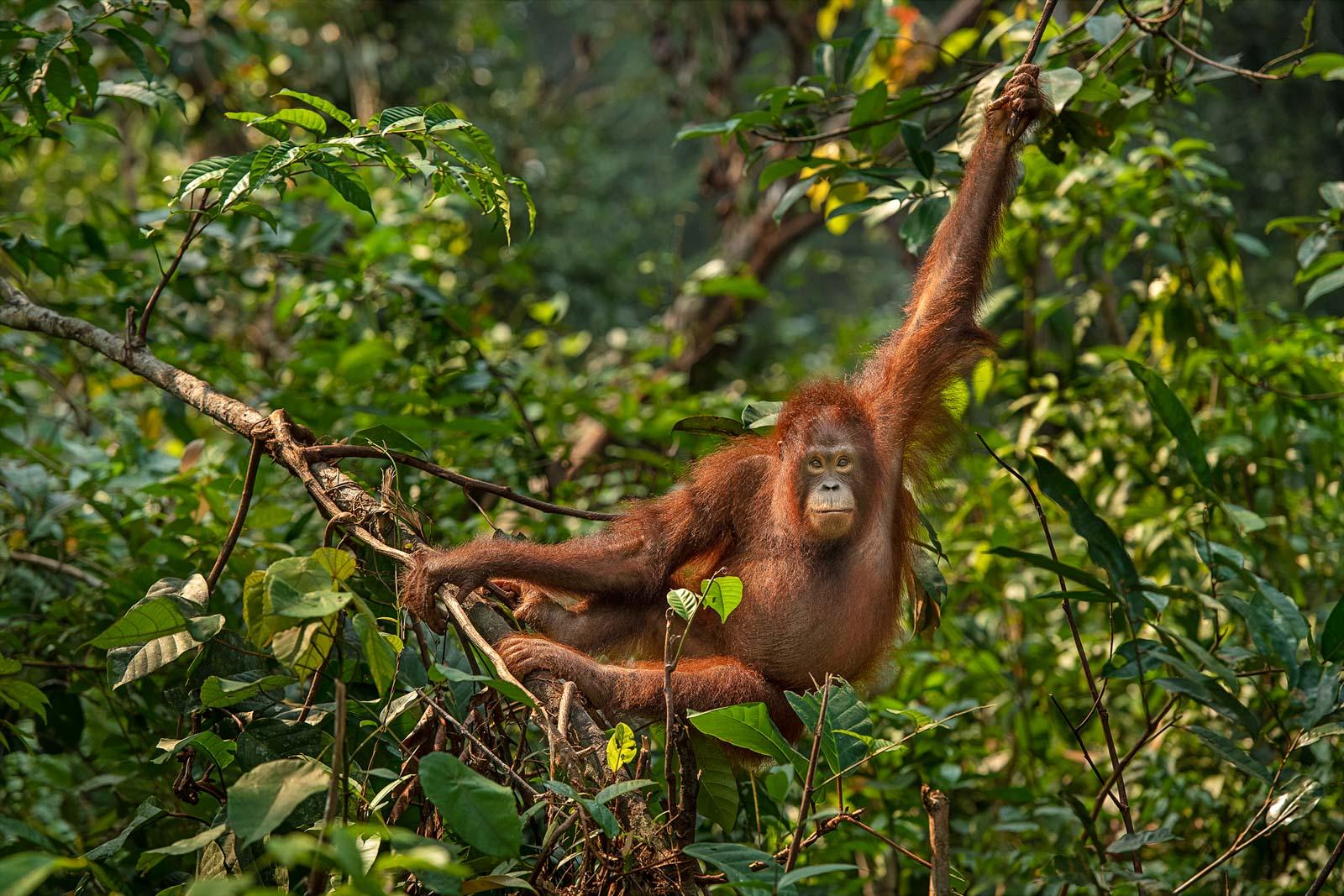
An arm span of up to 2.2 metres, hook-shaped hands, and feet that grip like hands give orangutans four-limbed climbing that no other great ape matches. They rarely leap. Instead, an orangutan sways a thin tree back and forth until it can reach the next one, a trick that lets a heavy animal cross gaps without descending to the ground.
Every evening, usually in the last hour of light, an orangutan builds a new nest. It takes 5 to 10 minutes: a sturdy fork is chosen, branches are bent inward and woven into a platform, leafy twigs are laid on top as a mattress, and in rain a few more branches are pulled over as a roof. A wild orangutan builds more than 10,000 nests in its lifetime, and old nests are the main way researchers count populations from the ground.
Tool use is real but local. At Suaq Balimbing in Sumatra, orangutans strip sticks to pry the seeds out of Neesia fruit, whose husks are lined with stinging hairs, and use other sticks to fish insects and honey out of tree holes. Populations only a few rivers away never learned it, which is why orangutans are a textbook example of culture in a non-human animal.
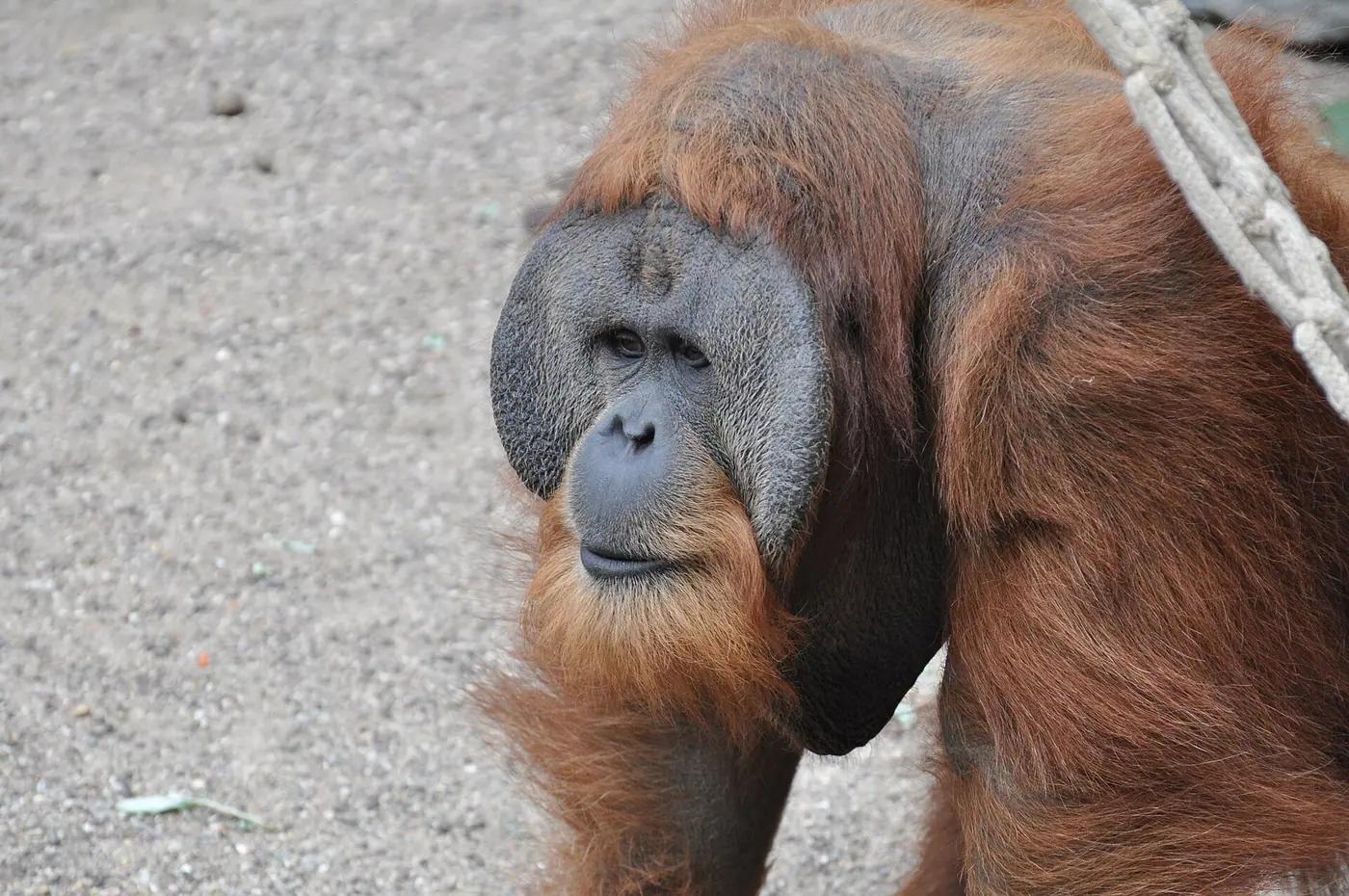
Flanged males are the other signature. Some adult males develop wide cheek pads, a throat sac, and a long call that carries over a kilometre through forest and tells females and rivals where he is. Other males can stay unflanged for a decade or more, slipping past the dominant male and breeding opportunistically.
Types of orangutans
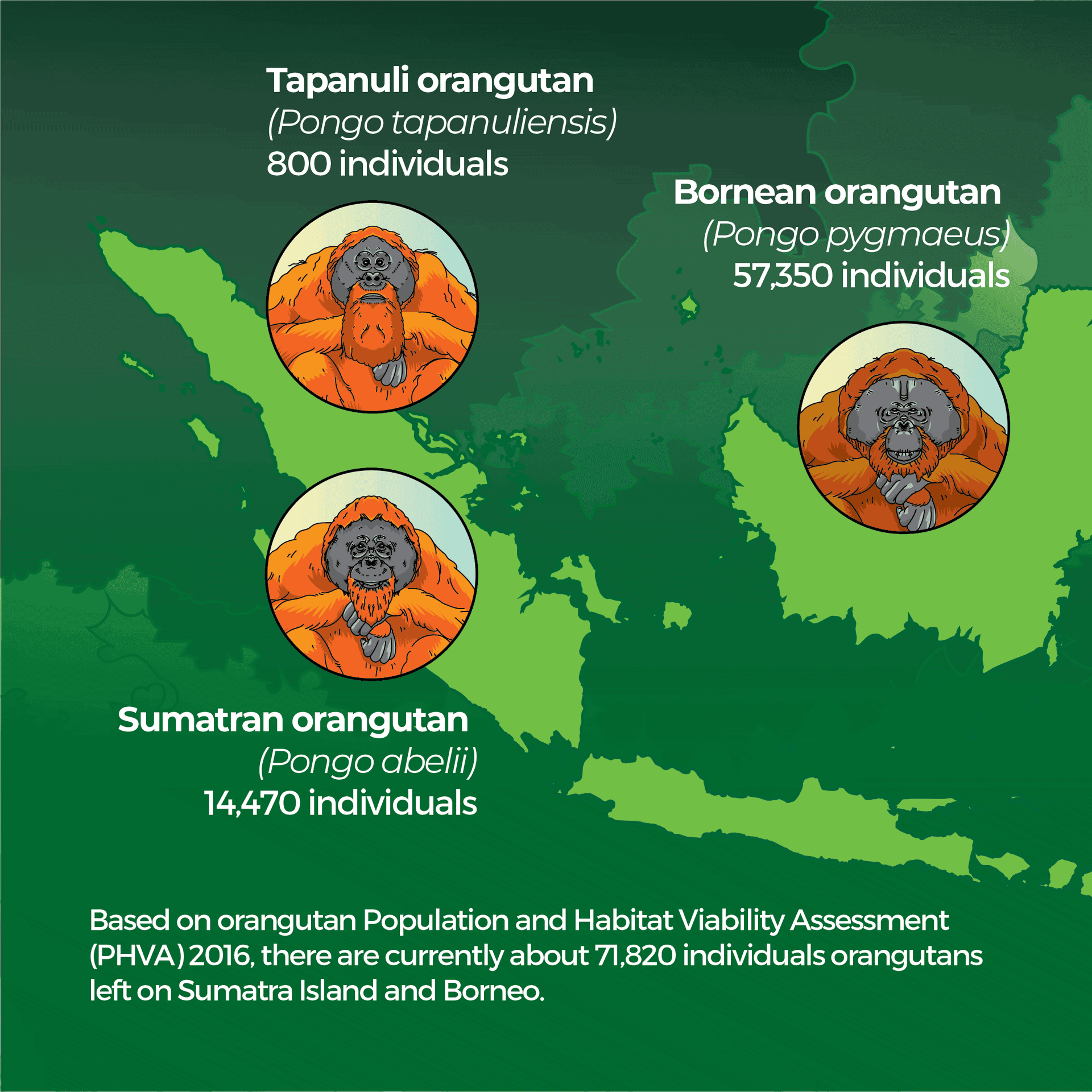
There are three living orangutan species, and the most useful comparison is Bornean orangutan vs Sumatran orangutan vs Tapanuli orangutan. Bornean orangutans are generally heavier-built and more robust, while Sumatran orangutans often look slimmer, paler, and more lightly built through the face and body.
Tapanuli orangutans are the rarest and most geographically restricted. They are closely related to the Sumatran form but are recognized as their own species, with differences in skull shape, hair texture, vocalization patterns, and isolated range in the Batang Toru ecosystem.
If you are trying to tell them apart in photos, geography is still one of the best clues. Borneo points to Bornean orangutan, northern Sumatra usually points to Sumatran orangutan, and the Batang Toru region points to Tapanuli orangutan.
Bornean orangutanBornean orangutansSumatran orangutanSumatran orangutansTapanuli orangutanTapanuli orangutans
Bornean, Sumatran, and Tapanuli orangutans compared
All three species are Critically Endangered. Bornean orangutans are by far the most numerous but have lost more than half their population since 1999 to logging, oil-palm conversion, and fire. The Tapanuli orangutan, described in 2017, is the rarest great ape on Earth and lives in a single block of upland forest south of Lake Toba.
| Species | Range | Build and hair | Behaviour | Wild population |
|---|---|---|---|---|
| Bornean orangutan (Pongo pygmaeus) | Borneo (Indonesian Kalimantan, Malaysian Sabah and Sarawak) | Heaviest; dark reddish-brown hair; males have wide, forward-facing cheek pads | Comes to the ground more often (no tigers on Borneo); less social | Roughly 100,000, declining |
| Sumatran orangutan (Pongo abelii) | Northern Sumatra, mainly the Leuser ecosystem | Slimmer; longer, paler orange hair; narrower face with a long beard | Almost never descends; more social at fruiting figs; tool use at some sites | About 14,000 |
| Tapanuli orangutan (Pongo tapanuliensis) | Batang Toru ecosystem, South Tapanuli, Sumatra | Frizzier hair; smaller skull; flanged males have flatter cheek pads and a prominent moustache | Higher-pitched, longer long call; eats more conifer cones and caterpillars | Fewer than 800 |
How orangutans survive in a complex forest
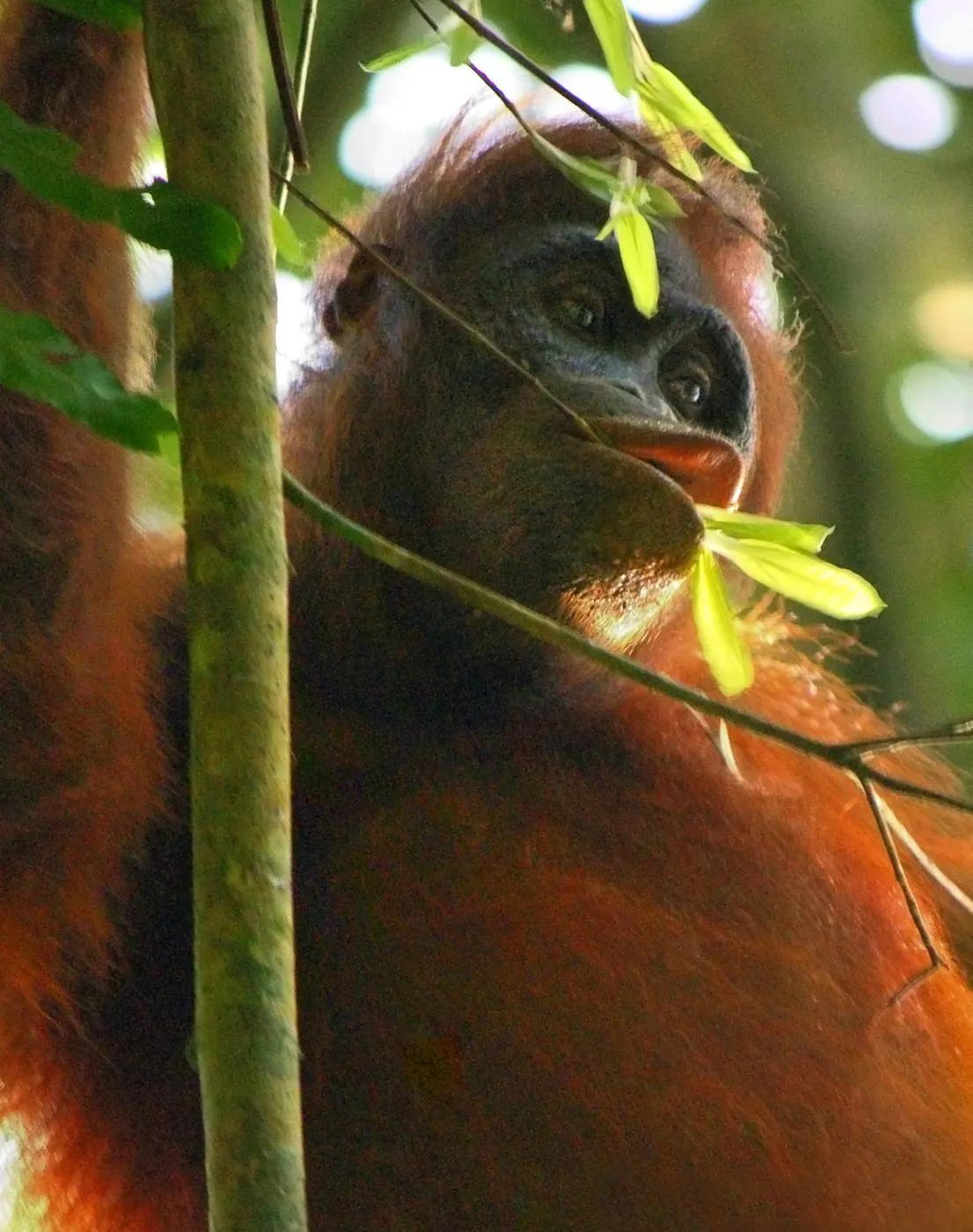
Fruit makes up around 60 percent of the diet, and fruit in Southeast Asian rainforests is unreliable. Dipterocarp forests mast-fruit every two to ten years and produce little in between, so an orangutan has to know hundreds of individual trees, including figs and durians, and when each one is likely to be ready. Field studies show orangutans travelling in straight lines to trees that have just come into fruit, which only works if they are tracking those trees in memory.
When fruit fails, they switch to bark, leaves, pith, termites, and ant nests, and they store fat during masts to carry them through lean months. Males have been recorded planning their travel the night before: a long call given in the evening predicts the direction the male will move the next morning, and females adjust their own routes to it.
A typical day is slow by design: roughly 1 kilometre of travel, several hours of feeding, a midday rest, and a nest by dusk. Energy is the constraint. An 80-kilogram animal that climbed and leapt like a gibbon would starve, so the orangutan's behaviour rewards caution, planning, and deep familiarity with a particular patch of forest. That is why habitat loss hits them so hard: clear the trees they know and you erase the map they survive by.
The ecosystem role of orangutans
Orangutans are the largest fruit-eaters in the canopy, and many of the seeds they swallow pass through intact and are dropped, with fertiliser, far from the parent tree. Large-seeded fruits that smaller birds and squirrels cannot carry depend on orangutans, hornbills, and a few other big dispersers to move them across the forest.
Their feeding also prunes. Branches broken for nests and food open small gaps that let light reach the forest floor, and the nests themselves become habitat for insects, frogs, and small mammals once abandoned. Because an orangutan uses most of its home range over a year, its seed shadow and its pruning are spread across the whole forest rather than concentrated in one place.
They are not just residents of the canopy. They help keep the canopy's future inventory moving, and the forests that hold orangutans also hold tigers, elephants, rhinos, and the carbon stocks that make the Leuser ecosystem one of the most important in Asia.
How to see orangutans in the wild
Wild orangutans are solitary and quiet, so most encounters come from knowing where fruit is and reading nests. These tips apply at the main sites in Borneo and Sumatra.
Where to go
Borneo: the Kinabatangan River and Danum Valley in Sabah, and Tanjung Puting in Kalimantan (boat-based, with rehabilitated animals at feeding stations). Sumatra: Bukit Lawang and Ketambe in Gunung Leuser National Park for the Sumatran species. The Tapanuli orangutan is only reachable with specialist guides in Batang Toru.
Look for nests
A nest is a rough platform of bent branches 10–30 m up, often near the trunk of a tree with a good fork. Green leaves mean it was built within a day or two; brown, collapsing nests are weeks old. A cluster of nests of different ages marks a regular feeding area.
Follow the fruit
Find a fruiting fig or durian and wait quietly. Orangutans visit big fig trees for days, and several animals may use the same tree. Dropped half-eaten fruit, chewed fruit skins, and husks on the trail tell you something large is feeding above.
Listen
A flanged male's long call is a series of roars and grumbles that lasts a minute or more and carries over a kilometre; it is most often given in the early morning and late afternoon. The kiss-squeak is a sharp sucking sound an annoyed orangutan makes at an observer.
Keep your distance and your health
Stay at least 10 m away, never feed them, and do not approach if you are ill: orangutans catch human respiratory infections easily. At rehabilitation centres, follow the ranger's instructions and keep food out of sight.
wildlife photography companion
What humans can learn from orangutans
Orangutans are a reminder that not every intelligent system should be optimized for speed. In dense, high-risk environments, patience and retained knowledge are the premium traits: the animal that remembers 300 fruit trees and when they ripen outlasts the one that moves fastest.
That is the practical takeaway. If the environment is structurally complex, slow learning can be smarter than fast guessing, and the lesson applies to your own field notes as well as to the ape. A good wildlife photography companion that records where you found an animal is worth more over ten trips than any single lucky sighting.
An orangutan's map of the forest is built one fruiting tree at a time, over decades.
Systems Intelligence & Hidden Purpose
See these animals as engineered biological systems: what they are built to do, how they fit the wider environment, and what their design can teach us.
Specialized Hardware
Long, powerful arms, hook-like hands and feet, strong spatial memory, and an unusually long learning period make orangutans high-capacity canopy navigation and problem-solving hardware.
Systems Script
Orangutans disperse seeds, prune movement routes through the canopy, and help maintain forest regeneration over long timescales. Their niche rewards cognition, patience, and memory more than constant aggression.
Strategic Insight
Complex environments do not always reward speed first. Sometimes the edge comes from learning slowly enough that the model actually holds.
Quick questions
Short answers to common questions readers ask on this topic.
- How do orangutans build nests?
- By bending and weaving branches into a platform in a tree fork, usually 10 to 30 metres up, then lining it with leafy twigs and sometimes adding a roof of branches against rain. It takes about 5 to 10 minutes, and an orangutan builds a fresh nest almost every evening plus occasional day nests, so one animal makes thousands in a lifetime. Counting nests is the standard way to survey wild populations.
- What is a flanged male orangutan?
- A fully mature adult male that has developed wide cheek pads (flanges), a large throat sac, and a long call that carries over a kilometre. Flanged males are the largest orangutans at 50 to 90 kilograms and dominate breeding in an area. Other adult males can stay unflanged for years, remaining smaller and breeding opportunistically; development of the flanges depends partly on whether a dominant male is already present.
- Do orangutans use tools?
- Yes, at some sites. Sumatran orangutans at Suaq Balimbing use stripped sticks to extract seeds from Neesia fruit and to probe tree holes for insects and honey, and many orangutans use leaves as gloves, napkins, or umbrellas. The behaviour varies between populations that live in similar habitat, which is why it is treated as learned culture rather than instinct.
- How many orangutans are left in the wild?
- Roughly 100,000 Bornean orangutans, about 14,000 Sumatran orangutans, and fewer than 800 Tapanuli orangutans. All three are listed as Critically Endangered by the IUCN. The main threats are forest clearance for oil palm and timber, fire, and the killing of animals that raid crops; Borneo has lost more than half its orangutans since 1999.
- What is the difference between Bornean and Sumatran orangutans?
- Bornean orangutans are heavier and darker, with reddish-brown hair and males that have wide, forward-facing cheek pads; they come to the ground more often because Borneo has no tigers. Sumatran orangutans are slimmer with longer, paler orange hair and a longer beard, stay in the trees almost constantly, and are more social at fruiting trees. Geography is the surest clue.
Animals mentioned
Jump from this article into the species pages behind the examples, systems notes, and field-guide references.
Sources and further reading
Answer guides related to this topic
If you want direct comparisons and clear recommendations, continue with these answer-focused pages.
Best Animal Identification Apps
Compare the best animal identification apps by features like photo/video identification, species coverage, collection capabilities, offline use, and more.
What Is Animal Collecting
Learn what animal collecting means in modern apps and how AnimalDex turns real-world sightings into cards, sets, rarity, and species learning.
Pokemon-Like Animal App
Looking for a Pokemon-like animal app with real species? AnimalDex combines creature-collection energy with AI scanning and wildlife learning.
Related comparisons
Continue with structured animal-vs-animal comparison pages connected to the species in this guide.
Chimpanzee vs Orangutan: Which Is Stronger?
Orangutan gets the stronger pure-strength verdict, while chimpanzee gets the faster, more aggressive, and more socially volatile profile.
Dolphin vs Orangutan: Which Is Smarter?
Dolphin gets the broader intelligence edge through communication, social learning, and fluid group coordination. Orangutan remains exceptional in deliberate problem solving, memory, and tool-oriented planning, especially in structured tasks.
Gorilla vs Orangutan: Which Is Stronger?
The gorilla is stronger overall: an adult male is roughly twice the weight of a large male orangutan, with far more total muscle. Orangutans have remarkable arm and grip strength for climbing, but on the ground the gorilla wins.
Related guides
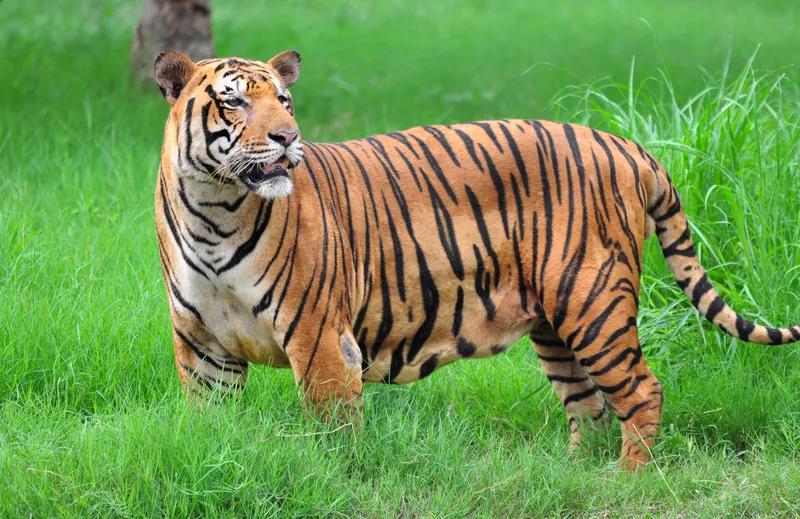
Tiger behavior
How Tigers Survive as Solo Apex Hunters
How tigers hunt alone: home-range sizes, a 5–10 percent hunting success rate, prey and kill rate, subspecies compared, and how to read tiger sign.
9 min read
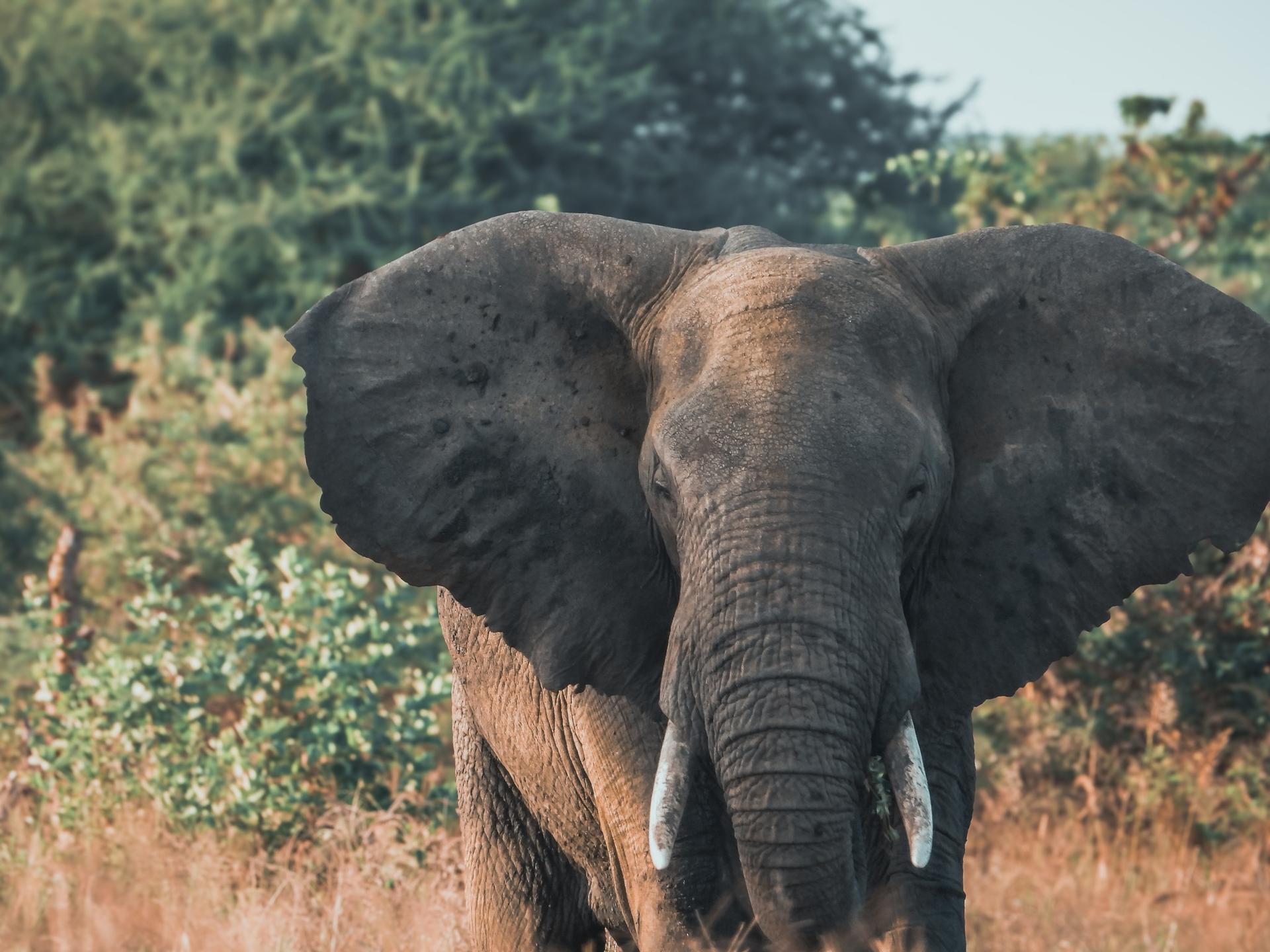
Why Elephants Never Stop Reshaping Landscapes
How elephants engineer savannas and forests: daily food and water intake, seed dispersal distances, keystone effects, and the three species compared.
8 min read
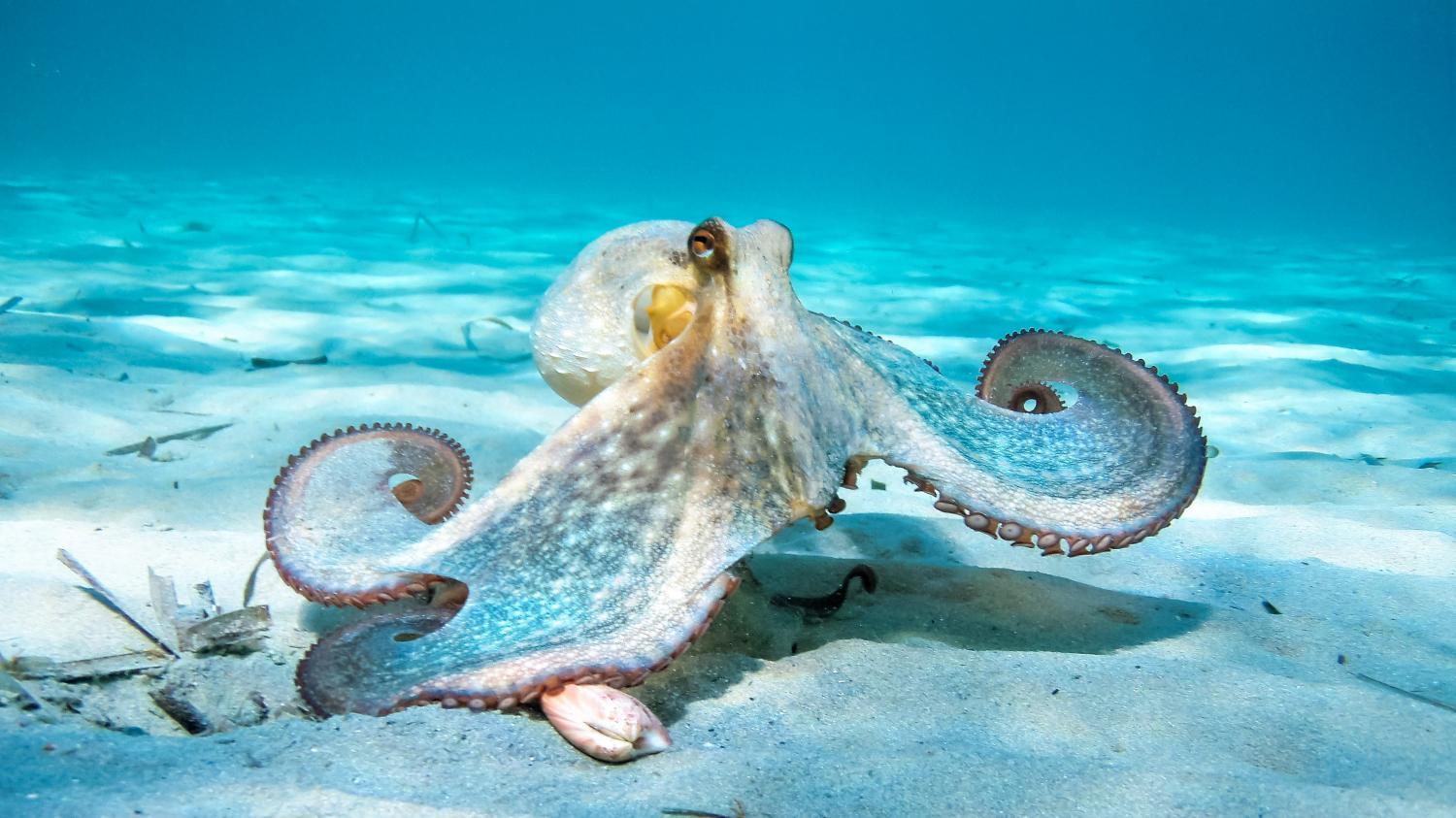
How Octopus Intelligence Works: Arms That Think
How octopus intelligence works: 500 million neurons, two thirds in the arms, suckers that taste, skin that changes in under a second, and fast learning.
8 min read