Independent buying guide · Updated August 12th 2026
Best Animal Identification Apps (2026)
We compared the most popular wildlife identification apps, bird apps and AI animal scanners to help you choose the right one.
Quick comparison
Quick answer
Five excellent apps. Five different jobs.

Best overall for collecting + learning
AnimalDex
Turns sightings into a collection and learning system.

Best for wildlife science
iNaturalist
Community-reviewed observations that can support research.

Best for beginners and families
Seek
Private, approachable, offline and built around exploration.

Best bird specialist
Merlin Bird ID
Excellent photo, sound and step-by-step bird identification.

Best general visual search
Google Lens
Fastest route from almost any image to broad web results.
Main comparison
Compare features at a glance
A tick means the feature is a meaningful part of the product. A half-circle means support is limited, adjacent or not the app’s primary purpose.
Tap an app below to view its full feature comparison.
| App | All animals | Birds | Insects | Plants | Offline | Collection | AI ID | Community verification | Education | Progression | Personal growth | Free | Premium | Video ID | Capture grading | Animal stats | Tiers & battles | Where to find it |
|---|---|---|---|---|---|---|---|---|---|---|---|---|---|---|---|---|---|---|
|
AnimalDex
|
✓ | ✓ | ✓ | — | — | ✓ | ✓ | — | ✓ | ✓ | ✓ | ✓ | ✓ | ✓ | ✓ | ✓ | ✓ | ✓ |
|
iNaturalist
|
✓ | ✓ | ✓ | ✓ | ◐ | ✓ | ✓ | ✓ | ✓ | — | — | ✓ | — | — | ◐ | — | — | ◐ |
|
Seek
|
✓ | ✓ | ✓ | ✓ | ✓ | ✓ | ✓ | — | ✓ | ✓ | — | ✓ | — | ◐ | — | — | — | ◐ |
|
Merlin Bird ID
|
— | ✓ | — | — | ✓ | ✓ | ✓ | — | ✓ | ◐ | — | ✓ | — | ◐ | — | — | — | ◐ |
|
Google Lens
|
◐ | ✓ | ✓ | ✓ | — | — | ✓ | — | ◐ | — | — | ✓ | — | ◐ | — | — | — | — |
 PictureThis
|
— | ◐ | ◐ | ✓ | ◐ | ✓ | ✓ | — | ✓ | — | — | ◐ | ✓ | — | — | — | — | — |
AnimalDex
iNaturalist
Seek
Merlin Bird ID
Google Lens
PictureThis
Feature availability can vary by platform, region and downloaded content. “Offline” means identification can work offline—not merely that a photo can be saved for later upload.
Honest strengths
Where each app wins—and where it doesn’t
01
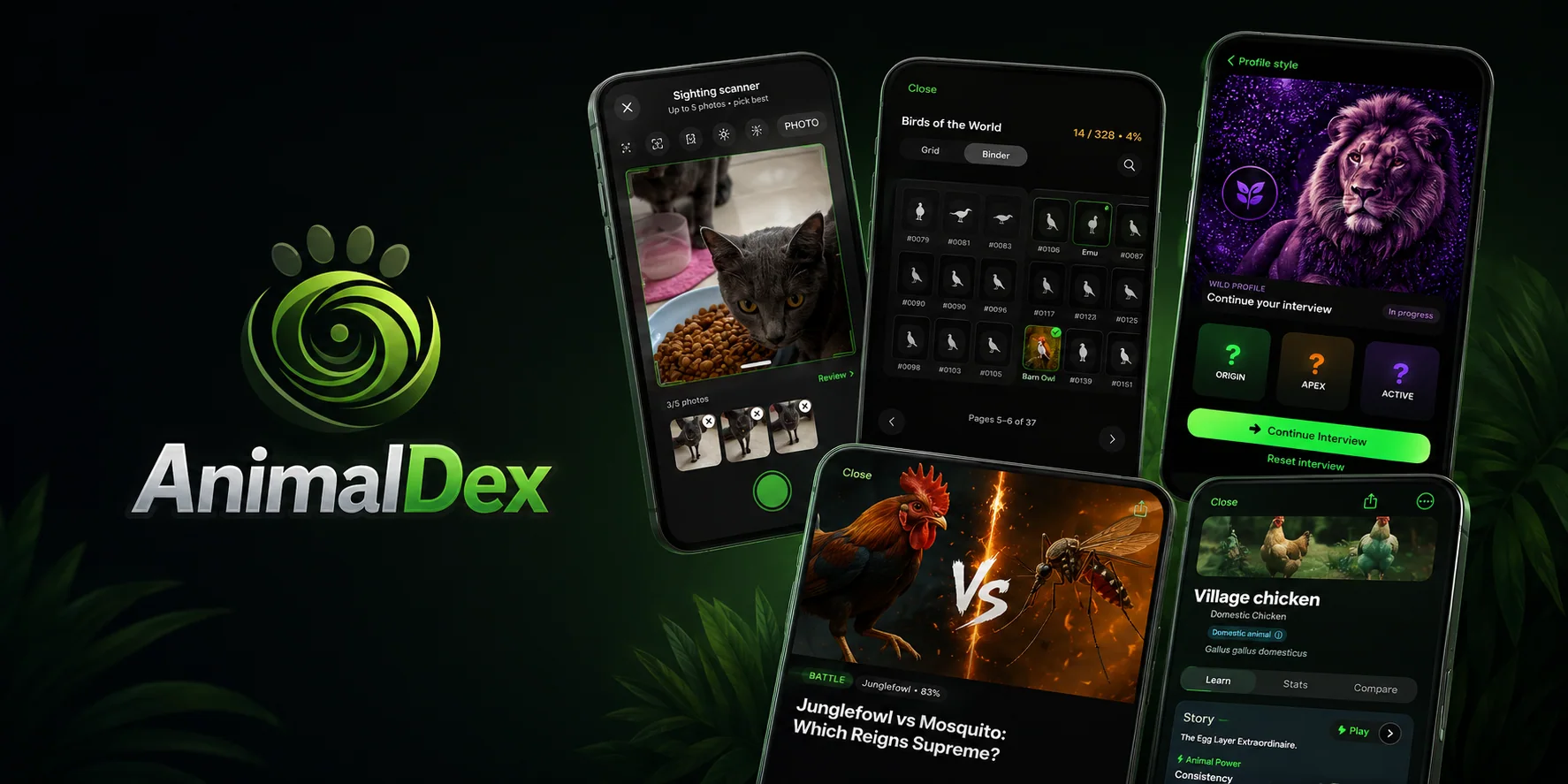
AnimalDex
Best if identification should lead somewhere
Best if…
Collectors, animal learners and people who want lessons and progression after a scan.
Not ideal if…
You need community verification, research-grade observations or dependable offline identification.
Strengths
- + Broad animal focus with over 2,000 indexed species profiles
- + Video captures identified by consensus across sampled frames
- + Every capture receives a 1–10 grade across seven weighted factors
- + Species stats, E–S tiers and comparison battles
- + Search any species for the nearest real place to see it
- + A behavioural lesson attached to each species, not only a name
Weaknesses
- − No iNaturalist-style expert community verification
- − Not the strongest offline field tool
- − Does not identify plants
- − Stats and tiers are an AnimalDex model, not a scientific ranking
02
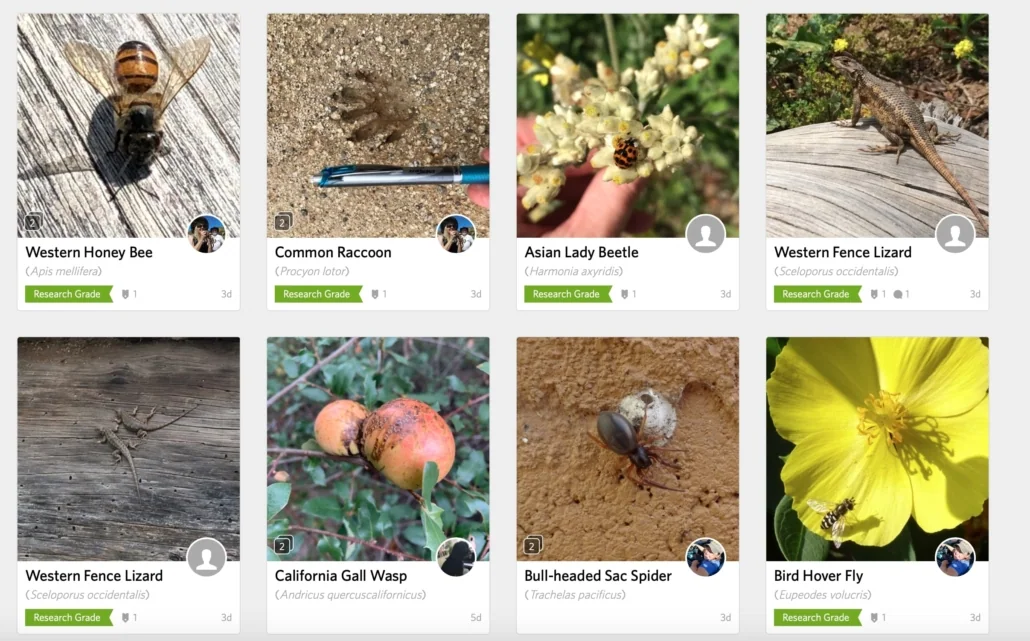
iNaturalist
Best wildlife science platform
Best if…
Naturalists, photographers and anyone who wants observations reviewed and useful to biodiversity science.
Not ideal if…
You want instant, private, game-like identification with no account or public data workflow.
Strengths
- + Community can confirm or refine IDs
- + Research Grade status makes records usable by science
- + Plants, animals, fungi and more
- + Observation maps show where a species has actually been recorded
- + Free, nonprofit and science-oriented
Weaknesses
- − Research Grade rates the record, not the quality of your photo
- − Photos and sound only—no video observations
- − Community confirmation is not always instant
- − Maps show where a species was seen before, not where to go now
03
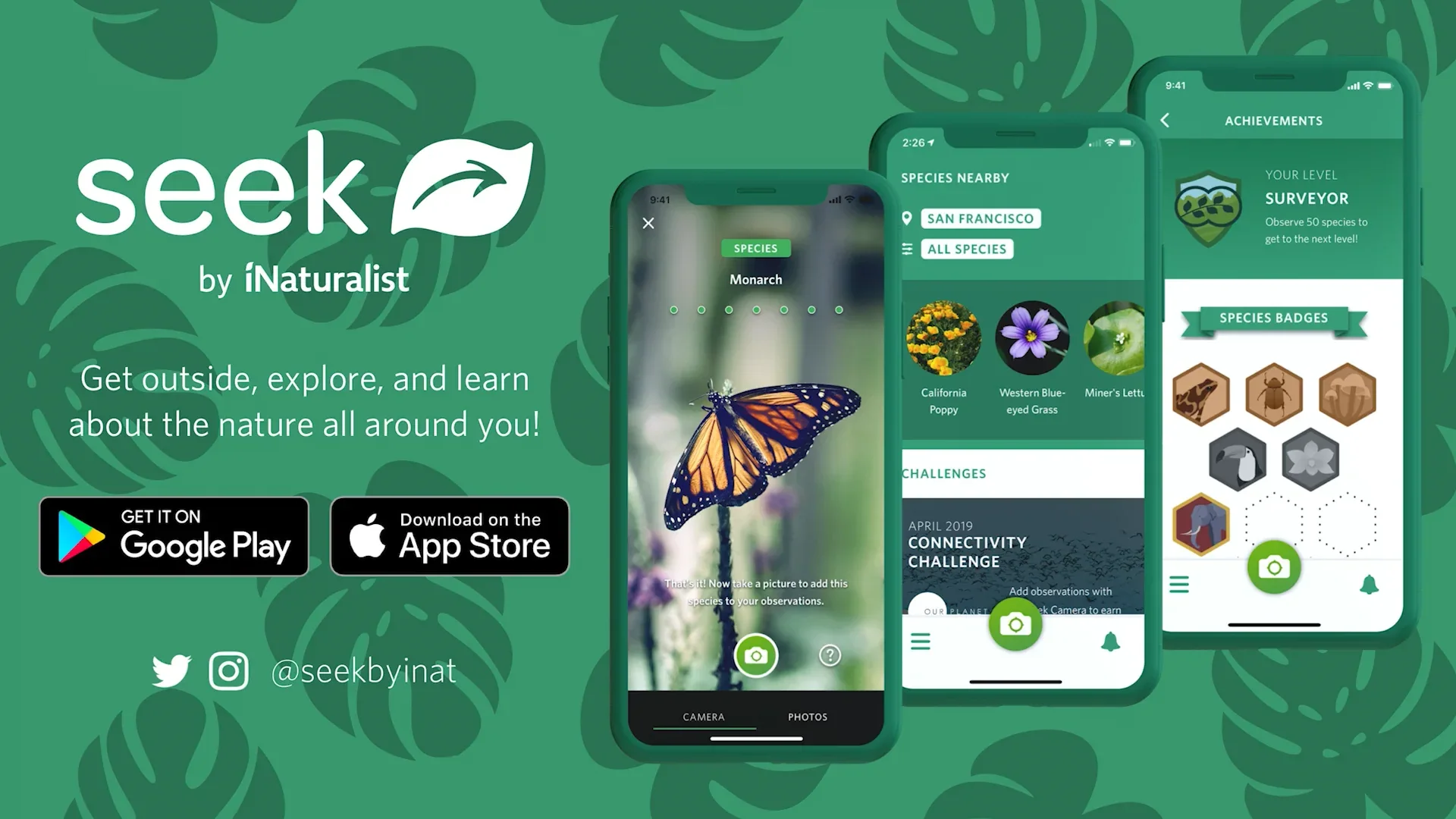
Seek by iNaturalist
Best beginner wildlife app
Best if…
Children, families, classrooms and hikers who want private, real-time identification without an account.
Not ideal if…
You need the newest iNaturalist model, expert review or a serious public wildlife log.
Strengths
- + Works without an internet connection
- + Live camera identification in real time
- + No account required and private by default
- + Badges and challenges reward exploration
Weaknesses
- − Its on-device model can trail iNaturalist’s current online model
- − Live view identifies but keeps no clip to re-examine
- − No stats, grading or species-level progression
- − Less suitable for research-grade records
04
Merlin Bird ID
The clear specialist for birds
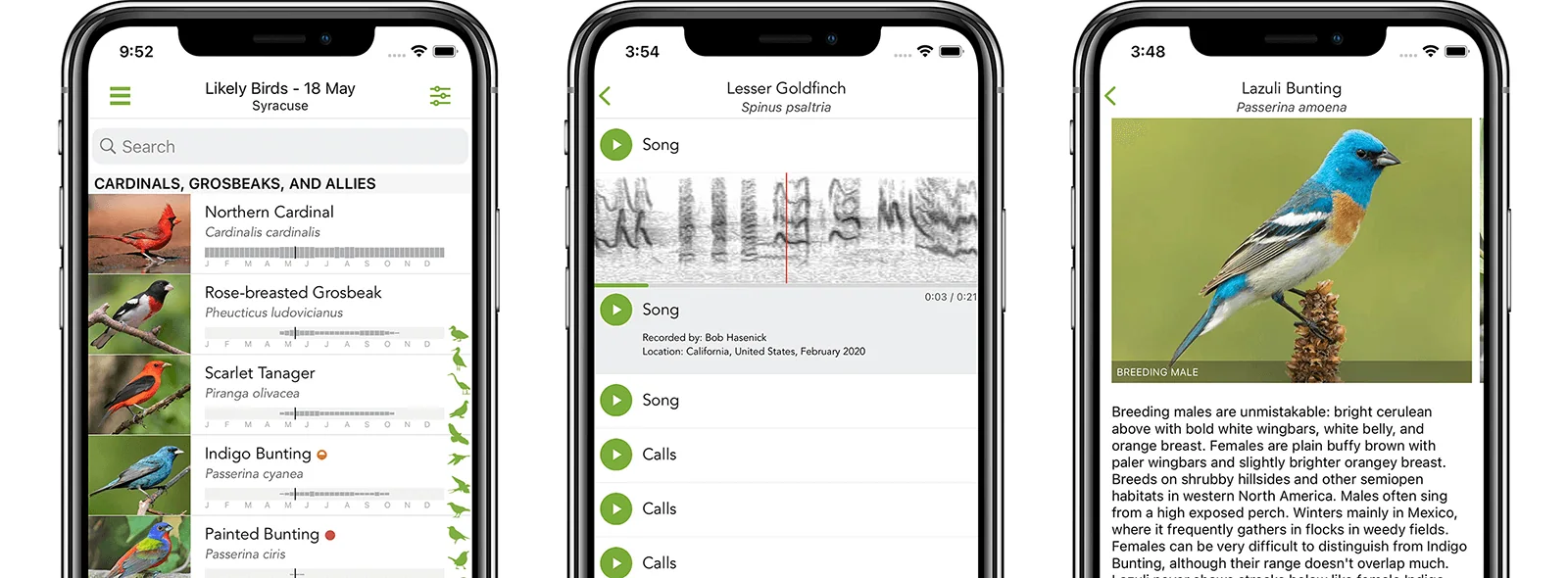
Best if…
Birders who want photo, sound and guided identification, including in places with poor reception.
Not ideal if…
You want mammals, reptiles, insects, plants or a general wildlife collection.
Strengths
- + Photo ID and Sound ID work offline after setup
- + Real-time sound identification is genuinely best in class
- + eBird data powers likely-birds-near-you lists and range maps
- + Maintains a bird life list
Weaknesses
- − Birds only
- − Real-time analysis is audio, not video
- − Regional packs require storage and preparation
- − No grading, stats or comparison layer
05
Google Lens
Best when you need broad visual search
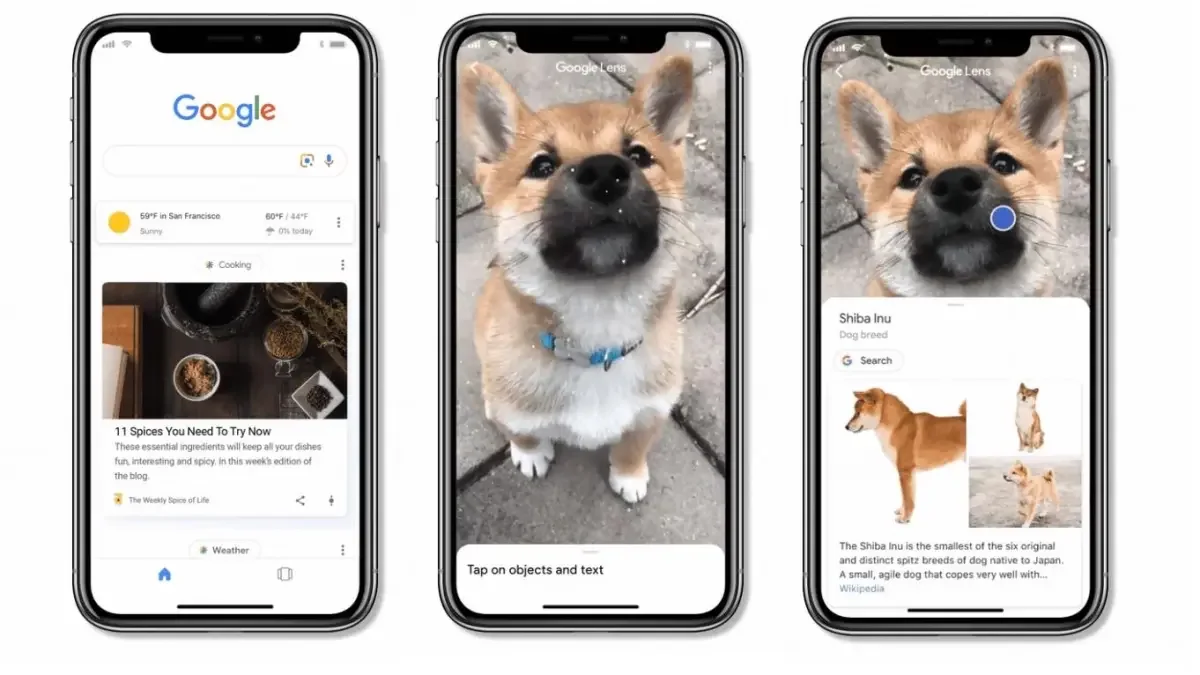
Best if…
Occasional users who want a quick lead from any photo without maintaining a dedicated nature log.
Not ideal if…
You need a curated field guide, offline use, collection progression or scientific verification.
Strengths
- + Understands far more than wildlife
- + Easy to access from the Google app and photos
- + Returns visually similar images and web context
- + Useful when the subject may not be an animal
Weaknesses
- − A search result is not a verified identification
- − No wildlife-specific observation workflow
- − Web results vary in quality and require judgment
06
PictureThis
Best here for plants—not animals
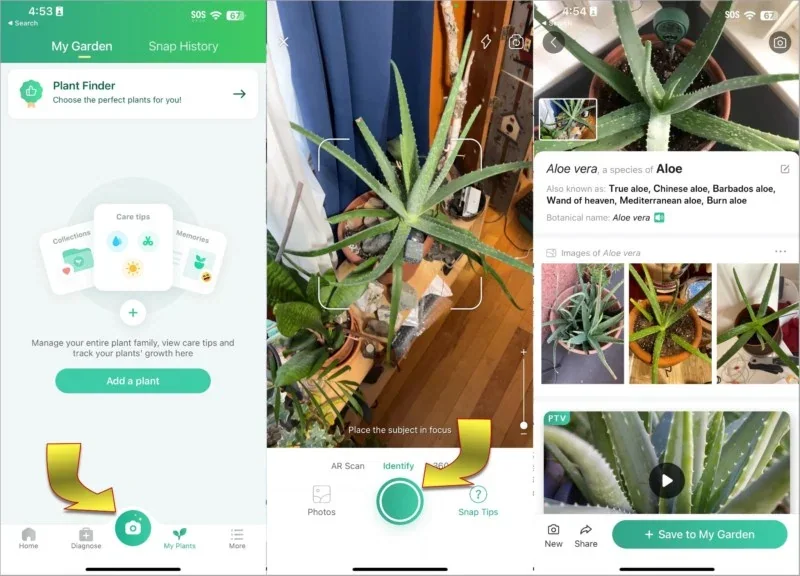
Best if…
Gardeners who need plant identification, care guidance and disease diagnosis.
Not ideal if…
Your priority is broad wildlife identification or animal collection.
Strengths
- + Strong plant-first identification workflow
- + Plant care and disease guidance
- + Personal garden organization
- + Detailed plant encyclopedia
Weaknesses
- − Not a general animal identifier
- − Many care features sit behind premium access
- − Wildlife features are not its core proposition
Interactive chooser
Which app is right for you?
Choose the job you actually need the app to do.
Our recommendation
Merlin Bird ID
Its bird-only focus, Sound ID, Photo ID and downloadable bird packs make it the specialist choice.
Visit Merlin Bird IDRecommendation changes by task—not by sponsor ranking.
A different philosophy
Why AnimalDex is different
Most identification tools optimize for one question: “What is this?” AnimalDex is designed around the follow-up: “What can I learn from this?”
That is not automatically better. If your priority is scientific contribution, use iNaturalist. If your priority is birds, use Merlin. The AnimalDex approach is for people who want discovery to compound.
Scan
↓Identify
↓Collect
↓Level up
↓Compare
↓Learn
↓Apply
Inside the app
The workflow, not just the pitch
Five product surfaces showing what happens after the camera opens.
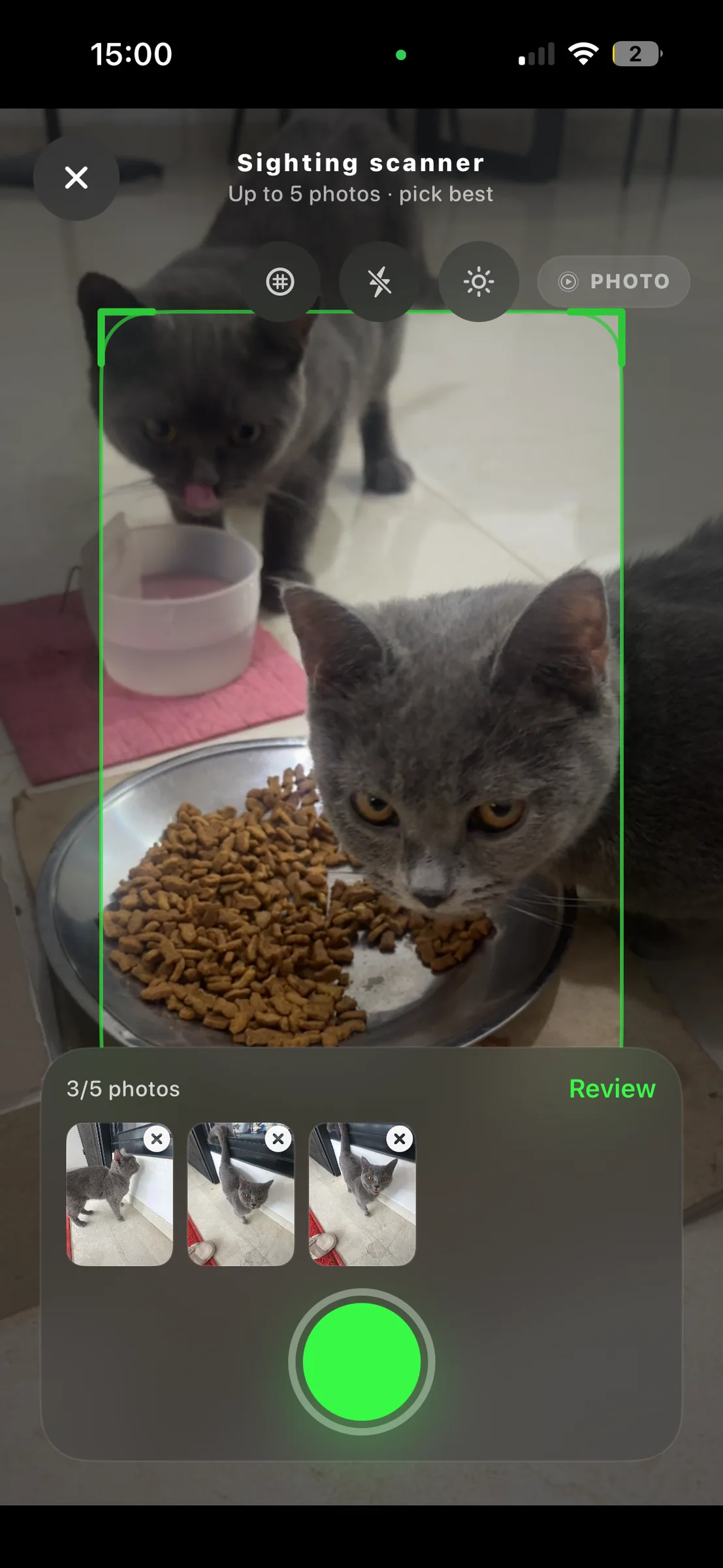
Scanner
Start with a photo and a likely identification.
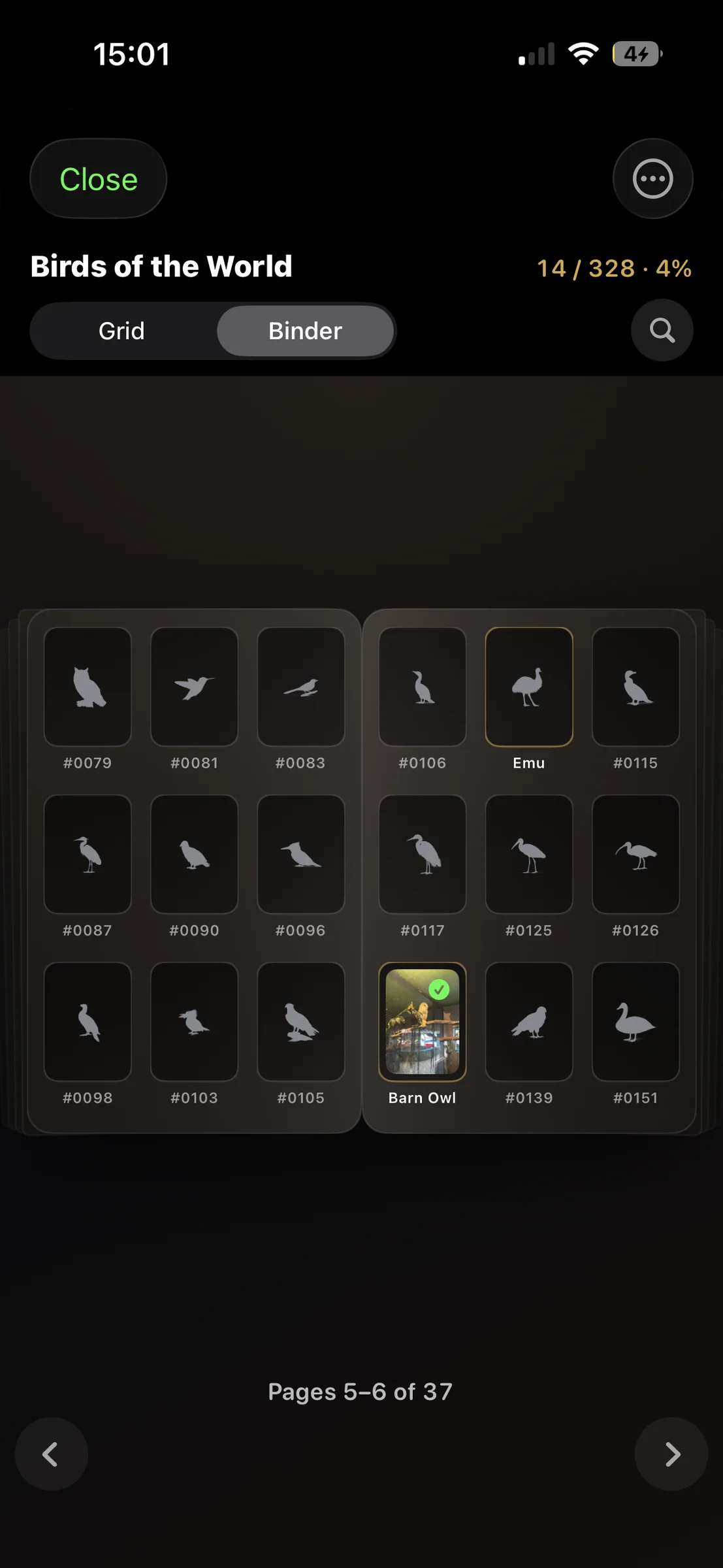
Collection
Keep discoveries instead of losing them after one search.
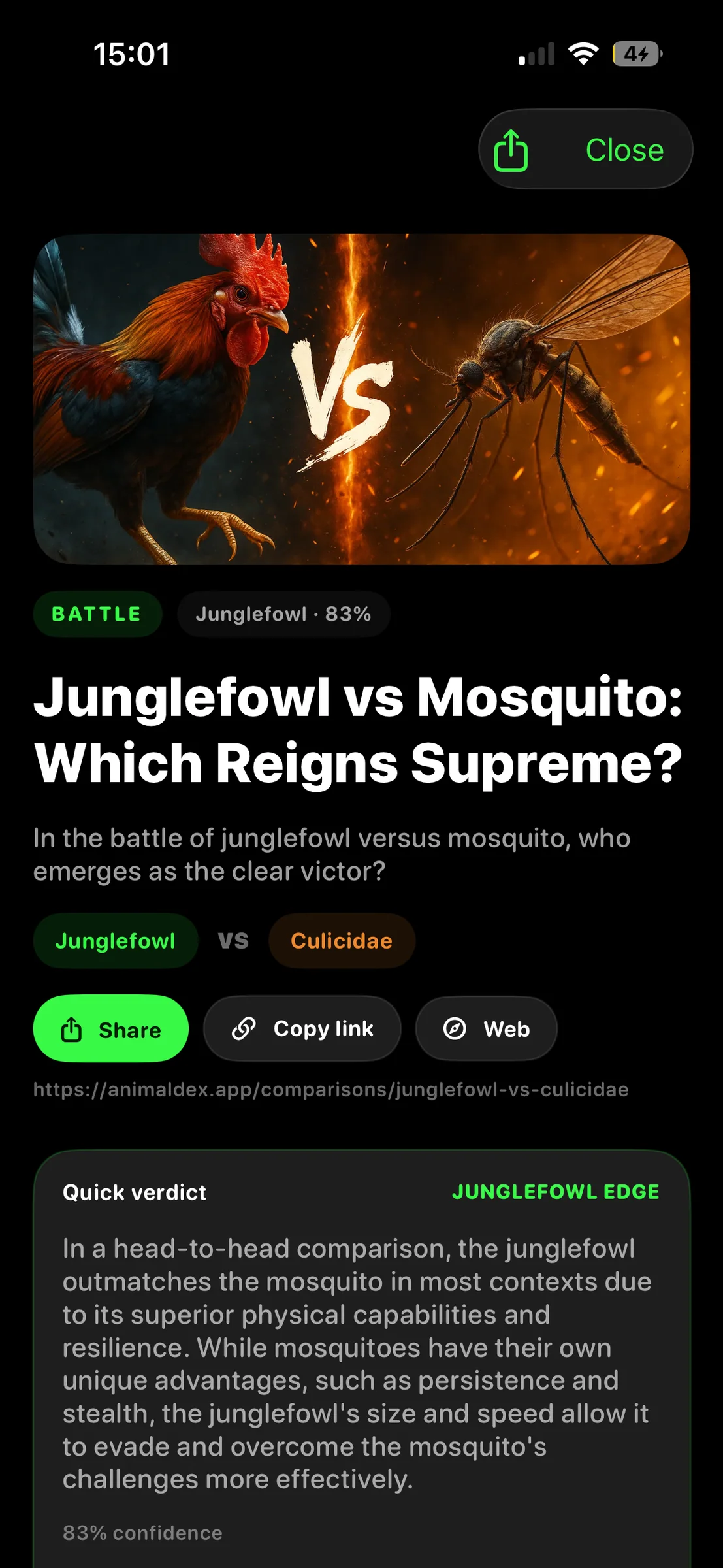
Comparisons
Place species side by side and explore their strengths and tradeoffs.
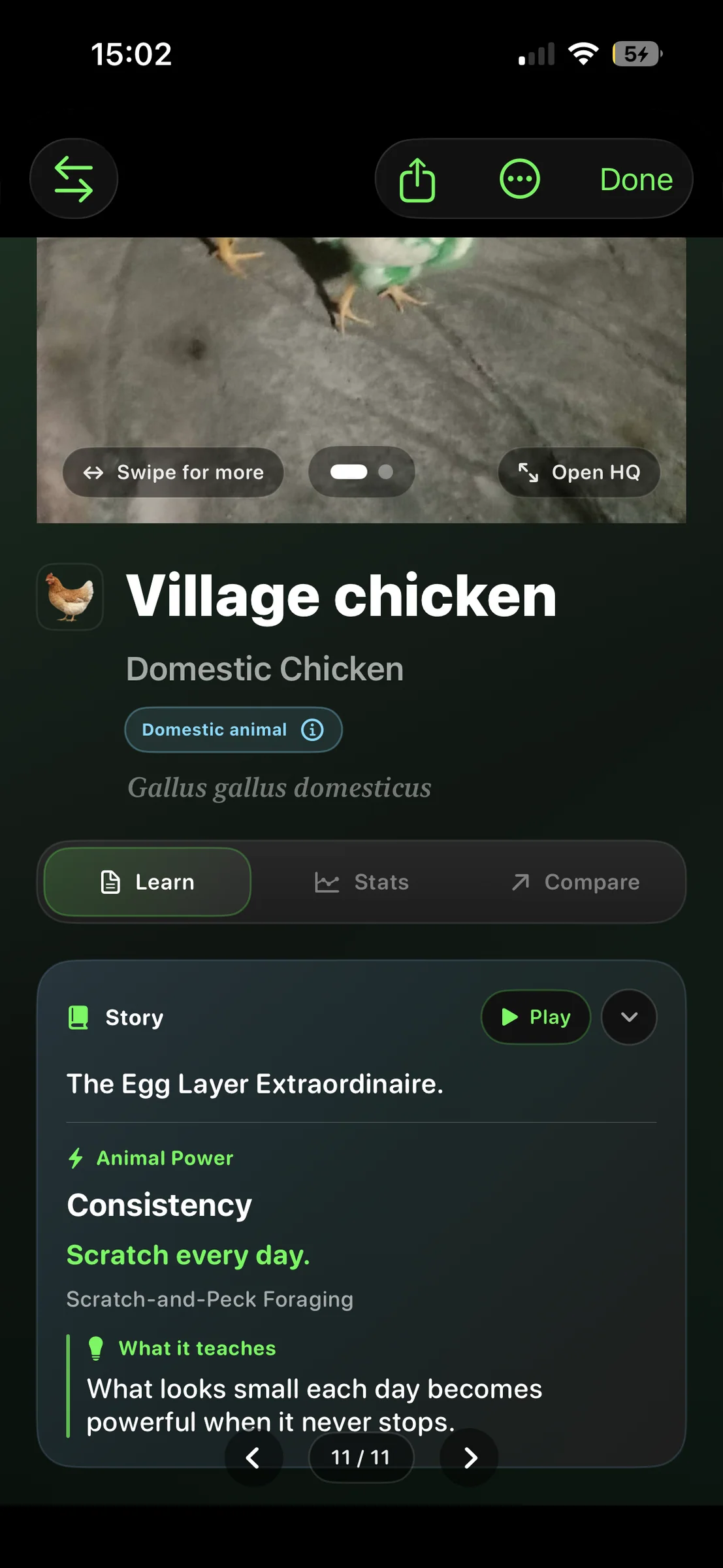
Lessons
Move from animal behaviour to a memorable idea.
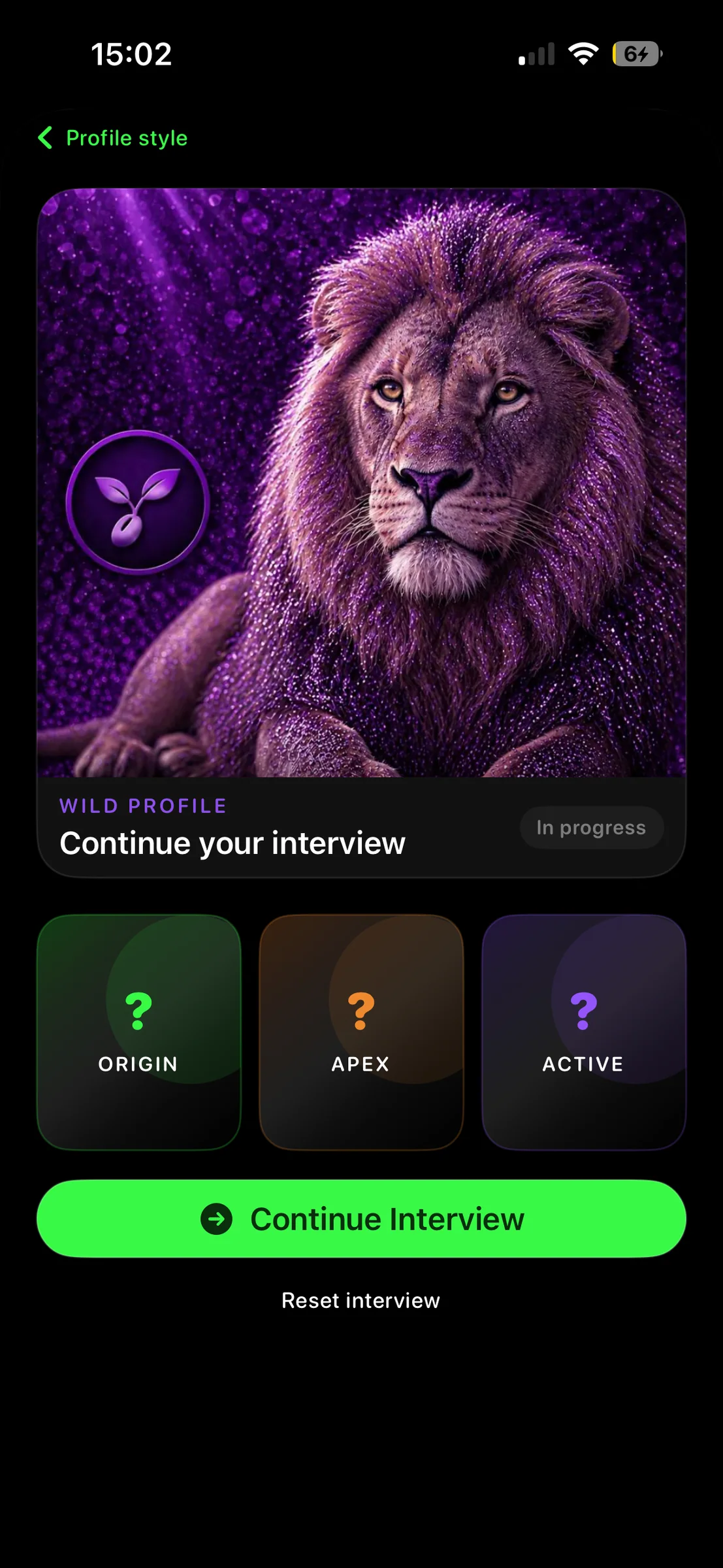
Wild Profile
See patterns across the animals you connect with.
Feature deep dive
Six differences that actually matter
The tick table above shows what exists. This section explains what those differences mean when you are standing in front of an animal—and what each app costs you to keep using.
01 · Video analysis
Identifying from a clip, not a lucky frame
In AnimalDex
AnimalDex accepts a video capture, samples frames across the clip with their timestamps, and identifies by consensus across those frames. One blurry frame cannot hijack the result, and one sharp frame cannot override weak agreement everywhere else—unless it uniquely shows decisive anatomy, such as an inverted hanging roost posture that separates a bat from a bird. The clip stays on the capture and plays back in the feed.
Everywhere else
Seek identifies live through the viewfinder but keeps no clip you can re-examine. Merlin’s real-time strength is Sound ID, which analyses audio rather than moving images. iNaturalist accepts photos and sound recordings, not video. Google Lens works from a single frame.
Why it matters: Animals that never hold still—bats in flight, fish, a bird deep in a canopy—rarely give you one clean photo. A clip gives the model several chances at the same animal.
02 · Photo grading
“Research Grade” and a capture grade measure different things
In AnimalDex
Every AnimalDex capture receives a grade from 1 to 10, built from seven weighted factors: identification confidence (24%), clarity and focus (20%), centering, proximity and framing (18%), shot quality (16%), body detail (8%), the animal’s condition (8%) and habitat and setting (6%). Deductions apply for a likely non-live source such as a photo of a screen, poster or print, for heavy obstruction like cage bars, and for identifications the model could not resolve. Community endorsements add a small lift. A grade above 7 requires sharp focus and clear image quality.
Everywhere else
iNaturalist’s Research Grade is a data-quality status, not a photo score: an observation needs a date, a location, media and a wild organism, and two-thirds of identifiers must agree on the species. A flat, unremarkable photo of an obvious species reaches Research Grade. A beautiful photo of a contested species does not. Seek, Merlin, Google Lens and PictureThis do not grade captures at all.
Why it matters: iNaturalist grades how useful your record is to science. AnimalDex grades the capture itself—so the feedback tells you how to take a better one next time.
03 · Stats, tiers and battles
Every species carries numbers you can actually compare
In AnimalDex
Each indexed species holds five stats—dominance, speed, size, intelligence and rarity—plus a power score that resolves to a battle tier from E up to S. Matchups are restricted to species within one tier of each other, so the arena stays a real comparison rather than a fantasy free-for-all. Head-to-head comparisons run across battle, speed, strength, intelligence, stealth, durability and agility, and challenges are settled by a chosen deciding stat.
Everywhere else
No other app in this comparison assigns species-level stats, tiers or head-to-head matchups. The nearest equivalent elsewhere is a life list: a count of what you have seen, with nothing to compare between entries.
Why it matters: Stats turn a collection into something you can reason about. They are an AnimalDex model for comparison, not a scientific ranking, and the tier guide says so on every list.
04 · Animal tracking
A heatmap of the past, or directions to the nearest place
In AnimalDex
Search any species in AnimalDex and it resolves the nearest real place you could go and see it—a local venue that keeps or features the animal, or a highly likely look destination inside its native range, with notes on what to look for. When an animal is genuinely not plausible near you, it says so and routes to the native range instead of inventing a pin down the street. A separate nearby guide bands what is likely around you right now into 0–5 m, 5–20 m and 20–50 m, plus a possible-but-uncommon list.
Everywhere else
iNaturalist maps verified past observations—excellent evidence of where a species has been recorded, and the better tool if you want proof. Seek surfaces nearby species lists. Merlin uses eBird data for likely-birds-near-you and range maps, for birds only.
Why it matters: “Where has this been seen?” and “where can I go to see it?” are different questions. Most apps answer the first one well and the second one not at all.
05 · Species depth
Over 2,000 indexed species, each with a profile and a lesson
In AnimalDex
AnimalDex has indexed over 2,000 species, each with its own AnimalDex number and profile: a field-guide entry, stats, comparisons and a behavioural principle—a real trait or strategy the animal uses, written so it can be applied to something in your own life. The catalogue keeps growing, and captures link into it rather than sitting as loose photos.
Everywhere else
Other identification apps answer “what is this?” and stop. iNaturalist adds taxonomy and observation history, Merlin adds calls and range information, and PictureThis adds plant care—but none of them attach a transferable idea to the animal.
Why it matters: The name of an animal is the least interesting thing about it. The point of indexing a species is what you can carry away from it.
06 · Credits and limits
What “free” actually costs in each app
In AnimalDex
AnimalDex is free to use and runs on credits. You earn them by doing the thing the app is for—logging captures, entering comparison battles, staying active—and you can buy more with real money if you want to. In normal use people very rarely run out, because ordinary exploring earns faster than it spends. There is no daily cap on how many animals you can capture.
Everywhere else
iNaturalist, Seek and Merlin Bird ID are genuinely free, backed by a nonprofit and a university lab, and that is the cleanest deal in the category. Google Lens is free. PictureThis gives you limited free use and pushes a subscription for its care features. Gotcha, a newer animal-capture app with a narrower feature set, indexes around 900 animals and stops free users at 10 captures per day unless they upgrade to Pro.
AnimalDex
Cost model
Free, with credits earned through captures and comparison battles; purchasable if you want more
The limit you actually hit
No daily capture cap; credits rarely run out in normal use
iNaturalist
Cost model
Free, nonprofit
The limit you actually hit
None—but records are public by design
Seek
Cost model
Free, no account needed
The limit you actually hit
None; on-device model can trail the online one
Merlin Bird ID
Cost model
Free, from the Cornell Lab of Ornithology
The limit you actually hit
Birds only; regional packs must be downloaded
Google Lens
Cost model
Free
The limit you actually hit
None, but it keeps no wildlife log for you
PictureThis
Cost model
Limited free use, subscription for the rest
The limit you actually hit
Care and diagnosis features sit behind the paywall
Gotcha
Cost model
Free tier with a Pro upgrade
The limit you actually hit
10 captures per day on the free tier; around 900 animals indexed
| App | Cost model | The limit you actually hit |
|---|---|---|
| AnimalDex | Free, with credits earned through captures and comparison battles; purchasable if you want more | No daily capture cap; credits rarely run out in normal use |
| iNaturalist | Free, nonprofit | None—but records are public by design |
| Seek | Free, no account needed | None; on-device model can trail the online one |
| Merlin Bird ID | Free, from the Cornell Lab of Ornithology | Birds only; regional packs must be downloaded |
| Google Lens | Free | None, but it keeps no wildlife log for you |
| PictureThis | Limited free use, subscription for the rest | Care and diagnosis features sit behind the paywall |
| Gotcha | Free tier with a Pro upgrade | 10 captures per day on the free tier; around 900 animals indexed |
Why it matters: A daily capture cap stops you on the exact day you find something worth capturing. A credit balance you refill by using the app normally is a different shape of limit—and if the free tools cover what you need, use them.
Trust before certainty
How to use AI identification responsibly
How identification works
Models compare visible patterns with labeled examples. Better tools also use location, date and expected range to rerank likely matches.
Why AI isn’t perfect
Lookalikes, juveniles, seasonal coats, poor angles and rare species can all defeat a confident-looking result.
Why habitat matters
Two visually similar species may occupy different regions or habitats. A result that ignores geography deserves more skepticism.
How to get better results
Use sharp light, multiple angles, an uncropped subject and close details. Keep date and location metadata whenever privacy allows.
Common questions
Animal identification app FAQ
Is AnimalDex free, and how do credits work?+
AnimalDex is free to use and runs on credits. You earn them by using the app—logging captures, entering comparison battles, staying active—and you can also buy them with real money. Because ordinary exploring earns credits faster than it spends them, people very rarely run out. There is no daily cap on captures.
Do any animal apps limit how many captures you can take per day?+
Gotcha limits free users to 10 captures a day unless they upgrade to Pro, and indexes around 900 animals. AnimalDex has no daily capture cap and uses earned credits instead. iNaturalist, Seek, Merlin Bird ID and Google Lens are free with no capture limit.
Which app can identify an animal from a video?+
AnimalDex identifies from video captures by sampling frames across the clip and taking a consensus across them. Seek and Google Lens identify live through the camera without keeping a clip, Merlin analyses sound in real time rather than video, and iNaturalist accepts photos and audio but not video.
What is the difference between iNaturalist Research Grade and an AnimalDex grade?+
Research Grade is a data-quality status: an iNaturalist observation qualifies when it has a date, a location, media, a wild organism and community agreement on the species. An AnimalDex grade scores the capture itself from 1 to 10 across identification confidence, clarity and focus, framing, shot quality, body detail, condition and habitat, with deductions for photos of screens or posters, cage bars and unresolved identifications.
Which app tells you where to find an animal near you?+
AnimalDex resolves the nearest real place to see a searched species, or routes to a likely look area inside its native range when the animal is not plausible locally. iNaturalist maps where a species has previously been observed, and Merlin uses eBird data for likely birds near you. They answer related but different questions.
How many species does AnimalDex cover?+
Over 2,000 species are indexed, each with its own profile, stats, comparisons and a behavioural lesson drawn from how the animal actually lives.
Is AnimalDex better than iNaturalist?+
Not for every job. iNaturalist is better for community verification, public wildlife records and citizen science. AnimalDex is the better fit when you want collecting, comparisons, progression and lessons after identification.
Should I use Seek or AnimalDex?+
Use Seek for a private, offline-friendly, child-safe nature explorer. Use AnimalDex when you want to build a collection and continue into comparisons, lessons and progression.
Which app works best for kids?+
Seek is the safest default recommendation because it requires no account, keeps observations on the device by default and uses badges and challenges. A parent may prefer AnimalDex when a shared collection and guided learning are the priority.
Which app identifies mammals?+
AnimalDex, iNaturalist, Seek and Google Lens can all suggest mammal identifications. iNaturalist offers the strongest path to human review; Seek is useful offline; AnimalDex adds collection and learning.
Can AI identify reptiles?+
Often, but not reliably from every image. Scale pattern, head shape, location and habitat can separate similar reptiles, so treat an AI result as a candidate—not proof, especially around venomous species.
Can AI identify insects?+
Yes, but insects are particularly difficult because many species differ through tiny structures that a casual photo will not show. Multiple angles and a location-aware platform materially improve the odds.
Which app is best offline?+
Merlin is the strongest offline specialist for birds after the relevant packs are downloaded. Seek is the best broad offline nature option. iNaturalist and Google Lens are more useful with a connection.
Is Google Lens accurate enough for wildlife?+
It is useful for generating leads and finding similar images. For difficult or safety-sensitive identifications, verify the result with field marks, distribution data or a knowledgeable human.
Are any of these apps completely free?+
iNaturalist, Seek, Merlin Bird ID and Google Lens are free to use. AnimalDex is free and runs on credits you earn by capturing and competing, with the option to buy more. PictureThis offers limited access and promotes a paid subscription, and Gotcha caps free users at 10 captures per day.
What photo gives an identification app the best chance?+
Use sharp natural light, fill the frame without cropping off key anatomy, photograph more than one angle and retain the location and date. For insects and plants, include close-up detail and the whole organism.