
Animal field guide
Alpine Chough
Pyrrhocorax graculus
Alpine Choughs are intelligent mountain corvids that move in flocks, play in strong winds, and search for insects, berries, and human scraps around cliffs and alpine settlements. Their survival comes from curiosity, group awareness, and comfort in high exposed places.
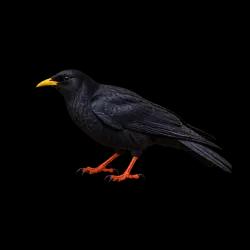
Alpine Chough at a glance
Animal · Europe · High mountains from southern Europe · Rippling · Relatively common
Known for: Glossy black plumage all over, Short, Bright coral-red legs in adults, Rippling
Its Power
High-Play Learning
Learn the mountain by making the air social.
Perspective becomes sharper when curiosity and group life stay active.
“Play at altitude.”
Capture a Alpine Chough, and it's yours when you finish one step it gives you.
Biological basis
Alpine Choughs are social mountain corvids that fly around cliffs and human areas, using intelligence, play, and opportunistic feeding.
Put it into practice
You learn a hard environment faster by staying curious with the people already there.
What does the alpine chough symbolize?
The alpine chough symbolizes high-play learning: learn the mountain by making the air social. It represents playfulness, curiosity and learning from others. Its AnimalDex motto: "Play at altitude."
The alpine chough as a spirit animal
If the alpine chough is your spirit animal, the AnimalDex reading is High-Play Learning: perspective becomes sharper when curiosity and group life stay active. It suggests a strength in playfulness and curiosity, and a reminder to use it on purpose.
What can the alpine chough help you with in life?
The alpine chough is a guide for playfulness, curiosity and learning from others. Its lesson applies wherever playfulness matters: perspective becomes sharper when curiosity and group life stay active.
- Playfulness
- Curiosity
- Learning from Others
In practice: You learn a hard environment faster by staying curious with the people already there.
What can we learn from the Alpine Chough?What does it mean to dream about or encounter a wild alpine chough?
Dreaming about a wild alpine chough, or coming across one, usually points to playfulness and curiosity: the qualities the alpine chough lives by. In AnimalDex, the alpine chough's principle is High-Play Learning: learn the mountain by making the air social. Read the moment through its core lesson: Perspective becomes sharper when curiosity and group life stay active.
It depends on how the alpine chough behaved. Calm or close by, it reads as curiosity within reach; aggressive or fleeing, it points to playfulness you are resisting.
Spotting an alpine chough in the wild
Coming across an alpine chough in person asks for attention more than interpretation. Watch it for a minute; the alpine chough's way of working is High-Play Learning, and the lesson is: perspective becomes sharper when curiosity and group life stay active.
An alpine chough that keeps appearing
Repeated sightings of an alpine chough usually mean the High-Play Learning lesson is still open: perspective becomes sharper when curiosity and group life stay active.
Dreaming of being chased by an alpine chough
If the alpine chough pursues you, look at where curiosity is being asked of you and you are stepping away instead of meeting it.
Dreaming that an alpine chough attacks you
An attack points to playfulness turned against you: someone using it on you, or your own playfulness overused until it costs you.
A calm or friendly alpine chough
A calm alpine chough suggests you have made peace with playfulness and can use it without force.
A dead or injured alpine chough
A dead or injured alpine chough, dreamed or found, can mark playfulness you have let lapse, or a phase built on High-Play Learning coming to an end.
These readings are reflective prompts drawn from how the alpine chough really lives, not predictions. If you meet one in the wild, watch from a distance and leave it undisturbed.
Capture your own Alpine Chough
Photograph or film one in the wild, at a zoo or at home with the app. It becomes yours: it remembers you, gives you steps, and can debate your problems with your other animals.
Animal field guide
Alpine Chough
Sign in to hear this read by a natural AI voice instead of your browser's.
Alpine Choughs are intelligent mountain corvids that move in flocks, play in strong winds, and search for insects, berries, and human scraps around cliffs and alpine settlements. Their survival comes from curiosity, group awareness, and comfort in high exposed places.
Native range
Natural range, not this capture location
High mountains from southern Europe and North Africa east to the Himalayas and China, mostly between about 1,500 and 5,000 metres. It uses alpine grassland, cliffs, scree and gorges, moving down to valleys in harsh winter weather.
Search near meAnimalDex stats
Size scale
Understand the animal
Understand the Alpine Chough
Factual biology first: what this animal is like, where it lives, how it survives, and why those traits exist.
01
Introduction to Alpine Chough
Alpine Choughs are intelligent mountain corvids that move in flocks, play in strong winds, and search for insects, berries, and human scraps around cliffs and alpine settlements. Their survival comes from curiosity, group awareness, and comfort in high exposed places.
How to identify a Alpine Chough
- Glossy black plumage all over
- Short, slightly curved yellow bill
- Bright coral-red legs in adults
- Rippling, high-pitched calls from the flock
- Long tail and rounded wings in soaring flight
Why Alpine Chough are interesting
- Pairs usually stay together for years and return to the same nest site each season.
- Juveniles have duller, black legs and gain the adult's red legs as they mature.
- It has been reported nesting above 6,000 metres in the Himalayas, one of the highest breeding altitudes recorded for any bird.
- Outside the breeding season, large flocks gather at good feeding sites.
02
Adaptations and biological abilities
03
Why does Alpine Chough behave this way?
- Glossy black plumage all over
- Short, slightly curved yellow bill
- Bright coral-red legs in adults
- Rippling, high-pitched calls from the flock
- Long tail and rounded wings in soaring flight
Active through the day. At night it roosts in caves, deep cliff crevices or sheltered rock ledges, often communally, and in winter may fly many kilometres from valley feeding sites back up to these roosts.
04
Why High mountains from southern Europe and North Africa east to the Himalayas and China?
Habitat: High mountains from southern Europe and North Africa east to the Himalayas and China, mostly between about 1,500 and 5,000 metres. It uses alpine grassland, cliffs, scree and gorges, moving down to valleys in harsh winter weather.
Native range: Europe, North Africa & Middle East, Central Asia, South Asia, East Asia
Native range
Natural range, not this specific capture location.
High mountains from southern Europe and North Africa east to the Himalayas and China, mostly between about 1,500 and 5,000 metres. It uses alpine grassland, cliffs, scree and gorges, moving down to valleys in harsh winter weather.
05
Why this diet?
In summer it probes turf and turns over stones for beetles, grasshoppers, larvae and snails. In autumn and winter it switches largely to fruit such as rose hips, juniper and other berries.
06
Activity, rest, and lifespan
Active through the day. At night it roosts in caves, deep cliff crevices or sheltered rock ledges, often communally, and in winter may fly many kilometres from valley feeding sites back up to these roosts.
Adult survival is high, and birds can live well over a decade in the wild, though most live fewer years.
07
Alpine Chough reproduction
Pairs nest in cliff crevices, caves or buildings, lining a stick nest with grass and wool. The female incubates three to five eggs for about two weeks, and the young fledge at roughly a month old.
Both sexes share the glossy black plumage, yellow bill and red legs. Males average slightly larger and heavier, a difference that cannot be judged reliably in the field.
08
Predators, threats, and defense
Golden eagles and peregrine falcons take adults, and eagle owls and ravens are probably also predators. Flocks call loudly on spotting a raptor and often mob it together in the air.
09
Conservation and rarity
Rarity: Relatively common · 45/100. AnimalDex canonical rarity score: 45/100, maintained by the live indexed species profile.
- Observe from a respectful distance and avoid changing the animal's behavior.
- Do not block feeding, shelter, nesting, or travel routes.
- Use a live camera capture without handling or staging wildlife.
Talk to it
Talk to the Alpine Chough
It answers as itself: ask about how it lives, or bring it something of yours and hear what it would do, from its own Power.
Anonymous: 6/day. Signed-in: 10/day. Pro: 100/day.
Side by side
The Alpine Chough, side by side
Nothing written side by side for the Alpine Chough yet. Pick any animal to compare it with. Compare with any animal →
Where to find them
Where to find Alpine Chough
To find Alpine Chough in the wild, focus on the exact habitat patches that match its body design and daily behavior, not just the broad country where it exists. You usually do better by working one good piece of habitat inside europe, North Africa & Middle East, Central Asia, South Asia, East Asia than by covering too much ground.
- Rocky slopes, ridge lines, cliff ledges, or open mountain meadows with a wide view
- Open grassland edges, lightly wooded plains, or raised ground where you can scan long distances
- Protected habitat blocks within europe, North Africa & Middle East, Central Asia, South Asia, East Asia
In the Ark
No Alpine Chough is aboard yet.
None have come aboard or left since November 17.
The Ark is a live, shared animal world. Animals come aboard when people capture them, and live there by rules based on their field guides.
Scientific name
Pyrrhocorax graculus
Category
Animal
Habitat
High mountains from southern Europe and North Africa east to the Himalayas and China, mostly between about 1,500 and 5,000 metres. It uses alpine grassland, cliffs, scree and gorges, moving down to valleys in harsh winter weather.
Rarity
Relatively common · 45/100
Native range
Europe, North Africa & Middle East, Central Asia, South Asia, East Asia
Take the encyclopedia outside
AnimalDex helps you scan real animals, identify species, collect cards, and learn from nature wherever you are.