Animal field guide
Asian Vine Snake
Ahaetulla prasina
The Asian Vine Snake is a pencil-thin, leaf-green tree snake of South-East Asian forests and gardens, with a long pointed head and horizontal pupils. It hunts lizards and frogs by day, moving so slowly and swaying so like a stem in the breeze that it is usually overlooked.
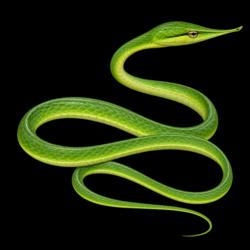
Asian Vine Snake at a glance
Reptile · Southeast Asia · Lowland and hill rainforest · Relatively common
Known for: Extremely slender bright green body, Long, Horizontal keyhole-shaped pupil, Thin pale line along the lower flank
Its Power
Keyhole Sight
Line up both eyes on the target before committing to the strike.
Knowing the exact distance before acting is worth more than acting quickly.
“Measure, then strike.”
Capture a Asian Vine Snake, and it's yours when you finish one step it gives you.
Biological basis
Ahaetulla prasina has horizontal keyhole-shaped pupils and a groove running along each side of its narrow snout, so both eyes can look straight ahead down the grooves. The overlapping fields give it binocular vision, unusual among snakes, which lets it judge the range to a lizard or frog on a swaying branch before it strikes.
Put it into practice
A carpenter who measures the alcove twice and checks the wall for square cuts the shelf once, while the one who hurries ends up buying the timber again.
What does the Asian vine snake symbolize?
The Asian vine snake symbolizes keyhole sight: line up both eyes on the target before committing to the strike. It represents precision, caution and perspective. Its AnimalDex motto: "Measure, then strike."
The Asian vine snake as a spirit animal
If the Asian vine snake is your spirit animal, the AnimalDex reading is Keyhole Sight: knowing the exact distance before acting is worth more than acting quickly. It suggests a strength in precision and caution, and a reminder to use it on purpose.
What can the Asian vine snake help you with in life?
The Asian vine snake is a guide for precision, caution and perspective. Its lesson applies wherever precision matters: knowing the exact distance before acting is worth more than acting quickly.
- Precision
- Caution
- Perspective
In practice: A carpenter who measures the alcove twice and checks the wall for square cuts the shelf once, while the one who hurries ends up buying the timber again.
What can we learn from the Asian Vine Snake?What does it mean to dream about or encounter a wild Asian vine snake?
Meeting a wild Asian vine snake, asleep or awake, is often a nudge toward precision, the quality the Asian vine snake is built around. In AnimalDex, the Asian vine snake's principle is Keyhole Sight: line up both eyes on the target before committing to the strike. Read the moment through its core lesson: Knowing the exact distance before acting is worth more than acting quickly.
Neither good nor bad on its own. How the Asian vine snake acts matters: at ease, it reflects precision; hostile, it flags precision out of balance.
Spotting an Asian vine snake in the wild
A real encounter is the plainest version of the sign: notice what the Asian vine snake was doing. Line up both eyes on the target before committing to the strike. That is the precision worth borrowing today.
An Asian vine snake that keeps appearing
Seeing the Asian vine snake again and again, in dreams or outside, suggests precision is a theme you have not settled yet.
Dreaming of being chased by an Asian vine snake
Being chased suggests you are avoiding the Keyhole Sight the Asian vine snake stands for: knowing the exact distance before acting is worth more than acting quickly. Ask what you keep postponing that needs precision.
Dreaming that an Asian vine snake attacks you
When the Asian vine snake attacks, the dream may be about pressure: caution or perspective applied too hard, by you or by someone close to you.
A calm or friendly Asian vine snake
A calm Asian vine snake suggests you have made peace with precision and can use it without force.
A dead or injured Asian vine snake
An injured Asian vine snake often reflects precision under strain; rest and repair come before pushing again.
These readings are reflective prompts drawn from how the Asian vine snake really lives, not predictions. If you meet one in the wild, watch from a distance and leave it undisturbed.
Capture your own Asian Vine Snake
Photograph or film one in the wild, at a zoo or at home with the app. It becomes yours: it remembers you, gives you steps, and can debate your problems with your other animals.
Animal field guide
Asian Vine Snake
Sign in to hear this read by a natural AI voice instead of your browser's.
The Asian Vine Snake is a pencil-thin, leaf-green tree snake of South-East Asian forests and gardens, with a long pointed head and horizontal pupils. It hunts lizards and frogs by day, moving so slowly and swaying so like a stem in the breeze that it is usually overlooked.
Native range
Natural range, not this capture location
Lowland and hill rainforest, forest edges, secondary growth, plantations, bamboo and well-planted gardens from mainland South-East Asia through Sumatra, Java, Borneo and the Philippines. It lives in shrubs and low trees, usually within a few metres of the ground, where thin green stems hide a thin green snake.
Search near meAnimalDex stats
Dominance
30
Speed
31
Size
28
Intelligence
30
Rarity
26%
Total
145
Size scale
Understand the animal
Understand the Asian Vine Snake
Factual biology first: what this animal is like, where it lives, how it survives, and why those traits exist.
01
Introduction to Asian Vine Snake
The Asian Vine Snake is a pencil-thin, leaf-green tree snake of South-East Asian forests and gardens, with a long pointed head and horizontal pupils. It hunts lizards and frogs by day, moving so slowly and swaying so like a stem in the breeze that it is usually overlooked.
How to identify a Asian Vine Snake
- Extremely slender bright green body
- Long, narrow, pointed head
- Horizontal keyhole-shaped pupil
- Thin pale line along the lower flank
Why Asian Vine Snake are interesting
- It is rear-fanged and mildly venomous, enough to subdue a lizard but not considered dangerous to people.
- When threatened it inflates its neck and forebody, spreading the scales to reveal black and white skin between them.
- Not all are green: yellow, tan, grey and orange-brown individuals occur, and juveniles are often duller than adults.
- It gives birth to live young rather than laying eggs.
- It often advances with a rocking, swaying motion that matches foliage moving in the wind.
- The Long-nosed Vine Snake (Ahaetulla nasuta) of India and Sri Lanka has a distinct fleshy point extending from the tip of its snout, which the Asian Vine Snake lacks.
02
Adaptations and biological abilities
03
Why does Asian Vine Snake behave this way?
- Extremely slender bright green body
- Long, narrow, pointed head
- Horizontal keyhole-shaped pupil
- Thin pale line along the lower flank
Active by day, relying on sight to hunt. At night it sleeps loosely coiled on the outer leaves and thin branches of shrubs, where it is often easier to find by torchlight than it ever is in daylight.
04
Why Lowland and hill rainforest?
Habitat: Lowland and hill rainforest, forest edges, secondary growth, plantations, bamboo and well-planted gardens from mainland South-East Asia through Sumatra, Java, Borneo and the Philippines. It lives in shrubs and low trees, usually within a few metres of the ground, where thin green stems hide a thin green snake.
Native range: Southeast Asia
Native range
Natural range, not this specific capture location.
Lowland and hill rainforest, forest edges, secondary growth, plantations, bamboo and well-planted gardens from mainland South-East Asia through Sumatra, Java, Borneo and the Philippines. It lives in shrubs and low trees, usually within a few metres of the ground, where thin green stems hide a thin green snake.
05
Why this diet?
06
Activity, rest, and lifespan
Active by day, relying on sight to hunt. At night it sleeps loosely coiled on the outer leaves and thin branches of shrubs, where it is often easier to find by torchlight than it ever is in daylight.
Not well recorded in the wild; captive animals have lived for roughly a decade.
07
Asian Vine Snake reproduction
Females give birth to a small litter of live young, commonly four to ten, each a thin miniature of the adult and independent from birth. The young hunt by sight from the start, taking small lizards and frogs.
Females grow longer and heavier-bodied than males, and males have a proportionally longer tail. Colour and pattern are otherwise alike.
08
Predators, threats, and defense
09
Conservation and rarity
Rarity: Relatively common · 26/100. AnimalDex canonical rarity score: 26/100, maintained by the live indexed species profile.
- Observe from a respectful distance and avoid changing the animal's behavior.
- Do not block feeding, shelter, nesting, or travel routes.
- Use a live camera capture without handling or staging wildlife.
Talk to it
Talk to the Asian Vine Snake
It answers as itself: ask about how it lives, or bring it something of yours and hear what it would do, from its own Power.
Anonymous: 3/day. Signed-in: 10/day. Pro: 100/day.
Side by side
The Asian Vine Snake, side by side
Nothing written side by side for the Asian Vine Snake yet. Pick any animal to compare it with. Compare with any animal →
Where to find them
Where to find Asian Vine Snake
To find Asian Vine Snake in the wild, focus on the exact habitat patches that match its body design and daily behavior, not just the broad country where it exists. You usually do better by working one good piece of habitat inside southeast Asia than by covering too much ground.
- Forest edge, canopy gaps, fruiting trees, or shaded trails where cover and food meet
- Burrow systems, sandy banks, fallen logs, or ground with clear den entrances
- Protected habitat blocks within southeast Asia
Where explorers saw it
- Kecamatan Pondok Melati, Jawa Barat, IndonesiaAug · 1 sighting
Scientific name
Ahaetulla prasina
Category
Reptile
Habitat
Lowland and hill rainforest, forest edges, secondary growth, plantations, bamboo and well-planted gardens from mainland South-East Asia through Sumatra, Java, Borneo and the Philippines. It lives in shrubs and low trees, usually within a few metres of the ground, where thin green stems hide a thin green snake.
Rarity
Relatively common · 26/100
Native range
Southeast Asia
Take the encyclopedia outside
AnimalDex helps you scan real animals, identify species, collect cards, and learn from nature wherever you are.