
Animal field guide
Australian Stingless Bee
Tetragonula carbonaria
One of Australia's native stingless bees, a shiny black insect about 4 millimetres long whose sting is too small to use. Colonies of several thousand workers live in hollow trees or wooden boxes and store a tangy honey, known as sugarbag, in clusters of resin-and-wax pots.
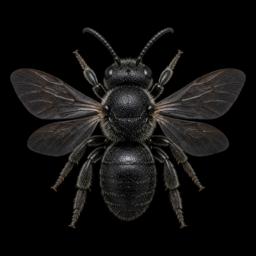
Australian Stingless Bee at a glance
Invertebrate · Australia & Oceania · Eucalypt forest · Relatively common
Known for: Shiny black body about 4 millimetres long, Does not sting, Pollen carried in baskets on the hind legs, Dark resin smeared around the nest entrance
Its Power
Spiral Hive
Design your workspace for natural growth and efficiency.
Organize your environment in a way that supports smooth expansion and efficient use of resources.
“Build for Growth.”
Capture a Australian Stingless Bee, and it's yours when you finish one step it gives you.
Biological basis
The Australian Stingless Bee constructs its hive in a spiral pattern, allowing for efficient expansion and resource management.
Put it into practice
Emma rearranges her office to allow easy access to supplies and space for new projects, boosting her productivity.
What does the Australian stingless bee symbolize?
The Australian stingless bee symbolizes spiral hive: design your workspace for natural growth and efficiency. It represents planning, coordination and renewal. Its AnimalDex motto: "Build for Growth."
The Australian stingless bee as a spirit animal
If the Australian stingless bee is your spirit animal, the AnimalDex reading is Spiral Hive: organize your environment in a way that supports smooth expansion and efficient use of resources. It suggests a strength in planning and coordination, and a reminder to use it on purpose.
What can the Australian stingless bee help you with in life?
The Australian stingless bee is a guide for planning, coordination and renewal. Its lesson applies wherever planning matters: organize your environment in a way that supports smooth expansion and efficient use of resources.
- Planning
- Coordination
- Renewal
In practice: Emma rearranges her office to allow easy access to supplies and space for new projects, boosting her productivity.
What can we learn from the Australian Stingless Bee?What does it mean to dream about or encounter a wild Australian stingless bee?
A wild Australian stingless bee, whether in a dream or in front of you, tends to show up when planning or coordination is on your mind. In AnimalDex, the Australian stingless bee's principle is Spiral Hive: design your workspace for natural growth and efficiency. Read the moment through its core lesson: Organize your environment in a way that supports smooth expansion and efficient use of resources.
Mostly a prompt rather than a warning. A calm Australian stingless bee suggests planning you already have; a threatening one suggests planning is being tested or pushed too far.
Spotting an Australian stingless bee in the wild
Coming across an Australian stingless bee in person asks for attention more than interpretation. Watch it for a minute; the Australian stingless bee's way of working is Spiral Hive, and the lesson is: organize your environment in a way that supports smooth expansion and efficient use of resources.
An Australian stingless bee that keeps appearing
Seeing the Australian stingless bee again and again, in dreams or outside, suggests planning is a theme you have not settled yet.
Dreaming of being chased by an Australian stingless bee
Being chased suggests you are avoiding the Spiral Hive the Australian stingless bee stands for: organize your environment in a way that supports smooth expansion and efficient use of resources. Ask what you keep postponing that needs planning.
Dreaming that an Australian stingless bee attacks you
An aggressive Australian stingless bee can mirror a conflict where planning has become a weapon rather than a strength.
A calm or friendly Australian stingless bee
Meeting a peaceful Australian stingless bee is usually encouraging: coordination and renewal are within reach.
A dead or injured Australian stingless bee
Seeing the Australian stingless bee hurt may point to coordination that has been neglected. Ask what it would take to restore it.
These readings are reflective prompts drawn from how the Australian stingless bee really lives, not predictions. If you meet one in the wild, watch from a distance and leave it undisturbed.
Capture your own Australian Stingless Bee
Photograph or film one in the wild, at a zoo or at home with the app. It becomes yours: it remembers you, gives you steps, and can debate your problems with your other animals.
Animal field guide
Australian Stingless Bee
Sign in to hear this read by a natural AI voice instead of your browser's.
One of Australia's native stingless bees, a shiny black insect about 4 millimetres long whose sting is too small to use. Colonies of several thousand workers live in hollow trees or wooden boxes and store a tangy honey, known as sugarbag, in clusters of resin-and-wax pots.
Native range
Natural range, not this capture location
Eucalypt forest, rainforest edges, woodland and leafy suburbs along the warm east coast of Australia, mainly from south-east Queensland to southern New South Wales, nesting in hollow trunks and branches, wall cavities and hive boxes.
Search near meAnimalDex stats
Size scale
Understand the animal
Understand the Australian Stingless Bee
Factual biology first: what this animal is like, where it lives, how it survives, and why those traits exist.
01
Introduction to Australian Stingless Bee
One of Australia's native stingless bees, a shiny black insect about 4 millimetres long whose sting is too small to use. Colonies of several thousand workers live in hollow trees or wooden boxes and store a tangy honey, known as sugarbag, in clusters of resin-and-wax pots.
How to identify a Australian Stingless Bee
- Shiny black body about 4 millimetres long
- Does not sting; bites when disturbed
- Pollen carried in baskets on the hind legs
- Dark resin smeared around the nest entrance
Why Australian Stingless Bee are interesting
- Australian beekeepers keep colonies in wooden boxes and split them to make new colonies.
- Neighbouring colonies sometimes fight large aerial battles, as one colony tries to take over another's nest.
- Boxed colonies are moved into macadamia orchards and other crops to pollinate them.
- Its building material, cerumen, is a mix of wax made by the bees and resin collected from plants.
02
Adaptations and biological abilities
03
Why does Australian Stingless Bee behave this way?
- Shiny black body about 4 millimetres long
- Does not sting; bites when disturbed
- Pollen carried in baskets on the hind legs
- Dark resin smeared around the nest entrance
Foragers fly by day in warm weather, usually above about 18 degrees Celsius, and stay inside on cool or rainy days. The whole colony remains in the nest at night.
04
Why Eucalypt forest?
Habitat: Eucalypt forest, rainforest edges, woodland and leafy suburbs along the warm east coast of Australia, mainly from south-east Queensland to southern New South Wales, nesting in hollow trunks and branches, wall cavities and hive boxes.
Native range: Australia & Oceania
Native range
Natural range, not this specific capture location.
Eucalypt forest, rainforest edges, woodland and leafy suburbs along the warm east coast of Australia, mainly from south-east Queensland to southern New South Wales, nesting in hollow trunks and branches, wall cavities and hive boxes.
05
Why this diet?
Workers collect nectar and pollen from a wide range of native and garden flowers, and gather plant resin for building. Larvae eat a mixed store of pollen and nectar sealed into their cell.
06
Activity, rest, and lifespan
Foragers fly by day in warm weather, usually above about 18 degrees Celsius, and stay inside on cool or rainy days. The whole colony remains in the nest at night.
Workers live roughly one to two months as adults; queens can live for several years, and a colony may persist for many years as queens are replaced.
07
Australian Stingless Bee reproduction
Each cell is stocked with food, given one egg by the queen and sealed, and the young bee emerges after several weeks. New colonies form when workers stock a new cavity nearby and a young queen moves in.
Workers are females with pollen baskets on the hind legs. Males look similar but lack the baskets and often gather in swarms outside nests; the egg-laying queen is larger, with a swollen abdomen.
08
Predators, threats, and defense
Small hive beetles and phorid flies invade weak nests, and spiders, assassin bugs and birds catch foragers. Without a working sting, workers defend the entrance by biting and by smearing intruders with sticky resin.
09
Conservation and rarity
Rarity: Relatively common · 12/100. AnimalDex canonical rarity score: 12/100, maintained by the live indexed species profile.
- Observe from a respectful distance and avoid changing the animal's behavior.
- Do not block feeding, shelter, nesting, or travel routes.
- Use a live camera capture without handling or staging wildlife.
Talk to it
Talk to the Australian Stingless Bee
It answers as itself: ask about how it lives, or bring it something of yours and hear what it would do, from its own Power.
Anonymous: 6/day. Signed-in: 10/day. Pro: 100/day.
Side by side
The Australian Stingless Bee, side by side
Nothing written side by side for the Australian Stingless Bee yet. Pick any animal to compare it with. Compare with any animal →
Where to find them
Where to find Australian Stingless Bee
To find Australian Stingless Bee in the wild, focus on the exact habitat patches that match its body design and daily behavior, not just the broad country where it exists. You usually do better by working one good piece of habitat inside australia & Oceania than by covering too much ground.
- Forest edge, canopy gaps, fruiting trees, or shaded trails where cover and food meet
- Headlands, reef edges, island colonies, tidal channels, or productive coastal water
- Sunlit logs, exposed branches, warm rocks, or regular perch sites used for scanning
In the Ark
1 Australian Stingless Bee is aboard right now.
Since November 17: 1 died of old age.
The Ark is a live, shared animal world. Animals come aboard when people capture them, and live there by rules based on their field guides.
Scientific name
Tetragonula carbonaria
Category
Invertebrate
Habitat
Eucalypt forest, rainforest edges, woodland and leafy suburbs along the warm east coast of Australia, mainly from south-east Queensland to southern New South Wales, nesting in hollow trunks and branches, wall cavities and hive boxes.
Rarity
Relatively common · 12/100
Native range
Australia & Oceania
Take the encyclopedia outside
AnimalDex helps you scan real animals, identify species, collect cards, and learn from nature wherever you are.