
Animal field guide
Barn Funnel Weaver
Tegenaria domestica
A long-legged, mottled brown spider that lives alongside people, building its web in dry corners of buildings. The web is a flat, dense sheet of silk leading back to a funnel-shaped retreat.
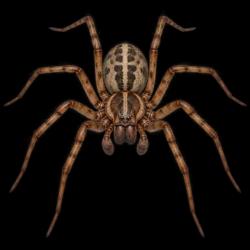
Barn Funnel Weaver at a glance
Animal · Europe · Dry · Relatively common
Known for: Legs banded with darker rings, Two dark stripes along the pale brown carapace, Abdomen with mottled chevron-like markings, Long
Its Power
Funnel Retreat
Create a safe retreat to regroup and plan.
The Barn Funnel Weaver demonstrates the importance of having a secure space to retreat to when needing to regroup and strategize.
“Retreat to strategize.”
Capture a Barn Funnel Weaver, and it's yours when you finish one step it gives you.
Biological basis
Barn Funnel Weavers build funnel-shaped webs with a retreat where they can hide from predators and ambush prey.
Put it into practice
After a hectic day at work, Sarah spends time in her cozy reading nook to relax and plan her next steps.
What does the barn funnel weaver symbolize?
The barn funnel weaver symbolizes funnel retreat: create a safe retreat to regroup and plan. It represents safe shelter, planning and strategy. Its AnimalDex motto: "Retreat to strategize."
The barn funnel weaver as a spirit animal
If the barn funnel weaver is your spirit animal, the AnimalDex reading is Funnel Retreat: the Barn Funnel Weaver demonstrates the importance of having a secure space to retreat to when needing to regroup and strategize. It suggests a strength in safe shelter and planning, and a reminder to use it on purpose.
What can the barn funnel weaver help you with in life?
The barn funnel weaver is a guide for safe shelter, planning and strategy. Its lesson applies wherever safe shelter matters: the Barn Funnel Weaver demonstrates the importance of having a secure space to retreat to when needing to regroup and strategize.
- Safe Shelter
- Planning
- Strategy
In practice: After a hectic day at work, Sarah spends time in her cozy reading nook to relax and plan her next steps.
What can we learn from the Barn Funnel Weaver?What does it mean to dream about or encounter a wild barn funnel weaver?
Dreaming about a wild barn funnel weaver, or coming across one, usually points to safe shelter and planning: the qualities the barn funnel weaver lives by. In AnimalDex, the barn funnel weaver's principle is Funnel Retreat: create a safe retreat to regroup and plan. Read the moment through its core lesson: The Barn Funnel Weaver demonstrates the importance of having a secure space to retreat to when needing to regroup and strategize.
It depends on how the barn funnel weaver behaved. Calm or close by, it reads as planning within reach; aggressive or fleeing, it points to safe shelter you are resisting.
Spotting a barn funnel weaver in the wild
Coming across a barn funnel weaver in person asks for attention more than interpretation. Watch it for a minute; the barn funnel weaver's way of working is Funnel Retreat, and the lesson is: the Barn Funnel Weaver demonstrates the importance of having a secure space to retreat to when needing to regroup and strategize.
A barn funnel weaver that keeps appearing
Seeing the barn funnel weaver again and again, in dreams or outside, suggests safe shelter is a theme you have not settled yet.
Dreaming of being chased by a barn funnel weaver
Being chased suggests you are avoiding the Funnel Retreat the barn funnel weaver stands for: the Barn Funnel Weaver demonstrates the importance of having a secure space to retreat to when needing to regroup and strategize. Ask what you keep postponing that needs safe shelter.
Dreaming that a barn funnel weaver attacks you
When the barn funnel weaver attacks, the dream may be about pressure: planning or strategy applied too hard, by you or by someone close to you.
A calm or friendly barn funnel weaver
Meeting a peaceful barn funnel weaver is usually encouraging: planning and strategy are within reach.
A dead or injured barn funnel weaver
A dead or injured barn funnel weaver, dreamed or found, can mark safe shelter you have let lapse, or a phase built on Funnel Retreat coming to an end.
These readings are reflective prompts drawn from how the barn funnel weaver really lives, not predictions. If you meet one in the wild, watch from a distance and leave it undisturbed.
Capture your own Barn Funnel Weaver
Photograph or film one in the wild, at a zoo or at home with the app. It becomes yours: it remembers you, gives you steps, and can debate your problems with your other animals.
Animal field guide
Barn Funnel Weaver
Sign in to hear this read by a natural AI voice instead of your browser's.
A long-legged, mottled brown spider that lives alongside people, building its web in dry corners of buildings. The web is a flat, dense sheet of silk leading back to a funnel-shaped retreat.
Native range
Natural range, not this capture location
Dry, sheltered places around buildings: barns, sheds, garages, cellars, window frames and woodpiles. In warmer southern Europe it also lives outdoors under bark and in rock crevices.
Search near meAnimalDex stats
Size scale
Understand the animal
Understand the Barn Funnel Weaver
Factual biology first: what this animal is like, where it lives, how it survives, and why those traits exist.
01
Introduction to Barn Funnel Weaver
A long-legged, mottled brown spider that lives alongside people, building its web in dry corners of buildings. The web is a flat, dense sheet of silk leading back to a funnel-shaped retreat.
How to identify a Barn Funnel Weaver
- Legs banded with darker rings
- Two dark stripes along the pale brown carapace
- Abdomen with mottled chevron-like markings
- Long, hairy legs, clearly longer than the body
Why Barn Funnel Weaver are interesting
- Its sheet web is not sticky; prey is caught because it stumbles and slows on the dense mat of silk.
- Adult males leave their own webs to search for females, and are then sometimes seen running across floors.
- A male may share a female's web for some time before mating.
- Carried with people and goods, it now lives in buildings on many continents far beyond its European home.
02
Adaptations and biological abilities
03
Why does Barn Funnel Weaver behave this way?
- Legs banded with darker rings
- Two dark stripes along the pale brown carapace
- Abdomen with mottled chevron-like markings
- Long, hairy legs, clearly longer than the body
Mostly nocturnal, sitting at the mouth of its tube after dark and withdrawing inside during the day.
04
Why Dry?
Habitat: Dry, sheltered places around buildings: barns, sheds, garages, cellars, window frames and woodpiles. In warmer southern Europe it also lives outdoors under bark and in rock crevices.
Native range: Europe
Native range
Natural range, not this specific capture location.
Dry, sheltered places around buildings: barns, sheds, garages, cellars, window frames and woodpiles. In warmer southern Europe it also lives outdoors under bark and in rock crevices.
05
Why this diet?
Flies, moths, beetles, woodlice and other small crawling or flying creatures that walk or fall onto the web. It digests prey externally and sucks it dry.
06
Activity, rest, and lifespan
Mostly nocturnal, sitting at the mouth of its tube after dark and withdrawing inside during the day.
Females commonly live about 2 years and sometimes longer; males usually die within months of maturing.
07
Barn Funnel Weaver reproduction
After mating, a female makes several egg sacs over time, each holding many eggs, and hides them near the web, often camouflaged with debris. Spiderlings disperse after hatching and moult several times before maturing.
Females are larger and heavier-bodied, reaching about 1 cm in body length. Males are smaller and slimmer with relatively longer legs and swollen, club-like palps.
08
Predators, threats, and defense
Daddy-long-legs spiders often invade its webs and kill it; spider-hunting wasps, centipedes, birds and other house spiders also take it. It retreats deep into its tube and runs fast when disturbed.
09
Conservation and rarity
Rarity: Relatively common · 10/100. AnimalDex canonical rarity score: 10/100, maintained by the live indexed species profile.
- Observe from a respectful distance and avoid changing the animal's behavior.
- Do not block feeding, shelter, nesting, or travel routes.
- Use a live camera capture without handling or staging wildlife.
Talk to it
Talk to the Barn Funnel Weaver
It answers as itself: ask about how it lives, or bring it something of yours and hear what it would do, from its own Power.
Anonymous: 6/day. Signed-in: 10/day. Pro: 100/day.
Side by side
The Barn Funnel Weaver, side by side
Nothing written side by side for the Barn Funnel Weaver yet. Pick any animal to compare it with. Compare with any animal →
Where to find them
Where to find Barn Funnel Weaver
To find Barn Funnel Weaver in the wild, focus on the exact habitat patches that match its body design and daily behavior, not just the broad country where it exists. You usually do better by working one good piece of habitat inside europe than by covering too much ground.
- Dry, sheltered places around buildings: barns, sheds
- Protected habitat blocks within europe
In the Ark
8 Barn Funnel Weavers are aboard right now.
None have come aboard or left since November 17.
The Ark is a live, shared animal world. Animals come aboard when people capture them, and live there by rules based on their field guides.
Scientific name
Tegenaria domestica
Category
Animal
Habitat
Dry, sheltered places around buildings: barns, sheds, garages, cellars, window frames and woodpiles. In warmer southern Europe it also lives outdoors under bark and in rock crevices.
Rarity
Relatively common · 10/100
Native range
Europe
Take the encyclopedia outside
AnimalDex helps you scan real animals, identify species, collect cards, and learn from nature wherever you are.