
Animal field guide
Bengal Monitor
Varanus bengalensis
A large monitor lizard of South Asia, reaching well over a metre with its tail. Unlike the water monitor, it lives mainly on dry land and is at home in scrub, farmland and semi-desert far from rivers and ponds.
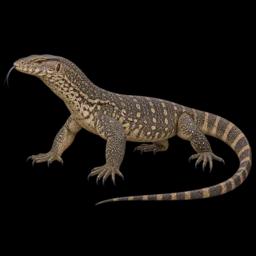
Bengal Monitor at a glance
Animal · South Asia · Dry scrub · Relatively common
Known for: Grey-brown or yellowish body finely speckled with, Oblique slit-shaped nostrils set back from the, Long tail flattened from side to side, Juveniles marked with bold pale spots and dark bands
Its Power
Measured Search
Tongue-Led Litter Probe
Thorough, methodical searching of ordinary ground finds more reliable food than waiting for rare large prizes.
“Probe every patch, steadily.”
Capture a Bengal Monitor, and it's yours when you finish one step it gives you.
Biological basis
Varanus bengalensis is an active forager that walks through scrub and farmland flicking its forked tongue to detect scent, digging into soil and litter for beetle larvae, scorpions and snails, and basking to warm up before foraging.
Put it into practice
An auditor samples every expense category a little each month rather than waiting for a whistleblower, and finds a duplicate supplier invoice before it grows.
What does the Bengal monitor symbolize?
The Bengal monitor symbolizes measured search: tongue-Led Litter Probe. It represents discipline, healthy routine and sharp observation. Its AnimalDex motto: "Probe every patch, steadily."
The Bengal monitor as a spirit animal
If the Bengal monitor is your spirit animal, the AnimalDex reading is Measured Search: thorough, methodical searching of ordinary ground finds more reliable food than waiting for rare large prizes. It suggests a strength in discipline and healthy routine, and a reminder to use it on purpose.
What can the Bengal monitor help you with in life?
The Bengal monitor is a guide for discipline, healthy routine and sharp observation. Its lesson applies wherever discipline matters: thorough, methodical searching of ordinary ground finds more reliable food than waiting for rare large prizes.
- Discipline
- Healthy Routine
- Sharp Observation
In practice: An auditor samples every expense category a little each month rather than waiting for a whistleblower, and finds a duplicate supplier invoice before it grows.
What can we learn from the Bengal Monitor?What does it mean to dream about or encounter a wild Bengal monitor?
Meeting a wild Bengal monitor, asleep or awake, is often a nudge toward discipline, the quality the Bengal monitor is built around. In AnimalDex, the Bengal monitor's principle is Measured Search: tongue-Led Litter Probe. Read the moment through its core lesson: Thorough, methodical searching of ordinary ground finds more reliable food than waiting for rare large prizes.
Mostly a prompt rather than a warning. A calm Bengal monitor suggests discipline you already have; a threatening one suggests discipline is being tested or pushed too far.
Spotting a Bengal monitor in the wild
A real encounter is the plainest version of the sign: notice what the Bengal monitor was doing. Tongue-Led Litter Probe. That is the discipline worth borrowing today.
A Bengal monitor that keeps appearing
A Bengal monitor that keeps turning up points to healthy routine you keep circling back to. The repetition is the message.
Dreaming of being chased by a Bengal monitor
If the Bengal monitor pursues you, look at where healthy routine is being asked of you and you are stepping away instead of meeting it.
Dreaming that a Bengal monitor attacks you
When the Bengal monitor attacks, the dream may be about pressure: healthy routine or sharp observation applied too hard, by you or by someone close to you.
A calm or friendly Bengal monitor
Meeting a peaceful Bengal monitor is usually encouraging: healthy routine and sharp observation are within reach.
A dead or injured Bengal monitor
Seeing the Bengal monitor hurt may point to healthy routine that has been neglected. Ask what it would take to restore it.
These readings are reflective prompts drawn from how the Bengal monitor really lives, not predictions. If you meet one in the wild, watch from a distance and leave it undisturbed.
Capture your own Bengal Monitor
Photograph or film one in the wild, at a zoo or at home with the app. It becomes yours: it remembers you, gives you steps, and can debate your problems with your other animals.
Animal field guide
Bengal Monitor
Sign in to hear this read by a natural AI voice instead of your browser's.
A large monitor lizard of South Asia, reaching well over a metre with its tail. Unlike the water monitor, it lives mainly on dry land and is at home in scrub, farmland and semi-desert far from rivers and ponds.
Native range
Natural range, not this capture location
Dry scrub, open deciduous forest, farmland, semi-desert and the edges of villages and towns, from lowland plains into foothills.
Search near meAnimalDex stats
Size scale
Understand the animal
Understand the Bengal Monitor
Factual biology first: what this animal is like, where it lives, how it survives, and why those traits exist.
01
Introduction to Bengal Monitor
A large monitor lizard of South Asia, reaching well over a metre with its tail. Unlike the water monitor, it lives mainly on dry land and is at home in scrub, farmland and semi-desert far from rivers and ponds.
How to identify a Bengal Monitor
- Grey-brown or yellowish body finely speckled with dark scales
- Oblique slit-shaped nostrils set back from the snout tip
- Long tail flattened from side to side
- Juveniles marked with bold pale spots and dark bands
- Strong limbs with long curved claws
Why Bengal Monitor are interesting
- It is fully protected under Indian wildlife law, although illegal trade in its body parts continues.
- It climbs well, and young animals in particular spend much time in trees.
- A monitor may stand upright on its hind legs, braced on its tail, to look over tall grass.
- Although it lives mainly on land, it can swim and will cross streams and canals when it needs to.
02
Adaptations and biological abilities
03
Why does Bengal Monitor behave this way?
- Grey-brown or yellowish body finely speckled with dark scales
- Oblique slit-shaped nostrils set back from the snout tip
- Long tail flattened from side to side
- Juveniles marked with bold pale spots and dark bands
- Strong limbs with long curved claws
Active by day, basking in the morning before foraging. Nights are spent in a burrow, crevice or tree hollow, and in cooler northern areas it stays inactive in shelter through the winter months.
04
Why Dry scrub?
Habitat: Dry scrub, open deciduous forest, farmland, semi-desert and the edges of villages and towns, from lowland plains into foothills.
Native range: South Asia
Native range
Natural range, not this specific capture location.
Dry scrub, open deciduous forest, farmland, semi-desert and the edges of villages and towns, from lowland plains into foothills.
05
Why this diet?
Mostly invertebrates such as beetles and their larvae, scorpions, snails and orthopterans found in soil and litter. It also takes frogs, bird and reptile eggs, small mammals and carrion when found.
06
Activity, rest, and lifespan
Active by day, basking in the morning before foraging. Nights are spent in a burrow, crevice or tree hollow, and in cooler northern areas it stays inactive in shelter through the winter months.
Wild lifespan has not been measured reliably; captive animals are reported to live about 15 to 20 years.
07
Bengal Monitor reproduction
Females lay a clutch that commonly holds around 20 eggs, placed in a dug hole, a burrow or a termite mound. Incubation is long, often several months, and the hatchlings fend for themselves from the start.
Males grow larger and heavier than females. In the breeding season rival males rear up on their hind legs and wrestle chest to chest.
08
Predators, threats, and defense
09
Conservation and rarity
Rarity: Relatively common · 35/100. AnimalDex canonical rarity score: 35/100, maintained by the live indexed species profile.
- Observe from a respectful distance and avoid changing the animal's behavior.
- Do not block feeding, shelter, nesting, or travel routes.
- Use a live camera capture without handling or staging wildlife.
Talk to it
Talk to the Bengal Monitor
It answers as itself: ask about how it lives, or bring it something of yours and hear what it would do, from its own Power.
Anonymous: 6/day. Signed-in: 10/day. Pro: 100/day.
Side by side
The Bengal Monitor, side by side
Nothing written side by side for the Bengal Monitor yet. Pick any animal to compare it with. Compare with any animal →
Where to find them
Where to find Bengal Monitor
To find Bengal Monitor in the wild, focus on the exact habitat patches that match its body design and daily behavior, not just the broad country where it exists. You usually do better by working one good piece of habitat inside south Asia than by covering too much ground.
- Forest edge, canopy gaps, fruiting trees, or shaded trails where cover and food meet
- Open grassland edges, lightly wooded plains, or raised ground where you can scan long distances
- Water sources, dune bases, rocky wadis, or shaded scrub at first and last light
Where explorers saw it
- Best Wild Safari, Cejlon, Südprovinz (Sri Lanka)Aug · 2 sightings
Guides to seeing Bengal Monitor
In the Ark
2 Bengal Monitors are aboard right now.
Since November 17: 2 came aboard.
The Ark is a live, shared animal world. Animals come aboard when people capture them, and live there by rules based on their field guides.
Scientific name
Varanus bengalensis
Category
Animal
Habitat
Dry scrub, open deciduous forest, farmland, semi-desert and the edges of villages and towns, from lowland plains into foothills.
Rarity
Relatively common · 35/100
Native range
South Asia
Take the encyclopedia outside
AnimalDex helps you scan real animals, identify species, collect cards, and learn from nature wherever you are.