Animal field guide
Big-headed Ant
Pheidole megacephala
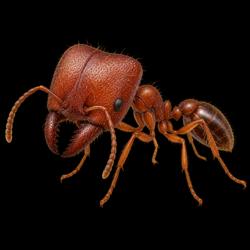
Two very different kinds of worker live in each colony of this small brown ant: numerous minor workers about 2 millimetres long, and far fewer majors whose heads are hugely enlarged relative to their bodies.
Big-headed Ant at a glance
Invertebrate · Sub-Saharan Africa · Warm · Workers have a short pair of spines · Relatively common
Known for: Workers light to reddish brown, Majors have heart-shaped heads notched at the back, Waist made of two small segments, Antennae end in a three-segmented club
Its Power
Major-minor Split
Build two kinds of worker and nothing in between.
Pheidole colonies have small minors doing the foraging and brood care, and majors with heads enlarged into milling and fighting tools, with no intermediate form. The gap in the middle is the design: two specialists beat a range of generalists.
“Two kinds, no middle.”
Capture a Big-headed Ant, and it's yours when you finish one step it gives you.
Biological basis
Pheidole megacephala exhibits a caste system where major workers, with their large heads, defend the colony, while minor workers focus on foraging and care.
Put it into practice
A small cafe runs smoothly because one person cooks, one serves and one handles the till.
What does the big-headed ant symbolize?
The big-headed ant symbolizes major-minor split: build two kinds of worker and nothing in between. It represents teamwork, mastering a niche and efficiency. Its AnimalDex motto: "Two kinds, no middle."
The big-headed ant as a spirit animal
If the big-headed ant is your spirit animal, the AnimalDex reading is Major-minor Split: pheidole colonies have small minors doing the foraging and brood care, and majors with heads enlarged into milling and fighting tools, with no intermediate form. The gap in the middle is the design: two specialists beat a range of generalists. It suggests a strength in teamwork and mastering a niche, and a reminder to use it on purpose.
What can the big-headed ant help you with in life?
The big-headed ant is a guide for teamwork, mastering a niche and efficiency. Its lesson applies wherever teamwork matters: pheidole colonies have small minors doing the foraging and brood care, and majors with heads enlarged into milling and fighting tools, with no intermediate form. The gap in the middle is the design: two specialists beat a range of generalists.
- Teamwork
- Mastering a Niche
- Efficiency
In practice: A small cafe runs smoothly because one person cooks, one serves and one handles the till.
What can we learn from the Big-headed Ant?What does it mean to dream about or encounter a wild big-headed ant?
A wild big-headed ant, whether in a dream or in front of you, tends to show up when teamwork or mastering a niche is on your mind. In AnimalDex, the big-headed ant's principle is Major-minor Split: build two kinds of worker and nothing in between. Read the moment through its core lesson: Pheidole colonies have small minors doing the foraging and brood care, and majors with heads enlarged into milling and fighting tools, with no intermediate form. The gap in the middle is the design: two specialists beat a range of generalists.
Mostly a prompt rather than a warning. A calm big-headed ant suggests teamwork you already have; a threatening one suggests teamwork is being tested or pushed too far.
Spotting a big-headed ant in the wild
If a big-headed ant crosses your path, take it as a cue to look at where teamwork fits your day. Its AnimalDex motto: "Two kinds, no middle."
A big-headed ant that keeps appearing
A big-headed ant that keeps turning up points to mastering a niche you keep circling back to. The repetition is the message.
Dreaming of being chased by a big-headed ant
A chase often means a demand for teamwork is catching up with you. The big-headed ant's lesson, "Pheidole colonies have small minors doing the foraging and brood care, and majors with heads enlarged into milling and fighting tools, with no intermediate form. The gap in the middle is the design: two specialists beat a range of generalists", is the part you may be running from.
Dreaming that a big-headed ant attacks you
An attack points to teamwork turned against you: someone using it on you, or your own teamwork overused until it costs you.
A calm or friendly big-headed ant
Meeting a peaceful big-headed ant is usually encouraging: mastering a niche and efficiency are within reach.
A dead or injured big-headed ant
A dead or injured big-headed ant, dreamed or found, can mark teamwork you have let lapse, or a phase built on Major-minor Split coming to an end.
These readings are reflective prompts drawn from how the big-headed ant really lives, not predictions. If you meet one in the wild, watch from a distance and leave it undisturbed.
Capture your own Big-headed Ant
Photograph or film one in the wild, at a zoo or at home with the app. It becomes yours: it remembers you, gives you steps, and can debate your problems with your other animals.
Animal field guide
Big-headed Ant
Sign in to hear this read by a natural AI voice instead of your browser's.
Two very different kinds of worker live in each colony of this small brown ant: numerous minor workers about 2 millimetres long, and far fewer majors whose heads are hugely enlarged relative to their bodies.
Native range
Natural range, not this capture location
Warm, fairly moist ground in grassland, savanna edges, forest margins, gardens and disturbed land, mostly at low to middle elevations. Nests are in soil, under stones, logs and leaf litter, and in cracks in paving and walls.
Search near meAnimalDex stats
Dominance
5
Speed
8
Size
1
Intelligence
17
Rarity
14%
Total
45
Size scale
Understand the animal
Understand the Big-headed Ant
Factual biology first: what this animal is like, where it lives, how it survives, and why those traits exist.
01
Introduction to Big-headed Ant
Two very different kinds of worker live in each colony of this small brown ant: numerous minor workers about 2 millimetres long, and far fewer majors whose heads are hugely enlarged relative to their bodies.
How to identify a Big-headed Ant
- Workers light to reddish brown, the rear body often darker
- Majors have heart-shaped heads notched at the back
- Waist made of two small segments
- Antennae end in a three-segmented club
- Workers have a short pair of spines on the rear of the thorax
Why Big-headed Ant are interesting
- Carried by human trade, it has become established in many warm parts of the world and is on the IUCN list of 100 of the world's worst invasive alien species.
- Where it invades, it can eliminate most native ants and many other small ground-living invertebrates.
- By protecting mealybugs from their enemies, it can worsen mealybug wilt disease in pineapple crops.
- Its genus, Pheidole, is one of the largest ant genera, with more than a thousand described species.
02
Adaptations and biological abilities
03
Why does Big-headed Ant behave this way?
- Workers light to reddish brown, the rear body often darker
- Majors have heart-shaped heads notched at the back
- Waist made of two small segments
- Antennae end in a three-segmented club
- Workers have a short pair of spines on the rear of the thorax
Colonies may forage by day and by night in warm weather, slowing during cool spells. In ants that have been studied, workers rest in many short bouts rather than one long sleep, and the same is probably true here.
04
Why Warm?
Habitat: Warm, fairly moist ground in grassland, savanna edges, forest margins, gardens and disturbed land, mostly at low to middle elevations. Nests are in soil, under stones, logs and leaf litter, and in cracks in paving and walls.
Native range: Sub-Saharan Africa
Native range
Natural range, not this specific capture location.
Warm, fairly moist ground in grassland, savanna edges, forest margins, gardens and disturbed land, mostly at low to middle elevations. Nests are in soil, under stones, logs and leaf litter, and in cracks in paving and walls.
05
Why this diet?
Takes dead insects, small live invertebrates, seeds and sugary food such as nectar and fruit juices. Large prey is often cut up where it lies and carried back in pieces, and colonies tend aphids, scale insects and mealybugs for their honeydew.
06
Activity, rest, and lifespan
Colonies may forage by day and by night in warm weather, slowing during cool spells. In ants that have been studied, workers rest in many short bouts rather than one long sleep, and the same is probably true here.
Individual lifespans are not well documented. Workers are thought to live only a few months, queens longer, and colonies persist far longer because many queens keep laying.
07
Big-headed Ant reproduction
Many queens lay eggs in each colony. Workers feed the legless larvae, and nutrition during development largely decides whether a larva becomes a minor, a major or a queen. New colonies usually form by budding, with queens and workers walking to a new nest site.
Workers are all sterile females. Queens are much larger, with a bulkier thorax and wings shed after mating; males are winged, slender and short-lived.
08
Predators, threats, and defense
09
Conservation and rarity
Rarity: Relatively common · 14/100. AnimalDex canonical rarity score: 14/100, maintained by the live indexed species profile.
- Observe from a respectful distance and avoid changing the animal's behavior.
- Do not block feeding, shelter, nesting, or travel routes.
- Use a live camera capture without handling or staging wildlife.
Talk to it
Talk to the Big-headed Ant
It answers as itself: ask about how it lives, or bring it something of yours and hear what it would do, from its own Power.
Anonymous: 3/day. Signed-in: 10/day. Pro: 100/day.
Side by side
The Big-headed Ant, side by side
Nothing written side by side for the Big-headed Ant yet. Pick any animal to compare it with. Compare with any animal →
Where to find them
Where to find Big-headed Ant
To find Big-headed Ant in the wild, focus on the exact habitat patches that match its body design and daily behavior, not just the broad country where it exists. You usually do better by working one good piece of habitat inside sub-Saharan Africa than by covering too much ground.
- Forest edge, canopy gaps, fruiting trees, or shaded trails where cover and food meet
- Open grassland edges, lightly wooded plains, or raised ground where you can scan long distances
- Protected habitat blocks within sub-Saharan Africa
Scientific name
Pheidole megacephala
Category
Invertebrate
Habitat
Warm, fairly moist ground in grassland, savanna edges, forest margins, gardens and disturbed land, mostly at low to middle elevations. Nests are in soil, under stones, logs and leaf litter, and in cracks in paving and walls.
Rarity
Relatively common · 14/100
Native range
Sub-Saharan Africa
Take the encyclopedia outside
AnimalDex helps you scan real animals, identify species, collect cards, and learn from nature wherever you are.