Animal field guide
Black Ground Beetle
Carabidae
Ground beetles form a family of around 40,000 described species, many of them glossy black, flattened and built for running. Most hide under stones and logs by day and hunt across the soil surface at night, seizing slugs, caterpillars and other invertebrates in sharp, forward-pointing jaws. Pterostichus melanarius, common in farmland and gardens, is a typical example.
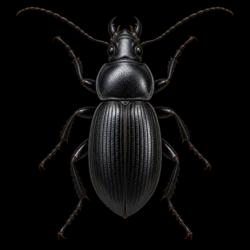
Black Ground Beetle at a glance
Invertebrate · Australia & Oceania · Soil surface and leaf litter in · Relatively common
Known for: Glossy black or dark metallic body, Long legs built for fast running, Wing cases marked with fine lengthwise grooves, Thread-like antennae and prominent forward-pointing
Its Power
Grounded Patience
Low, Fast Ground Hunting
Stay grounded and keep at it: a small hunter covers its patch quickly, night after night.
“Stay low, move steady.”
Capture a Black Ground Beetle, and it's yours when you finish one step it gives you.
Biological basis
The black ground beetle is a fast, ground-dwelling night hunter that runs over the soil catching slugs and insects, and it can spray defensive chemicals from glands at the tip of its abdomen.
Put it into practice
You check the garden for snails every evening, and that small steady habit keeps the lettuces safe.
What does the black ground beetle symbolize?
The black ground beetle symbolizes grounded patience: low, Fast Ground Hunting. It represents grounding, energy management and pacing. Its AnimalDex motto: "Stay low, move steady."
The black ground beetle as a spirit animal
If the black ground beetle is your spirit animal, the AnimalDex reading is Grounded Patience: stay grounded and keep at it: a small hunter covers its patch quickly, night after night. It suggests a strength in grounding and energy management, and a reminder to use it on purpose.
What can the black ground beetle help you with in life?
The black ground beetle is a guide for grounding, energy management and pacing. Its lesson applies wherever grounding matters: stay grounded and keep at it: a small hunter covers its patch quickly, night after night.
- Grounding
- Energy Management
- Pacing
In practice: You check the garden for snails every evening, and that small steady habit keeps the lettuces safe.
What can we learn from the Black Ground Beetle?What does it mean to dream about or encounter a wild black ground beetle?
Dreaming about a wild black ground beetle, or coming across one, usually points to grounding and energy management: the qualities the black ground beetle lives by. In AnimalDex, the black ground beetle's principle is Grounded Patience: low, Fast Ground Hunting. Read the moment through its core lesson: Stay grounded and keep at it: a small hunter covers its patch quickly, night after night.
It depends on how the black ground beetle behaved. Calm or close by, it reads as energy management within reach; aggressive or fleeing, it points to grounding you are resisting.
Spotting a black ground beetle in the wild
Coming across a black ground beetle in person asks for attention more than interpretation. Watch it for a minute; the black ground beetle's way of working is Grounded Patience, and the lesson is: stay grounded and keep at it: a small hunter covers its patch quickly, night after night.
A black ground beetle that keeps appearing
Repeated sightings of a black ground beetle usually mean the Grounded Patience lesson is still open: stay grounded and keep at it: a small hunter covers its patch quickly, night after night.
Dreaming of being chased by a black ground beetle
If the black ground beetle pursues you, look at where energy management is being asked of you and you are stepping away instead of meeting it.
Dreaming that a black ground beetle attacks you
An attack points to grounding turned against you: someone using it on you, or your own grounding overused until it costs you.
A calm or friendly black ground beetle
A calm black ground beetle suggests you have made peace with grounding and can use it without force.
A dead or injured black ground beetle
An injured black ground beetle often reflects grounding under strain; rest and repair come before pushing again.
These readings are reflective prompts drawn from how the black ground beetle really lives, not predictions. If you meet one in the wild, watch from a distance and leave it undisturbed.
Capture your own Black Ground Beetle
Photograph or film one in the wild, at a zoo or at home with the app. It becomes yours: it remembers you, gives you steps, and can debate your problems with your other animals.
Animal field guide
Black Ground Beetle
Sign in to hear this read by a natural AI voice instead of your browser's.
Ground beetles form a family of around 40,000 described species, many of them glossy black, flattened and built for running. Pterostichus melanarius, common in farmland and gardens, is a typical example.
Native range
Natural range, not this capture location
Soil surface and leaf litter in woodland, grassland, farmland, gardens and riverbanks, sheltering under stones, logs, loose bark and mulch. Most species favour moist ground; some live on open sand, in caves or up in trees.
Search near meAnimalDex stats
Dominance
9
Speed
18
Size
2
Intelligence
6
Rarity
7%
Total
42
Size scale
Understand the animal
Understand the Black Ground Beetle
Factual biology first: what this animal is like, where it lives, how it survives, and why those traits exist.
01
Introduction to Black Ground Beetle
Ground beetles form a family of around 40,000 described species, many of them glossy black, flattened and built for running. Most hide under stones and logs by day and hunt across the soil surface at night, seizing slugs, caterpillars and other invertebrates in sharp, forward-pointing jaws. Pterostichus melanarius, common in farmland and gardens, is a typical example.
How to identify a Black Ground Beetle
- Glossy black or dark metallic body, somewhat flattened
- Long legs built for fast running
- Wing cases marked with fine lengthwise grooves
- Thread-like antennae and prominent forward-pointing jaws
- Runs rather than flies when disturbed
Why Black Ground Beetle are interesting
- Many species have fused wing cases or reduced hind wings and cannot fly at all.
- Bombardier beetles, members of this family, spray a hot chemical mixture at close to 100 degrees Celsius from the abdomen with an audible pop.
- Farmers value ground beetles because both adults and larvae eat slugs, aphids and weed seeds in crop fields.
- Pterostichus melanarius, a common European species, was carried to North America and is now widespread there.
- Researchers sample ground beetles with pitfall traps, cups sunk level with the soil, because the beetles travel mainly on foot.
02
Adaptations and biological abilities
03
Why does Black Ground Beetle behave this way?
- Glossy black or dark metallic body, somewhat flattened
- Long legs built for fast running
- Wing cases marked with fine lengthwise grooves
- Thread-like antennae and prominent forward-pointing jaws
- Runs rather than flies when disturbed
Most of the black, ground-living species are nocturnal and spend the day under stones, logs and litter. Some, including many metallic species, run about in daylight. In temperate regions they pass winter in the soil as adults or larvae.
04
Why Soil surface and leaf litter in woodland?
Habitat: Soil surface and leaf litter in woodland, grassland, farmland, gardens and riverbanks, sheltering under stones, logs, loose bark and mulch. Most species favour moist ground; some live on open sand, in caves or up in trees.
Native range: Australia & Oceania, Central Asia, East Asia, Europe, North Africa & Middle East, North America, South America, South Asia, Southeast Asia, Sub-Saharan Africa
Native range
Natural range, not this specific capture location.
Soil surface and leaf litter in woodland, grassland, farmland, gardens and riverbanks, sheltering under stones, logs, loose bark and mulch. Most species favour moist ground; some live on open sand, in caves or up in trees.
05
Why this diet?
Most are predators of slugs, snails, caterpillars, aphids, fly larvae and worms, which they run down or track by scent and grip in the mandibles. Many also scavenge dead insects, and a number of species eat seeds.
06
Activity, rest, and lifespan
Most of the black, ground-living species are nocturnal and spend the day under stones, logs and litter. Some, including many metallic species, run about in daylight. In temperate regions they pass winter in the soil as adults or larvae.
Commonly 1 to 2 years from egg to death. Adults of some larger species, such as those of the genus Carabus, can live 2 to 4 years.
07
Black Ground Beetle reproduction
Females lay eggs singly or in small batches in soil or litter, with totals from a few dozen to several hundred depending on species. The larvae hunt in the soil, usually passing through three stages before pupating in an earthen cell.
Sexes look alike in colour and shape. In many species males have broadened front foot segments with adhesive pads for gripping the female, and females are often slightly larger.
08
Predators, threats, and defense
09
Conservation and rarity
Rarity: Relatively common · 7/100. AnimalDex canonical rarity score: 7/100, maintained by the live indexed species profile.
- Observe from a respectful distance and avoid changing the animal's behavior.
- Do not block feeding, shelter, nesting, or travel routes.
- Use a live camera capture without handling or staging wildlife.
Talk to it
Talk to the Black Ground Beetle
It answers as itself: ask about how it lives, or bring it something of yours and hear what it would do, from its own Power.
Anonymous: 3/day. Signed-in: 10/day. Pro: 100/day.
Side by side
The Black Ground Beetle, side by side
Nothing written side by side for the Black Ground Beetle yet. Pick any animal to compare it with. Compare with any animal →
Where to find them
Where to find Black Ground Beetle
To find Black Ground Beetle in the wild, focus on the exact habitat patches that match its body design and daily behavior, not just the broad country where it exists. You usually do better by working one good piece of habitat inside australia & Oceania, Central Asia, East Asia, Europe, North Africa & Middle East, North America, South America, South Asia, Southeast Asia, Sub-Saharan Africa than by covering too much ground.
- Quiet marsh edges, reedbeds, river bends, or shallow wetland margins
- Forest edge, canopy gaps, fruiting trees, or shaded trails where cover and food meet
- Open grassland edges, lightly wooded plains, or raised ground where you can scan long distances
Where explorers saw it
- Riverside, Washington County, United StatesAug · 1 sighting
- Wilson-Goburn-Roosevelt-Territorial, Battle Creek, United StatesJun · 1 sighting
Scientific name
Carabidae
Category
Invertebrate
Habitat
Soil surface and leaf litter in woodland, grassland, farmland, gardens and riverbanks, sheltering under stones, logs, loose bark and mulch. Most species favour moist ground; some live on open sand, in caves or up in trees.
Rarity
Relatively common · 7/100
Native range
Australia & Oceania, Central Asia, East Asia, Europe, North Africa & Middle East, North America, South America, South Asia, Southeast Asia, Sub-Saharan Africa
Take the encyclopedia outside
AnimalDex helps you scan real animals, identify species, collect cards, and learn from nature wherever you are.