Animal field guide
Blister Beetle
Meloidae
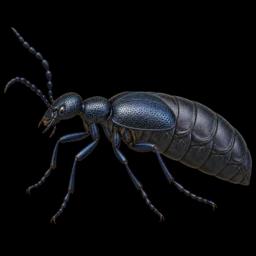
Soft-bodied, often brightly coloured beetles, with roughly 2,500 species worldwide, that carry cantharidin, a toxin that raises painful blisters on skin. In some species studied, males make the toxin in quantity and pass it to females during mating, and females coat their eggs with it.
Blister Beetle at a glance
Invertebrate · Australia & Oceania · Most diverse in warm · Relatively common
Known for: Soft, Head broader than the narrow neck behind it, Front body section narrower than the base of the, Long legs and slender or beaded antennae
Its Power
Chemical Boundary
Bleed a blistering toxin at the leg joints when handled.
A clear, costly consequence for crossing a boundary protects better than hiding does.
“Cross me, and blister.”
Capture a Blister Beetle, and it's yours when you finish one step it gives you.
Biological basis
Blister beetles (Meloidae) contain cantharidin, a defensive terpene that blisters skin. When disturbed, many release haemolymph carrying cantharidin from leg joints, and bright warning colours in many species advertise the chemical defence.
Put it into practice
A landlord puts a clear clause in every lease that late rent triggers a fixed fee, and late payments almost stop.
What does the blister beetle symbolize?
The blister beetle symbolizes chemical boundary: bleed a blistering toxin at the leg joints when handled. It represents boundaries, conflict prevention and self-defense. Its AnimalDex motto: "Cross me, and blister."
The blister beetle as a spirit animal
If the blister beetle is your spirit animal, the AnimalDex reading is Chemical Boundary: a clear, costly consequence for crossing a boundary protects better than hiding does. It suggests a strength in boundaries and conflict prevention, and a reminder to use it on purpose.
What can the blister beetle help you with in life?
The blister beetle is a guide for boundaries, conflict prevention and self-defense. Its lesson applies wherever boundaries matters: a clear, costly consequence for crossing a boundary protects better than hiding does.
- Boundaries
- Conflict Prevention
- Self-Defense
In practice: A landlord puts a clear clause in every lease that late rent triggers a fixed fee, and late payments almost stop.
What can we learn from the Blister Beetle?What does it mean to dream about or encounter a wild blister beetle?
Meeting a wild blister beetle, asleep or awake, is often a nudge toward boundaries, the quality the blister beetle is built around. In AnimalDex, the blister beetle's principle is Chemical Boundary: bleed a blistering toxin at the leg joints when handled. Read the moment through its core lesson: A clear, costly consequence for crossing a boundary protects better than hiding does.
Mostly a prompt rather than a warning. A calm blister beetle suggests boundaries you already have; a threatening one suggests boundaries is being tested or pushed too far.
Spotting a blister beetle in the wild
If a blister beetle crosses your path, take it as a cue to look at where boundaries fits your day. Its AnimalDex motto: "Cross me, and blister."
A blister beetle that keeps appearing
A blister beetle that keeps turning up points to conflict prevention you keep circling back to. The repetition is the message.
Dreaming of being chased by a blister beetle
If the blister beetle pursues you, look at where conflict prevention is being asked of you and you are stepping away instead of meeting it.
Dreaming that a blister beetle attacks you
When the blister beetle attacks, the dream may be about pressure: conflict prevention or self-defense applied too hard, by you or by someone close to you.
A calm or friendly blister beetle
Meeting a peaceful blister beetle is usually encouraging: conflict prevention and self-defense are within reach.
A dead or injured blister beetle
Seeing the blister beetle hurt may point to conflict prevention that has been neglected. Ask what it would take to restore it.
These readings are reflective prompts drawn from how the blister beetle really lives, not predictions. If you meet one in the wild, watch from a distance and leave it undisturbed.
Capture your own Blister Beetle
Photograph or film one in the wild, at a zoo or at home with the app. It becomes yours: it remembers you, gives you steps, and can debate your problems with your other animals.
Animal field guide
Blister Beetle
Sign in to hear this read by a natural AI voice instead of your browser's.
Soft-bodied, often brightly coloured beetles, with roughly 2,500 species worldwide, that carry cantharidin, a toxin that raises painful blisters on skin. In some species studied, males make the toxin in quantity and pass it to females during mating, and females coat their eggs with it.
Native range
Natural range, not this capture location
Most diverse in warm, dry regions: grassland, savanna, steppe, desert scrub, meadows and farmland, wherever flowers and the ground-nesting bees or grasshoppers their larvae need are plentiful. Fewer species live in woodland.
Search near meAnimalDex stats
Dominance
12
Speed
14
Size
2
Intelligence
5
Rarity
30%
Total
63
Size scale
Understand the animal
Understand the Blister Beetle
Factual biology first: what this animal is like, where it lives, how it survives, and why those traits exist.
01
Introduction to Blister Beetle
Soft-bodied, often brightly coloured beetles, with roughly 2,500 species worldwide, that carry cantharidin, a toxin that raises painful blisters on skin. In some species studied, males make the toxin in quantity and pass it to females during mating, and females coat their eggs with it.
How to identify a Blister Beetle
- Soft, leathery wing cases, often not covering the whole abdomen
- Head broader than the narrow neck behind it
- Front body section narrower than the base of the wing cases
- Long legs and slender or beaded antennae
- Often black, metallic or boldly marked in red, yellow or orange
- Oil beetles have short, overlapping wing cases and a swollen abdomen
Why Blister Beetle are interesting
- Spanish fly, the crushed body of the green blister beetle Lytta vesicatoria, was used for centuries as a supposed aphrodisiac and caused many poisonings.
- In North America horses have been fatally poisoned by striped blister beetles of the genus Epicauta crushed into baled alfalfa hay.
- Larvae of the oil beetle Meloe franciscanus cluster together to imitate a female bee, then cling to a male that tries to mate and ride to a nest.
- Cantharidin is still used in medicine, applied to the skin to remove warts and treat the viral rash molluscum contagiosum.
02
Adaptations and biological abilities
03
Why does Blister Beetle behave this way?
- Soft, leathery wing cases, often not covering the whole abdomen
- Head broader than the narrow neck behind it
- Front body section narrower than the base of the wing cases
- Long legs and slender or beaded antennae
- Often black, metallic or boldly marked in red, yellow or orange
- Oil beetles have short, overlapping wing cases and a swollen abdomen
Adults of most species are active by day, especially in warm sunshine; at night and in cool weather they shelter under plants, stones or in soil cracks. Some desert species are active at dusk or after dark.
04
Why Most diverse in warm?
Habitat: Most diverse in warm, dry regions: grassland, savanna, steppe, desert scrub, meadows and farmland, wherever flowers and the ground-nesting bees or grasshoppers their larvae need are plentiful. Fewer species live in woodland.
Native range: Australia & Oceania, Central Asia, East Asia, Europe, North Africa & Middle East, North America, South America, South Asia, Southeast Asia, Sub-Saharan Africa
Native range
Natural range, not this specific capture location.
Most diverse in warm, dry regions: grassland, savanna, steppe, desert scrub, meadows and farmland, wherever flowers and the ground-nesting bees or grasshoppers their larvae need are plentiful. Fewer species live in woodland.
05
Why this diet?
Adults eat plants, chewing leaves and flowers, and some take only nectar and pollen or hardly feed at all. Larvae are specialist predators: many eat the eggs and food stores in the nests of solitary bees, others eat grasshopper egg pods in the soil.
06
Activity, rest, and lifespan
Adults of most species are active by day, especially in warm sunshine; at night and in cool weather they shelter under plants, stones or in soil cracks. Some desert species are active at dusk or after dark.
Adults usually live for a few weeks to a few months. The full life cycle typically takes about a year, but in some species larvae can pause in the soil for one or more extra years.
07
Blister Beetle reproduction
Females lay batches of tens to hundreds of eggs in soil or on plants, and oil beetles lay thousands in a season. Most hatch as tiny, active larvae that find a bee nest or grasshopper egg pod, then moult into fat grubs that feed without moving.
In many species the sexes look alike, but males often have modified antennae or leg segments used to grip the female during courtship. Females are usually larger, especially the heavy-bodied female oil beetles.
08
Predators, threats, and defense
09
Conservation and rarity
Rarity: Relatively common · 30/100. AnimalDex canonical rarity score: 30/100, maintained by the live indexed species profile.
- Observe from a respectful distance and avoid changing the animal's behavior.
- Do not block feeding, shelter, nesting, or travel routes.
- Use a live camera capture without handling or staging wildlife.
Talk to it
Talk to the Blister Beetle
It answers as itself: ask about how it lives, or bring it something of yours and hear what it would do, from its own Power.
Anonymous: 3/day. Signed-in: 10/day. Pro: 100/day.
Side by side
The Blister Beetle, side by side
Nothing written side by side for the Blister Beetle yet. Pick any animal to compare it with. Compare with any animal →
Where to find them
Where to find Blister Beetle
To find Blister Beetle in the wild, focus on the exact habitat patches that match its body design and daily behavior, not just the broad country where it exists. You usually do better by working one good piece of habitat inside australia & Oceania, Central Asia, East Asia, Europe, North Africa & Middle East, North America, South America, South Asia, Southeast Asia, Sub-Saharan Africa than by covering too much ground.
- Forest edge, canopy gaps, fruiting trees, or shaded trails where cover and food meet
- Open grassland edges, lightly wooded plains, or raised ground where you can scan long distances
- Water sources, dune bases, rocky wadis, or shaded scrub at first and last light
Scientific name
Meloidae
Category
Invertebrate
Habitat
Most diverse in warm, dry regions: grassland, savanna, steppe, desert scrub, meadows and farmland, wherever flowers and the ground-nesting bees or grasshoppers their larvae need are plentiful. Fewer species live in woodland.
Rarity
Relatively common · 30/100
Native range
Australia & Oceania, Central Asia, East Asia, Europe, North Africa & Middle East, North America, South America, South Asia, Southeast Asia, Sub-Saharan Africa
Take the encyclopedia outside
AnimalDex helps you scan real animals, identify species, collect cards, and learn from nature wherever you are.