Animal field guide
Centipede
Chilopoda
Long, mostly flattened predators with one pair of legs on each body segment, centipedes kill with a weapon found in no other animals. The first pair of legs has become a set of hollow pincers, the forcipules, which inject venom. Adults have between 15 and 191 pairs of legs, depending on the species.
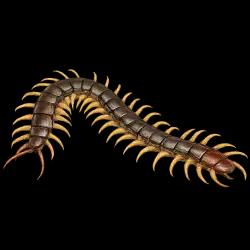
Centipede at a glance
Invertebrate · Australia & Oceania · Damp · One pair of legs on each body · Relatively common
Known for: One pair of legs on each body segment, Body flattened in most species, Venom claws curving forward beneath the head, Last legs long and trailing backwards in many
Its Power
Precision
Many Legs, One Path
Move with coordinated steps when the ground is uneven and the goal is clear.
“Coordinate, then commit.”
Capture a Centipede, and it's yours when you finish one step it gives you.
Biological basis
Centipedes coordinate dozens of legs in waves, using speed and precise footing to hunt and escape across complex ground.
Put it into practice
A family moving house gives each person one room, then everyone packs and loads on the same signal.
What does the centipede symbolize?
The centipede symbolizes precision: many Legs, One Path. It represents coordination, decisive action and focus. Its AnimalDex motto: "Coordinate, then commit."
The centipede as a spirit animal
If the centipede is your spirit animal, the AnimalDex reading is Precision: move with coordinated steps when the ground is uneven and the goal is clear. It suggests a strength in coordination and decisive action, and a reminder to use it on purpose.
What can the centipede help you with in life?
The centipede is a guide for coordination, decisive action and focus. Its lesson applies wherever coordination matters: move with coordinated steps when the ground is uneven and the goal is clear.
- Coordination
- Decisive Action
- Focus
In practice: A family moving house gives each person one room, then everyone packs and loads on the same signal.
What can we learn from the Centipede?What does it mean to dream about or encounter a wild centipede?
Dreaming about a wild centipede, or coming across one, usually points to coordination and decisive action: the qualities the centipede lives by. In AnimalDex, the centipede's principle is Precision: many Legs, One Path. Read the moment through its core lesson: Move with coordinated steps when the ground is uneven and the goal is clear.
It depends on how the centipede behaved. Calm or close by, it reads as decisive action within reach; aggressive or fleeing, it points to coordination you are resisting.
Spotting a centipede in the wild
A real encounter is the plainest version of the sign: notice what the centipede was doing. Many Legs, One Path. That is the coordination worth borrowing today.
A centipede that keeps appearing
A centipede that keeps turning up points to decisive action you keep circling back to. The repetition is the message.
Dreaming of being chased by a centipede
If the centipede pursues you, look at where decisive action is being asked of you and you are stepping away instead of meeting it.
Dreaming that a centipede attacks you
An attack points to coordination turned against you: someone using it on you, or your own coordination overused until it costs you.
A calm or friendly centipede
A calm centipede suggests you have made peace with coordination and can use it without force.
A dead or injured centipede
An injured centipede often reflects coordination under strain; rest and repair come before pushing again.
These readings are reflective prompts drawn from how the centipede really lives, not predictions. If you meet one in the wild, watch from a distance and leave it undisturbed.
Capture your own Centipede
Photograph or film one in the wild, at a zoo or at home with the app. It becomes yours: it remembers you, gives you steps, and can debate your problems with your other animals.
Animal field guide
Centipede
Sign in to hear this read by a natural AI voice instead of your browser's.
Long, mostly flattened predators with one pair of legs on each body segment, centipedes kill with a weapon found in no other animals. Adults have between 15 and 191 pairs of legs, depending on the species.
Native range
Natural range, not this capture location
Damp, sheltered places on land: leaf litter, soil, rotting logs, under bark and stones, and in caves. Most species lose water quickly through the cuticle, so they keep to humid hiding places in habitats from rainforest to desert. A few live on the seashore.
Search near meAnimalDex stats
Dominance
18
Speed
18
Size
8
Intelligence
18
Rarity
22%
Total
84
Size scale
Understand the animal
Understand the Centipede
Factual biology first: what this animal is like, where it lives, how it survives, and why those traits exist.
01
Introduction to Centipede
Long, mostly flattened predators with one pair of legs on each body segment, centipedes kill with a weapon found in no other animals. The first pair of legs has become a set of hollow pincers, the forcipules, which inject venom. Adults have between 15 and 191 pairs of legs, depending on the species.
How to identify a Centipede
- One pair of legs on each body segment
- Body flattened in most species, with many-jointed antennae
- Venom claws curving forward beneath the head
- Last legs long and trailing backwards in many species
- Fast run when uncovered; soil centipedes move slowly
Why Centipede are interesting
- No centipede has exactly 100 legs, because the number of leg pairs in an adult is always odd.
- Stone centipedes and house centipedes hatch with only a few pairs of legs and add more at each moult until they are adult.
- The giant centipede Scolopendra gigantea of South America can exceed 25 centimetres and has been filmed catching bats in caves in Venezuela.
- House centipedes have compound eyes and very long legs, and can run at around 40 centimetres a second.
- Fossil centipedes are known from rocks more than 400 million years old, placing them among the earliest predators on land.
02
Adaptations and biological abilities
03
Why does Centipede behave this way?
- One pair of legs on each body segment
- Body flattened in most species, with many-jointed antennae
- Venom claws curving forward beneath the head
- Last legs long and trailing backwards in many species
- Fast run when uncovered; soil centipedes move slowly
Mostly nocturnal. By day they shelter in soil or under stones, bark and logs, where it stays damp, and come out to hunt after dark. House centipedes may also be seen by day inside dim buildings.
04
Why Damp?
Habitat: Damp, sheltered places on land: leaf litter, soil, rotting logs, under bark and stones, and in caves. Most species lose water quickly through the cuticle, so they keep to humid hiding places in habitats from rainforest to desert. A few live on the seashore.
Native range: Australia & Oceania, Central Asia, East Asia, Europe, North Africa & Middle East, North America, South America, South Asia, Southeast Asia, Sub-Saharan Africa
Native range
Natural range, not this specific capture location.
Damp, sheltered places on land: leaf litter, soil, rotting logs, under bark and stones, and in caves. Most species lose water quickly through the cuticle, so they keep to humid hiding places in habitats from rainforest to desert. A few live on the seashore.
05
Why this diet?
06
Activity, rest, and lifespan
Mostly nocturnal. By day they shelter in soil or under stones, bark and logs, where it stays damp, and come out to hunt after dark. House centipedes may also be seen by day inside dim buildings.
Many species live several years, long for an arthropod, commonly about 2 to 6. House centipedes are reported to reach 3 to 7 years and large Scolopendra around 10 in captivity, though these upper figures are poorly documented.
07
Centipede reproduction
Males leave a sperm packet that the female picks up. Many species lay roughly 10 to 60 eggs. Scolopendra and the soil centipedes coil around eggs and hatchlings to guard them, while stone and house centipedes lay eggs singly in soil and leave them.
The sexes look alike in most species and usually cannot be told apart in the field. In some groups males have modified last legs, and in soil centipedes males often have slightly fewer leg pairs than females.
08
Predators, threats, and defense
09
Conservation and rarity
Rarity: Relatively common · 22/100. AnimalDex canonical rarity score: 22/100, maintained by the live indexed species profile.
- Observe from a respectful distance and avoid changing the animal's behavior.
- Do not block feeding, shelter, nesting, or travel routes.
- Use a live camera capture without handling or staging wildlife.
Talk to it
Talk to the Centipede
It answers as itself: ask about how it lives, or bring it something of yours and hear what it would do, from its own Power.
Anonymous: 3/day. Signed-in: 10/day. Pro: 100/day.
Side by side
The Centipede, side by side
Nothing written side by side for the Centipede yet. Pick any animal to compare it with. Compare with any animal →
Where to find them
Where to find Centipede
To find Centipede in the wild, focus on the exact habitat patches that match its body design and daily behavior, not just the broad country where it exists. You usually do better by working one good piece of habitat inside australia & Oceania, Central Asia, East Asia, Europe, North Africa & Middle East, North America, South America, South Asia, Southeast Asia, Sub-Saharan Africa than by covering too much ground.
- Forest edge, canopy gaps, fruiting trees, or shaded trails where cover and food meet
- Water sources, dune bases, rocky wadis, or shaded scrub at first and last light
- Headlands, reef edges, island colonies, tidal channels, or productive coastal water
Where explorers saw it
- Subang Jaya, Damansara, MalaysiaAug · 1 sighting
Scientific name
Chilopoda
Category
Invertebrate
Habitat
Damp, sheltered places on land: leaf litter, soil, rotting logs, under bark and stones, and in caves. Most species lose water quickly through the cuticle, so they keep to humid hiding places in habitats from rainforest to desert. A few live on the seashore.
Rarity
Relatively common · 22/100
Native range
Australia & Oceania, Central Asia, East Asia, Europe, North Africa & Middle East, North America, South America, South Asia, Southeast Asia, Sub-Saharan Africa
Take the encyclopedia outside
AnimalDex helps you scan real animals, identify species, collect cards, and learn from nature wherever you are.