
Animal field guide
Chihuahuan Raven
Corvus cryptoleucus
A raven of hot, dry grassland and scrub, it breeds later in the year than most birds around it. Egg-laying often waits until late spring and summer, timing that is thought to match the flush of insects after summer rains.
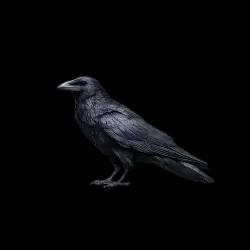
Chihuahuan Raven at a glance
Animal · North America · Hot · Relatively common
Known for: Glossy black plumage throughout, Neck feathers white at the base, Heavy bill with long nasal bristles covering much, Smaller than a common raven
Its Power
Desert Raven Experiment
Test the dry country with a clever beak and social eye.
Playfulness becomes intelligence when curiosity studies the edge of survival.
“Test the desert.”
Capture a Chihuahuan Raven, and it's yours when you finish one step it gives you.
Biological basis
Chihuahuan Ravens are intelligent corvids of arid regions, using flexible foraging, social behavior, and problem-solving ability.
Put it into practice
You experiment with a rough situation until it reveals where the opportunity is hidden.
What does the chihuahuan raven symbolize?
The chihuahuan raven symbolizes desert raven experiment: test the dry country with a clever beak and social eye. It represents curiosity, playfulness and reading the room. Its AnimalDex motto: "Test the desert."
The chihuahuan raven as a spirit animal
If the chihuahuan raven is your spirit animal, the AnimalDex reading is Desert Raven Experiment: playfulness becomes intelligence when curiosity studies the edge of survival. It suggests a strength in curiosity and playfulness, and a reminder to use it on purpose.
What can the chihuahuan raven help you with in life?
The chihuahuan raven is a guide for curiosity, playfulness and reading the room. Its lesson applies wherever curiosity matters: playfulness becomes intelligence when curiosity studies the edge of survival.
- Curiosity
- Playfulness
- Reading the Room
In practice: You experiment with a rough situation until it reveals where the opportunity is hidden.
What can we learn from the Chihuahuan Raven?What does it mean to dream about or encounter a wild chihuahuan raven?
A wild chihuahuan raven, whether in a dream or in front of you, tends to show up when curiosity or playfulness is on your mind. In AnimalDex, the chihuahuan raven's principle is Desert Raven Experiment: test the dry country with a clever beak and social eye. Read the moment through its core lesson: Playfulness becomes intelligence when curiosity studies the edge of survival.
It depends on how the chihuahuan raven behaved. Calm or close by, it reads as playfulness within reach; aggressive or fleeing, it points to curiosity you are resisting.
Spotting a chihuahuan raven in the wild
If a chihuahuan raven crosses your path, take it as a cue to look at where curiosity fits your day. Its AnimalDex motto: "Test the desert."
A chihuahuan raven that keeps appearing
Repeated sightings of a chihuahuan raven usually mean the Desert Raven Experiment lesson is still open: playfulness becomes intelligence when curiosity studies the edge of survival.
Dreaming of being chased by a chihuahuan raven
If the chihuahuan raven pursues you, look at where playfulness is being asked of you and you are stepping away instead of meeting it.
Dreaming that a chihuahuan raven attacks you
An attack points to curiosity turned against you: someone using it on you, or your own curiosity overused until it costs you.
A calm or friendly chihuahuan raven
A relaxed chihuahuan raven near you, in a dream or in person, reads as readiness: Desert Raven Experiment is available to you now, as its motto puts it, "Test the desert.".
A dead or injured chihuahuan raven
Seeing the chihuahuan raven hurt may point to playfulness that has been neglected. Ask what it would take to restore it.
These readings are reflective prompts drawn from how the chihuahuan raven really lives, not predictions. If you meet one in the wild, watch from a distance and leave it undisturbed.
Capture your own Chihuahuan Raven
Photograph or film one in the wild, at a zoo or at home with the app. It becomes yours: it remembers you, gives you steps, and can debate your problems with your other animals.
Animal field guide
Chihuahuan Raven
Sign in to hear this read by a natural AI voice instead of your browser's.
A raven of hot, dry grassland and scrub, it breeds later in the year than most birds around it. Egg-laying often waits until late spring and summer, timing that is thought to match the flush of insects after summer rains.
Native range
Natural range, not this capture location
Hot, arid grassland and desert scrub of mesquite, creosote bush and yucca, together with ranchland, cultivated fields and roadsides on lowland plains and broad valleys.
Search near meAnimalDex stats
Size scale
Understand the animal
Understand the Chihuahuan Raven
Factual biology first: what this animal is like, where it lives, how it survives, and why those traits exist.
01
Introduction to Chihuahuan Raven
A raven of hot, dry grassland and scrub, it breeds later in the year than most birds around it. Egg-laying often waits until late spring and summer, timing that is thought to match the flush of insects after summer rains.
How to identify a Chihuahuan Raven
- Glossy black plumage throughout
- Neck feathers white at the base, visible when wind ruffles them
- Heavy bill with long nasal bristles covering much of it
- Smaller than a common raven, with a less wedge-shaped tail
- Hoarse croak, higher-pitched than a common raven's
Why Chihuahuan Raven are interesting
- Many birds in the northern part of the range are thought to move south in winter, while those farther south stay year-round.
- Flocks often soar together on thermals, circling high over the desert like hawks on hot afternoons.
- Where its range overlaps the common raven's, the two are hard to tell apart and tend to be separated by habitat, this species favouring flatter, more open country.
- Its range runs from the south-western United States through the Chihuahuan Desert into central Mexico.
02
Adaptations and biological abilities
03
Why does Chihuahuan Raven behave this way?
- Glossy black plumage throughout
- Neck feathers white at the base, visible when wind ruffles them
- Heavy bill with long nasal bristles covering much of it
- Smaller than a common raven, with a less wedge-shaped tail
- Hoarse croak, higher-pitched than a common raven's
Active by day. Outside the breeding season it gathers at dusk in communal roosts, sometimes of hundreds of birds, in trees or on power poles and lines.
04
Why Hot?
Habitat: Hot, arid grassland and desert scrub of mesquite, creosote bush and yucca, together with ranchland, cultivated fields and roadsides on lowland plains and broad valleys.
Native range: North America
Native range
Natural range, not this specific capture location.
Hot, arid grassland and desert scrub of mesquite, creosote bush and yucca, together with ranchland, cultivated fields and roadsides on lowland plains and broad valleys.
05
Why this diet?
06
Activity, rest, and lifespan
Active by day. Outside the breeding season it gathers at dusk in communal roosts, sometimes of hundreds of birds, in trees or on power poles and lines.
Wild lifespan is poorly documented for this species.
07
Chihuahuan Raven reproduction
Clutches usually hold about five or six eggs, sometimes fewer or more. The female incubates for around three weeks while the male brings food, and both parents feed the young until they leave the nest at about five weeks.
Males and females may differ in size, markings, calls, or breeding roles depending on the species. For Deserttest, any sex difference matters only when it changes protection, display, parenting, or movement.
08
Predators, threats, and defense
09
Conservation and rarity
Rarity: Relatively common · 40/100. AnimalDex canonical rarity score: 40/100, maintained by the live indexed species profile.
- Observe from a respectful distance and avoid changing the animal's behavior.
- Do not block feeding, shelter, nesting, or travel routes.
- Use a live camera capture without handling or staging wildlife.
Talk to it
Talk to the Chihuahuan Raven
It answers as itself: ask about how it lives, or bring it something of yours and hear what it would do, from its own Power.
Anonymous: 6/day. Signed-in: 10/day. Pro: 100/day.
Side by side
The Chihuahuan Raven, side by side
Nothing written side by side for the Chihuahuan Raven yet. Pick any animal to compare it with. Compare with any animal →
Where to find them
Where to find Chihuahuan Raven
To find Chihuahuan Raven in the wild, focus on the exact habitat patches that match its body design and daily behavior, not just the broad country where it exists. You usually do better by working one good piece of habitat inside north America than by covering too much ground.
- Open grassland edges, lightly wooded plains, or raised ground where you can scan long distances
- Water sources, dune bases, rocky wadis, or shaded scrub at first and last light
- Protected habitat blocks within north America
In the Ark
No Chihuahuan Raven is aboard yet.
None have come aboard or left since November 17.
The Ark is a live, shared animal world. Animals come aboard when people capture them, and live there by rules based on their field guides.
Scientific name
Corvus cryptoleucus
Category
Animal
Habitat
Hot, arid grassland and desert scrub of mesquite, creosote bush and yucca, together with ranchland, cultivated fields and roadsides on lowland plains and broad valleys.
Rarity
Relatively common · 40/100
Native range
North America
Take the encyclopedia outside
AnimalDex helps you scan real animals, identify species, collect cards, and learn from nature wherever you are.
Featured in tier lists
See where this species appears in AnimalDex tier-list pages built around structured comparison and methodology.
#2 · Character
Most Curious Animals
Like other ravens, it inspects unfamiliar objects, plays, and works out new food sources around deserts, farms and towns.
Read tier list