
Animal field guide
Common Buzzard
Buteo buteo
A broad-winged hawk about 50 centimetres long, with plumage that ranges from almost white to dark chocolate brown. Riding rising air over hillsides and fields, it can search a wide area for prey with hardly a wingbeat.
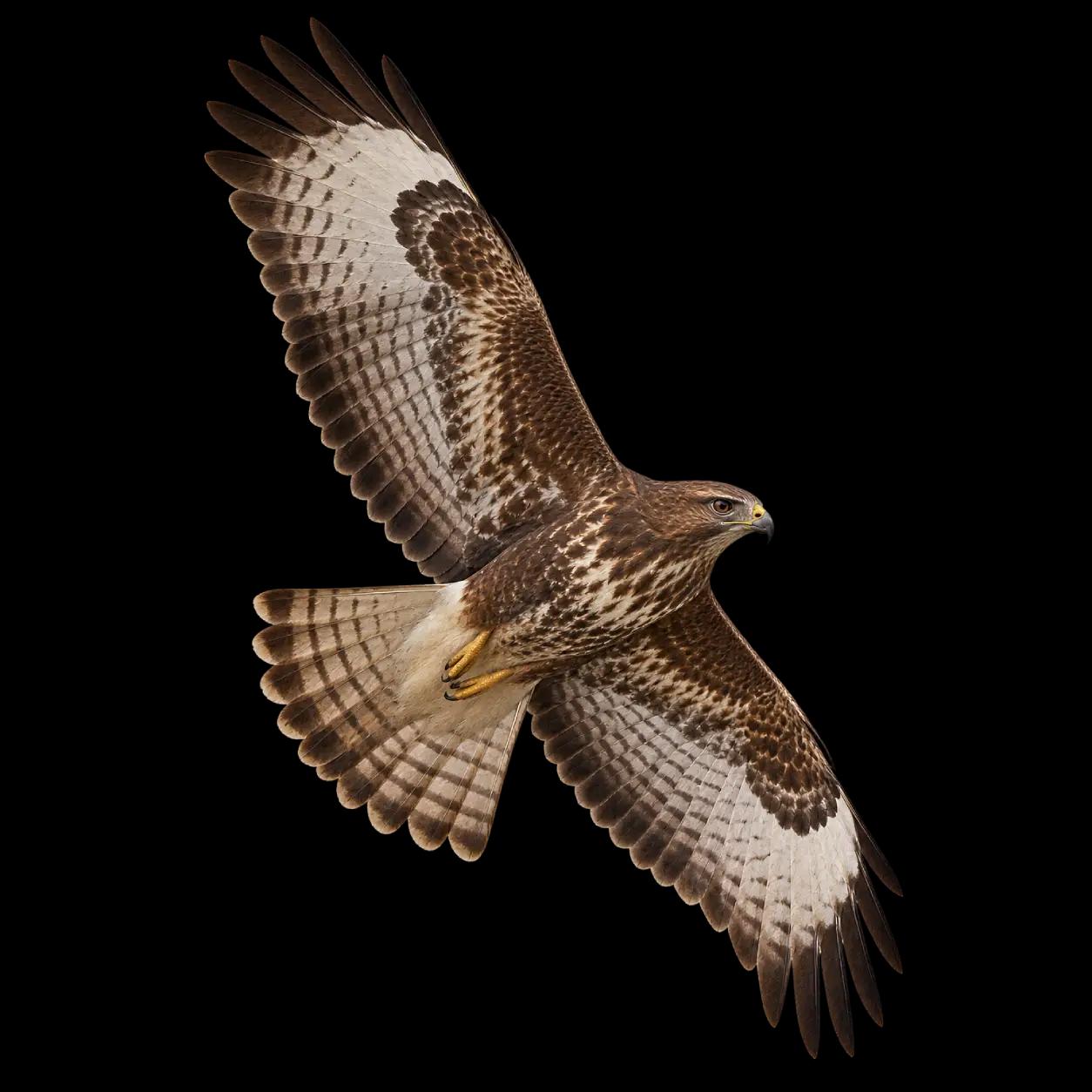
Common Buzzard at a glance
Animal · Europe · Mixed farmland with woods · Relatively common
Known for: Broad, Wings raised in a shallow V when soaring, Dark wrist patches on a paler underwing, Pale band across the breast in many birds
Its Power
Soaring Perspective
Elevate your viewpoint to gain clarity and insight.
The Common Buzzard uses its ability to soar at great heights to survey vast landscapes, allowing it to spot opportunities and threats from afar.
“Rise for clarity.”
Capture a Common Buzzard, and it's yours when you finish one step it gives you.
Biological basis
Common Buzzards are known for their soaring flight, which they use to scan large areas for prey and to monitor their territory.
Put it into practice
A café owner steps back from daily orders to review the whole year and spots a slow decline in time.
What does the common buzzard symbolize?
The common buzzard symbolizes soaring perspective: elevate your viewpoint to gain clarity and insight. It represents perspective, sharp observation and energy management. Its AnimalDex motto: "Rise for clarity."
The common buzzard as a spirit animal
If the common buzzard is your spirit animal, the AnimalDex reading is Soaring Perspective: the Common Buzzard uses its ability to soar at great heights to survey vast landscapes, allowing it to spot opportunities and threats from afar. It suggests a strength in perspective and sharp observation, and a reminder to use it on purpose.
What can the common buzzard help you with in life?
The common buzzard is a guide for perspective, sharp observation and energy management. Its lesson applies wherever perspective matters: the Common Buzzard uses its ability to soar at great heights to survey vast landscapes, allowing it to spot opportunities and threats from afar.
- Perspective
- Sharp Observation
- Energy Management
In practice: A café owner steps back from daily orders to review the whole year and spots a slow decline in time.
What can we learn from the Common Buzzard?What does it mean to dream about or encounter a wild common buzzard?
Meeting a wild common buzzard, asleep or awake, is often a nudge toward perspective, the quality the common buzzard is built around. In AnimalDex, the common buzzard's principle is Soaring Perspective: elevate your viewpoint to gain clarity and insight. Read the moment through its core lesson: The Common Buzzard uses its ability to soar at great heights to survey vast landscapes, allowing it to spot opportunities and threats from afar.
Mostly a prompt rather than a warning. A calm common buzzard suggests perspective you already have; a threatening one suggests perspective is being tested or pushed too far.
Spotting a common buzzard in the wild
A real encounter is the plainest version of the sign: notice what the common buzzard was doing. Elevate your viewpoint to gain clarity and insight. That is the perspective worth borrowing today.
A common buzzard that keeps appearing
A common buzzard that keeps turning up points to sharp observation you keep circling back to. The repetition is the message.
Dreaming of being chased by a common buzzard
If the common buzzard pursues you, look at where sharp observation is being asked of you and you are stepping away instead of meeting it.
Dreaming that a common buzzard attacks you
When the common buzzard attacks, the dream may be about pressure: sharp observation or energy management applied too hard, by you or by someone close to you.
A calm or friendly common buzzard
Meeting a peaceful common buzzard is usually encouraging: sharp observation and energy management are within reach.
A dead or injured common buzzard
Seeing the common buzzard hurt may point to sharp observation that has been neglected. Ask what it would take to restore it.
These readings are reflective prompts drawn from how the common buzzard really lives, not predictions. If you meet one in the wild, watch from a distance and leave it undisturbed.
Capture your own Common Buzzard
Photograph or film one in the wild, at a zoo or at home with the app. It becomes yours: it remembers you, gives you steps, and can debate your problems with your other animals.
Animal field guide
Common Buzzard
Sign in to hear this read by a natural AI voice instead of your browser's.
A broad-winged hawk about 50 centimetres long, with plumage that ranges from almost white to dark chocolate brown. Riding rising air over hillsides and fields, it can search a wide area for prey with hardly a wingbeat.
Native range
Natural range, not this capture location
Mixed farmland with woods, copses and hedgerows, moorland edges and hilly country with scattered trees, from sea level into the mountains. It nests in woodland but hunts over open grassland and fields.
Search near meAnimalDex stats
Size scale
Understand the animal
Understand the Common Buzzard
Factual biology first: what this animal is like, where it lives, how it survives, and why those traits exist.
01
Introduction to Common Buzzard
A broad-winged hawk about 50 centimetres long, with plumage that ranges from almost white to dark chocolate brown. Riding rising air over hillsides and fields, it can search a wide area for prey with hardly a wingbeat.
How to identify a Common Buzzard
- Broad, rounded wings and a short, fanned tail
- Wings raised in a shallow V when soaring
- Dark wrist patches on a paler underwing
- Pale band across the breast in many birds
Why Common Buzzard are interesting
- UK population estimates now rank it as the most numerous bird of prey in Britain, after it spread back into eastern England from the 1990s.
- Birds from Russia and farther east winter as far away as southern Africa, while most Scandinavian birds move only to southern Scandinavia or western Europe.
- In spring, pairs perform a rollercoaster display, climbing high then plunging in steep dives.
- Eurasian Jays sometimes give a convincing imitation of its mewing call.
- Eastern birds belong to a smaller, often rufous-tinged form known as the Steppe Buzzard.
02
Adaptations and biological abilities
03
Why does Common Buzzard behave this way?
- Broad, rounded wings and a short, fanned tail
- Wings raised in a shallow V when soaring
- Dark wrist patches on a paler underwing
- Pale band across the breast in many birds
Active only by day, busiest from mid-morning into the afternoon. At night it roosts in a tall tree, usually inside woodland within its territory.
04
Why Mixed farmland with woods?
Habitat: Mixed farmland with woods, copses and hedgerows, moorland edges and hilly country with scattered trees, from sea level into the mountains. It nests in woodland but hunts over open grassland and fields.
Native range: Europe, Central Asia
Native range
Natural range, not this specific capture location.
Mixed farmland with woods, copses and hedgerows, moorland edges and hilly country with scattered trees, from sea level into the mountains. It nests in woodland but hunts over open grassland and fields.
05
Why this diet?
Voles, mice and young rabbits make up much of the diet, with birds, reptiles, frogs, large insects and earthworms; carrion matters in winter. It hunts from perches, by soaring and hovering, and walks fields for worms.
06
Activity, rest, and lifespan
Active only by day, busiest from mid-morning into the afternoon. At night it roosts in a tall tree, usually inside woodland within its territory.
Typically around 8 to 12 years in the wild for birds that survive their first year; ringed birds have been recorded at over 25 years.
07
Common Buzzard reproduction
Pairs build or reuse a bulky stick nest in a tree fork or on a crag, often decorated with fresh green leaves. Usually 2 to 4 eggs are incubated for about five weeks, mainly by the female, and chicks fledge at around seven to eight weeks.
Plumage does not differ between the sexes. Females average slightly larger, but sizes overlap and birds can rarely be sexed unless a pair sits side by side.
08
Predators, threats, and defense
09
Conservation and rarity
Rarity: Relatively common · 19/100. AnimalDex canonical rarity score: 19/100, maintained by the live indexed species profile.
- Observe from a respectful distance and avoid changing the animal's behavior.
- Do not block feeding, shelter, nesting, or travel routes.
- Use a live camera capture without handling or staging wildlife.
Talk to it
Talk to the Common Buzzard
It answers as itself: ask about how it lives, or bring it something of yours and hear what it would do, from its own Power.
Anonymous: 6/day. Signed-in: 10/day. Pro: 100/day.
Side by side
The Common Buzzard, side by side
Nothing written side by side for the Common Buzzard yet. Pick any animal to compare it with. Compare with any animal →
Where to find them
Where to find Common Buzzard
To find Common Buzzard in the wild, focus on the exact habitat patches that match its body design and daily behavior, not just the broad country where it exists. You usually do better by working one good piece of habitat inside europe, Central Asia than by covering too much ground.
- Forest edge, canopy gaps, fruiting trees, or shaded trails where cover and food meet
- Rocky slopes, ridge lines, cliff ledges, or open mountain meadows with a wide view
- Open grassland edges, lightly wooded plains, or raised ground where you can scan long distances
Where explorers saw it
- Vlaardingen, Zuid-Holland, NederlandNov · 1 sighting
- Santa Maria da Feira, Aveiro, PortugalAug · 1 sighting
Guides to seeing Common Buzzard
In the Ark
5 Common Buzzards are aboard right now.
Since November 5: 5 came aboard.
The Ark is a live, shared animal world. Animals come aboard when people capture them, and live there by rules based on their field guides.
Scientific name
Buteo buteo
Category
Animal
Habitat
Mixed farmland with woods, copses and hedgerows, moorland edges and hilly country with scattered trees, from sea level into the mountains. It nests in woodland but hunts over open grassland and fields.
Rarity
Relatively common · 19/100
Native range
Europe, Central Asia
Take the encyclopedia outside
AnimalDex helps you scan real animals, identify species, collect cards, and learn from nature wherever you are.