Animal field guide
Peters's Jumping Spider
Plexippus petersi
Flies resting on a sunny wall are stalked to within a few centimetres and then leapt upon, the distance judged by a pair of large forward-facing eyes. Roughly 6 to 10 mm long, this jumping spider is common on houses and garden walls across southern and eastern Asia.
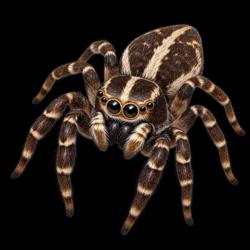
Peters's Jumping Spider at a glance
Arachnid · South Asia · Sunny walls · Large · Relatively common
Known for: Stout, Large, Dark brown carapace with a pale stripe down the, Abdomen with a pale central band edged by darker
Its Power
Precision Leap
Focus on your target and leap with precision.
Peters's Jumping Spider uses its exceptional vision and precise jumping ability to catch prey, teaching us to focus and act with accuracy.
“Leap with accuracy.”
Capture a Peters's Jumping Spider, and it's yours when you finish one step it gives you.
Biological basis
Peters's Jumping Spider has excellent eyesight and can leap several times its body length to capture prey with precision.
Put it into practice
A climber studies the next hold, measures the gap by eye, and commits to a single clean move.
What does the Peters's jumping spider symbolize?
The Peters's jumping spider symbolizes precision leap: focus on your target and leap with precision. It represents precision, focus and sharp observation. Its AnimalDex motto: "Leap with accuracy."
The Peters's jumping spider as a spirit animal
If the Peters's jumping spider is your spirit animal, the AnimalDex reading is Precision Leap: peters's Jumping Spider uses its exceptional vision and precise jumping ability to catch prey, teaching us to focus and act with accuracy. It suggests a strength in precision and focus, and a reminder to use it on purpose.
What can the Peters's jumping spider help you with in life?
The Peters's jumping spider is a guide for precision, focus and sharp observation. Its lesson applies wherever precision matters: peters's Jumping Spider uses its exceptional vision and precise jumping ability to catch prey, teaching us to focus and act with accuracy.
- Precision
- Focus
- Sharp Observation
In practice: A climber studies the next hold, measures the gap by eye, and commits to a single clean move.
What can we learn from the Peters's Jumping Spider?What does it mean to dream about or encounter a wild Peters's jumping spider?
A wild Peters's jumping spider, whether in a dream or in front of you, tends to show up when precision or focus is on your mind. In AnimalDex, the Peters's jumping spider's principle is Precision Leap: focus on your target and leap with precision. Read the moment through its core lesson: Peters's Jumping Spider uses its exceptional vision and precise jumping ability to catch prey, teaching us to focus and act with accuracy.
Mostly a prompt rather than a warning. A calm Peters's jumping spider suggests precision you already have; a threatening one suggests precision is being tested or pushed too far.
Spotting a Peters's jumping spider in the wild
Coming across a Peters's jumping spider in person asks for attention more than interpretation. Watch it for a minute; the Peters's jumping spider's way of working is Precision Leap, and the lesson is: peters's Jumping Spider uses its exceptional vision and precise jumping ability to catch prey, teaching us to focus and act with accuracy.
A Peters's jumping spider that keeps appearing
Seeing the Peters's jumping spider again and again, in dreams or outside, suggests precision is a theme you have not settled yet.
Dreaming of being chased by a Peters's jumping spider
If the Peters's jumping spider pursues you, look at where focus is being asked of you and you are stepping away instead of meeting it.
Dreaming that a Peters's jumping spider attacks you
When the Peters's jumping spider attacks, the dream may be about pressure: focus or sharp observation applied too hard, by you or by someone close to you.
A calm or friendly Peters's jumping spider
A relaxed Peters's jumping spider near you, in a dream or in person, reads as readiness: Precision Leap is available to you now, as its motto puts it, "Leap with accuracy.".
A dead or injured Peters's jumping spider
An injured Peters's jumping spider often reflects precision under strain; rest and repair come before pushing again.
These readings are reflective prompts drawn from how the Peters's jumping spider really lives, not predictions. If you meet one in the wild, watch from a distance and leave it undisturbed.
Capture your own Peters's Jumping Spider
Photograph or film one in the wild, at a zoo or at home with the app. It becomes yours: it remembers you, gives you steps, and can debate your problems with your other animals.
Animal field guide
Peters's Jumping Spider
Sign in to hear this read by a natural AI voice instead of your browser's.
Flies resting on a sunny wall are stalked to within a few centimetres and then leapt upon, the distance judged by a pair of large forward-facing eyes. Roughly 6 to 10 mm long, this jumping spider is common on houses and garden walls across southern and eastern Asia.
Native range
Natural range, not this capture location
Sunny walls, window frames, fences and verandas of buildings, and the trunks, foliage and low vegetation of gardens, farmland and scrub in warm lowland areas of southern, south-eastern and eastern Asia.
Search near meAnimalDex stats
Dominance
13
Speed
14
Size
2
Intelligence
30
Rarity
16%
Total
75
Size scale
Understand the animal
Understand the Peters's Jumping Spider
Factual biology first: what this animal is like, where it lives, how it survives, and why those traits exist.
01
Introduction to Peters's Jumping Spider
Flies resting on a sunny wall are stalked to within a few centimetres and then leapt upon, the distance judged by a pair of large forward-facing eyes. Roughly 6 to 10 mm long, this jumping spider is common on houses and garden walls across southern and eastern Asia.
How to identify a Peters's Jumping Spider
- Stout, hairy body about 6 to 10 millimetres long
- Large, forward-facing pair of front eyes
- Dark brown carapace with a pale stripe down the middle
- Abdomen with a pale central band edged by darker stripes
- Front legs thicker and darker than the rest, especially in males
Why Peters's Jumping Spider are interesting
- Males court females with a dance, raising and waving their dark front legs while stepping from side to side in front of her.
- Before leaping it attaches a silk safety line to the surface, so a missed jump ends dangling rather than falling.
- It spins no web to catch prey, and at night rests inside a small silk retreat in a crevice or corner.
- Jumping spiders leap partly by sharply raising the blood pressure in their legs, which extends them rapidly.
02
Adaptations and biological abilities
03
Why does Peters's Jumping Spider behave this way?
- Stout, hairy body about 6 to 10 millimetres long
- Large, forward-facing pair of front eyes
- Dark brown carapace with a pale stripe down the middle
- Abdomen with a pale central band edged by darker stripes
- Front legs thicker and darker than the rest, especially in males
Active in daylight, especially in sun. At night and in bad weather it rests inside a small silk retreat spun in a crack, under a ledge or in a window frame.
04
Why Sunny walls?
Habitat: Sunny walls, window frames, fences and verandas of buildings, and the trunks, foliage and low vegetation of gardens, farmland and scrub in warm lowland areas of southern, south-eastern and eastern Asia.
Native range: South Asia, Southeast Asia, East Asia
Native range
Natural range, not this specific capture location.
Sunny walls, window frames, fences and verandas of buildings, and the trunks, foliage and low vegetation of gardens, farmland and scrub in warm lowland areas of southern, south-eastern and eastern Asia.
05
Why this diet?
Houseflies, other small flies, mosquitoes, moths and other small insects, and sometimes other spiders. Prey is found by sight alone, and small victims are subdued with a venomous bite.
06
Activity, rest, and lifespan
Active in daylight, especially in sun. At night and in bad weather it rests inside a small silk retreat spun in a crack, under a ledge or in a window frame.
A peer-reviewed lifespan figure for Plexippus petersi is lacking; males court by raising dark front legs in a side-to-side dance.
07
Peters's Jumping Spider reproduction
The female lays her eggs in a silk sac inside her retreat and guards it until the spiderlings hatch. The young stay briefly in the retreat and then disperse to hunt on their own, moulting several times before adulthood.
Males are generally described as darker, with sharper pale markings on the carapace and abdomen, and females as somewhat larger and browner; these differences are not well described for this species.
08
Predators, threats, and defense
House geckos, birds, spider-hunting wasps and larger spiders take it. It avoids attack with rapid sideways dodges and leaps, trailing a silk safety line that lets it drop and climb back.
09
Conservation and rarity
Rarity: Relatively common · 16/100. AnimalDex canonical rarity score: 16/100, maintained by the live indexed species profile.
- Observe from a respectful distance and avoid changing the animal's behavior.
- Do not block feeding, shelter, nesting, or travel routes.
- Use a live camera capture without handling or staging wildlife.
Talk to it
Talk to the Peters's Jumping Spider
It answers as itself: ask about how it lives, or bring it something of yours and hear what it would do, from its own Power.
Anonymous: 3/day. Signed-in: 10/day. Pro: 100/day.
Side by side
The Peters's Jumping Spider, side by side
Nothing written side by side for the Peters's Jumping Spider yet. Pick any animal to compare it with. Compare with any animal →
Where to find them
Where to find Peters's Jumping Spider
To find Peters's Jumping Spider in the wild, focus on the exact habitat patches that match its body design and daily behavior, not just the broad country where it exists. You usually do better by working one good piece of habitat inside south Asia, Southeast Asia, East Asia than by covering too much ground.
- Sunlit logs, exposed branches, warm rocks, or regular perch sites used for scanning
- Protected habitat blocks within south Asia, Southeast Asia, East Asia
Scientific name
Plexippus petersi
Category
Arachnid
Habitat
Sunny walls, window frames, fences and verandas of buildings, and the trunks, foliage and low vegetation of gardens, farmland and scrub in warm lowland areas of southern, south-eastern and eastern Asia.
Rarity
Relatively common · 16/100
Native range
South Asia, Southeast Asia, East Asia
Take the encyclopedia outside
AnimalDex helps you scan real animals, identify species, collect cards, and learn from nature wherever you are.