
Animal field guide
Cone-headed Grasshopper
Acrida ungarica
This long, slender grasshopper has a head drawn out into a forward-pointing cone, with flattened, sword-shaped antennae at its tip. Held flat along a grass stem, its green or straw-coloured body becomes almost impossible to pick out from the leaves around it.
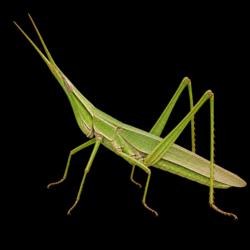
Cone-headed Grasshopper at a glance
Invertebrate · Europe · Tall · Relatively common
Known for: Head extended into a long, Flattened, Long, Narrow
Its Power
Grass Blade Leap
Leap decisively when opportunity arises.
The cone-headed grasshopper uses its powerful legs to make sudden, long jumps, allowing it to escape predators and explore new areas.
“Cling, then spring free.”
Capture a Cone-headed Grasshopper, and it's yours when you finish one step it gives you.
Biological basis
Cone-headed grasshoppers are known for their ability to make rapid, long-distance jumps to evade threats and move through their environment efficiently.
Put it into practice
In a brainstorming session, Alex quickly proposes a bold idea when the team seems stuck, sparking new discussions.
What does the cone-headed grasshopper symbolize?
The cone-headed grasshopper symbolizes grass blade leap: leap decisively when opportunity arises. It represents decisive action, knowing when to leave and readiness. Its AnimalDex motto: "Cling, then spring free."
The cone-headed grasshopper as a spirit animal
If the cone-headed grasshopper is your spirit animal, the AnimalDex reading is Grass Blade Leap: the cone-headed grasshopper uses its powerful legs to make sudden, long jumps, allowing it to escape predators and explore new areas. It suggests a strength in decisive action and knowing when to leave, and a reminder to use it on purpose.
What can the cone-headed grasshopper help you with in life?
The cone-headed grasshopper is a guide for decisive action, knowing when to leave and readiness. Its lesson applies wherever decisive action matters: the cone-headed grasshopper uses its powerful legs to make sudden, long jumps, allowing it to escape predators and explore new areas.
- Decisive Action
- Knowing When to Leave
- Readiness
In practice: In a brainstorming session, Alex quickly proposes a bold idea when the team seems stuck, sparking new discussions.
What can we learn from the Cone-headed Grasshopper?What does it mean to dream about or encounter a wild cone-headed grasshopper?
Dreaming about a wild cone-headed grasshopper, or coming across one, usually points to decisive action and knowing when to leave: the qualities the cone-headed grasshopper lives by. In AnimalDex, the cone-headed grasshopper's principle is Grass Blade Leap: leap decisively when opportunity arises. Read the moment through its core lesson: The cone-headed grasshopper uses its powerful legs to make sudden, long jumps, allowing it to escape predators and explore new areas.
Neither good nor bad on its own. How the cone-headed grasshopper acts matters: at ease, it reflects decisive action; hostile, it flags decisive action out of balance.
Spotting a cone-headed grasshopper in the wild
A real encounter is the plainest version of the sign: notice what the cone-headed grasshopper was doing. Leap decisively when opportunity arises. That is the decisive action worth borrowing today.
A cone-headed grasshopper that keeps appearing
Repeated sightings of a cone-headed grasshopper usually mean the Grass Blade Leap lesson is still open: the cone-headed grasshopper uses its powerful legs to make sudden, long jumps, allowing it to escape predators and explore new areas.
Dreaming of being chased by a cone-headed grasshopper
A chase often means a demand for decisive action is catching up with you. The cone-headed grasshopper's lesson, "The cone-headed grasshopper uses its powerful legs to make sudden, long jumps, allowing it to escape predators and explore new areas", is the part you may be running from.
Dreaming that a cone-headed grasshopper attacks you
An attack points to decisive action turned against you: someone using it on you, or your own decisive action overused until it costs you.
A calm or friendly cone-headed grasshopper
Meeting a peaceful cone-headed grasshopper is usually encouraging: knowing when to leave and readiness are within reach.
A dead or injured cone-headed grasshopper
Seeing the cone-headed grasshopper hurt may point to knowing when to leave that has been neglected. Ask what it would take to restore it.
These readings are reflective prompts drawn from how the cone-headed grasshopper really lives, not predictions. If you meet one in the wild, watch from a distance and leave it undisturbed.
Capture your own Cone-headed Grasshopper
Photograph or film one in the wild, at a zoo or at home with the app. It becomes yours: it remembers you, gives you steps, and can debate your problems with your other animals.
Animal field guide
Cone-headed Grasshopper
Sign in to hear this read by a natural AI voice instead of your browser's.
This long, slender grasshopper has a head drawn out into a forward-pointing cone, with flattened, sword-shaped antennae at its tip. Held flat along a grass stem, its green or straw-coloured body becomes almost impossible to pick out from the leaves around it.
Native range
Natural range, not this capture location
Tall, warm grassland across southern Europe, from Mediterranean coasts north into the Hungarian plain: dry meadows, sandy and dune grassland, and rough lowland ground where grasses stand high through late summer. It has also been recorded in damper grassy places.
Search near meAnimalDex stats
Size scale
Understand the animal
Understand the Cone-headed Grasshopper
Factual biology first: what this animal is like, where it lives, how it survives, and why those traits exist.
01
Introduction to Cone-headed Grasshopper
This long, slender grasshopper has a head drawn out into a forward-pointing cone, with flattened, sword-shaped antennae at its tip. Held flat along a grass stem, its green or straw-coloured body becomes almost impossible to pick out from the leaves around it.
How to identify a Cone-headed Grasshopper
- Head extended into a long, pointed cone
- Flattened, sword-shaped antennae
- Long, thin hind legs
- Narrow, pointed forewings
Why Cone-headed Grasshopper are interesting
- The species name ungarica is Latin for Hungarian, referring to Hungary.
- Adult females reach roughly 5 to 7 centimetres in length, counting the long pointed head.
- Males have been reported to make a dry crackling sound in flight.
- At the northern edge of its range it is thought to have declined where tall grassland has been lost.
02
Adaptations and biological abilities
03
Why does Cone-headed Grasshopper behave this way?
- Head extended into a long, pointed cone
- Flattened, sword-shaped antennae
- Long, thin hind legs
- Narrow, pointed forewings
Active by day once the sun has warmed the grass, and largely inactive on cool mornings and dull days. It spends the night resting on grass stems within the sward.
04
Why Tall?
Habitat: Tall, warm grassland across southern Europe, from Mediterranean coasts north into the Hungarian plain: dry meadows, sandy and dune grassland, and rough lowland ground where grasses stand high through late summer. It has also been recorded in damper grassy places.
Native range: Europe
Native range
Natural range, not this specific capture location.
Tall, warm grassland across southern Europe, from Mediterranean coasts north into the Hungarian plain: dry meadows, sandy and dune grassland, and rough lowland ground where grasses stand high through late summer. It has also been recorded in damper grassy places.
05
Why this diet?
Feeds on grasses, chewing the leaf blades from the edge with strong mandibles.
06
Activity, rest, and lifespan
Active by day once the sun has warmed the grass, and largely inactive on cool mornings and dull days. It spends the night resting on grass stems within the sward.
About a year from egg to death, most of it spent as an overwintering egg; adults survive a few months from midsummer into autumn.
07
Cone-headed Grasshopper reproduction
Females lay eggs in pods in the soil in late summer and autumn. The eggs overwinter, and nymphs hatch in late spring, passing through several moults before becoming adult in summer. There is one generation a year.
Females are far bigger, often around twice the length of males, and heavier-bodied. Both sexes occur in green and brown forms.
08
Predators, threats, and defense
An adult that has been noticed is reported to edge round to the far side of its stem, keeping the stem between itself and the threat. The animals that hunt it have not been specifically documented.
09
Conservation and rarity
Rarity: Relatively common · 12/100. AnimalDex canonical rarity score: 12/100, maintained by the live indexed species profile.
- Observe from a respectful distance and avoid changing the animal's behavior.
- Do not block feeding, shelter, nesting, or travel routes.
- Use a live camera capture without handling or staging wildlife.
Talk to it
Talk to the Cone-headed Grasshopper
It answers as itself: ask about how it lives, or bring it something of yours and hear what it would do, from its own Power.
Anonymous: 6/day. Signed-in: 10/day. Pro: 100/day.
Side by side
The Cone-headed Grasshopper, side by side
Nothing written side by side for the Cone-headed Grasshopper yet. Pick any animal to compare it with. Compare with any animal →
Where to find them
Where to find Cone-headed Grasshopper
To find Cone-headed Grasshopper in the wild, focus on the exact habitat patches that match its body design and daily behavior, not just the broad country where it exists. You usually do better by working one good piece of habitat inside europe than by covering too much ground.
- Open grassland edges, lightly wooded plains, or raised ground where you can scan long distances
- Water sources, dune bases, rocky wadis, or shaded scrub at first and last light
- Headlands, reef edges, island colonies, tidal channels, or productive coastal water
In the Ark
1 Cone-headed Grasshopper is aboard right now.
Since November 5: 1 came aboard.
The Ark is a live, shared animal world. Animals come aboard when people capture them, and live there by rules based on their field guides.
Scientific name
Acrida ungarica
Category
Invertebrate
Habitat
Tall, warm grassland across southern Europe, from Mediterranean coasts north into the Hungarian plain: dry meadows, sandy and dune grassland, and rough lowland ground where grasses stand high through late summer. It has also been recorded in damper grassy places.
Rarity
Relatively common · 12/100
Native range
Europe
Take the encyclopedia outside
AnimalDex helps you scan real animals, identify species, collect cards, and learn from nature wherever you are.