
Animal field guide
Crimson Sunbird
Aethopyga siparaja
A small sunbird of southern and South-east Asia, the male brilliant crimson with a glossy green crown and tail. It feeds at flowers in gardens and forest edge, often perching beside the bloom rather than hovering.
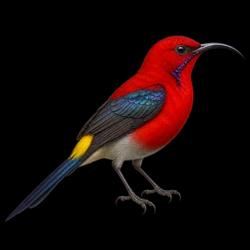
Crimson Sunbird at a glance
Animal · East Asia · Crimson Sunbirds range from the · Relatively common
Known for: Crimson head, Glossy green or violet crown and long tail in the, Female plain olive above and paler yellowish below, Thin
Its Power
Nectar Navigation
Seek out diverse opportunities for growth and nourishment.
Crimson Sunbirds are adept at locating and feeding on a variety of nectar sources, demonstrating the importance of exploring diverse opportunities for sustenance and growth.
“Explore and Nourish.”
Capture a Crimson Sunbird, and it's yours when you finish one step it gives you.
Biological basis
Crimson Sunbirds are known for their ability to navigate through different environments to find and feed on a wide range of nectar-producing flowers.
Put it into practice
A musician earns from lessons, weddings and session work, so one quiet month never sinks her.
What does the crimson sunbird symbolize?
The crimson sunbird symbolizes nectar navigation: seek out diverse opportunities for growth and nourishment. It represents exploration, versatility and curiosity. Its AnimalDex motto: "Explore and Nourish."
The crimson sunbird as a spirit animal
If the crimson sunbird is your spirit animal, the AnimalDex reading is Nectar Navigation: crimson Sunbirds are adept at locating and feeding on a variety of nectar sources, demonstrating the importance of exploring diverse opportunities for sustenance and growth. It suggests a strength in exploration and versatility, and a reminder to use it on purpose.
What can the crimson sunbird help you with in life?
The crimson sunbird is a guide for exploration, versatility and curiosity. Its lesson applies wherever exploration matters: crimson Sunbirds are adept at locating and feeding on a variety of nectar sources, demonstrating the importance of exploring diverse opportunities for sustenance and growth.
- Exploration
- Versatility
- Curiosity
In practice: A musician earns from lessons, weddings and session work, so one quiet month never sinks her.
What can we learn from the Crimson Sunbird?What does it mean to dream about or encounter a wild crimson sunbird?
Dreaming about a wild crimson sunbird, or coming across one, usually points to exploration and versatility: the qualities the crimson sunbird lives by. In AnimalDex, the crimson sunbird's principle is Nectar Navigation: seek out diverse opportunities for growth and nourishment. Read the moment through its core lesson: Crimson Sunbirds are adept at locating and feeding on a variety of nectar sources, demonstrating the importance of exploring diverse opportunities for sustenance and growth.
Mostly a prompt rather than a warning. A calm crimson sunbird suggests exploration you already have; a threatening one suggests exploration is being tested or pushed too far.
Spotting a crimson sunbird in the wild
Coming across a crimson sunbird in person asks for attention more than interpretation. Watch it for a minute; the crimson sunbird's way of working is Nectar Navigation, and the lesson is: crimson Sunbirds are adept at locating and feeding on a variety of nectar sources, demonstrating the importance of exploring diverse opportunities for sustenance and growth.
A crimson sunbird that keeps appearing
A crimson sunbird that keeps turning up points to versatility you keep circling back to. The repetition is the message.
Dreaming of being chased by a crimson sunbird
Being chased suggests you are avoiding the Nectar Navigation the crimson sunbird stands for: crimson Sunbirds are adept at locating and feeding on a variety of nectar sources, demonstrating the importance of exploring diverse opportunities for sustenance and growth. Ask what you keep postponing that needs exploration.
Dreaming that a crimson sunbird attacks you
An attack points to exploration turned against you: someone using it on you, or your own exploration overused until it costs you.
A calm or friendly crimson sunbird
A relaxed crimson sunbird near you, in a dream or in person, reads as readiness: Nectar Navigation is available to you now, as its motto puts it, "Explore and Nourish.".
A dead or injured crimson sunbird
A dead or injured crimson sunbird, dreamed or found, can mark exploration you have let lapse, or a phase built on Nectar Navigation coming to an end.
These readings are reflective prompts drawn from how the crimson sunbird really lives, not predictions. If you meet one in the wild, watch from a distance and leave it undisturbed.
Capture your own Crimson Sunbird
Photograph or film one in the wild, at a zoo or at home with the app. It becomes yours: it remembers you, gives you steps, and can debate your problems with your other animals.
Animal field guide
Crimson Sunbird
Sign in to hear this read by a natural AI voice instead of your browser's.
A small sunbird of southern and South-east Asia, the male brilliant crimson with a glossy green crown and tail. It feeds at flowers in gardens and forest edge, often perching beside the bloom rather than hovering.
Native range
Natural range, not this capture location
Crimson Sunbirds range from the Indian subcontinent and Himalayan foothills through southern China and Southeast Asia to parts of Indonesia. They inhabit tropical and subtropical forest, forest edge, secondary woodland, mangroves, gardens and plantations where flowering shrubs and trees provide nectar and insects.
Search near meAnimalDex stats
Size scale
Understand the animal
Understand the Crimson Sunbird
Factual biology first: what this animal is like, where it lives, how it survives, and why those traits exist.
01
Introduction to Crimson Sunbird
A small sunbird of southern and South-east Asia, the male brilliant crimson with a glossy green crown and tail. It feeds at flowers in gardens and forest edge, often perching beside the bloom rather than hovering.
How to identify a Crimson Sunbird
- Crimson head, throat, breast and back in the male
- Glossy green or violet crown and long tail in the male
- Female plain olive above and paler yellowish below
- Thin, strongly down-curved bill
- Olive-grey belly in the male
Why Crimson Sunbird are interesting
- The female builds a hanging, pear-shaped nest of plant fibres and cobweb, often with a small porch over the side entrance.
- Several subspecies across its wide range differ in the extent of crimson and in the length of the male's tail.
- Like many sunbirds, it sometimes pierces the base of long tubular flowers to reach the nectar.
- Sunbirds resemble hummingbirds but are not closely related; the likeness comes from convergent evolution.
02
Adaptations and biological abilities
03
Why does Crimson Sunbird behave this way?
- Crimson head, throat, breast and back in the male
- Glossy green or violet crown and long tail in the male
- Female plain olive above and paler yellowish below
- Thin, strongly down-curved bill
- Olive-grey belly in the male
Active by day, most busy at flowers in the morning. At night it roosts alone among dense foliage. It does not migrate over most of its range or enter seasonal dormancy.
04
Why Crimson Sunbirds range from the Indian subcontinent and Himalayan foothills through southern China and Southeast Asia to parts of Indonesia?
Habitat: Crimson Sunbirds range from the Indian subcontinent and Himalayan foothills through southern China and Southeast Asia to parts of Indonesia. They inhabit tropical and subtropical forest, forest edge, secondary woodland, mangroves, gardens and plantations where flowering shrubs and trees provide nectar and insects.
Native range: East Asia, South Asia, Southeast Asia
Native range
Natural range, not this specific capture location.
Crimson Sunbirds range from the Indian subcontinent and Himalayan foothills through southern China and Southeast Asia to parts of Indonesia. They inhabit tropical and subtropical forest, forest edge, secondary woodland, mangroves, gardens and plantations where flowering shrubs and trees provide nectar and insects.
05
Why this diet?
Nectar from flowers such as hibiscus, banana, coral trees and mistletoes, taken while perched or in brief hovering, plus small insects and spiders picked from foliage or caught in flight.
06
Activity, rest, and lifespan
Active by day, most busy at flowers in the morning. At night it roosts alone among dense foliage. It does not migrate over most of its range or enter seasonal dormancy.
Aethopyga siparaja ringing lifespan remains sparse; males of this nectar-feeding sunbird wear scarlet heads across South and Southeast Asia.
07
Crimson Sunbird reproduction
Nesting is by the female, which builds the suspended nest alone, often low in a shrub or garden plant. She lays usually two or three eggs and incubates them; the male may help feed the chicks.
Strongly different: the male is crimson with a glossy green crown and long tail, while the female is dull olive-green with no red and a short tail.
08
Predators, threats, and defense
09
Conservation and rarity
Rarity: Relatively common · 20/100. AnimalDex canonical rarity score: 20/100, maintained by the live indexed species profile.
- Observe from a respectful distance and avoid changing the animal's behavior.
- Do not block feeding, shelter, nesting, or travel routes.
- Use a live camera capture without handling or staging wildlife.
Talk to it
Talk to the Crimson Sunbird
It answers as itself: ask about how it lives, or bring it something of yours and hear what it would do, from its own Power.
Anonymous: 6/day. Signed-in: 10/day. Pro: 100/day.
Side by side
The Crimson Sunbird, side by side
Nothing written side by side for the Crimson Sunbird yet. Pick any animal to compare it with. Compare with any animal →
Where to find them
Where to find Crimson Sunbird
To find Crimson Sunbird in the wild, focus on the exact habitat patches that match its body design and daily behavior, not just the broad country where it exists. You usually do better by working one good piece of habitat inside east Asia, South Asia, Southeast Asia than by covering too much ground.
- Quiet marsh edges, reedbeds, river bends, or shallow wetland margins
- Forest edge, canopy gaps, fruiting trees, or shaded trails where cover and food meet
- Sunlit logs, exposed branches, warm rocks, or regular perch sites used for scanning
In the Ark
1 Crimson Sunbird is aboard right now.
None have come aboard or left since November 17.
The Ark is a live, shared animal world. Animals come aboard when people capture them, and live there by rules based on their field guides.
Scientific name
Aethopyga siparaja
Category
Animal
Habitat
Crimson Sunbirds range from the Indian subcontinent and Himalayan foothills through southern China and Southeast Asia to parts of Indonesia. They inhabit tropical and subtropical forest, forest edge, secondary woodland, mangroves, gardens and plantations where flowering shrubs and trees provide nectar and insects.
Rarity
Relatively common · 20/100
Native range
East Asia, South Asia, Southeast Asia
Take the encyclopedia outside
AnimalDex helps you scan real animals, identify species, collect cards, and learn from nature wherever you are.