
Animal field guide
Dark Sword-grass
Agrotis ipsilon
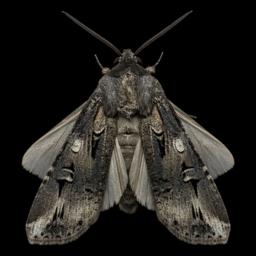
A stout brown noctuid moth found on every continent except Antarctica, and one of the best-known migrant moths. In cooler regions it cannot survive the winter, and each year those areas are restocked by moths flying in from warmer ground. The caterpillar, known as the black cutworm, bites through young plant stems at soil level.
Dark Sword-grass at a glance
Animal · North America · Open lowland country with low · Relatively common
Known for: Wingspan roughly 40 to 55 millimetres, A black dagger-shaped dash running outwards from, Pale whitish-grey hindwings with darker veins, Rests with wings folded flat over the back
Its Power
Nocturnal Migration
Travel under cover of darkness to avoid threats.
Moving at night can help you avoid obstacles and dangers that are more active during the day.
“Move in the night.”
Capture a Dark Sword-grass, and it's yours when you finish one step it gives you.
Biological basis
The Dark Sword-grass moth migrates by night, often flying high on warm winds that carry it hundreds of kilometres while the birds that hunt by day are at rest.
Put it into practice
She schedules her long drives at night to avoid traffic and the stress of busy roads.
What does the dark sword-grass symbolize?
The dark sword-grass symbolizes nocturnal migration: travel under cover of darkness to avoid threats. It represents the long journey, right timing and quiet strategy. Its AnimalDex motto: "Move in the night."
The dark sword-grass as a spirit animal
If the dark sword-grass is your spirit animal, the AnimalDex reading is Nocturnal Migration: moving at night can help you avoid obstacles and dangers that are more active during the day. It suggests a strength in the long journey and right timing, and a reminder to use it on purpose.
What can the dark sword-grass help you with in life?
The dark sword-grass is a guide for the long journey, right timing and quiet strategy. Its lesson applies wherever the long journey matters: moving at night can help you avoid obstacles and dangers that are more active during the day.
- The Long Journey
- Right Timing
- Quiet Strategy
In practice: She schedules her long drives at night to avoid traffic and the stress of busy roads.
What can we learn from the Dark Sword-grass?What does it mean to dream about or encounter a wild dark sword-grass?
A wild dark sword-grass, whether in a dream or in front of you, tends to show up when the long journey or right timing is on your mind. In AnimalDex, the dark sword-grass's principle is Nocturnal Migration: travel under cover of darkness to avoid threats. Read the moment through its core lesson: Moving at night can help you avoid obstacles and dangers that are more active during the day.
Neither good nor bad on its own. How the dark sword-grass acts matters: at ease, it reflects the long journey; hostile, it flags the long journey out of balance.
Spotting a dark sword-grass in the wild
A real encounter is the plainest version of the sign: notice what the dark sword-grass was doing. Travel under cover of darkness to avoid threats. That is the the long journey worth borrowing today.
A dark sword-grass that keeps appearing
Seeing the dark sword-grass again and again, in dreams or outside, suggests the long journey is a theme you have not settled yet.
Dreaming of being chased by a dark sword-grass
Being chased suggests you are avoiding the Nocturnal Migration the dark sword-grass stands for: moving at night can help you avoid obstacles and dangers that are more active during the day. Ask what you keep postponing that needs the long journey.
Dreaming that a dark sword-grass attacks you
An attack points to the long journey turned against you: someone using it on you, or your own the long journey overused until it costs you.
A calm or friendly dark sword-grass
A calm dark sword-grass suggests you have made peace with the long journey and can use it without force.
A dead or injured dark sword-grass
An injured dark sword-grass often reflects the long journey under strain; rest and repair come before pushing again.
These readings are reflective prompts drawn from how the dark sword-grass really lives, not predictions. If you meet one in the wild, watch from a distance and leave it undisturbed.
Capture your own Dark Sword-grass
Photograph or film one in the wild, at a zoo or at home with the app. It becomes yours: it remembers you, gives you steps, and can debate your problems with your other animals.
Animal field guide
Dark Sword-grass
Sign in to hear this read by a natural AI voice instead of your browser's.
A stout brown noctuid moth found on every continent except Antarctica, and one of the best-known migrant moths. The caterpillar, known as the black cutworm, bites through young plant stems at soil level.
Native range
Natural range, not this capture location
Open lowland country with low plants and loose soil: farmland, market gardens, grassland, coastal dunes and town gardens. Caterpillars live in the top few centimetres of soil beneath their food plants.
Search near meAnimalDex stats
Size scale
Understand the animal
Understand the Dark Sword-grass
Factual biology first: what this animal is like, where it lives, how it survives, and why those traits exist.
01
Introduction to Dark Sword-grass
A stout brown noctuid moth found on every continent except Antarctica, and one of the best-known migrant moths. In cooler regions it cannot survive the winter, and each year those areas are restocked by moths flying in from warmer ground. The caterpillar, known as the black cutworm, bites through young plant stems at soil level.
How to identify a Dark Sword-grass
- Wingspan roughly 40 to 55 millimetres
- A black dagger-shaped dash running outwards from the kidney-shaped wing mark
- Pale whitish-grey hindwings with darker veins
- Rests with wings folded flat over the back
- Caterpillar smooth, greasy-looking and grey-black
Why Dark Sword-grass are interesting
- Adults feed readily at sugary baits painted on tree trunks, a method moth recorders use alongside light traps to survey them.
- Marked moths have been recaptured hundreds of kilometres from where they were released, confirming that the journeys are real migrations.
- The black cutworm is a serious pest of maize and vegetable crops in many countries, because one caterpillar can cut down several seedlings in a night.
- In Britain it is a regular immigrant, arriving from continental Europe in numbers that vary greatly from year to year.
02
Adaptations and biological abilities
03
Why does Dark Sword-grass behave this way?
- Wingspan roughly 40 to 55 millimetres
- A black dagger-shaped dash running outwards from the kidney-shaped wing mark
- Pale whitish-grey hindwings with darker veins
- Rests with wings folded flat over the back
- Caterpillar smooth, greasy-looking and grey-black
Adults are nocturnal, resting by day in vegetation, under debris or in crevices. Caterpillars stay buried in the soil by day and come up after dark to feed.
04
Why Open lowland country with low plants and loose soil?
Habitat: Open lowland country with low plants and loose soil: farmland, market gardens, grassland, coastal dunes and town gardens. Caterpillars live in the top few centimetres of soil beneath their food plants.
Native range: North America, South America, Europe, North Africa & Middle East, Sub-Saharan Africa, Central Asia, South Asia, Southeast Asia, East Asia, Australia & Oceania
Native range
Natural range, not this specific capture location.
Open lowland country with low plants and loose soil: farmland, market gardens, grassland, coastal dunes and town gardens. Caterpillars live in the top few centimetres of soil beneath their food plants.
05
Why this diet?
Caterpillars eat a very wide range of plants, including maize, potatoes, beans, cabbages, tomatoes and grasses, often biting through stems at ground level at night. Adults drink nectar from flowers and other sugary liquids.
06
Activity, rest, and lifespan
Adults are nocturnal, resting by day in vegetation, under debris or in crevices. Caterpillars stay buried in the soil by day and come up after dark to feed.
Adults usually live about one to three weeks. In warm weather the whole cycle from egg to adult takes roughly five to eight weeks, allowing several generations a year.
07
Dark Sword-grass reproduction
A female can lay over a thousand eggs, singly or in small clusters on low leaves, plant debris or soil. Eggs hatch within a few days, and the caterpillars pass through six or seven stages before pupating in a small chamber in the soil.
The sexes are similar in colour and pattern. Males have antennae with comb-like branches along part of their length, while females have simple, thread-like antennae.
08
Predators, threats, and defense
Ground beetles, birds, parasitic wasps and parasitic flies attack the caterpillars, and bats catch adults in flight. Caterpillars hide in the soil by day and curl into a tight C-shape when disturbed.
09
Conservation and rarity
Rarity: Relatively common · 12/100. AnimalDex canonical rarity score: 12/100, maintained by the live indexed species profile.
- Observe from a respectful distance and avoid changing the animal's behavior.
- Do not block feeding, shelter, nesting, or travel routes.
- Use a live camera capture without handling or staging wildlife.
Talk to it
Talk to the Dark Sword-grass
It answers as itself: ask about how it lives, or bring it something of yours and hear what it would do, from its own Power.
Anonymous: 6/day. Signed-in: 10/day. Pro: 100/day.
Side by side
The Dark Sword-grass, side by side
Nothing written side by side for the Dark Sword-grass yet. Pick any animal to compare it with. Compare with any animal →
Where to find them
Where to find Dark Sword-grass
To find Dark Sword-grass in the wild, focus on the exact habitat patches that match its body design and daily behavior, not just the broad country where it exists. You usually do better by working one good piece of habitat inside north America, South America, Europe, North Africa & Middle East, Sub-Saharan Africa, Central Asia, South Asia, Southeast Asia, East Asia, Australia & Oceania than by covering too much ground.
- Open grassland edges, lightly wooded plains, or raised ground where you can scan long distances
- Water sources, dune bases, rocky wadis, or shaded scrub at first and last light
- Headlands, reef edges, island colonies, tidal channels, or productive coastal water
In the Ark
2 Dark Sword-grasses are aboard right now.
Since November 17: 3 died of old age.
The Ark is a live, shared animal world. Animals come aboard when people capture them, and live there by rules based on their field guides.
Scientific name
Agrotis ipsilon
Category
Animal
Habitat
Open lowland country with low plants and loose soil: farmland, market gardens, grassland, coastal dunes and town gardens. Caterpillars live in the top few centimetres of soil beneath their food plants.
Rarity
Relatively common · 12/100
Native range
North America, South America, Europe, North Africa & Middle East, Sub-Saharan Africa, Central Asia, South Asia, Southeast Asia, East Asia, Australia & Oceania
Take the encyclopedia outside
AnimalDex helps you scan real animals, identify species, collect cards, and learn from nature wherever you are.