
Animal field guide
Giant Dead Leaf Mantis
Deroplatys desiccata
The Dead Leaf Mantis teaches that stillness can be active. By becoming part of the background, it controls when it is seen.
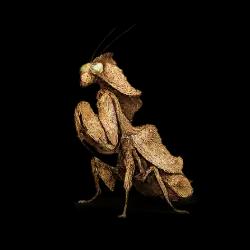
Giant Dead Leaf Mantis at a glance
Animal · Southeast Asia · Lowland rainforest of the Malay · Uncommon
Known for: Wide, Mottled brown colouring with ragged, Spiny grasping forelegs folded beneath the shield, Broad
Its Power
Perfect Stillness
Mimics dead leaves through shape, color, and stillness, hiding from both prey and predators.
Sometimes the strongest move is to become unreadable.
“Vanish into patience.”
Capture a Giant Dead Leaf Mantis, and it's yours when you finish one step it gives you.
Biological basis
Dead leaf mantises use leaf-like camouflage and ambush hunting behavior to disappear into forest litter.
Put it into practice
When pressure rises, reduce unnecessary signals and wait until action is truly useful.
What does the giant dead leaf mantis symbolize?
The giant dead leaf mantis symbolizes perfect stillness: mimics dead leaves through shape, color, and stillness, hiding from both prey and predators. It represents stillness, blending in and discretion. Its AnimalDex motto: "Vanish into patience."
The giant dead leaf mantis as a spirit animal
If the giant dead leaf mantis is your spirit animal, the AnimalDex reading is Perfect Stillness: sometimes the strongest move is to become unreadable. It suggests a strength in stillness and blending in, and a reminder to use it on purpose.
What can the giant dead leaf mantis help you with in life?
The giant dead leaf mantis is a guide for stillness, blending in and discretion. Its lesson applies wherever stillness matters: sometimes the strongest move is to become unreadable.
- Stillness
- Blending In
- Discretion
In practice: When pressure rises, reduce unnecessary signals and wait until action is truly useful.
What can we learn from the Giant Dead Leaf Mantis?What does it mean to dream about or encounter a wild giant dead leaf mantis?
Meeting a wild giant dead leaf mantis, asleep or awake, is often a nudge toward stillness, the quality the giant dead leaf mantis is built around. In AnimalDex, the giant dead leaf mantis's principle is Perfect Stillness: mimics dead leaves through shape, color, and stillness, hiding from both prey and predators. Read the moment through its core lesson: Sometimes the strongest move is to become unreadable.
Neither good nor bad on its own. How the giant dead leaf mantis acts matters: at ease, it reflects stillness; hostile, it flags stillness out of balance.
Spotting a giant dead leaf mantis in the wild
A real encounter is the plainest version of the sign: notice what the giant dead leaf mantis was doing. Mimics dead leaves through shape, color, and stillness, hiding from both prey and predators. That is the stillness worth borrowing today.
A giant dead leaf mantis that keeps appearing
A giant dead leaf mantis that keeps turning up points to blending in you keep circling back to. The repetition is the message.
Dreaming of being chased by a giant dead leaf mantis
Being chased suggests you are avoiding the Perfect Stillness the giant dead leaf mantis stands for: sometimes the strongest move is to become unreadable. Ask what you keep postponing that needs stillness.
Dreaming that a giant dead leaf mantis attacks you
When the giant dead leaf mantis attacks, the dream may be about pressure: blending in or discretion applied too hard, by you or by someone close to you.
A calm or friendly giant dead leaf mantis
A calm giant dead leaf mantis suggests you have made peace with stillness and can use it without force.
A dead or injured giant dead leaf mantis
An injured giant dead leaf mantis often reflects stillness under strain; rest and repair come before pushing again.
These readings are reflective prompts drawn from how the giant dead leaf mantis really lives, not predictions. If you meet one in the wild, watch from a distance and leave it undisturbed.
Capture your own Giant Dead Leaf Mantis
Photograph or film one in the wild, at a zoo or at home with the app. It becomes yours: it remembers you, gives you steps, and can debate your problems with your other animals.
Animal field guide
Giant Dead Leaf Mantis
Sign in to hear this read by a natural AI voice instead of your browser's.
The Dead Leaf Mantis teaches that stillness can be active. By becoming part of the background, it controls when it is seen.
Native range
Natural range, not this capture location
Lowland rainforest of the Malay Peninsula, Sumatra and Borneo, in the shaded understorey among dead leaves, shrubs and low branches.
Search near meAnimalDex stats
Size scale
Understand the animal
Understand the Giant Dead Leaf Mantis
Factual biology first: what this animal is like, where it lives, how it survives, and why those traits exist.
01
Introduction to Giant Dead Leaf Mantis
The Dead Leaf Mantis teaches that stillness can be active. By becoming part of the background, it controls when it is seen.
How to identify a Giant Dead Leaf Mantis
- Wide, leaf-shaped shield over the front of the thorax
- Mottled brown colouring with ragged, leaf-like edges
- Spiny grasping forelegs folded beneath the shield
- Broad, flattened abdomen under leaf-veined wings
Why Giant Dead Leaf Mantis are interesting
- The species name desiccata means dried up, describing its withered-leaf appearance.
- Young nymphs are reported to rest with the abdomen curled up over the back, which makes them look like a curled leaf fragment.
- Adult females have been reported to reach about 8 centimetres in length, well above the size of males.
- Several other species in its genus, Deroplatys, share the same dead-leaf disguise across South-east Asian forests.
02
Adaptations and biological abilities
03
Why does Giant Dead Leaf Mantis behave this way?
- Wide, leaf-shaped shield over the front of the thorax
- Mottled brown colouring with ragged, leaf-like edges
- Spiny grasping forelegs folded beneath the shield
- Broad, flattened abdomen under leaf-veined wings
Its daily rhythm in the wild is poorly documented. It hunts by ambush and stays motionless among dead leaves and low twigs for long periods, by day and night. No seasonal dormancy is known in its humid forest range.
04
Why Lowland rainforest of the Malay Peninsula?
Habitat: Lowland rainforest of the Malay Peninsula, Sumatra and Borneo, in the shaded understorey among dead leaves, shrubs and low branches.
Native range: Southeast Asia
Native range
Natural range, not this specific capture location.
Lowland rainforest of the Malay Peninsula, Sumatra and Borneo, in the shaded understorey among dead leaves, shrubs and low branches.
05
Why this diet?
An ambush predator that waits motionless and snatches passing insects such as flies, moths and crickets with its spiny forelegs.
06
Activity, rest, and lifespan
Its daily rhythm in the wild is poorly documented. It hunts by ambush and stays motionless among dead leaves and low twigs for long periods, by day and night. No seasonal dormancy is known in its humid forest range.
Wild lifespan is not documented. In captivity the whole life cycle takes roughly a year, and adult females outlive males by several months.
07
Giant Dead Leaf Mantis reproduction
The female lays her eggs in a foamy case, an ootheca, fixed to a twig. In captivity nymphs usually hatch after several weeks, often a few dozen from one case; there is no parental care, and the young moult several times before becoming adults.
Females are much larger and heavier-bodied. Males are slimmer, with longer wings and antennae, and fly readily; females rarely fly.
08
Predators, threats, and defense
09
Conservation and rarity
Rarity: Uncommon · 50/100. AnimalDex canonical rarity score: 50/100, maintained by the live indexed species profile.
- Observe from a respectful distance and avoid changing the animal's behavior.
- Do not block feeding, shelter, nesting, or travel routes.
- Use a live camera capture without handling or staging wildlife.
Talk to it
Talk to the Giant Dead Leaf Mantis
It answers as itself: ask about how it lives, or bring it something of yours and hear what it would do, from its own Power.
Anonymous: 6/day. Signed-in: 10/day. Pro: 100/day.
Side by side
The Giant Dead Leaf Mantis, side by side
Nothing written side by side for the Giant Dead Leaf Mantis yet. Pick any animal to compare it with. Compare with any animal →
Where to find them
Where to find Giant Dead Leaf Mantis
To find Giant Dead Leaf Mantis in the wild, focus on the exact habitat patches that match its body design and daily behavior, not just the broad country where it exists. You usually do better by working one good piece of habitat inside southeast Asia than by covering too much ground.
- Forest edge, canopy gaps, fruiting trees, or shaded trails where cover and food meet
- Protected habitat blocks within southeast Asia
In the Ark
No Giant Dead Leaf Mantis is aboard yet.
None have come aboard or left since November 17.
The Ark is a live, shared animal world. Animals come aboard when people capture them, and live there by rules based on their field guides.
Scientific name
Deroplatys desiccata
Category
Animal
Habitat
Lowland rainforest of the Malay Peninsula, Sumatra and Borneo, in the shaded understorey among dead leaves, shrubs and low branches.
Rarity
Uncommon · 50/100
Native range
Southeast Asia
Take the encyclopedia outside
AnimalDex helps you scan real animals, identify species, collect cards, and learn from nature wherever you are.