
Animal field guide
Denison Barb
Sahyadria denisonii
Denison Barb is a streamlined, red-striped cyprinid of fast, oxygen-rich Western Ghats rivers and a familiar but conservation-sensitive aquarium fish.
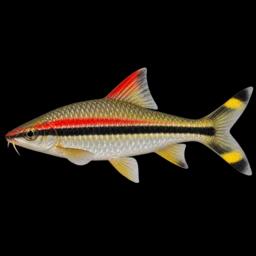
Denison Barb at a glance
Animal · South Asia · Clear · Rare
Known for: Red stripe from snout through the front half of the, Black horizontal stripe along a silver body, Forked tail with black-and-yellow markings
Its Power
Shared Direction
Align first, then let every member add speed.
A group moves cleanly when each member reads the same direction instead of choosing a separate route.
“Move as one.”
Capture a Denison Barb, and it's yours when you finish one step it gives you.
Biological basis
Denison Barbs school in flowing water, matching the heading and spacing of neighbours so many vulnerable fish behave like one fast-moving unit.
Put it into practice
A response team agrees on one incident channel and one priority before specialists begin acting in parallel.
What does the denison barb symbolize?
The denison barb symbolizes shared direction: align first, then let every member add speed. It represents coordination, teamwork and momentum. Its AnimalDex motto: "Move as one."
The denison barb as a spirit animal
If the denison barb is your spirit animal, the AnimalDex reading is Shared Direction: a group moves cleanly when each member reads the same direction instead of choosing a separate route. It suggests a strength in coordination and teamwork, and a reminder to use it on purpose.
What can the denison barb help you with in life?
The denison barb is a guide for coordination, teamwork and momentum. Its lesson applies wherever coordination matters: a group moves cleanly when each member reads the same direction instead of choosing a separate route.
- Coordination
- Teamwork
- Momentum
In practice: A response team agrees on one incident channel and one priority before specialists begin acting in parallel.
What can we learn from the Denison Barb?What does it mean to dream about or encounter a wild denison barb?
Meeting a wild denison barb, asleep or awake, is often a nudge toward coordination, the quality the denison barb is built around. In AnimalDex, the denison barb's principle is Shared Direction: align first, then let every member add speed. Read the moment through its core lesson: A group moves cleanly when each member reads the same direction instead of choosing a separate route.
It depends on how the denison barb behaved. Calm or close by, it reads as teamwork within reach; aggressive or fleeing, it points to coordination you are resisting.
Spotting a denison barb in the wild
If a denison barb crosses your path, take it as a cue to look at where coordination fits your day. Its AnimalDex motto: "Move as one."
A denison barb that keeps appearing
A denison barb that keeps turning up points to teamwork you keep circling back to. The repetition is the message.
Dreaming of being chased by a denison barb
Being chased suggests you are avoiding the Shared Direction the denison barb stands for: a group moves cleanly when each member reads the same direction instead of choosing a separate route. Ask what you keep postponing that needs coordination.
Dreaming that a denison barb attacks you
An aggressive denison barb can mirror a conflict where coordination has become a weapon rather than a strength.
A calm or friendly denison barb
A calm denison barb suggests you have made peace with coordination and can use it without force.
A dead or injured denison barb
A dead or injured denison barb, dreamed or found, can mark coordination you have let lapse, or a phase built on Shared Direction coming to an end.
These readings are reflective prompts drawn from how the denison barb really lives, not predictions. If you meet one in the wild, watch from a distance and leave it undisturbed.
Capture your own Denison Barb
Photograph or film one in the wild, at a zoo or at home with the app. It becomes yours: it remembers you, gives you steps, and can debate your problems with your other animals.
Animal field guide
Denison Barb
Sign in to hear this read by a natural AI voice instead of your browser's.
Denison Barb is a streamlined, red-striped cyprinid of fast, oxygen-rich Western Ghats rivers and a familiar but conservation-sensitive aquarium fish.
Native range
Natural range, not this capture location
Clear, well-oxygenated streams and rivers in the Western Ghats of India, especially rocky reaches with current and shaded margins.
Search near meAnimalDex stats
Size scale
Understand the animal
Understand the Denison Barb
Factual biology first: what this animal is like, where it lives, how it survives, and why those traits exist.
01
Introduction to Denison Barb
Denison Barb is a streamlined, red-striped cyprinid of fast, oxygen-rich Western Ghats rivers and a familiar but conservation-sensitive aquarium fish.
How to identify a Denison Barb
- Red stripe from snout through the front half of the body
- Black horizontal stripe along a silver body
- Forked tail with black-and-yellow markings
Why Denison Barb are interesting
- The accepted name is Sahyadria denisonii; Puntius denisonii is an older combination.
- It is endemic to India's Western Ghats, where it lives in fast-flowing rivers mainly in Kerala and Karnataka.
- It is a social fish normally kept and seen in groups.
- Heavy collection for the aquarium trade contributed to it being listed as Endangered by the IUCN.
02
Adaptations and biological abilities
03
Why does Denison Barb behave this way?
- Red stripe from snout through the front half of the body
- Black horizontal stripe along a silver body
- Forked tail with black-and-yellow markings
It rests in calmer water while remaining with the group.
04
Why Clear?
Habitat: Clear, well-oxygenated streams and rivers in the Western Ghats of India, especially rocky reaches with current and shaded margins.
Native range: South Asia
Native range
Natural range, not this specific capture location.
Clear, well-oxygenated streams and rivers in the Western Ghats of India, especially rocky reaches with current and shaded margins.
05
Why this diet?
Algae, plant material, small invertebrates and other available river foods.
06
Activity, rest, and lifespan
It rests in calmer water while remaining with the group.
Commonly several years in aquaria when kept in suitable cool, oxygenated water.
07
Denison Barb reproduction
Eggs are scattered among plants or substrate and receive no prolonged parental care.
Sexes are similar; mature females are often fuller-bodied.
08
Predators, threats, and defense
Larger fishes, birds and aquatic predators; schooling and rapid coordinated movement reduce an individual's exposure.
09
Conservation and rarity
Rarity: Rare · 72/100. AnimalDex canonical rarity score: 72/100, maintained by the live indexed species profile.
- Observe from a respectful distance and avoid changing the animal's behavior.
- Do not block feeding, shelter, nesting, or travel routes.
- Use a live camera capture without handling or staging wildlife.
Talk to it
Talk to the Denison Barb
It answers as itself: ask about how it lives, or bring it something of yours and hear what it would do, from its own Power.
Anonymous: 6/day. Signed-in: 10/day. Pro: 100/day.
Side by side
The Denison Barb, side by side
Nothing written side by side for the Denison Barb yet. Pick any animal to compare it with. Compare with any animal →
Where to find them
Where to find Denison Barb
To find Denison Barb in the wild, focus on the exact habitat patches that match its body design and daily behavior, not just the broad country where it exists. You usually do better by working one good piece of habitat inside south Asia than by covering too much ground.
- Quiet marsh edges, reedbeds, river bends, or shallow wetland margins
- Protected habitat blocks within south Asia
In the Ark
1 Denison Barb is aboard right now.
Since November 5: 1 came aboard.
The Ark is a live, shared animal world. Animals come aboard when people capture them, and live there by rules based on their field guides.
Scientific name
Sahyadria denisonii
Category
Animal
Habitat
Clear, well-oxygenated streams and rivers in the Western Ghats of India, especially rocky reaches with current and shaded margins.
Rarity
Rare · 72/100
Native range
South Asia
Take the encyclopedia outside
AnimalDex helps you scan real animals, identify species, collect cards, and learn from nature wherever you are.